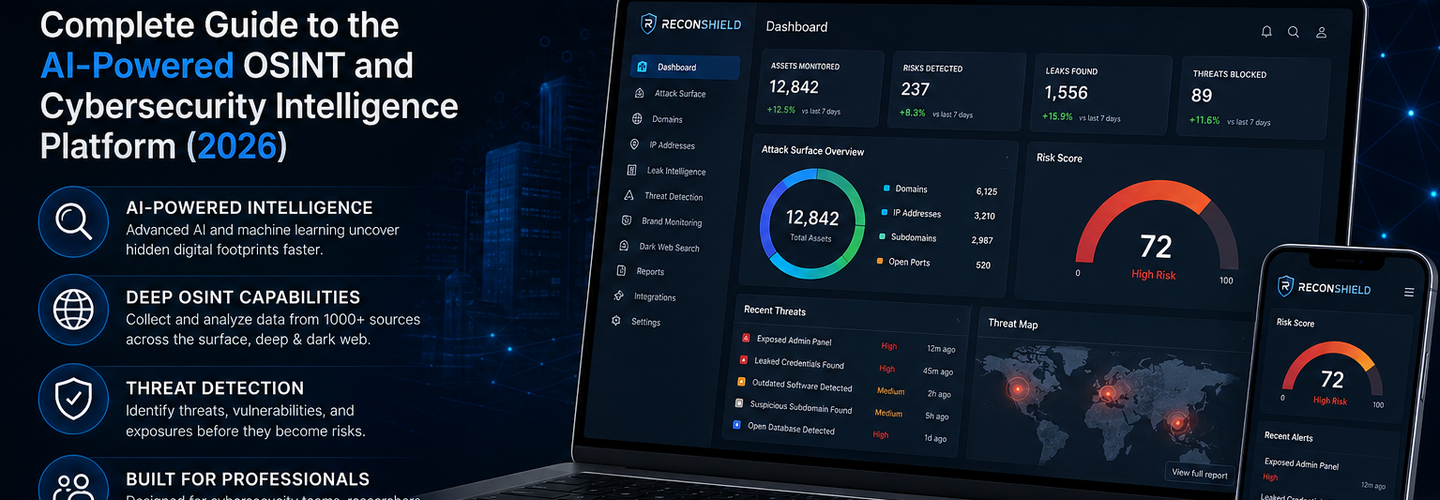
What Is ReconShield? Complete Guide to the AI-Powered OSINT and Cybersecurity Intelligence Platform (2026)
Summarize this blog post with: ChatGPT | Perplexity | Claude | Grok
You probably know your organization owns domains, servers, cloud assets, and public-facing applications. What many teams don't realize is how much of that infrastructure is already visible — and potentially exposed — to anyone with a browser and a basic knowledge of public registries. ReconShield was built for exactly this problem: giving security teams, researchers, developers, and IT professionals the same visibility into their internet-facing infrastructure that an attacker already has, using entirely passive, non-intrusive methods. In this guide, you'll learn exactly what ReconShield is, how it works, what each tool does, and how to use the platform to improve your external security posture right now.
## Key Takeaways
- ▸ReconShield is an AI-powered cybersecurity intelligence platform that provides attack surface visibility and passive OSINT analysis for security researchers, SOC teams, IT professionals, and developers — entirely free.
- ▸Passive reconnaissance is ReconShield's foundational methodology — all data is collected from public registries, DNS resolvers, threat feeds, and certificate logs without sending any direct traffic to target infrastructure.
- ▸The ReconShield platform has three major components: the Passive Diagnostics Scanner Suite, seven specialized security tools, and a peer-reviewed threat intelligence publication with deep-dive OSINT research.
- ▸Attack surface monitoring through ReconShield identifies exposed services, DNS misconfigurations, email authentication gaps, weak SSL/TLS configurations, and missing security headers — the security risks that attackers exploit first.
- ▸AI-powered exposure analysis transforms the raw telemetry from passive infrastructure scans into human-readable risk reports that security teams can prioritize and act on without needing deep specialist knowledge in every domain.
- ▸ReconShield operates entirely on defensive, ethical principles — all tools require user authorization confirmation and query only public data sources, making every workflow legally and ethically sound for authorized security research.
- ▸Infrastructure visibility is the prerequisite for security — organizations cannot protect assets they do not know are exposed, and ReconShield delivers the attacker's view of your infrastructure before the attacker does.
## What Is ReconShield?
ReconShield is an AI-powered cybersecurity intelligence platform that provides attack surface visibility through passive OSINT analysis — combining a passive diagnostics scanner suite, seven specialized security tools, a live threat intelligence feed, and a peer-reviewed cybersecurity research publication into a single, free, accessible platform designed for authorized defensive security research.
The platform was built by Surendra Reddy, a cybersecurity researcher and OSINT analyst who identified a persistent gap in the security tooling market: enterprise-grade attack surface visibility tools were exclusively available at enterprise prices, leaving security researchers, independent analysts, SOC teams at smaller organizations, IT professionals, and students without access to the foundational visibility capabilities that effective defensive security requires. ReconShield was created to close that gap by democratizing access to the same infrastructure intelligence capabilities previously available only to large security vendors.
ReconShield's core operating principle is passive reconnaissance — every tool on the platform queries public data sources including DNS registries, WHOIS and RDAP databases, Certificate Transparency logs, Regional Internet Registry databases, global threat intelligence feeds, and HTTP header analysis — without sending any direct packets, probes, or payloads to target infrastructure. This means every ReconShield query generates logs only on the authoritative third-party database being queried, not on the target system — making every workflow entirely non-intrusive and legally defensible for authorized security research.
The platform's mission, stated across all its products, is directionally simple: infrastructure visibility is the first step toward defense. Organizations that can see their internet-facing assets the way a threat actor sees them — before an attack is attempted — are in a fundamentally stronger defensive position than those relying exclusively on perimeter controls and reactive incident response. For a foundational understanding of the passive OSINT methodology that underpins every ReconShield tool, the OSINT Fundamentals guide covers the complete intelligence discipline in operational depth.
## Why Does Attack Surface Visibility Matter in 2026?
Attack surface visibility matters because the average organization exposes significantly more internet-facing infrastructure than its internal team is aware of — and every unmonitored asset is a potential entry point for threat actors who conduct systematic passive reconnaissance before every targeted attack.
The modern enterprise attack surface is not a defined perimeter — it is a continuously expanding, dynamically changing collection of domains, subdomains, IP addresses, cloud services, APIs, third-party integrations, and legacy systems accumulated over years of organizational growth, acquisition, and cloud migration. The average organization has over 500 internet-facing assets — Source: RiskIQ Attack Surface Report, 2024 — the majority of which are not tracked in internal asset inventories and therefore not monitored for security configuration drift, expired certificates, misconfigured DNS records, or exposed services.
Threat actors exploit this visibility gap systematically. Professional attack groups spend days or weeks in passive reconnaissance before attempting any active exploitation — mapping the target's complete external infrastructure using exactly the same public data sources that ReconShield aggregates. Every subdomain exposed in Certificate Transparency logs, every misconfigured email authentication record visible in DNS, every expired SSL certificate announcing itself to any scanner, every HTTP security header missing from a web application response — all of this is visible to attackers before they make a single connection to the target. The average attacker spends 3–5 days in reconnaissance before initial access — Source: Mandiant M-Trends Report, 2024 — time spent building precisely the visibility picture that ReconShield delivers in minutes.
ReconShield's value proposition is direct: run the same reconnaissance against your own infrastructure before attackers do, identify the gaps it exposes, and close them before they are exploited. For the structured methodology behind professional attack surface analysis, the ReconShield passive reconnaissance guide covers the complete five-phase passive investigation workflow.
## How Does ReconShield Work?
ReconShield works by querying authoritative public data sources — DNS registries, WHOIS databases, Certificate Transparency logs, IP routing registries, threat intelligence feeds, and live web server responses — to build a comprehensive security intelligence picture of any domain without interacting with the target's infrastructure directly.
The platform's data collection architecture is built on passive OSINT principles. When a user submits a domain or IP address for analysis, ReconShield routes the query to the appropriate authoritative data source for each intelligence dimension — DNS registries for record data, ICANN-accredited RDAP servers for registration data, CT log APIs for certificate history, RIR WHOIS databases for IP block ownership, and aggregated threat feed APIs for reputation scoring. The target infrastructure sees none of this activity. Only the authoritative third-party registries experience queries, and those queries are indistinguishable from the millions of legitimate lookup requests those registries handle daily.
The AI analysis layer processes the raw data returned by each query, correlating signals across data source categories, identifying patterns that indicate specific risk types, and producing human-readable risk interpretations that contextualize the technical findings for security practitioners at every expertise level. A missing DMARC record is not just flagged as absent — the AI interpretation explains that the absence means the domain can be freely impersonated in phishing campaigns, what the business impact of that exposure is, and what the remediation action is. This transformation from raw data to contextualised risk insight is the capability that makes ReconShield particularly valuable for security generalists and practitioners who need broad visibility without deep specialist knowledge in every security domain.
## What Are the Core Components of the ReconShield Platform?
The ReconShield platform has three distinct components — the Passive Diagnostics Scanner Suite, the specialized security tools suite, and the Intel Feed — each designed for a different depth and breadth of security investigation.
The Passive Diagnostics Scanner Suite
The ReconShield Passive Diagnostics Scanner is the platform's flagship integrated audit tool — running a comprehensive passive security analysis across six critical audit vectors simultaneously for any domain entered: Email Authentication, SSL/TLS Diagnostics, HTTP Security Headers, Infrastructure Exposure, DNS Intelligence, and Threat Intelligence.
The scanner operates across 21 active diagnostic modules organized into those six silos. A single scan evaluates: SPF configuration, DKIM selector validation, DMARC policy alignment, BIMI parameter validation, and MX routing diagnostics in the Email Authentication silo. Cipher suite strength, TLS protocol version compliance, HSTS deployment, certificate chain validation, and cryptographic expiration in the SSL/TLS silo. Content Security Policy, Strict-Transport-Security, X-Frame-Options, Permissions-Policy, and CORS configuration in the HTTP Security Headers silo. Open port passive discovery, CDN and WAF detection, ASN registry mapping, and hosting verification in the Infrastructure Exposure silo. DNSSEC key validation, nameserver authority verification, TXT record auditing, and zone transfer checks in the DNS Intelligence silo. And IP and domain reputation cross-referencing, threat feed matching, historical exposure analysis, and registry abuse database queries in the Threat Intelligence silo.
The scanner requires authorization confirmation before any analysis begins — users must explicitly confirm they are authorized to analyze the submitted infrastructure. This design reflects ReconShield's foundational commitment to ethical, authorized security research as the only legitimate use of these capabilities.
The Specialized Security Tools Suite
The specialized tools suite provides seven individual, deep-dive security analysis tools — each targeting a specific intelligence dimension for focused investigations that require more granular control than an integrated scan provides.
Each tool is accessible individually through the Security Tools hub and covers a distinct security intelligence category. Collectively they cover the full external attack surface from DNS and WHOIS registration data through network-layer port exposure to application-layer web security posture.
The Intel Feed
The ReconShield Intel Feed is the platform's peer-reviewed cybersecurity research publication — publishing deep-dive OSINT research, vulnerability analysis, threat intelligence briefings, and practical security implementation guides authored by Surendra Reddy and reviewed for technical accuracy by the ReconShield editorial team.
The Intel Feed is organized across six topical intelligence categories: Threat Intelligence, OSINT & Analysis, Web Security, AI Cybersecurity, Vulnerability Research, and Internet-Facing Assets — providing a structured knowledge base that supports the practical application of ReconShield's tools in real security workflows. The Live Threat Pulse widget on the platform homepage provides real-time awareness of active threat actor IP addresses and ongoing campaigns flagged by ReconShield's threat intelligence monitoring.
## What Are the ReconShield Security Tools?
ReconShield provides seven specialized security intelligence tools, each freely accessible without registration, covering every major dimension of external attack surface analysis.
DNS Lookup and Security Analysis Tool
The DNS Security Analysis Tool audits DNS zone records across every major record type — returning A, AAAA, MX, TXT, NS, CNAME, and SOA records for any domain alongside security-specific validation of SPF configuration, DKIM selector presence, DMARC policy enforcement, and DNSSEC status.
This tool is the primary starting point for email security investigations, subdomain mapping exercises, and DNS configuration auditing. A single query surfaces whether a domain is properly protected against email spoofing (through SPF and DMARC validation), whether its name servers are correctly configured (through NS record comparison against WHOIS data), and whether any DNS records are missing, misconfigured, or stale. For complete reference on interpreting every DNS record type as a security signal, the ReconShield DNS record types guide covers every record in operational detail.
WHOIS Domain Intelligence Tool
The WHOIS Intelligence Tool queries both modern RDAP endpoints and legacy WHOIS servers to return normalized domain registration records including EPP status codes, registrar identity, name server configuration, creation date, and expiry date for any domain — and network block ownership, ASN registration, and abuse contacts for any IP address.
WHOIS intelligence is foundational to phishing domain investigation (creation date immediately distinguishes fresh campaign infrastructure from established legitimate domains), domain hijacking detection (EPP lock status reveals whether unauthorized transfers or name server changes are technically preventable), and third-party vendor risk assessment (registration security posture reflects operational security discipline). For the complete methodology of WHOIS-based domain investigation, see the ReconShield WHOIS lookup guide and the WHOIS domain intelligence deep-dive.
IP Reputation Intelligence Tool
The IP Reputation Intelligence Tool cross-references any IPv4 or IPv6 address against global threat intelligence feeds — returning ASN ownership, hosting provider classification, geolocation, proxy and VPN detection, composite threat reputation score, and multi-feed blacklist presence in a single passive lookup.
This tool serves alert triage during incident response (rapidly distinguishing known-malicious infrastructure from ambiguous cloud addresses), fraud prevention (identifying proxy and VPN connections that require step-up authentication), email deliverability troubleshooting (checking mail server IP blacklist status), and third-party vendor assessment (evaluating the reputation of vendor-operated infrastructure). The IP reputation check complete guide covers the full six-step IP investigation workflow in operational detail.
SSL/TLS Crypto Checker
The SSL/TLS Checker analyses the complete cryptographic configuration of any domain's TLS implementation — auditing cipher suite strength, protocol version support (detecting deprecated TLS 1.0 and TLS 1.1 exposure), certificate chain validity, Subject Alternative Names, certificate expiry timelines, and HSTS deployment status.
Certificate intelligence from this tool serves multiple investigation purposes: identifying domains with expired or soon-to-expire certificates that will disrupt services or create security warnings, surfacing Subject Alternative Names that reveal related subdomains and infrastructure relationships, detecting weak cipher suites that enable downgrade attacks, and verifying that certificate issuance aligns with published CAA records. For complete email security context, the SPF-DKIM-DMARC Blueprint covers how SSL/TLS configuration interacts with email authentication across the full security stack.
Security Headers Auditor
The Security Headers Auditor evaluates the browser-level security controls implemented in any web server's HTTP response headers — assessing Content Security Policy (CSP) configuration, Strict-Transport-Security (HSTS) deployment, X-Frame-Options clickjacking protection, Permissions-Policy scope, X-Content-Type-Options, and CORS policy correctness.
HTTP security headers are the application-layer controls that modern browsers enforce to prevent cross-site scripting (XSS), clickjacking, MIME-type confusion, and cross-origin data leakage. Their presence or absence is immediately visible to any passive observer — making security header configuration both a direct attack surface risk and a measurable proxy for overall web application security maturity. For the complete implementation guide covering every header and its security significance, the ReconShield OWASP HTTP Headers Hardening guide is the definitive reference. The HTTP security headers explained guide provides the accessible introduction for practitioners new to browser security controls.
Exposure Assessment Tool
The Exposure Assessment Tool performs a passive OWASP misconfiguration analysis on any web application — detecting server configuration risks, information disclosure vulnerabilities, and application-layer exposure issues that compound the impact of other security findings without requiring active exploitation or direct interaction with the target's application logic.
This tool bridges the gap between infrastructure-layer passive intelligence (DNS, WHOIS, IP reputation) and application-layer security posture assessment — providing a passive view of the web application security issues that an attacker performing external reconnaissance would observe before any active exploitation attempt.
TCP Port Scanner
The TCP Port Scanner passively maps open TCP ports on any IP address within authorized research scope — revealing which services are exposed to the public internet, identifying inadvertently accessible services like SSH (port 22), RDP (port 3389), database servers (port 3306 MySQL, port 5432 PostgreSQL), and administrative interfaces that represent unnecessary attack surface.
Port intelligence complements every other ReconShield tool — a DNS record pointing to an IP with unexpected open ports, a WHOIS-attributed IP range with exposed database ports, or a high-reputation IP with RDP exposed to the internet are all meaningful security findings that require correlation across intelligence dimensions. The ReconShield Shadow IT Exposed Ports guide covers which exposed services represent the highest attack surface risk and how passive port intelligence integrates into a complete external security assessment.
## Who Should Use ReconShield?
ReconShield is designed for every security practitioner who needs external infrastructure visibility without enterprise budget — with specific value propositions for distinct professional roles.
Security researchers and OSINT analysts use ReconShield as the primary passive intelligence collection platform for infrastructure investigations, threat actor campaign mapping, and attribution research. The tool suite covers every major passive OSINT data source category — DNS, WHOIS, certificate, IP, and web application — in a single platform with consistent, normalized outputs suitable for both manual analysis and documentation in intelligence products.
SOC analysts and incident responders use ReconShield to rapidly enrich security alerts with infrastructure context — running IP reputation checks on suspicious addresses from firewall and SIEM alerts, querying WHOIS for domain creation dates on phishing domains in email headers, and auditing SSL certificates of external connections flagged by DLP tools. The speed of passive intelligence retrieval — seconds per query — makes ReconShield operationally compatible with the triage timelines that SOC workflows demand.
IT administrators and security engineers use ReconShield to audit their own organization's external security posture — discovering the complete DNS record set for their domains, verifying email authentication configuration, checking EPP lock status on all registered domains, confirming SSL certificate validity and cipher suite strength, and identifying any open ports on public-facing servers that exceed their intended exposure. The passive reconnaissance guide provides the structured methodology for turning these individual tool checks into a complete external security assessment.
Developers and DevSecOps practitioners use ReconShield to validate the security configuration of applications and infrastructure before and after deployment — confirming that security headers are correctly implemented, that TLS is configured to current standards, that DNS records are correctly published, and that newly deployed services are not inadvertently exposing unexpected ports or services.
Startup founders and small business owners use ReconShield to achieve a level of external security visibility previously accessible only to organizations with dedicated security teams and enterprise tooling budgets. A founder who can spend 15 minutes running their domain through the Passive Diagnostics Scanner and addressing the critical findings has meaningfully improved their security posture relative to the baseline of no external monitoring.
Cybersecurity students and educators use ReconShield as a practical learning environment for passive reconnaissance, DNS security, email authentication, and web application security concepts — applying theoretical knowledge to real infrastructure in a legally sound, ethically framed context that develops the investigative skills required for professional security careers.
## What Security Risks Does ReconShield Help Identify?
ReconShield surfaces six categories of security risk — each corresponding to a specific failure mode in external infrastructure security that attackers actively exploit in the early phases of targeted attacks.
Email Authentication Gaps Enabling Domain Spoofing
Missing or misconfigured SPF, DKIM, and DMARC records leave domains freely spoofable for phishing and business email compromise campaigns. ReconShield's DNS tool and scanner both validate email authentication configuration and flag every gap — from missing records to soft-fail SPF qualifiers that provide no actual protection to DMARC records stuck at p=none monitoring mode. Business email compromise attacks exploiting domain spoofing cost organizations $2.9 billion in 2023 — Source: FBI IC3, 2023. The email spoofing prevention guide covers the complete remediation workflow for every authentication gap ReconShield surfaces.
Exposed Services Creating Unnecessary Network Attack Surface
Open ports for services like RDP, SSH, database servers, and administrative interfaces that are accessible from the public internet represent direct entry points for brute-force attacks, exploitation of known CVEs, and credential stuffing. ReconShield's Port Scanner maps this exposure passively before active exploitation reveals it.
Weak or Expired SSL/TLS Configuration
Expired certificates cause immediate service disruption and browser security warnings that damage user trust. Weak cipher suites enable downgrade attacks. Deprecated protocol versions (TLS 1.0, TLS 1.1) expose encrypted sessions to known cryptographic vulnerabilities. ReconShield's SSL/TLS Checker surfaces all of these without requiring any active interaction with the target server.
Missing HTTP Security Headers
Absent Content Security Policy headers enable cross-site scripting attacks. Missing X-Frame-Options permits clickjacking. Absent HSTS allows protocol downgrade and SSL-stripping. Missing X-Content-Type-Options enables MIME confusion attacks. Each missing header is a specific, exploitable application-layer vulnerability that ReconShield's Security Headers Auditor identifies and flags with remediation context.
DNS Misconfigurations and Subdomain Takeover Risks
Dangling CNAME records pointing to deprovisioned cloud services, unauthorized name server changes, missing DNSSEC validation, and stale DNS records pointing to recycled IP addresses are all discoverable through passive DNS intelligence. ReconShield's DNS tool identifies each configuration type and explains its specific exploitation risk. The DNS record types guide covers how every record type creates specific attack surface when misconfigured.
Domain Registration Security Gaps
Missing EPP lock protections, approaching domain expiry, and WHOIS name server discrepancies are the leading indicators of domain hijacking risk and impending service disruption. ReconShield's WHOIS tool provides the registration intelligence needed to detect and address these risks before they become incidents. For the comprehensive domain security program methodology, see the domain expiration monitoring guide and the domain ownership verification guide.
## How Does ReconShield Use AI in Its Security Analysis?
ReconShield integrates AI-powered exposure analysis to transform complex, multi-source security telemetry into prioritized, human-readable risk reports — addressing the fundamental challenge that the volume and technical complexity of infrastructure security data exceeds the capacity of individual analysts to manually process without decision-support tooling.
The AI analysis layer operates on the normalized output of every passive data collection query — correlating signals across DNS, WHOIS, certificate, IP reputation, and web security dimensions to identify patterns that indicate specific risk categories. A domain with no DMARC record, a recently created registration date, a name server belonging to a bulletproof hosting provider, and a TLS certificate with a SAN list containing brand impersonation strings produces a correlated risk profile that the AI layer identifies as high-confidence phishing infrastructure — a conclusion that manual analysis of each individual signal would require significant analyst time to reach.
For defensive security teams auditing their own infrastructure, the AI interpretation layer contextualises technical findings in business-impact language — explaining not just that a configuration gap exists but what an attacker could do with it, what the business consequence of exploitation would be, and what the specific remediation action is. This translation from technical finding to business-relevant risk statement is what makes ReconShield's analysis actionable for security generalists and executive stakeholders alongside the deep-technical practitioners who can interpret raw scanner output directly.
AI-assisted risk interpretation reduces mean time to triage for external security findings by up to 60% in environments where analysts must evaluate findings across multiple security domains simultaneously — Source: Gartner Security Operations Survey, 2024. ReconShield's AI layer delivers this acceleration at no cost to every user of the platform regardless of organizational size or security program maturity.
## Is ReconShield Safe and Ethical to Use?
ReconShield is designed from the ground up around defensive cybersecurity principles — every tool requires explicit authorization confirmation, all data collection is passive, and the platform explicitly prohibits use for scanning infrastructure without the express permission of its owner.
The legal and ethical foundation is built into the platform's technical architecture rather than just its terms of service. Because ReconShield queries only public third-party data sources — DNS registries, WHOIS databases, certificate transparency logs, threat feed APIs — rather than interacting directly with target infrastructure, the collection methodology is legally equivalent to reading a public record. There is no unauthorized computer access, no active probing, and no interaction with the target's systems at any point in the intelligence collection process.
The platform's authorization confirmation requirement before any scan is a deliberate design choice that creates a moment of explicit user accountability — every ReconShield scan is an authorized security research action by design. The legal disclaimer displayed prominently across the platform reinforces this: ReconShield is for authorized security research and educational purposes only.
For the full passive OSINT legal and ethical framework that governs all ReconShield workflows, the OSINT fundamentals guide covers jurisdictional legal boundaries, ethical collection principles, and the distinction between passive OSINT and active scanning that determines legal permissibility.
## ReconShield Use Cases: Practical Examples
ReconShield delivers measurable security value across eight practical use cases — each representing a common security workflow that the platform's tool suite covers completely with passive intelligence.
Domain security audit uses the WHOIS tool, DNS tool, and SSL Checker in sequence to evaluate whether a domain has appropriate EPP locks, correct email authentication, clean DNS records, and a valid TLS certificate — a complete external domain health check in under five minutes. The domain ownership verification guide covers how this audit integrates with domain control verification workflows.
Email security validation uses the DNS tool to verify SPF syntax, DKIM selector presence, and DMARC enforcement level for any domain — providing the diagnostic basis for email authentication remediation. The SPF Complete Guide and DKIM Configuration Guide provide the implementation detail for addressing findings.
Phishing domain investigation uses the WHOIS tool's creation date field to immediately classify suspicious domains, the IP Reputation tool to assess hosting infrastructure, and the DNS tool to examine name server and MX configuration — building a complete phishing infrastructure profile in under three minutes without alerting the attacker.
Vendor security assessment uses the DNS tool for email authentication posture, the WHOIS tool for domain registration security, the SSL Checker for certificate management, and the IP Reputation tool for mail server IP hygiene — generating an objective, evidence-based vendor security posture assessment without requiring vendor cooperation or self-assessment questionnaire responses.
Incident response triage uses the IP Reputation tool to attribute suspicious addresses from SIEM alerts to ASN operators and threat categories, the WHOIS tool to identify domain age and registrar for suspicious URLs in email headers, and the Port Scanner to characterize open services on attacker infrastructure — all within the first minutes of an active investigation.
Attack surface discovery uses the Passive Diagnostics Scanner to run a complete six-silo audit of any domain — surfacing every external security risk across email authentication, SSL/TLS, HTTP headers, infrastructure exposure, DNS intelligence, and threat reputation in a single workflow.
Security awareness training support uses ReconShield tool outputs as concrete examples during security awareness programs — showing employees what information is publicly visible about their organization's infrastructure and why security hygiene practices directly impact organizational risk.
Competitive security benchmarking uses ReconShield's tools to passively assess the external security posture of peer organizations — providing objective, publicly available data points for security program maturity comparison without any active scanning or unauthorized access.
## How to Get Started With ReconShield
Getting started with ReconShield requires no registration, no payment, and no installation — every tool is accessible immediately from the platform's web interface, and the Passive Diagnostics Scanner provides a complete external security audit from a single domain input.
The recommended starting sequence for first-time users depends on their primary security concern. For organizations who want a comprehensive initial audit, start with the Passive Diagnostics Scanner — enter your primary domain, confirm authorization, and receive a complete six-silo security analysis covering email authentication, SSL/TLS, security headers, infrastructure exposure, DNS, and threat intelligence in one workflow.
For targeted investigations, go directly to the specialized tool that matches your investigation type. Suspicious email? Start with the WHOIS tool for domain age and the IP Reputation tool for sender IP attribution. Email deliverability issues? Start with the DNS Security Analysis tool for SPF, DKIM, and DMARC validation. Certificate expiry concern? Start with the SSL/TLS Checker. Web application security review? Start with the Security Headers Auditor and Exposure Assessment Tool.
After completing any tool-based analysis, the Intel Feed provides the research depth to understand every finding in full context. The Threat Intelligence, OSINT & Analysis, Web Security, and Email Security categories collectively cover the complete knowledge base for acting on every category of finding the platform surfaces.
## What Should You Do After Using ReconShield?
ReconShield findings are inputs to a remediation and continuous monitoring workflow — the platform delivers the visibility; what security teams do with that visibility determines the security outcome.
Prioritize findings by exploitability and impact. Critical findings — missing DMARC enforcement on a high-email-volume domain, open RDP port on a public-facing server, expired SSL certificate on a customer-facing application — require immediate remediation. Important findings — soft-fail SPF instead of hard-fail, missing security headers on a secondary web property, approaching domain expiry — require scheduled remediation within 30 days. Informational findings — suboptimal but non-critical configuration choices — should be tracked and addressed during normal maintenance cycles.
Fix security gaps using ReconShield's research guides. Every category of finding that the platform's tools surface has a corresponding deep-dive implementation guide in the Intel Feed. Email authentication gaps → SPF-DKIM-DMARC Blueprint. DNS misconfigurations → DNS Record Types guide. Domain registration security → WHOIS domain intelligence guide. SSL/TLS weakness → SSL/TLS Regulatory Compliance guide. Security header gaps → OWASP HTTP Headers Hardening guide.
Build continuous monitoring into your security operations. A one-time audit establishes a security baseline — continuous monitoring maintains it. Schedule quarterly full-domain audits using the Passive Diagnostics Scanner. Set up 90/60/30-day domain expiry alerting. Monitor DMARC aggregate reports weekly for new unauthorized senders. Review IP reputation for mail server addresses monthly. The domain expiration monitoring guide and passive reconnaissance guide provide the complete continuous monitoring program methodology.
## Conclusion
ReconShield is not a compliance checkbox tool or a one-time vulnerability scanner — it is an infrastructure visibility platform built on the principle that defensive security starts with knowing exactly what your organization is exposing to the internet, and that this knowledge should be available to every security practitioner regardless of budget.
The platform's passive OSINT methodology means every workflow is non-intrusive, legally sound, and immediately actionable. The combination of the integrated Passive Diagnostics Scanner, seven specialized security tools, a live threat intelligence feed, and a continuously growing peer-reviewed research publication makes ReconShield the most comprehensive free external security intelligence platform available to security researchers, SOC teams, IT administrators, developers, and students in 2026.
Start with the Passive Diagnostics Scanner to get your complete external security posture picture in minutes. Then use the specialized tools — DNS, WHOIS, IP Reputation, SSL/TLS, Security Headers, Port Scanner, Exposure Assessment — for the deep-dive analysis that turns each finding into a specific, fixable gap. And use the Intel Feed to build the knowledge that makes every finding actionable.
Infrastructure visibility is the foundation of defensive security. ReconShield delivers that visibility — free, passive, and immediately available.
Written by Surendra Reddy Cybersecurity Researcher & Founder, ReconShield. Surendra is a cybersecurity engineer specializing in Open Source Intelligence (OSINT), exposure intelligence, and AI-driven threat analysis. He built ReconShield to democratize access to enterprise-grade infrastructure visibility tools and secure the digital internet-facing assets of organizations worldwide. Author Profile → | LinkedIn | GitHub
Reviewed by ReconShield Editorial Team — Peer-reviewed for technical accuracy, platform feature completeness, and alignment with current OSINT and passive reconnaissance standards.
## Analyst Commentary & Implementation Blueprint
Security advisory
Continuous security exposure assessment is critical to identifying public vulnerabilities before they are exploited. Organizations should maintain a passive inventory of all web servers, TLS configs, and open ports, ensuring that default configurations are eliminated and security advisories are actively implemented.
Hardened Security Configuration Blueprint
# General Security Hardening Directive
ServerTokens ProductOnly
ServerSignature Off
FileETag None
Actionable Mitigation Checklist
- ✔Perform passive asset inventories weekly.
- ✔Restrict administrative ports using local firewall controls.
- ✔Monitor active CVE alerts for exposed software.
Common Inquiries & FAQs
Why is passive scanning preferred for continuous auditing?
Passive audits do not cause operational impact or trigger firewall blocks, making them ideal for constant surveillance of internet-facing assets.
What should I do if a vulnerability is flagged?
Apply the latest vendor patches, restrict access to the resource via firewalls, or verify configuration flags to mitigate risks.
Surendra Reddy
Surendra Reddy is a cybersecurity researcher and founder of ReconShield, specializing in OSINT and defensive infrastructure analysis.
Connect on LinkedIn ↗// AUDIT BRIEFING DISCUSSION (2 COMMENTS)
Great breakdown of the passive infrastructure vectors. We recently audited our external DNS zones and found multiple dangling staging environments. Implementing wildcard certificates reduced our CT log leaks significantly.
Is there any automated tooling you recommend for daily crt.sh scraping? Manually checking CT logs is becoming unsustainable for our domain portfolio.
// MORE ARTICLES
SplitVPN Hacked: Data Breach Exposes 865,000 User Records and 58 Million Hidden Connection Logs (July 2026)
SplitVPN hacked: 865,336 user records and 58 million connection logs exposed, directly contradicting the VPN's "no-logs" promise. What was leaked and what to do now.

Critical WordPress wp2shell RCE Vulnerability Puts Millions of Sites at Risk—Patch Now
wp2shell is a pre-auth RCE in WordPress Core affecting 500M+ sites. Public exploits exist—patch to 7.0.2 or 6.9.5 immediately.
New Windows RDP Flaws Could Lead to Data Theft — Everything You Need to Know
Microsoft patched a dozen Windows RDP flaws in July 2026 that could leak memory data. See affected versions, KB numbers, and how to patch.