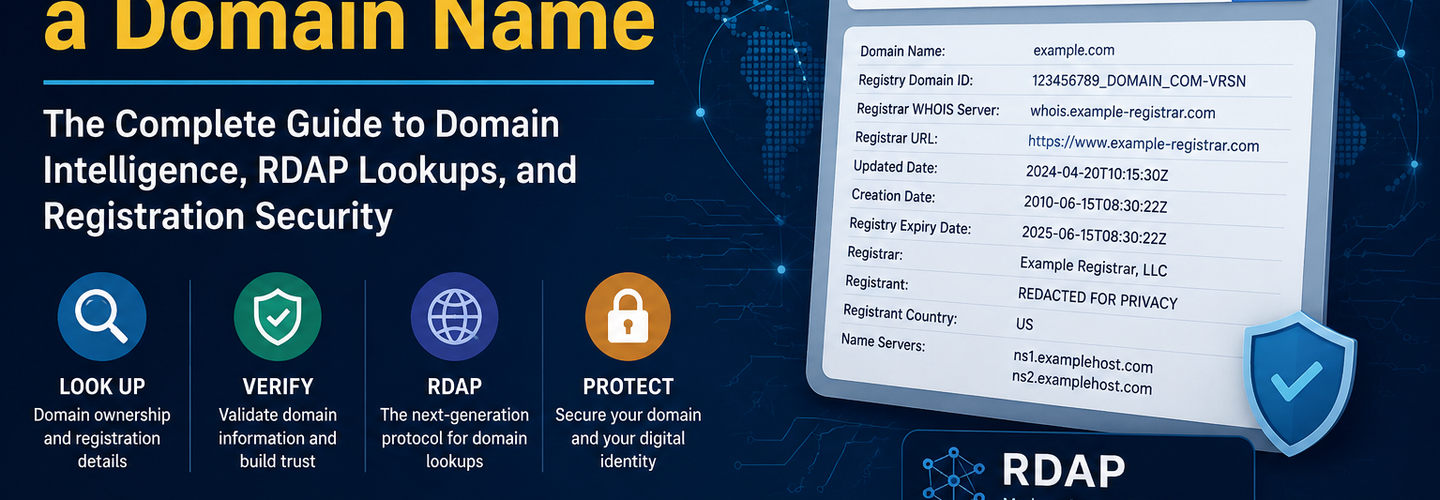
WHOIS a Domain Name: The Complete Guide to Domain Intelligence, RDAP Lookups, and Registration Security (2026)
Summarize this blog post with: ChatGPT | Perplexity | Claude | Grok
You've probably typed a domain name into a browser and wondered who actually owns it — or run a WHOIS query on a suspicious IP during an incident and received a wall of unstructured plain text that told you half of what you needed. WHOIS has been the internet's domain registration lookup protocol since the 1980s, but in 2026 it has been largely superseded by RDAP, redacted by GDPR, and weaponized by threat actors as a reconnaissance tool. In this guide, you'll learn exactly how WHOIS domain lookups work, what every field in a registration record means, how modern RDAP compares, and how security teams use domain intelligence to detect phishing campaigns, investigate breaches, and protect their own domain assets.
## Key Takeaways
- ▸WHOIS is the protocol used to query domain registration records — including owner information, registrar details, name servers, and expiry dates — from global registry databases.
- ▸RDAP (Registration Data Access Protocol) is the modern, structured replacement for legacy WHOIS, returning JSON-formatted responses over HTTPS instead of raw text over TCP port 43.
- ▸GDPR and ICANN privacy policies have redacted personal registrant data from most public WHOIS records since 2018, making historical WHOIS databases and RDAP authenticated access critical for security investigations.
- ▸EPP status codes displayed in every WHOIS record indicate whether a domain is protected against unauthorized transfer, modification, or deletion — and absence of lock codes is a direct security risk.
- ▸Security teams use WHOIS intelligence to attribute phishing domains to known threat actors, detect domain hijacking, monitor expiring assets, and investigate malicious infrastructure during incident response.
- ▸Newly registered domains with short registration periods are the strongest passive WHOIS indicator of phishing and malware campaign infrastructure.
- ▸Organizations must monitor their own WHOIS records continuously because unauthorized name server changes are often the first — and only — visible sign of an active domain hijacking attempt.
## What Is a WHOIS Domain Lookup and How Does It Work?
WHOIS is an internet query-and-response protocol that retrieves domain registration records stored in distributed databases maintained by registrars, registries, and Regional Internet Registries (RIRs) — returning ownership information, administrative contacts, authoritative name servers, registration dates, and domain status codes for any queried domain name or IP address block.
The name is not an acronym — it literally means "who is" responsible for this resource. When you run a WHOIS lookup on example.com, your query travels through a chain of databases. First, the root WHOIS server for .com domains (operated by Verisign) confirms the domain exists and redirects you to the registrar's WHOIS server. Then the registrar's server returns the full registration record. This two-step referral model is why results sometimes differ between WHOIS clients — they may query the registry layer or the registrar layer, which hold different levels of detail.
For IP addresses and Autonomous System Numbers (ASNs), WHOIS queries are handled by the five Regional Internet Registries: ARIN (North America), RIPE NCC (Europe/Middle East), APNIC (Asia-Pacific), LACNIC (Latin America), and AFRINIC (Africa). Each RIR maintains its own WHOIS database and query server. Use the ReconShield IP Reputation Intelligence tool to cross-reference IP WHOIS data against live threat feeds — combining registration ownership with real-time reputation scoring in a single passive lookup.
What Information Does a WHOIS Record Contain?
A complete WHOIS record contains seven categories of information: registrant contact data, administrative contact data, technical contact data, registrar details, registry dates, name server records, and EPP domain status codes. Each category serves a distinct purpose for both legitimate administrative use and security investigation.
Registrant data identifies the legal owner of the domain — typically a name, organization, address, email, and phone number. Since GDPR enforcement began in 2018, most registrars redact this field by default for EEA-located registrants, replacing it with proxy contact details. Registrar details identify which ICANN-accredited company sold the registration, their IANA ID, and the registrar's abuse contact — the address security researchers use to report malicious domains. Registry dates include the creation date (when the domain was first registered), the updated date (last modification), and the expiry date (when registration lapses). Name servers identify the authoritative DNS servers hosting the domain's zone file — the most operationally critical field, because unauthorized name server changes redirect all domain traffic. EPP status codes indicate which registry and registrar-level protections are active on the domain.
## What Is the Difference Between WHOIS and RDAP?
RDAP (Registration Data Access Protocol) is the modern successor to legacy WHOIS that delivers structured JSON responses over encrypted HTTPS instead of unstructured plain text over TCP port 43, addressing the legacy protocol's core limitations of inconsistent formatting, lack of encryption, poor internationalization support, and absence of access control.
WHOIS was defined in RFC 3912 in 2004 (based on protocols dating to 1982) as a minimal TCP transaction: a client connects to port 43, sends a text query, receives a text response, and the connection closes. The response format is entirely at the discretion of each registry — meaning automated parsing requires different regex patterns for every TLD. RDAP, defined across RFC 7480–7485, uses RESTful HTTPS queries with IANA-bootstrapped server discovery and standardized JSON output that any programming language can parse predictably.
Why RDAP Matters for Security Automation
RDAP is the preferred protocol for security automation because its structured JSON output allows tools to programmatically extract specific fields — creation dates, registrar IDs, name servers, status codes — without fragile text parsing that breaks across different registries. Security orchestration platforms, threat intelligence feeds, and SOC automation workflows all benefit from RDAP's consistency.
For example, a SOAR playbook responding to a phishing alert can automatically query RDAP for the suspicious domain's creation date and registration period in a single HTTP call, then flag the domain for immediate blocking if it was registered within the last 30 days. The same query via legacy WHOIS would require maintaining 1,500+ registry-specific text parsers to achieve equivalent reliability. The ReconShield WHOIS Intelligence tool queries both RDAP endpoints and legacy WHOIS fallback servers, returning normalized registration data regardless of which protocol the target registry supports.
How IANA Bootstrap Servers Enable RDAP Discovery
RDAP uses IANA-managed bootstrap registries to automatically route queries to the correct authoritative server for any TLD, IP block, or ASN — eliminating the manual WHOIS server directory lookup that legacy clients required. When an RDAP client queries example.com, it first checks the IANA RDAP bootstrap file for .com to find Verisign's RDAP endpoint, then sends the query directly.
This bootstrap architecture means RDAP clients need only a single implementation to cover all TLDs globally, compared to legacy WHOIS tools that maintain manually-curated server lists. For security researchers performing bulk domain investigations, this difference in query reliability is significant — RDAP queries succeed consistently across new TLDs (.io, .xyz, .ai) where legacy WHOIS server mappings are frequently outdated or missing entirely.
## What Do EPP Domain Status Codes Mean?
EPP (Extensible Provisioning Protocol) status codes are machine-readable flags embedded in every WHOIS and RDAP record that indicate which operations are currently permitted or blocked on a domain registration — and their presence or absence is one of the most directly actionable security signals available from a domain lookup.
There are two levels of EPP locks: registrar-level locks (prefixed with client) and registry-level locks (prefixed with server). Registrar locks are set by default or on customer request through the registrar's control panel. Registry locks require manual out-of-band verification with the registry operator — for .com domains, that means Verisign — and are significantly harder for attackers to remove even if the registrar account is compromised.
Critical EPP Status Codes Every Security Team Must Know
clientTransferProhibited blocks the domain from being transferred to a different registrar without the current registrar's explicit authorization. This is the most commonly attacked protection — removing it is the first step in a domain hijacking via registrar account compromise. Every internet-facing domain should have this status active.
clientUpdateProhibited prevents unauthorized changes to the domain's registration record, including name server modifications. A domain without this code can have its authoritative name servers swapped — silently redirecting all DNS queries, email, and web traffic to attacker-controlled infrastructure. If your WHOIS record shows only clientTransferProhibited without clientUpdateProhibited, name server hijacking remains possible even if the domain cannot be transferred.
clientDeleteProhibited prevents the domain from being deleted or allowed to expire through the registrar interface. Without this, a compromised registrar account can delete a critical domain, triggering an immediate expiry and release cycle that lets attackers re-register it within hours.
serverTransferProhibited and serverUpdateProhibited are the registry-level equivalents — significantly stronger because they require out-of-band verification with the registry operator before they can be removed. For domains critical to business operations — corporate root domains, payment portals, authentication endpoints — registry-level locks should be considered mandatory. Check the current EPP status of your domains instantly using the ReconShield WHOIS Checker, then cross-reference name server integrity with the DNS Security Analysis tool to verify that your WHOIS-listed name servers match your actual authoritative DNS configuration.
pendingDelete indicates the domain has passed its redemption grace period and is queued for release to the public registration pool — typically within five days. Monitoring competitor or legacy domains reaching this status allows threat actors to immediately re-register high-value domain names the moment they become available.
## Why Is WHOIS Intelligence Critical for Cybersecurity Teams?
WHOIS domain intelligence is a foundational layer of passive reconnaissance that enables security teams to attribute malicious infrastructure, investigate incidents, detect phishing campaigns, and monitor their own domain assets — all without generating any detectable network traffic toward the target. Because WHOIS queries go to registry databases rather than the target's servers, they are inherently passive and legally defensible.
The investigation value of WHOIS data has only increased as other intelligence sources have become noisier. IP addresses rotate constantly across CDNs and cloud providers. Email headers are spoofed. But domain registration data — even when registrant details are redacted — still exposes creation dates, registrar patterns, name server infrastructure, and registration timing that correlate strongly with campaign behavior. Understanding how to systematically collect and correlate this data is core to the passive OSINT methodology used by professional threat intelligence analysts.
How Security Teams Use WHOIS to Detect Phishing Campaigns
Phishing domains exhibit consistent WHOIS signatures that trained analysts can identify within seconds of running a lookup: recent creation dates (typically within 7–30 days of the campaign launch), short registration periods (1-year registrations suggesting intent to use and discard), low-reputation registrars with permissive abuse policies, name server providers associated with bulletproof hosting, and registrant organizations that do not match the impersonated brand.
For example, a financial institution's brand protection team monitoring for impersonation domains would immediately flag secure-login-bankname[.]com with a creation date of three days ago, a 1-year registration term, and name servers pointing to a bulletproof hosting provider in Eastern Europe — compared to the legitimate bank's domain, registered decades ago, using enterprise-grade DNS providers, and protected by registry-level locks. This WHOIS signature analysis can be completed passively in under 60 seconds per domain.
Over 1,200 phishing domains targeting Fortune 500 brands are registered daily — Source: Interisle Consulting Phishing Landscape Report, 2024. The majority share registrar clustering patterns detectable through WHOIS metadata. Organizations running active brand protection programs use automated WHOIS monitoring of newly registered domains matching their trademark patterns to block phishing infrastructure before it sends its first email.
Incident Response Applications of WHOIS Lookups
During a live security incident involving unknown outbound connections or suspicious email traffic, WHOIS lookups on the involved domains and IPs provide critical attribution data within the first minutes of investigation — identifying the hosting provider's abuse contact, the registrar responsible for the domain, the domain's age (distinguishing established legitimate infrastructure from freshly registered malicious domains), and whether the infrastructure has been previously associated with known threat actors.
For example, if a SIEM alert fires on an endpoint making repeated HTTPS connections to analytics-update[.]net, a WHOIS lookup immediately reveals: creation date (14 days ago), registrar (known for hosting malware C2 domains), name servers (shared with five other recently registered domains), expiry (1 year). This data, combined with a passive port scan of the associated IP and an IP reputation check, builds a complete infrastructure picture in under three minutes without sending a single packet to the suspicious host. For a structured methodology on building this kind of passive investigation workflow, the ReconShield Passive OSINT anatomy guide is the definitive reference.
Domain Hijacking Prevention Through WHOIS Monitoring
Domain hijacking — the unauthorized seizure of a domain by modifying its registration record, name servers, or registrar — is consistently detected first through WHOIS record changes, making continuous WHOIS monitoring a critical defensive control for any organization with internet-facing infrastructure. The attack pattern is well-established: compromise the registrar account, remove transfer and update locks, change name servers to attacker-controlled infrastructure, and optionally initiate a registrar transfer to lock the legitimate owner out.
In 2024, a major software company suffered a domain hijacking after threat actors used a historical WHOIS record to recover the original administrative email address, registered that expired email domain, and used it to reset the registrar account password. The initial WHOIS name server change — from legitimate CDN to attacker-controlled servers — was visible in the domain's WHOIS record for 47 minutes before it was detected. Organizations that implement automated WHOIS monitoring with alerting on name server changes detect these modifications in under five minutes on average, compared to a median detection time of several hours for those relying on manual checks — Source: Interisle Consulting, 2024.
## How Does WHOIS Privacy Protection Work and What Are Its Limitations?
WHOIS privacy protection (also called domain privacy or proxy registration) replaces a domain owner's actual registrant contact data — name, address, email, and phone number — with generic proxy contact details provided by the registrar's privacy service, preventing the owner's personal or corporate information from appearing in publicly queryable WHOIS records.
Privacy protection became the default for most consumer registrars following ICANN's 2018 Temporary Specification, adopted in response to GDPR enforcement. Under GDPR, registrars are legally required to redact personally identifiable information from public WHOIS records for EEA-located registrants. The result is that the majority of newly registered domains now display registrar proxy contact details rather than actual owner information in public WHOIS records.
What Privacy Protection Does Not Hide
WHOIS privacy protection conceals the registrant's identity but does not conceal domain registration metadata — the creation date, registration period, registrar identity, name servers, EPP status codes, and registry-assigned domain ID all remain fully visible. For security investigations, this metadata is often more operationally useful than redacted contact data, because registration timing and infrastructure choices reveal intent and campaign patterns that static contact data does not.
Privacy protection also does not prevent law enforcement, regulators, or credible security researchers from obtaining the underlying registrant data through formal channels. Registrars are required by ICANN to provide access to non-public registration data for legitimate security and abuse purposes through the System for Standardized Access/Disclosure (SSAD). Historical WHOIS archive databases — which captured registration records before privacy protections were applied — also preserve pre-redaction data for a significant portion of existing domains.
The GDPR Impact on Security Investigations
GDPR has substantially complicated domain attribution investigations by removing direct registrant contact data from public WHOIS records for the majority of European-registered domains, forcing security analysts to rely on infrastructure metadata, historical records, and formal abuse reporting channels rather than direct registrant lookup. This has made registrar clustering — identifying groups of malicious domains sharing the same registrar, name server provider, or registration window — a more critical analytical technique than direct contact attribution.
The practical impact is most visible in phishing investigations. Pre-GDPR, analysts could identify a campaign by its shared registrant email across dozens of domains in minutes. Post-GDPR, the same analysis requires cross-referencing name server providers, SSL certificate patterns, IP hosting blocks, and WHOIS creation timestamps across multiple passive data sources. The SSL/TLS Checker is a valuable complement to WHOIS analysis in this context — SSL certificate Subject Alternative Names, issuance dates, and certificate authority choices often expose infrastructure relationships that WHOIS redaction hides.
## What Are the Most Common WHOIS Security Risks and How Do You Fix Them?
The most critical WHOIS-related security risks are missing domain lock protections, exposed administrative contact data, expiring domain assets, and unauthorized name server changes — each of which can be identified and remediated through a structured domain registration audit conducted using WHOIS and DNS intelligence.
Missing Domain Lock Protections
A domain without clientTransferProhibited, clientUpdateProhibited, and clientDeleteProhibited active is vulnerable to unauthorized modification by any attacker who compromises the registrar account credentials. Registrar account compromise — through phishing, credential stuffing, or social engineering of registrar support — is the most common initial access vector for domain hijacking. The locks act as a secondary authorization layer that attackers must explicitly remove before making changes, creating a detectable window for monitoring systems to alert.
For critical corporate domains, supplement registrar-level locks with registry-level locks (serverTransferProhibited, serverUpdateProhibited). Registry locks require out-of-band verification — typically a phone call or physical mail to the registry operator — before they can be removed, making them effectively immune to registrar account compromise. Verify your current lock status immediately using the ReconShield WHOIS Checker and confirm that your DNS zone file matches the name servers listed in your WHOIS record using the DNS Security Analysis tool.
Expiring Domain Assets and Shadow Domain Inventory
Forgotten domain assets that lapse into expiry create an immediate re-registration opportunity for threat actors, who can acquire aged, trusted domains and use them for phishing, malware delivery, or email spoofing with an established reputation. Organizations with large domain portfolios — common in enterprise environments where domain registrations accumulate across product lines, marketing campaigns, and acquisitions — routinely fail to track renewal obligations for secondary and legacy domains.
A domain that expires and is re-registered by a threat actor can immediately begin receiving email destined for the original owner's organization — including password reset emails, financial notifications, and internal correspondence to addresses still referencing the expired domain. Conduct a quarterly WHOIS audit of all registered domains across your organization's portfolio, flagging any with less than 90 days of remaining registration. Set all business-critical domains to auto-renew with a secondary payment method and a minimum 2-year registration term.
Exposed Historical Registration Data
Historical WHOIS archives — which captured domain registration records before GDPR redaction was implemented — remain publicly accessible through commercial and open-source databases, exposing corporate email addresses, employee phone numbers, and physical addresses that were included in registrant data before privacy policies changed. Threat actors routinely query these historical archives as part of pre-attack reconnaissance to identify IT administrator emails for spear-phishing, internal naming conventions for social engineering, and corporate address data for targeted physical security assessments.
Audit your organization's historical WHOIS footprint by searching archived registration databases for all domains associated with your organization. Identify any internal email addresses or personal contact details that appear in pre-privacy-era records. For the email addresses exposed, implement additional monitoring and enforce MFA for all associated accounts. Review the SPF, DKIM, and DMARC security guide to ensure your email authentication infrastructure is hardened against spoofing attacks that leverage historically exposed contact data.
## How to Perform a WHOIS Domain Security Audit: Step-by-Step
A structured WHOIS domain security audit systematically evaluates your domain registration posture across five dimensions: lock status, name server integrity, expiry timeline, contact data exposure, and registrar account security. This audit should be conducted quarterly for all business-critical domains and annually for secondary domains.
Step 1 — Inventory all registered domains. Compile a complete list of every domain registered under your organization's name, including legacy domains, regional domains, product domains, and defensively registered variations. Many organizations discover 30–50% more registered domains during this step than their IT team was aware of.
Step 2 — Run a WHOIS lookup on each domain. Use the ReconShield WHOIS Checker to retrieve the current registration record for each domain. Record the EPP status codes, name servers, creation date, expiry date, and registrar for each entry. Flag any domain missing clientTransferProhibited or clientUpdateProhibited as a critical finding.
Step 3 — Cross-reference name servers against your DNS records. Use the ReconShield DNS Security Analysis tool to query each domain's active name servers and compare them against the name servers listed in the WHOIS record. Any discrepancy is a potential sign of unauthorized name server modification — escalate immediately for investigation.
Step 4 — Audit SSL certificate coverage. Verify that each domain has a valid, non-expired SSL/TLS certificate issued to the correct entity using the ReconShield SSL/TLS Checker. A certificate issued to an unexpected organization, or the absence of HTTPS on a domain that previously had it, can indicate infrastructure compromise that WHOIS monitoring alone would not catch.
Step 5 — Audit web application exposure. For any active domain, run a passive exposure assessment using the ReconShield Exposure Assessment Tool to identify OWASP misconfigurations, missing security headers, and other application-layer risks that compound the impact of a domain-level compromise. Verify HTTP security headers separately with the Security Headers Auditor.
Step 6 — Harden registrar account security. Enable MFA on all registrar accounts. Set a registrar account PIN or passphrase for support interactions. Review and remove all unauthorized account users. Confirm that the recovery email address for each registrar account is a monitored corporate address — not a personal email that could be compromised independently.
## Which WHOIS Fields Are Most Valuable for Threat Intelligence?
The four WHOIS fields with the highest signal value for threat intelligence investigations are the creation date, the registrar identity, the name server records, and the registration period — all of which remain visible even when registrant contact data is fully redacted under GDPR privacy policies.
Creation date is the single most predictive field for identifying malicious infrastructure. Phishing domains are overwhelmingly registered within 30 days of campaign launch — often within 24–72 hours of the first malicious email being sent. A domain impersonating a 20-year-old financial institution but created three days ago is almost certainly malicious. Registration period reinforces this signal: attackers typically register domains for one year or less, while legitimate organizations renew critical domains for 2–10 years. A 1-year registration on a domain mimicking a major brand is a strong secondary indicator.
Registrar identity enables clustering analysis — identifying groups of malicious domains that share the same registrar. Certain registrars are disproportionately represented in malicious domain registrations due to permissive abuse policies, automated registration APIs with minimal verification, and cryptocurrency payment acceptance that enables anonymous bulk registration. The Interisle Consulting Phishing Landscape Report consistently identifies the same 10–15 registrars as responsible for the majority of phishing domain registrations globally each year — Source: Interisle Consulting, 2024.
Name server records are the most operationally critical field for both attack and defense. For attackers, changing a domain's name servers to attacker-controlled infrastructure is sufficient to intercept all traffic without any other changes to the domain or its content. For defenders, detecting unauthorized name server changes is the fastest method of identifying an active domain hijacking in progress. Use the ReconShield DNS Security Analysis tool to audit your name server configuration and validate DNSSEC status, SPF alignment, and DMARC enforcement simultaneously. For a complete understanding of how email authentication records interact with your name server configuration, the ReconShield SPF, DKIM, and DMARC Blueprint is the comprehensive technical reference.
## Tools and Resources for Domain WHOIS Intelligence
Effective domain WHOIS intelligence requires a combination of real-time lookup tools, historical database access, passive monitoring capabilities, and integrated DNS and SSL analysis — because no single data source provides complete visibility into domain registration security posture.
The ReconShield passive intelligence suite provides all of these capabilities in a non-intrusive, authorized research framework:
WHOIS Intelligence Tool — Queries both RDAP and legacy WHOIS protocols across all major registries and RIRs. Returns normalized registration records including creation dates, EPP status codes, name servers, and registrar details for domain names, IP blocks, and ASNs.
DNS Security Analysis Tool — Audits A, AAAA, MX, TXT, NS, and CNAME records against a target domain. Validates SPF, DKIM, and DMARC email authentication configurations, checks DNSSEC status, and detects DNS security misconfigurations that compound the risk of domain compromise.
IP Reputation Intelligence Tool — Cross-references IP addresses extracted from WHOIS name server records against live threat intelligence feeds. Returns ASN ownership, hosting provider identity, geolocation, proxy and VPN detection, and aggregated threat reputation scores from multiple intelligence sources simultaneously.
SSL/TLS Checker — Audits the TLS certificate chain for any domain, returning certificate subject, issuer, Subject Alternative Names, expiry date, cipher suite support, and TLS version compatibility. Certificate transparency logs serve as an independent verification of domain ownership that can be correlated with WHOIS registration data.
Security Headers Auditor — Evaluates the browser-level security controls active on a domain's web server, including Content-Security-Policy, HSTS, X-Frame-Options, and Referrer-Policy. Security header configuration provides an additional independent signal of domain compromise when compared against historical baselines.
Port Scanner — Passively maps open TCP ports on IP addresses associated with a domain's name servers and hosting infrastructure, identifying inadvertently exposed services that increase the attack surface of domain-adjacent infrastructure.
Exposure Assessment Tool — Performs a comprehensive passive security audit of a domain's web application layer, detecting OWASP misconfigurations and server exposure issues that represent the application-level complement to the registration-level risks surfaced by WHOIS analysis.
For the complete methodology on integrating these tools into a structured passive intelligence workflow, the ReconShield Passive OSINT guide provides step-by-step reconnaissance procedures used by professional threat intelligence analysts.
## What's Next: Automating WHOIS Intelligence for Continuous Domain Security
The next stage of domain security for enterprise organizations is continuous, automated WHOIS monitoring integrated directly into security orchestration workflows — moving from reactive incident lookups to proactive alerting on registration changes and newly registered lookalike domains.
Automated WHOIS monitoring pipelines typically combine three capabilities: continuous polling of your own domain portfolio's WHOIS records with alerting on any field changes; streaming queries against newly registered domain feeds filtered for brand-name pattern matches; and automated RDAP lookups triggered by SIEM alerts on suspicious outbound connections or email headers. RDAP's structured JSON responses make this automation significantly more reliable than legacy WHOIS parsing.
Organizations that implement automated domain monitoring detect domain hijacking attempts in under 5 minutes on average compared to several hours for those relying on manual checks — Source: Interisle Consulting Domain Security Report, 2024. For shadow IT domain discovery — identifying internet-facing assets registered by business units without IT oversight — the ReconShield Shadow IT Exposed Ports guide documents the full methodology for discovering unauthorized infrastructure that may be missing from your domain inventory entirely.
The ReconShield passive scanner suite provides the foundational infrastructure visibility layer for building these monitoring workflows — auditing email security records, SSL configurations, HTTP security headers, and exposed services across your complete internet-facing attack surface through a single, non-intrusive interface.
## Conclusion
WHOIS is not just a legacy internet utility — it is one of the most information-dense, consistently available passive intelligence sources in cybersecurity. Every domain registration leaves a metadata trail: when it was registered, by whom (even when redacted), where it resolves, how long it was purchased for, and how well it is protected. For attackers, this trail enables attribution and clustering. For defenders, it enables the same — and adds proactive monitoring of your own registration posture.
Start with your own domains. Run a WHOIS lookup on every domain your organization owns using the ReconShield WHOIS Checker. Verify that transfer and update locks are active. Confirm your name servers with the DNS Security Analysis tool. Check your SSL certificates with the SSL/TLS Checker. Then build outward — monitor newly registered domains matching your brand, integrate WHOIS lookups into your incident response playbooks, and schedule quarterly audits of your full domain portfolio.
Domain registration intelligence is passive, legal, and available right now. The organizations that use it proactively maintain significantly stronger domain security postures than those that query WHOIS only after something has already gone wrong.
Written by Surendra Reddy Cybersecurity Researcher & Founder, ReconShield. Surendra is a cybersecurity engineer specializing in Open Source Intelligence (OSINT), exposure intelligence, and AI-driven threat analysis. He built ReconShield to democratize access to enterprise-grade infrastructure visibility tools and secure the digital internet-facing assets of organizations worldwide. Author Profile →
Reviewed by ReconShield Editorial Team — Peer-reviewed for technical accuracy against IANA RDAP specifications, ICANN registration policy, and active threat intelligence on domain-based attack patterns.
## Analyst Commentary & Implementation Blueprint
Security advisory
Continuous security exposure assessment is critical to identifying public vulnerabilities before they are exploited. Organizations should maintain a passive inventory of all web servers, TLS configs, and open ports, ensuring that default configurations are eliminated and security advisories are actively implemented.
Hardened Security Configuration Blueprint
# General Security Hardening Directive
ServerTokens ProductOnly
ServerSignature Off
FileETag None
Actionable Mitigation Checklist
- ✔Perform passive asset inventories weekly.
- ✔Restrict administrative ports using local firewall controls.
- ✔Monitor active CVE alerts for exposed software.
Common Inquiries & FAQs
Why is passive scanning preferred for continuous auditing?
Passive audits do not cause operational impact or trigger firewall blocks, making them ideal for constant surveillance of internet-facing assets.
What should I do if a vulnerability is flagged?
Apply the latest vendor patches, restrict access to the resource via firewalls, or verify configuration flags to mitigate risks.
Surendra Reddy
Surendra Reddy is a cybersecurity researcher and founder of ReconShield, specializing in OSINT and defensive infrastructure analysis.
Connect on LinkedIn ↗// AUDIT BRIEFING DISCUSSION (2 COMMENTS)
Great breakdown of the passive infrastructure vectors. We recently audited our external DNS zones and found multiple dangling staging environments. Implementing wildcard certificates reduced our CT log leaks significantly.
Is there any automated tooling you recommend for daily crt.sh scraping? Manually checking CT logs is becoming unsustainable for our domain portfolio.
// MORE ARTICLES
SplitVPN Hacked: Data Breach Exposes 865,000 User Records and 58 Million Hidden Connection Logs (July 2026)
SplitVPN hacked: 865,336 user records and 58 million connection logs exposed, directly contradicting the VPN's "no-logs" promise. What was leaked and what to do now.
Critical WordPress wp2shell RCE Vulnerability Puts Millions of Sites at Risk—Patch Now
wp2shell is a pre-auth RCE in WordPress Core affecting 500M+ sites. Public exploits exist—patch to 7.0.2 or 6.9.5 immediately.
New Windows RDP Flaws Could Lead to Data Theft — Everything You Need to Know
Microsoft patched a dozen Windows RDP flaws in July 2026 that could leak memory data. See affected versions, KB numbers, and how to patch.