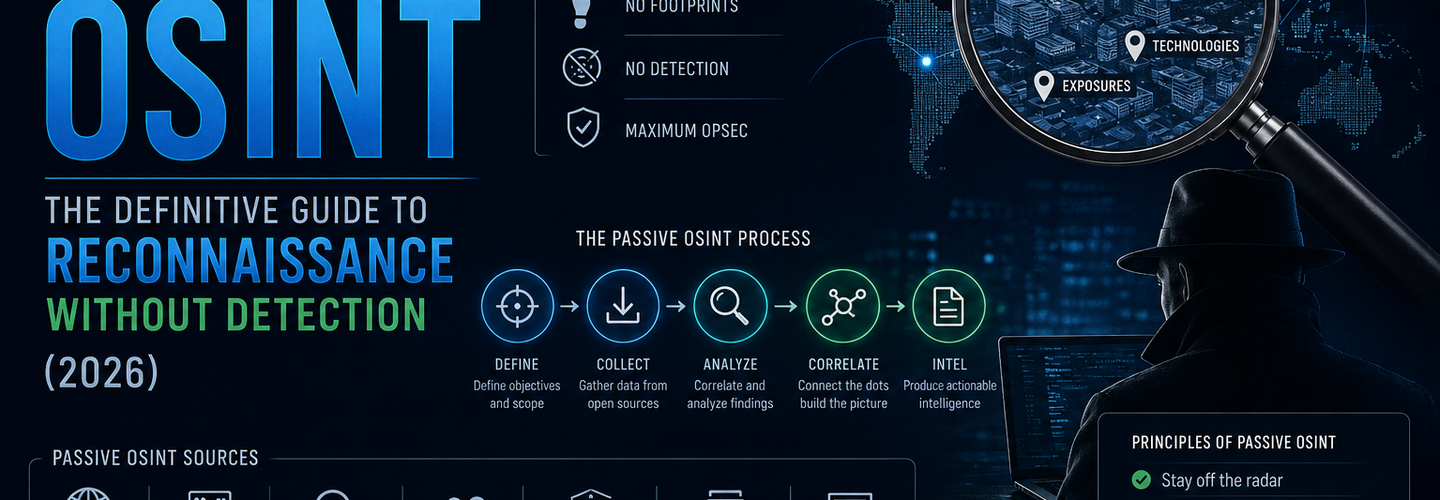
The Anatomy of Passive OSINT: The Definitive Guide to Reconnaissance Without Detection (2026)
Summarize this blog post with: ChatGPT | Perplexity | Claude | Grok
Most cybersecurity investigations start with gathering publicly available information, and you've probably already used search engines or social media during early reconnaissance. What many analysts miss is how powerful passive OSINT becomes when DNS records, metadata, infrastructure data, and breach intelligence are systematically correlated rather than collected in isolation. In this guide, you'll learn the complete anatomy of passive OSINT — the data sources, techniques, workflows, and ethical practices used by modern threat intelligence teams and professional investigators.
## Key Takeaways
- ▸Passive OSINT involves collecting publicly available intelligence without directly interacting with the target system or individual, making it inherently safer and legally defensible.
- ▸Passive reconnaissance reduces detection risk because investigators never actively probe or connect to target systems — all data comes from third-party public sources.
- ▸DNS records, metadata, social media, breach databases, and certificate transparency logs are the most valuable passive OSINT data sources for infrastructure and identity investigations.
- ▸Effective passive OSINT workflows require data validation, cross-source correlation, and careful documentation before conclusions can be drawn.
- ▸Tools like Shodan, Maltego, SecurityTrails, and SpiderFoot streamline passive intelligence collection and automate infrastructure relationship mapping.
- ▸Ethical passive OSINT depends on respecting privacy laws, platform terms of service, and operational security boundaries at every stage of collection.
- ▸Structured passive reconnaissance directly improves threat intelligence quality, attack surface mapping accuracy, and the speed of cybersecurity investigations.
## What Is Passive OSINT and How Does It Work?
Passive OSINT is the process of collecting publicly available intelligence without directly interacting with the target — relying entirely on third-party data sources, public records, and archived information to build an intelligence picture. OSINT, or Open Source Intelligence, encompasses any information gathered from publicly accessible sources. The "passive" qualifier is critical: it means the investigator never sends packets to the target, queries the target's systems, or creates any interaction that could be logged by the target's infrastructure.
Passive reconnaissance involves analyzing external data sources such as DNS records, search engines, social media platforms, and metadata — all of which are accessible without establishing a direct connection to the target network. For example, querying a third-party DNS lookup service for a domain's historical IP records is passive. Running an Nmap scan against that domain's IP address is active. The distinction matters enormously — both legally and operationally.
The difference between passive and active OSINT is best understood through the concept of attribution risk. In passive intelligence gathering, the target has no way to detect the investigation because the investigator never touches the target's systems. In active reconnaissance, every probe, scan, or query may appear in the target's access logs, firewall alerts, or IDS dashboards. For investigators in threat intelligence, law enforcement, or competitive intelligence roles, passive OSINT is the only method that preserves plausible deniability and legal defensibility.
Publicly available intelligence sources include domain registration records, historical DNS data, certificate transparency logs, social media profiles, job postings, leaked breach databases, web archive snapshots, and search engine caches. Each of these data sources reveals something about the target's infrastructure, personnel, technology stack, or operational patterns — without the target ever knowing an investigation is underway. For a foundational understanding of how threat intelligence teams use these same data principles operationally, our Beginner's Guide to Threat Intelligence and IOC Analysis walks through the complete intelligence lifecycle from collection to action.
## Why Is Passive Reconnaissance Important in Cybersecurity?
Passive reconnaissance is important in cybersecurity because it enables investigators to gather actionable intelligence about targets, threats, and attack surfaces without creating legal exposure, operational risk, or alerting adversaries to the investigation. In an era of increasing regulatory scrutiny and cyber awareness, the ability to gather intelligence cleanly and safely is a core professional skill.
The scale of publicly available intelligence is staggering. Over 3.5 billion records have been exposed in data breaches catalogued by public databases since 2013 — Source: HIBP / Troy Hunt, 2024. DNS history services maintain years of historical resolution data for billions of domains. Certificate transparency logs have recorded over 10 billion SSL/TLS certificates since 2013 — Source: crt.sh / Let's Encrypt Transparency Report, 2023. This volume of freely available data means that a skilled passive OSINT analyst can build a comprehensive intelligence picture of almost any internet-facing organization without ever making direct contact.
Threat intelligence and attack surface analysis represent the two most operationally valuable applications of passive OSINT. Threat intelligence teams use passive collection to identify adversary infrastructure, track threat actor campaigns, and monitor for newly registered domains that resemble their organization's brand. Attack surface analysts use passive data to discover forgotten subdomains, exposed cloud storage buckets, misconfigured DNS records, and historically exposed services that an organization may not even know exist.
Legal and ethical advantages of passive OSINT are significant. Because investigators access only publicly available data through third-party services, they operate entirely within the bounds of acceptable use — provided they respect the terms of service of the platforms they access. Active reconnaissance, by contrast, risks violating the Computer Fraud and Abuse Act (CFAA) in the US, the Computer Misuse Act in the UK, and equivalent legislation in most jurisdictions. Passive methods eliminate this risk entirely when practiced correctly. For teams building formal threat intelligence programs, understanding this distinction is covered in our threat intelligence lifecycle guide in the ReconShield Intel Feed.
## What Are the Most Valuable Data Sources for Passive OSINT?
The most valuable passive OSINT data sources are DNS intelligence, certificate transparency logs, WHOIS and RDAP records, social media platforms, breach databases, and web archives — each revealing a distinct layer of the target's digital footprint without requiring any direct interaction. Skilled analysts triangulate across multiple sources to build a coherent intelligence picture that no single source could provide alone.
DNS Intelligence and Passive DNS Analysis
Passive DNS analysis helps investigators identify historical domain-to-IP relationships and infrastructure changes over time — revealing how a target's network has evolved, which hosting providers it uses, and whether suspicious domains share infrastructure with known threats. Unlike active DNS queries, which resolve directly against authoritative nameservers, passive DNS analysis draws from collections of historical DNS resolution data aggregated by security companies and researchers.
For example, a threat actor may register a phishing domain today, but passive DNS records might show that the same IP address hosted a different phishing domain six months ago — linking the campaigns through shared infrastructure. SecurityTrails and Farsight DNSDB are the two most widely used commercial passive DNS services. For investigators who want to analyze DNS security configuration alongside passive DNS data, the ReconShield DNS Lookup and Security Analysis tool audits A, MX, TXT, and NS records and validates SPF and DMARC configurations — essential for identifying misconfigured email infrastructure during passive investigations.
Certificate Transparency Logs
Certificate transparency logs provide publicly accessible, tamper-evident records of every SSL/TLS certificate issued by a participating certificate authority — revealing subdomains, organizational infrastructure, and historical certificate patterns that organizations often don't realize are public. The CT log system was established by Google to prevent certificate mis-issuance, but it has become one of the most powerful passive OSINT data sources available.
Every time an organization obtains an SSL certificate for a subdomain — including internal-looking names like dev.example.com, staging.example.com, or vpn.example.com — that certificate is logged publicly. Investigators can query CT logs via crt.sh or Censys to enumerate subdomains that would otherwise be invisible to conventional reconnaissance. This technique frequently reveals development environments, internal tools, and forgotten services. For teams validating their own SSL/TLS posture as part of attack surface awareness, the ReconShield SSL/TLS Crypto Checker audits certificate chains and cipher suites across internet-facing infrastructure.
WHOIS and RDAP Domain Intelligence
WHOIS and RDAP records expose domain registration details — registrant organization names, nameservers, registration dates, and registrar information — that help investigators attribute domains to organizations or track threat actor registration patterns. Even with privacy-masked WHOIS records, metadata like nameserver configurations, registration date clustering, and registrar preferences can link domains to the same operator. Our ReconShield WHOIS Domain Intelligence tool queries modern RDAP endpoints to surface infrastructure attribution data useful for passive investigation and threat hunting.
Social Media and Public Breach Intelligence
Social media platforms expose employee names, job titles, technology stacks, office locations, and organizational structures through LinkedIn profiles, Twitter/X posts, GitHub repositories, and job listings. This personnel intelligence is invaluable for social engineering risk assessments and organizational mapping during threat intelligence investigations. Breach databases — accessed through platforms like Have I Been Pwned — reveal compromised email addresses, credential exposure, and data exfiltration history without any interaction with the target organization's systems.
## What Passive OSINT Techniques Do Professionals Use?
Professional passive OSINT practitioners use a structured combination of search operator techniques, passive DNS queries, certificate log enumeration, metadata extraction, and archive analysis to build comprehensive intelligence profiles from publicly available data sources. Each technique targets a different data layer of the target's digital footprint.
Search Engine Reconnaissance and Google Dorking
Google dorking is the use of advanced search operators to surface sensitive or specific information indexed by search engines that would not appear in standard queries. Operators like site:, filetype:, inurl:, and intitle: allow investigators to find exposed configuration files, publicly indexed documents, login panels, and other resources that organizations inadvertently make searchable. For example, site:target.com filetype:pdf returns all PDF documents indexed from a domain — potentially exposing internal reports, contracts, or technical specifications. Google dorking remains entirely passive because the investigator queries Google's index, not the target's server directly.
GitHub Reconnaissance
GitHub and other code repositories are frequently overlooked but extraordinarily rich passive OSINT sources. Developers often accidentally commit API keys, database credentials, internal IP addresses, and environment configuration files to public repositories. Tools like truffleHog and GitHub's native search operators allow investigators to passively search public repositories for sensitive strings associated with a target organization. Over 10 million API keys have been found exposed in public GitHub repositories — Source: GitGuardian State of Secrets Sprawl Report, 2024.
Web Archive and Cached Data Analysis
The Wayback Machine (web.archive.org) preserves historical snapshots of websites, allowing investigators to access content, technology stacks, and infrastructure details from years past — often revealing information that has since been removed from live sites. Analysts use archive data to recover deleted pages, identify previously used subdomains, and track changes in an organization's technology infrastructure over time. This is especially valuable in investigations where a target has attempted to scrub publicly visible information after an incident.
Metadata Analysis
Metadata embedded in publicly accessible documents — PDFs, Word files, images, and presentations — can reveal author names, software versions, internal file paths, printer names, and organizational data that was never intended to be public. Tools like ExifTool and FOCA extract metadata from documents indexed by search engines, providing investigator leads about internal systems and personnel without any active probing. For broader context on how metadata exposure contributes to organizational attack surface risk, the ReconShield Exposure Assessment Tool performs passive analysis to identify OWASP-level configuration risks on web infrastructure.
## How to Build a Passive OSINT Workflow Step by Step
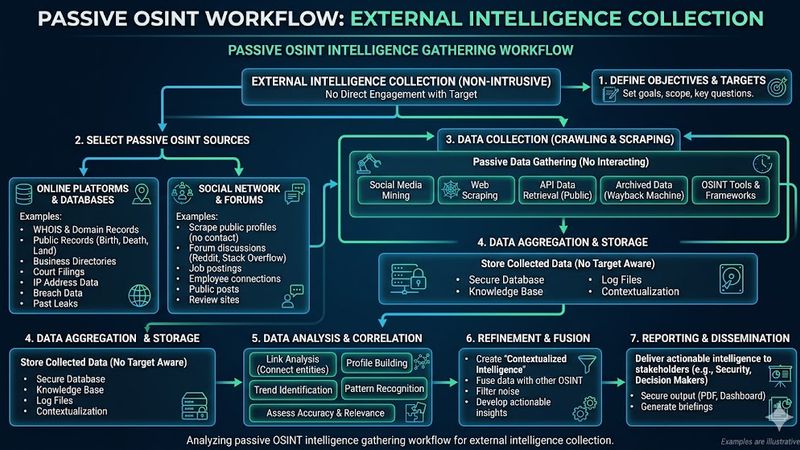
An effective passive OSINT workflow follows a structured sequence of objective definition, source identification, safe collection, multi-source correlation, validation, and evidence documentation — ensuring that intelligence is accurate, legally gathered, and operationally useful. Ad-hoc collection without a workflow produces unreliable results and increases the risk of operational security failures.
Step 1 — Define investigation objectives. Every passive OSINT investigation must begin with a clearly scoped objective. Are you mapping an organization's attack surface? Investigating a phishing domain? Profiling a threat actor's infrastructure? The objective determines which data sources are relevant and what constitutes a meaningful finding. Unfocused collection leads to data overload and missed signals.
Step 2 — Identify passive data sources. Based on the objective, select the specific passive sources you'll query — passive DNS services, CT logs, WHOIS records, search engine indexes, social media platforms, breach databases, and web archives. Selecting sources before collecting prevents scope creep and ensures your methodology can be documented and repeated.
Step 3 — Collect intelligence safely. Use dedicated investigation browsers, VPNs, or Tor circuits to prevent your investigator identity from being associated with the intelligence collection activity. Even passive OSINT can create metadata trails in third-party services. Operating from a clean, isolated research environment protects both your identity and the integrity of the investigation.
Step 4 — Correlate findings across sources. Effective OSINT workflows require validating intelligence from multiple independent public sources before drawing conclusions. A single source can be incorrect, outdated, or deliberately misleading. When a finding appears in three independent passive sources — for example, a domain appearing in CT logs, passive DNS records, and social media posts — confidence in that finding increases substantially.
Step 5 — Validate and document evidence. Screenshot, archive, and timestamp every finding at the moment of discovery. Public data can be removed or changed. Preserving evidence with verified timestamps is essential for any investigation that may later support legal proceedings, incident reports, or customer briefings. Chain of custody matters even in digital investigations.
For teams integrating passive intelligence collection into SOC operations, the ReconShield IP Reputation Intelligence tool cross-references IP addresses and ASNs against global threat feeds — a practical complement to passive DNS and CT log data during active investigations.
## What Are the Best Tools for Passive OSINT Collection?
The best passive OSINT tools combine automated data aggregation, multi-source querying, and relationship visualization to help investigators gather and correlate intelligence faster than manual methods allow. Each tool targets a specific layer of the passive OSINT stack.
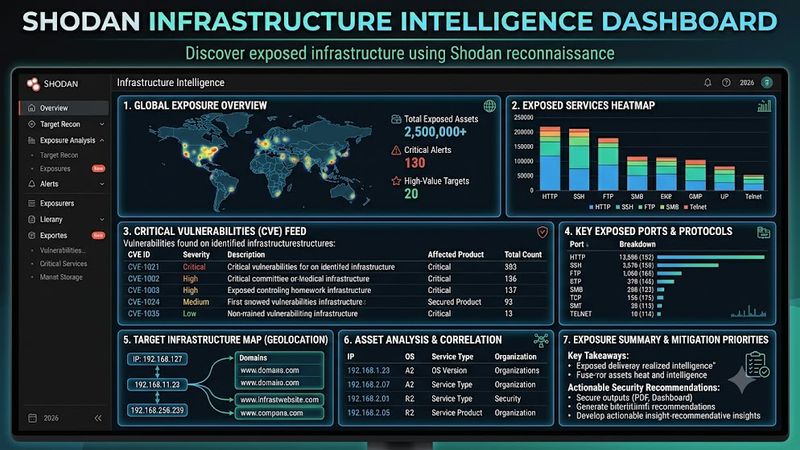
Shodan is a search engine for internet-connected devices that indexes banner data, open ports, certificate information, and service metadata from millions of hosts. Investigators use Shodan to passively discover exposed services associated with a target organization without directly scanning those services. Shodan is entirely passive from the investigator's perspective — the scanning is done by Shodan's own infrastructure, not the analyst's machine.
Maltego is a graph-based intelligence platform that automates the transformation of a single seed — a domain, email address, IP, or person — into a multi-node relationship map by querying dozens of passive data sources simultaneously. It visualizes how entities relate to each other, making it invaluable for investigating complex infrastructure or organizational networks.
SecurityTrails provides passive DNS history, WHOIS records, and subdomain enumeration at scale. It is one of the most comprehensive passive DNS databases available commercially, with historical records spanning years of DNS resolution data for billions of domains.
theHarvester is an open-source tool that gathers email addresses, domain names, subdomains, and employee names from public sources including search engines, SHODAN, and DNS records. It is commonly used in the early stages of passive reconnaissance to build an initial entity list.
SpiderFoot is an open-source intelligence automation framework that queries over 200 public data sources — including WHOIS, DNS, breach databases, social media, and threat intelligence feeds — from a single interface. SpiderFoot's automated collection capabilities make it particularly effective for attack surface discovery at scale.
Have I Been Pwned allows investigators to check whether an email address or domain has appeared in known public data breaches, providing immediate insight into credential exposure risk without any interaction with the target's systems.
The Wayback Machine (archive.org) serves as an historical intelligence source for passive investigation, preserving years of web content that may reveal technology changes, personnel, removed content, and historical infrastructure details.
For teams wanting to complement third-party OSINT tools with direct infrastructure diagnostics, the ReconShield Security Headers Auditor and Port Scanner provide passive assessments of web security posture and exposed network services across your own internet-facing assets.
[Insert image: SpiderFoot OSINT framework showing automated multi-source intelligence collection dashboard | Alt text: "Perform passive OSINT collection with SpiderFoot automated reconnaissance"]
[Insert image: Maltego graph visualization showing domain-to-IP-to-organization relationship mapping | Alt text: "Visualize passive OSINT relationships with Maltego graph intelligence"]
## What Legal and Ethical Rules Apply to Passive OSINT?
Passive OSINT is legal when investigators access only genuinely public data through legitimate means — but legal exposure increases rapidly when investigators bypass access controls, violate platform terms of service, or collect data on private individuals without lawful purpose. The passive label does not automatically make an investigation compliant; the nature of the data accessed and the purpose of the investigation both matter.
Privacy law considerations are jurisdiction-specific but increasingly global. GDPR in Europe imposes obligations on investigators who collect or process personal data about EU residents, even from public sources. CCPA in California extends similar protections. Investigators operating across borders must understand which privacy frameworks apply to the individuals whose data they are collecting, regardless of where that data was originally published.
Platform terms of service are a significant and often overlooked constraint. Automated scraping of platforms like LinkedIn, Twitter/X, or Facebook may violate their terms of service even when the underlying data is technically public. In the US, the Ninth Circuit Court's ruling in hiQ Labs v. LinkedIn has partially clarified that scraping publicly accessible data is not unauthorized access under the CFAA — but this remains an evolving legal landscape.
Operational security (OPSEC) during passive OSINT is as much about protecting the investigator as it is about following ethical practices. Using personal accounts, home IP addresses, or identifiable browser profiles during an OSINT investigation creates attribution risk. Professional investigators use dedicated research personas, isolated virtual machines, and VPN or Tor circuits to maintain separation between their operational identity and their personal identity. For teams performing authorized security research on their own infrastructure, all ReconShield tools operate entirely passively with zero packets sent directly to target systems.
## What Are Common Mistakes in Passive OSINT Investigations?
The most common passive OSINT mistakes are failing to validate sources, poor operational security, accidental active reconnaissance, and over-collecting irrelevant data that obscures actionable intelligence. Each mistake reduces the quality of the investigation and increases risk for the investigator.
Failing to validate sources is the single most damaging mistake. Public data is frequently outdated, incorrect, or deliberately seeded with false information by adversaries practicing counter-OSINT. An analyst who builds conclusions on a single unverified passive source risks producing flawed intelligence that leads to incorrect decisions. Every significant finding must be corroborated by at least one independent passive source before being treated as reliable.
Accidentally crossing into active reconnaissance is a constant risk, especially for analysts who use tools with both passive and active capabilities. Running Nmap against a target IP, sending a test email to verify an address, or visiting a target website from your investigator machine all cross the line into active reconnaissance. Many OSINT frameworks include active modules that must be explicitly disabled during passive-only investigations.
Poor operational security exposes the investigator's identity, organization, or investigation to the target. Querying WHOIS records from a corporate IP address, searching for a target on LinkedIn while logged into a professional account, or using a home browser profile for investigation work all create attribution trails. Effective investigators treat OPSEC as a non-negotiable baseline, not an optional precaution.
Over-collecting irrelevant data creates noise that buries genuine intelligence signals. Passive OSINT produces enormous volumes of data — the discipline is knowing which data sources are relevant to the specific investigation objective and which can be excluded. Structuring collection around a clear hypothesis, rather than open-ended data accumulation, produces sharper and more defensible intelligence outputs.
## What Happens After Passive OSINT in a Security Investigation?
After passive OSINT, security investigations typically transition to more focused intelligence activities — including active reconnaissance, targeted threat hunting, automated OSINT pipeline development, or direct integration of passive findings into SOC detection workflows. Passive OSINT provides the map; subsequent phases use that map to plan and execute more targeted security actions.
Transitioning to active reconnaissance should only happen with explicit authorization and a clear scope definition. Penetration testers and red team operators use passive OSINT findings to inform their active scanning strategies — targeting specific IP ranges, services, and technologies identified during passive collection rather than broadly scanning all of a target's infrastructure. This makes active reconnaissance faster, more targeted, and less likely to trigger defensive alerts.
Building automated OSINT workflows is the next maturity step for teams that conduct regular passive intelligence operations. Tools like SpiderFoot HX, OSINT Framework automation scripts, and custom Python pipelines can continuously monitor passive data sources — alerting teams to new subdomains, certificate issuances, or breach exposures in near-real-time. This transforms passive OSINT from a point-in-time investigation into a continuous intelligence capability.
Integrating passive OSINT into SOC operations means feeding passive intelligence findings directly into SIEM correlation rules, threat hunting playbooks, and incident response workflows. When a SOC analyst receives an alert about a suspicious IP, passive OSINT data — historical DNS records, ASN reputation, breach database hits, and certificate history — provides the immediate context needed to triage the alert accurately. For teams building this context at scale, the ReconShield IP Reputation Intelligence tool and DNS Lookup tool provide on-demand passive intelligence enrichment that integrates naturally into investigation workflows.
Continuous passive monitoring represents the most advanced application of passive OSINT principles — maintaining persistent visibility into changes in a target's or organization's digital footprint through automated alerting on DNS changes, new certificate issuances, fresh breach exposures, and emerging social media intelligence. Organizations that implement continuous passive monitoring discover attack surface changes and external threats significantly faster than those relying on periodic manual reviews.
## Conclusion
Passive OSINT is not just a beginner's tool — it is the intelligence foundation that every professional investigation, threat hunt, and attack surface assessment is built upon. Passive intelligence gathering done systematically produces more reliable, more defensible, and more actionable results than any amount of active scanning performed without proper reconnaissance.
The path forward is clear. Build your passive OSINT capability layer by layer: master the core data sources, establish a repeatable collection workflow, adopt the right tools for each investigation type, and enforce rigorous OPSEC practices from day one. The investigators who consistently produce the best intelligence are not the ones with access to the most expensive tools — they are the ones who understand which public data sources matter, how to correlate findings across them, and how to validate conclusions before acting.
Start your passive reconnaissance journey today by auditing your own organization's digital footprint with the ReconShield passive diagnostics suite — and discover what a professional investigator would find about your infrastructure before an adversary does.
Written by Surendra Reddy Cybersecurity Researcher & Founder, ReconShield. Surendra is a cybersecurity engineer specializing in Open Source Intelligence (OSINT), exposure intelligence, and AI-driven threat analysis. He built ReconShield to democratize access to enterprise-grade infrastructure visibility tools and secure the digital internet-facing assets.
Reviewed by ReconShield Editorial Team — Peer-reviewed for technical accuracy, OSINT methodology correctness, and legal compliance guidance against current privacy and cybersecurity frameworks.
## Analyst Commentary & Implementation Blueprint
Security advisory
Passive reconnaissance represents a critical blind spot for many enterprise security programs. While active scans are logged, passive data gathering using certificate transparency logs and regional caching databases leaves zero footprints on target systems. Security teams must assume that their entire public-facing architecture is mapped and regularly audit their DNS zone files to purge unused hostnames.
Wildcard TLS & DNS Scoping Blueprint
# DNS Zone File Example - Restrict Subdomain Leaks
; Avoid naming hostnames after internal dev stages
*.prod.reconshield.in.    IN  CNAME   wildcard-origin.reconshield.in.
; Purge stale DNS resource records promptly
staging-db-01             IN  A       127.0.0.1 ; DEPRECATED - PURGE IMMEDIATELY
Actionable Mitigation Checklist
- ✔Audit public DNS zones for stale subdomains monthly.
- ✔Implement wildcard certificates to prevent public subdomain enumeration.
- ✔Avoid exposing descriptive hostnames in DNS records.
Common Inquiries & FAQs
Can passive scanning be detected by firewalls?
No. Passive scanning queries third-party datasets (like certificate logs or search caches) instead of sending traffic to your server, leaving no trace in your network logs.
How do I reduce my passive OSINT footprint?
Purge unused DNS records, avoid naming subdomains after internal services (e.g. staging-db.company.com), and implement wildcard certificates to hide subdomains from certificate transparency logs.
Surendra Reddy
Surendra Reddy is a cybersecurity researcher and founder of ReconShield, specializing in OSINT and defensive infrastructure analysis.
Connect on LinkedIn ↗// AUDIT BRIEFING DISCUSSION (2 COMMENTS)
Great breakdown of the passive infrastructure vectors. We recently audited our external DNS zones and found multiple dangling staging environments. Implementing wildcard certificates reduced our CT log leaks significantly.
Is there any automated tooling you recommend for daily crt.sh scraping? Manually checking CT logs is becoming unsustainable for our domain portfolio.
// MORE ARTICLES

The Gentlemen Ransomware Targets Windows Networks with 21 Lateral Movement Techniques
The Gentlemen ransomware uses 21 lateral movement techniques to spread across Windows networks. See its attack chain, IOCs, and defenses.
Critical Chrome Extension Flaws Put Millions of Browsers at Risk of Account Takeover: The Definitive 2026 Security Guide
Critical Chrome extension flaws expose millions to account takeover. Learn how the attacks work, which extensions are at risk, and how to protect your accounts.
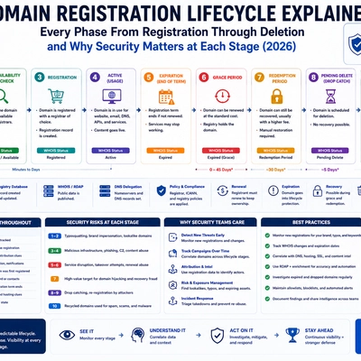
Domain Registration Lifecycle Explained: Every Phase From Registration Through Deletion and Why Security Matters at Each Stage (2026)
Domain registration lifecycle explained: registration, renewal, expiry, grace period, redemption, deletion, and security implications for every phase in 2026.