Domain Registration Lifecycle Explained: Every Phase From Registration Through Deletion and Why Security Matters at Each Stage (2026)
Summarize this blog post with: ChatGPT | Perplexity | Claude | Grok
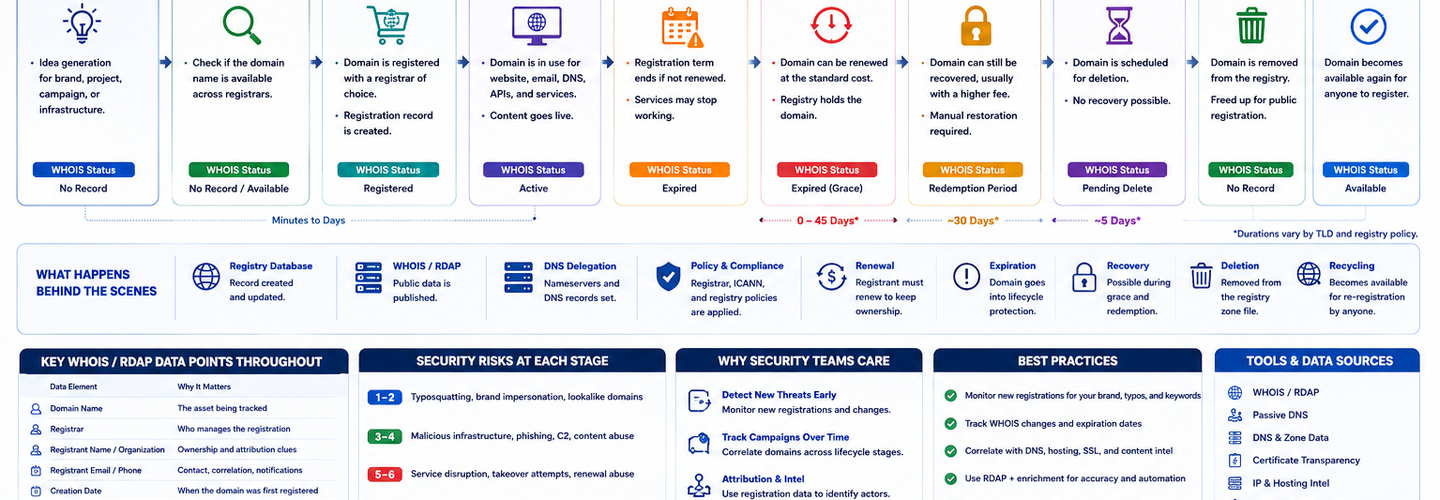
A domain's life does not begin when you type your name into a registrar's search box and click "Register" — and it does not end when you decide you no longer need it. Every domain passes through a structured, precisely defined lifecycle governed by ICANN registrar agreements and standardized technical processes. Understanding this lifecycle is critical for security because different lifecycle phases create different security risks: an active domain faces hijacking attacks, an expiring domain faces re-registration by threat actors, and a domain in the deletion queue faces immediate acquisition by domain speculators and cybercriminals. In this guide, you'll learn the exact timeline of every domain lifecycle phase, what happens at each stage, how to monitor for risks in each phase, and what security actions you should take to protect domains you own while defending against threats from domains you do not.
## Key Takeaways
- ▸The domain lifecycle has eight distinct phases, each with specific technical states, timeline windows, and security implications — from initial registration through public deletion and potential re-registration.
- ▸Active registration is the longest and most stable phase — a domain can remain active indefinitely as long as renewal occurs before expiry, making this the phase where most legitimate organizational domains spend their operational life.
- ▸The expiry date triggers a structured grace period sequence defined by ICANN registrar agreements — domains do not simply disappear; they move through Auto-Renew Grace Period (ARGP), Redemption Grace Period (RGP), Pending Delete, and finally Public Release in a precise, predictable timeline.
- ▸The redemption grace period is the last window for legitimate recovery — typically 30 days after expiry, during which the original registrant can restore the domain at a premium fee, but after which it enters a deletion queue with no recovery option.
- ▸Expired domains are immediately exploited by threat actors — the moment a high-value domain becomes available for re-registration, cybercriminals attempt to acquire it within seconds, using automated tools to monitor deletion feeds and execute instant registrations.
- ▸The pending delete phase (5–10 days) is when attackers most actively monitor — they know the domain is irrecoverably queued for deletion and will become publicly available within a predictable window, allowing them to pre-stage registration attempts.
- ▸Domain security during active phases depends on EPP locks, registrar account security, and continuous WHOIS monitoring — the operational controls that prevent unauthorized transfer or modification during the extended active phase.
## The Eight Phases of the Domain Lifecycle
Every ICANN-managed generic TLD domain passes through eight distinct lifecycle phases, each with specific technical characteristics, timing, and security implications. Understanding this progression is essential for both protecting domains you own and defending against threats from domains you do not.
Phase 1 — Registration and Initial Activation
The domain lifecycle begins when a registrant completes a registration transaction with an ICANN-accredited registrar, providing a domain name, selecting a registration period (typically 1–10 years), entering contact information, and completing payment. The registrar submits the registration request to the authoritative registry for the TLD (Verisign for .com, Public Interest Registry for .org, etc.), which validates the request and creates the initial domain record.
The domain enters an Active state immediately upon successful registry creation. The registrant receives confirmation of the registration details, including the registration date, expiry date, assigned nameservers (if provided during registration), and the registrar's control panel credentials for future management.
Security implications: The initial registration establishes who claims ownership of the domain in the WHOIS database. Organizations must ensure that the registrant contact information is accurate and current, and that the registrar account that created the domain is protected with strong authentication. Early-stage security failures — registering under personal email addresses rather than organizational accounts, failing to enable MFA on the registrar account — create vulnerabilities that persist throughout the domain's entire lifecycle.
Action items: Register corporate domains through organizational email addresses, not personal addresses. Enable multi-factor authentication (MFA) immediately on the registrar account. Verify that the registrant contact information reflects current organizational structure and is monitored for access. Document the registration in your domain inventory with baseline WHOIS data.
Phase 2 — Active Registration (Operational Phase)
The active registration phase is the longest and most stable phase of the domain lifecycle — lasting from initial registration through renewal until the domain either expires or is deliberately allowed to lapse. During this phase, the domain is fully operational: DNS can be configured, email can be routed, websites can be hosted, and all ICANN-specified services function normally.
Active domains can remain in this state indefinitely. An organization that registers a domain in 2010 and renewals it continuously is still in active status in 2026 — the domain will remain active as long as the organization continues to pay renewal fees and the registrar agreement remains in force.
Security implications: The active phase is where the vast majority of security risk occurs because the domain is in operational use, likely receiving email, hosting web applications, and serving as a public-facing organizational asset. Threat actors target active domains through compromised registrar accounts, phishing attacks on domain administrators, and DNS hijacking via name server manipulation. The security controls required during the active phase — EPP locks, registrar account MFA, continuous WHOIS monitoring, DNS configuration monitoring — are the only defensive measures available during this extended timeline.
Action items: Activate clientTransferProhibited and clientUpdateProhibited EPP locks on every active domain. Implement registry-level locks on mission-critical domains. Monitor WHOIS records continuously for unauthorized changes (name server modifications, lock removal, registrar account access events). Set up DNS record monitoring to detect unauthorized changes. Maintain a current domain inventory and cross-reference it against WHOIS data quarterly.
For the complete methodology on protecting active domains from hijacking during this phase, the ReconShield domain expiration monitoring guide covers continuous monitoring workflows.
Phase 3 — Auto-Renew Grace Period (ARGP)
The Auto-Renew Grace Period begins when the domain's registration reaches its expiry date — entering a grace period where the original registrant can still renew the domain at standard renewal rates without any additional fees or penalties. The ARGP typically lasts 30 days, though specific durations vary by TLD and registrar.
If the registrant has enabled auto-renewal with a valid payment method on file, the domain is automatically renewed during the ARGP, and the domain remains in active status without any interruption. If auto-renewal is not enabled or fails due to expired payment methods, the domain progresses to the next phase.
Most registrars maintain DNS resolution during the ARGP (though some allow it to lapse), meaning websites and email continue functioning even if the auto-renewal process has not yet completed. This grace period is intentional — it allows registrants to address billing issues without immediately losing service.
Security implications: The ARGP is the first phase where security risks shift from hijacking to expiration. Auto-renewal failures are the most common entry point to the expiration sequence. Payment method expiration (a credit card that expired in March will fail any auto-renewal scheduled for April or later), billing email address changes (employees with registrar account access leave the organization and billing notifications go to their personal email), and registrar account decommissioning (during infrastructure consolidation, legacy registrar accounts are closed without transferring all domains) are the common failure modes.
Action items: Verify auto-renewal is enabled on every mission-critical domain. Maintain a backup payment method on every registrar account. Confirm the billing notification email address is actively monitored. Set up 90-day, 60-day, and 30-day expiry alerts to reach multiple people in the organization. For Tier 1 domains, call the registrar 60 days before expiry to confirm renewal is scheduled.
For the complete domain expiration monitoring program, including how to identify domains that will fail auto-renewal before the ARGP, see the ReconShield domain expiration monitoring guide.
Phase 4 — Redemption Grace Period (RGP)
The Redemption Grace Period begins when the domain has passed through the Auto-Renew Grace Period without being renewed — typically around day 30–60 after the expiry date. The domain is no longer resolving through DNS for most registrars, and the domain is effectively offline.
However, the domain is not yet available for public re-registration. The original registrant still has the legal right to restore the domain during the RGP, which typically lasts 30 days. The restoration requires payment of a premium fee (typically $100–300, depending on registrar and TLD) in addition to the renewal fee. This premium reflects the administrative cost of registry restoration and serves as a financial deterrent against neglectful renewals.
The domain's EPP status code during RGP is redemptionPeriod, indicating that the domain is in a special administrative state. The domain is partially withdrawn from public WHOIS visibility during some of this period on some registrars' systems, though not entirely invisible.
Security implications: The RGP is the critical window where legitimate recovery is still possible but increasingly unlikely. Organizations that do not catch the expiration during ARGP may discover it during RGP, but the premium restoration fee creates a financial barrier to recovery. For threat actors, the RGP is the final phase where recovery attempts by the legitimate owner are still possible — but the threat actor's window is approaching where the domain will become permanently available.
Action items: If a critical domain is discovered to have expired and entered RGP, immediate action is required. Contact the registrar immediately to confirm the domain's RGP status and the premium restoration fee. Authorize payment and restoration if the domain's operational importance justifies the premium cost. Simultaneously implement temporary mitigation: publish notices to users that the domain is temporarily offline, migrate critical services to backup domains, and update customer communications to prevent confusion.
Phase 5 — Pending Delete
The Pending Delete phase begins when the Redemption Grace Period expires without the domain being restored — typically around day 60–65 after the expiry date. The domain status changes to pendingDelete, and DNS resolution is typically disabled entirely.
During the Pending Delete phase (typically 5–10 days), the domain cannot be renewed by anyone — not even the original registrant. It is irrecoverably queued for deletion from the registry database. The domain cannot be transferred. No additional fees will bring it back. It is in a final countdown to permanent removal.
Security implications: The Pending Delete phase is where threat actors most intensively monitor. They know the domain is irrecoverably queued for deletion and will become publicly available within a known, predictable window. They stage automated registration attempts. They monitor deletion feeds from vendors that provide real-time notifications of pending-delete domains. When the clock hits the deletion timestamp, thousands of registrations may be attempted for valuable domains simultaneously, and the fastest actor (or the one with automated tooling) claims the domain.
For high-value domains — corporate root domains, brand-critical subdomains, domains with SEO authority — the Pending Delete phase is when acquisition by cybercriminals is most likely.
Action items: Once a domain enters Pending Delete, recovery by the legitimate owner is no longer possible. The only mitigation is prevention: ensuring auto-renewal is enabled during the active phase so the domain never reaches this stage. If a critical domain is discovered to be pending deletion and was allowed to expire unintentionally, the only option is to wait for public release and attempt immediate re-registration — which is unlikely to succeed if threat actors are monitoring and attempting registrations simultaneously.
Phase 6 — Public Release and Active Re-Registration Market
The domain is deleted from the registry database and becomes available for immediate public re-registration — typically occurring around 65–75 days after the original expiry date, depending on the specific TLD and registrar.
The moment the domain becomes publicly available, registrars process registration requests from anyone worldwide. Automated registration services operated by domain speculators, cybercriminals, and legitimate domain investors all attempt to register valuable domains within seconds of release. For high-profile domains, thousands of registration attempts may be processed per second by automated systems.
Security implications: If a high-value domain owned by your organization was allowed to expire and reach public release, threat actors have multiple pathways to acquire it. Domain speculators may register it to monetize through parking pages. Cybercriminals may register it to conduct phishing campaigns impersonating your organization. Competitors may register it to disrupt your brand. The longer the domain sits in the public release pool unclaimed (which is typically minutes to hours for valuable domains, maximum days for niche domains), the higher the likelihood that someone other than the original owner will register it.
Action items: The only meaningful mitigation at this phase is proactive registration: if your organization's critical domain was allowed to expire, attempt immediate re-registration the moment it becomes publicly available. However, this is logistically difficult — you must monitor the deletion feed in real-time, be ready to register the instant it becomes available, and process the registration faster than competing registrants. For this reason, prevention (ensuring the domain never expires) is vastly more cost-effective than attempting recovery after public release.
For the methodology of defending against high-value domain expiration, see the ReconShield domain expiration monitoring guide.
Phase 7 — Re-Registration Speculation or Malicious Use
If the domain is successfully re-registered after public release, it enters active status again under new ownership — either legitimate re-registration by the original owner, or acquisition by a speculator, competitor, or malicious actor.
The timeline for this phase depends entirely on who re-registered the domain and what their intent is. Legitimate organizations that allowed a domain to expire and successfully re-registered it immediately re-establish the domain in active operational status. Domain speculators may hold the domain for weeks or months while attempting to resell it. Cybercriminals may activate phishing campaigns, malware hosting, or other malicious infrastructure on the domain immediately upon acquisition.
Security implications: From an external security perspective, a domain that was legitimately allowed to expire and then re-registered by a threat actor is now the threat actor's asset, with all the associated risks. Email impersonation, phishing campaigns, malware distribution, and credential harvesting can all operate through the re-registered domain without technical difficulty. The organization that allowed it to expire is partially responsible for enabling this threat through their domain management failure.
Action items: If you discover that a critical domain owned by your organization has been re-registered by a third party after expiration, immediate escalation is required. Determine whether the new registrant is hostile or neutral. Contact the registrar to investigate whether re-registration occurred through a legitimate process or through fraudulent means. If the registrant is hostile and conducting malicious operations, report to law enforcement and the registrar's abuse team. Simultaneously, register alternative domains for critical services and update customer communications to prevent users from being directed to the malicious version by search results or cached links.
Phase 8 — Long-Term Reuse or Re-Expiration
A re-registered domain enters the standard active lifecycle again — either being maintained and renewed indefinitely by the new owner, or allowed to expire again, starting the entire lifecycle over.
This phase is where long-term infrastructure exists for re-registered domains. If the re-registrant is a legitimate domain speculator or the original owner who successfully recovered the domain, it enters normal renewal cycles. If the re-registrant is a cybercriminal using the domain for campaigns, it remains active as long as it is generating value for the attacker, then is abandoned when operational goals are achieved and the domain begins to accumulate security reputation signals.
Security implications: This phase is where security teams must implement monitoring for brand-based and infrastructure-based threats. If your organization's domains expire and are re-registered by threat actors, your monitoring should detect the re-registration and the malicious use within days of it occurring. This detection requires:
- ▸Brand monitoring services that track new domain registrations matching your organization's name
- ▸DNS and IP reputation monitoring of competitor or lookalike domains
- ▸WHOIS monitoring of your own domains (and critical subsidiaries) detecting ownership transfers
- ▸Threat intelligence feeds that aggregate malicious domain data
For the complete brand protection and infrastructure monitoring methodology, see the ReconShield domain expiration monitoring guide and the WHOIS for threat intelligence guide.
## Timeline Summary: The Complete Domain Lifecycle
For reference, here is the standard timeline of domain phases (using a .com domain as the example, with specific timelines varying by TLD):
- ▸Day 0: Expiry date reached. Domain enters Active Renewal or ARGP.
- ▸Days 1–30: Auto-Renew Grace Period (ARGP). Auto-renewal occurs or domain remains unrenewed.
- ▸Days 30–60: Redemption Grace Period (RGP). Original registrant can restore at premium fee.
- ▸Days 60–65: Pending Delete (PD). Domain irrecoverably queued for deletion, not recoverable.
- ▸Day 65+: Public Release. Domain deleted and available for new registration.
The exact timeline varies by registrar and TLD. Some registrars maintain shorter grace periods (15 days instead of 30). Some TLDs have different default timelines (.org may differ from .com). Always verify the specific timeline for your organization's TLDs with the registrar.
## Security Across the Lifecycle: What Changes at Each Phase
The security posture required for each lifecycle phase differs significantly — because the threat model changes as the domain progresses through renewal cycles.
Active Phase (Longest): Focus on preventing hijacking through EPP locks, registrar account security, and WHOIS monitoring. The threat is unauthorized transfer or modification during operational use.
ARGP Phase (Days 1–30 after expiry): Focus on ensuring auto-renewal succeeds. Verify payment methods are current, billing notifications reach monitored addresses, and renewal is confirmed before ARGP expires. The threat is accidental expiration due to payment failure.
RGP Phase (Days 30–60): If domain has unexpectedly expired, focus on rapid restoration. Evaluate whether the premium restoration fee is justified by operational importance. The threat is permanent loss if recovery window is missed.
Pending Delete / Public Release (Days 60+): Focus on prevention before reaching this phase. If the domain has reached pending delete, accept that recovery is unlikely and prepare defensive measures: brand monitoring for re-registration, blocking of lookalike domains if they appear, and alternative service infrastructure.
## Monitoring the Lifecycle: Automated Approaches
Sophisticated domain lifecycle management requires automation — managing the timeline manually across dozens or hundreds of domains is error-prone and operationally inefficient.
Implement scheduled WHOIS queries using the ReconShield WHOIS Intelligence tool that retrieve expiry dates for all domains in your portfolio. Compare against a baseline and flag any domains that have changed status (from active to grace period, from grace period to redemption, etc.). Set up automated alerts for specific timeline milestones: 90 days before expiry, 60 days before expiry, 30 days before expiry, and immediately if a domain is discovered to have already expired.
For critical domains, set expiry reminders at the registrar level AND in your internal security systems. Do not rely on a single notification source — employees leave, email addresses change, registrar notifications fail to reach the intended recipient.
For threat intelligence, maintain a feed of newly registered domains matching your organization's trademark patterns. Use the ReconShield WHOIS Intelligence tool to check registrar and name server patterns against known malicious infrastructure. Flag any lookalike domains registered by threat actors attempting to capitalize on a domain you allowed to expire.
## Real-World Lifecycle Failure: Case Study
A large financial services organization registered their primary domain in 2005. In 2024, organizational restructuring moved domain management from IT to a managed services provider. The MSP consolidated registrars, transferring most domains but overlooking two regional subsidiaries' domains that were registered through a legacy provider.
June 2025: One of the legacy domain registrations reaches expiry. Auto-renewal fails because the billing email address associated with the registrar account was for an employee who left the organization in 2022. The legacy registrar has no backup contact. The domain enters ARGP undetected.
July 2025: The domain enters RGP. The financial services organization discovers the lapsed domain only when customers report errors accessing the regional subsidiary website. The organization contacts the registrar and authorizes the $150 premium restoration fee. The domain is restored. Total impact: 15 days of service outage, customer trust damage, and $150 in unnecessary restoration fees.
August 2025: While investigating the first expired domain, the organization discovers a second legacy domain was also allowed to expire (created during a 2010 acquisition). This domain entered RGP in June but was never discovered. It is now in the Pending Delete phase. The organization is informed that recovery is no longer possible — the domain will be publicly released in 5 days.
September 2025: The domain is deleted and becomes publicly available. Within 24 hours, a cybercriminal registers the domain (which, since it was a subsidiary domain, is effectively a lookalike of the organization's brand). The attacker registers it for $9.99, sets up MX records, and begins hosting phishing pages claiming to offer account password resets for the financial services organization.
October 2025: The organization's brand monitoring detects the lookalike domain. Investigation reveals that the domain was registered by a threat actor, is actively hosting phishing content, and has successfully compromised 47 of the organization's customers. The organization reports the domain to the registrar, law enforcement, and the registrar suspends the domain within 48 hours. But the damage is done: 47 compromised customer accounts, regulatory notification requirements, incident response costs, and customer trust damage.
Lesson: The $150 premium restoration fee for the first domain was vastly cheaper than the incident response costs, regulatory fines, and customer trust damage from the second domain. More importantly, the entire incident was preventable through basic domain lifecycle management: a centralized domain inventory, automated expiry alerting across all registrars and organizational units, and verification that every domain's registrant contact and billing contact information was current and monitored.
## Defensive Actions at Every Lifecycle Phase
Use this checklist to ensure your organization is protected at every domain lifecycle phase:
Active Registration Phase:
- ▸Activate clientTransferProhibited, clientUpdateProhibited, and clientDeleteProhibited EPP locks
- ▸Enable registry-level locks on mission-critical domains
- ▸Enable MFA on all registrar accounts
- ▸Maintain current contact information in WHOIS
- ▸Set up automated WHOIS monitoring for unauthorized changes
- ▸Monitor DNS records continuously for unauthorized modifications
- ▸Cross-reference live DNS records against WHOIS-listed name servers using the ReconShield DNS Security Analysis tool
- ▸Document all domains in a centralized inventory
30–90 Days Before Expiry:
- ▸Verify auto-renewal is enabled with a valid payment method
- ▸Confirm billing notification email address is monitored
- ▸Set up 90-day, 60-day, and 30-day expiry alerts to multiple recipients
- ▸For Tier 1 domains, place a phone call to the registrar to confirm renewal is scheduled
Upon Expiration (ARGP/RGP):
- ▸Immediately attempt to renew if auto-renewal failed
- ▸If in RGP, evaluate whether the premium restoration fee is justified
- ▸If accepted as lost, implement brand monitoring for re-registration
- ▸Update customer communications if the domain is customer-facing
After Public Release:
- ▸Monitor for re-registration of your organization's domain by threat actors
- ▸If re-registered by attackers, report to registrar, law enforcement, and relevant authorities
- ▸Implement blocking of lookalike domains in your email security and web filtering
## Conclusion
The domain registration lifecycle is not a single event — it is a structured, multi-phase process that spans months or years from initial registration through final deletion, with distinct security implications at each phase. Organizations that understand and plan for this lifecycle protect their critical domains effectively. Organizations that treat domains as "set and forget" assets frequently allow critical domains to expire, enabling threat actors to acquire them and weaponize them against the organization itself.
Start with domain inventory. Use the ReconShield WHOIS Intelligence tool to query every domain your organization owns and establish baseline registration dates, registrar information, and expiry dates. Set up automated expiry alerting at 90, 60, and 30 days before expiry. Verify auto-renewal is enabled on all critical domains. Enable EPP locks to prevent unauthorized transfer.
Then implement continuous monitoring. Query WHOIS records monthly using the ReconShield WHOIS Intelligence tool to detect unauthorized changes. Validate current name servers against WHOIS-listed servers using the ReconShield DNS Security Analysis tool. Monitor for new lookalike domain registrations using brand monitoring tools.
The domain lifecycle is predictable. The timeline is defined by ICANN. The threats at each phase are well-understood. Organizations that plan for every phase protect their domains effectively. Organizations that plan only for the active phase frequently lose them to expiration or threat actor acquisition.
Written by Surendra Reddy Cybersecurity Researcher & Founder, ReconShield. Surendra specializes in OSINT, exposure intelligence, and AI-driven threat analysis. Author Profile →
Reviewed by ReconShield Editorial Team — Peer-reviewed for technical accuracy against ICANN Registrar Accreditation Agreement (RAA) specifications, registry operator policies, and current domain security practices.
June 2026 Cybersecurity Review: Top Cyber Attacks, Data Breaches & Critical Vulnerabilities
WHOIS vs RDAP: Understanding the Protocol Transition for Domain Intelligence in 2026
## Analyst Commentary & Implementation Blueprint
Security advisory
Continuous security exposure assessment is critical to identifying public vulnerabilities before they are exploited. Organizations should maintain a passive inventory of all web servers, TLS configs, and open ports, ensuring that default configurations are eliminated and security advisories are actively implemented.
Hardened Security Configuration Blueprint
# General Security Hardening Directive
ServerTokens ProductOnly
ServerSignature Off
FileETag None
Actionable Mitigation Checklist
- ✔Perform passive asset inventories weekly.
- ✔Restrict administrative ports using local firewall controls.
- ✔Monitor active CVE alerts for exposed software.
Common Inquiries & FAQs
Why is passive scanning preferred for continuous auditing?
Passive audits do not cause operational impact or trigger firewall blocks, making them ideal for constant surveillance of internet-facing assets.
What should I do if a vulnerability is flagged?
Apply the latest vendor patches, restrict access to the resource via firewalls, or verify configuration flags to mitigate risks.
Surendra Reddy
Surendra Reddy is a cybersecurity researcher and founder of ReconShield, specializing in OSINT and defensive infrastructure analysis.
Connect on LinkedIn ↗// AUDIT BRIEFING DISCUSSION (2 COMMENTS)
Great breakdown of the passive infrastructure vectors. We recently audited our external DNS zones and found multiple dangling staging environments. Implementing wildcard certificates reduced our CT log leaks significantly.
Is there any automated tooling you recommend for daily crt.sh scraping? Manually checking CT logs is becoming unsustainable for our domain portfolio.
// MORE ARTICLES

The Gentlemen Ransomware Targets Windows Networks with 21 Lateral Movement Techniques
The Gentlemen ransomware uses 21 lateral movement techniques to spread across Windows networks. See its attack chain, IOCs, and defenses.
Chrome 149 Released With Critical Security Fixes for Windows, macOS, and Linux
Chrome 149 is out with critical security fixes for Windows, macOS, and Linux. Learn what's patched, the risks of waiting, and how to update Chrome now.

Billions of Passwords at Risk After Massive Infostealer Data Leak
Billions of passwords are at risk after a massive infostealer data leak. Learn how the breach happened, who's exposed, and how to secure your accounts now.