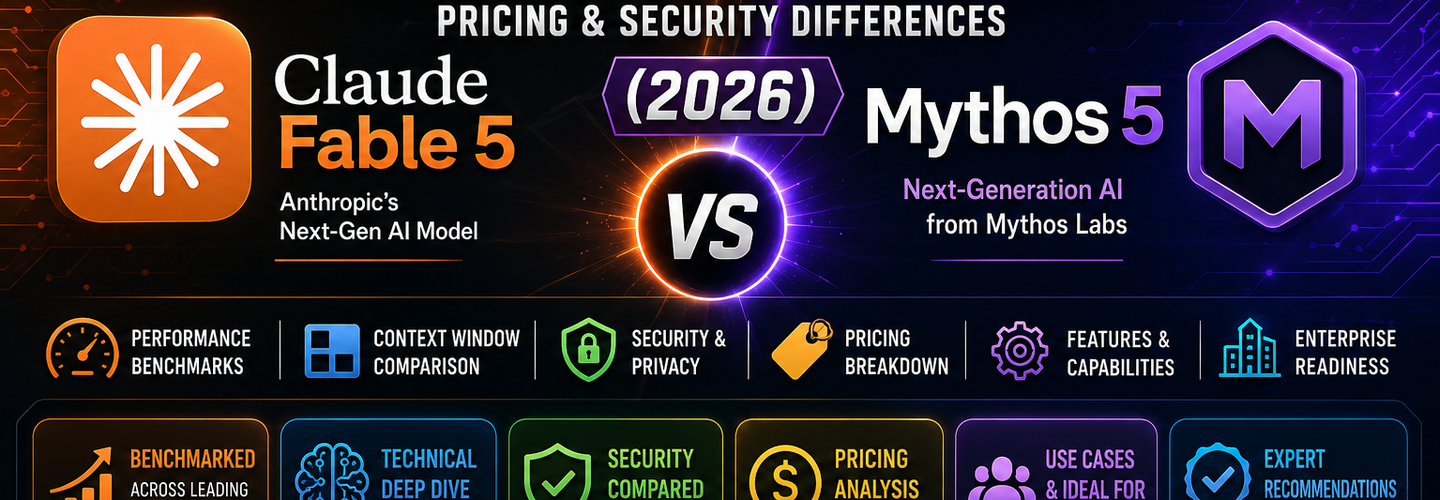
Claude Fable 5 vs Mythos 5: Complete Technical Comparison, Benchmarks, Pricing and Security Differences (2026)
Summarize this blog post with: ChatGPT | Perplexity | Claude | Grok
Anthropic released two models on June 9, 2026, and called them both part of the same family — but they are not the same product, they are not available to the same people, and they are not appropriate for the same use cases. Claude Fable 5 is the most capable AI model Anthropic has ever made publicly available. Claude Mythos 5 is the same underlying model with its most sensitive capabilities unlocked, available exclusively to vetted cybersecurity organizations through a controlled access program. If you are trying to figure out which one matters to you, what the benchmarks actually mean, what the pricing commits you to, and what the safety architecture separating the two models really does — this guide covers everything that has been confirmed as of June 11, 2026.
## Key Takeaways
- ▸Claude Fable 5 and Claude Mythos 5 share identical model weights — the difference between them is entirely in what each model is permitted to do, enforced through safety classifiers that Fable 5 applies and Mythos 5 has lifted in specific high-risk domains.
- ▸Fable 5 is the first publicly available Mythos-class model — released June 9, 2026, available via the Claude API (claude-fable-5), Claude apps, and Amazon Bedrock, and included free for Pro, Max, Team, and Enterprise subscribers through June 22, 2026.
- ▸Mythos 5 is not a general release — it is the upgrade to Claude Mythos Preview within Project Glasswing, available initially only to vetted cyber defenders, infrastructure providers, and select life sciences organizations in collaboration with the US government.
- ▸Both models are priced at $10/$50 per million input/output tokens — exactly double the rate of Claude Opus 4.8, and less than half the price of Claude Mythos Preview (previously $25/$125 per million tokens).
- ▸Fable 5 leads all publicly available models on agentic coding benchmarks: 80.3% on SWE-Bench Pro versus 69.2% for Opus 4.8, 58.6% for GPT-5.5, and 54.2% for Gemini 3.1 Pro.
- ▸Mythos 5's unrestricted cybersecurity capabilities represent a dual-use risk that Anthropic explicitly acknowledged — the model can autonomously construct multi-step exploit chains, which is why access is restricted to Project Glasswing partners working on defensive security for critical infrastructure.
- ▸The safety reroute in Fable 5 triggers in under 5% of sessions on average — queries that exceed the safety threshold fall back to Claude Opus 4.8, with the handoff happening in under seconds and transparently noted to the user.
## What Are Claude Fable 5 and Claude Mythos 5?
Claude Fable 5 and Claude Mythos 5 are Anthropic's fifth-generation frontier models, representing the first public release of what Anthropic internally calls the "Mythos-class" tier — a capability level that exceeds everything Anthropic has previously made generally available, launched simultaneously on June 9, 2026, as two distinct products with different access policies and safety configurations.
The Mythos-class designation signals that these models sit above the Opus line in Anthropic's model hierarchy. Claude Opus 4.8 — released May 2026 — represented the previous capability ceiling for general access. Fable 5 and Mythos 5 exceed it on nearly every evaluated benchmark, with the performance gap widening on longer, more complex, and more autonomous tasks.
Today we're launching Claude Fable 5: a Mythos-class model that we've made safe for general use. Fable 5's capabilities exceed those of any model we've ever made generally available. It is state-of-the-art on nearly all tested benchmarks of AI capability, showing exceptional performance in software engineering, knowledge work, vision, scientific research, and many other areas. The longer and more complex the task, the larger Fable 5's lead over our other models.
The dual-model structure is deliberate and novel. Anthropic has not previously shipped a frontier model as two simultaneous products differentiated by safety configuration rather than by capability. The decision reflects a specific judgment about Fable 5's capabilities: they are powerful enough to cause serious harm in certain domains without safeguards, but restricting the entire model to the access tier appropriate for those domains would deny most users significant legitimate value. Splitting the model into a public version with classifiers and a restricted version without them resolves this tension — at the cost of added architectural complexity and the inherent challenge of ensuring the classifiers actually work as intended.
## The Architecture Difference: What Separates Fable 5 From Mythos 5
The single architectural distinction between Claude Fable 5 and Claude Mythos 5 is a set of safety classifiers that Fable 5 applies before responding to any query — three categories of sensitive topics for which Fable 5 will decline to use its full Mythos-class capabilities and instead route the request to Claude Opus 4.8, which responds in its place.
Fable 5 is the Mythos model with three classifier categories bolted on. When a request trips one of them, Fable 5 declines it. The three classifier categories cover cybersecurity exploitation capabilities, chemical and biological weapon assistance, and a third undisclosed category that Anthropic describes as related to catastrophic-risk domains. Mythos 5 has these classifiers lifted in at least the cybersecurity domain for its authorized partners — allowing the full underlying model capability to be applied to offensive security research, vulnerability discovery, and exploit construction that Fable 5 explicitly blocks.
Without safeguards, Fable 5's capabilities in areas like cybersecurity could be misused to cause serious damage. We've therefore launched the model with safeguards that mean queries on some topics will instead receive a response from our next-most-capable model, Claude Opus 4.8.
The rerouting mechanism is important to understand precisely. When Fable 5 trips a classifier, the user receives a response from Opus 4.8 — not a refusal with no output, but a response from a still-capable model. To release the model both safely and quickly, we've tuned these safeguards conservatively—they'll sometimes catch harmless requests, though they trigger, on average, in less than 5% of sessions. Anthropic acknowledges this false-positive rate as a known limitation of the current conservative classifier tuning, and commits to reducing it as improved safeguards are developed.
For the vast majority of tasks — coding, analysis, writing, reasoning, research, vision tasks — Fable 5 and Mythos 5 are functionally identical. The capability gap between them is narrow but extremely consequential in the specific domains where it exists.
## Benchmark Performance: Where Fable 5 and Mythos 5 Stand
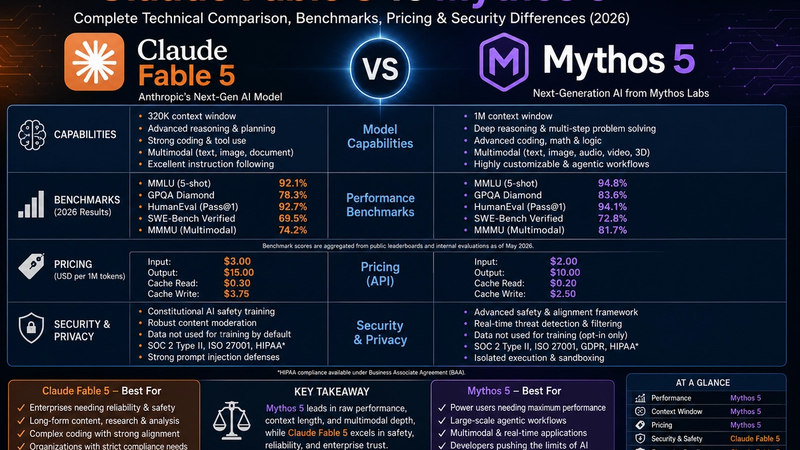
Fable 5 achieves state-of-the-art results on nearly every publicly evaluated benchmark, with the widest performance margins appearing in agentic coding, long-horizon autonomous tasks, and complex knowledge work. Mythos 5 matches or slightly exceeds Fable 5 on specific benchmarks where its unrestricted capabilities apply, while Fable 5 leads on several general-purpose evaluations.
Agentic Coding Benchmarks
On SWE-Bench Pro, a benchmark for solving real software engineering tasks from public GitHub repos without help, Fable 5 hits 80.3 percent. Claude Opus 4.8 lands at 69.2 percent, GPT 5.5 at 58.6 percent, and Gemini 3.1 Pro at 54.2 percent. The 11-point gap over Anthropic's own previous best model is the most meaningful number in the agentic coding comparison — SWE-Bench Pro tests genuine software engineering capability on real-world repositories under conditions that do not allow test-set memorization.
On Cognition's FrontierCode benchmark, which tests demanding coding tasks under production standards, Fable 5 scores 29.3 percent. Claude Opus 4.8 manages 13.4 percent. GPT 5.5 gets just 5.7 percent. FrontierCode is notable because it evaluates token efficiency alongside task completion — models that solve problems with unnecessarily verbose or wasteful reasoning score lower even if they arrive at the correct solution. Fable 5's score more than doubling Opus 4.8 on this benchmark suggests genuine qualitative improvement in how the model approaches complex coding problems, not just in whether it can complete them.
Terminal-Bench 2.1, which evaluates autonomous terminal-based task completion, sees Fable 5 at 88.0% — though this specific score is flagged as a Mythos 5 result in Anthropic's benchmark table, with Fable 5 landing somewhat closer to Opus 4.8 on this evaluation.
Knowledge Work and Reasoning
Knowledge work (GDPval-AA 1932), spatial reasoning, tool use, legal, and health all show the same shape: a clear lead over Opus 4.8 and the broader field. On Hebbia's Finance Benchmark for senior-level reasoning — testing document-based reasoning, chart and table interpretation, and problem solving at the standard expected of financial analysts — Fable 5 has the highest score of any model, with substantial gains in document-based reasoning, chart and table interpretation, and problem solving.
The Legal Agent Benchmark shows Fable 5 at 13.3% against GPT-5.5's 2.1% — a comparison that requires context to interpret correctly. Legal agent benchmarks test whether a model can autonomously execute complex multi-step legal research and analysis tasks, not whether it can answer general legal questions. The absolute percentages are low because the tasks are genuinely difficult; the relative comparison is more meaningful.
Vision Capabilities
Fable 5 is the new state-of-the-art model for tasks involving vision. It can extract precise numbers from detailed scientific figures and can perform complex vision-based tasks like rebuilding a web app's source code from screenshots alone.
The Pokémon FireRed demonstration is illustrative rather than formally benchmarked, but it provides useful qualitative signal about vision-based task execution. Previous Claude models struggled to play Pokémon FireRed even with harnesses that gave them additional helpful tools, but Fable 5 beat FireRed with a minimal, vision-only harness. The reduction in required scaffolding — the model accomplishing with minimal tooling what previous models could not accomplish with extensive tooling — is a reliable signal of genuine capability improvement rather than benchmark optimization.
Cybersecurity-Specific Benchmarks
On ExploitBench — a benchmark specifically evaluating autonomous exploit construction and vulnerability discovery capability — Opus 4.8 scores 40.0%. Fable 5's score on cybersecurity-specific evaluations is not individually disclosed in Anthropic's public benchmark table, as these capabilities are precisely where the classifier boundary between Fable 5 and Mythos 5 applies. Mythos 5's performance on these benchmarks is reserved for Project Glasswing partner communications.
Life Sciences: Where Mythos 5 Differentiates Most
The most striking capability differentiation between Fable 5 and Mythos 5 appears in life sciences research applications — domain where Mythos 5's unrestricted capabilities produce qualitatively different outcomes.
Using Mythos 5, our internal protein design experts accelerated aspects of the drug design process by around ten times. In one example, they found that Mythos 5, with protein design and bioinformatics tools but no human assistance, matches or beats skilled human operators. In doing so, the model executes all of the tasks that are normally completed by a scientist: choosing binding sites, selecting and running protein design tools, and recovering from failures along the way. Nine of the 14 protein targets from this study yielded strong candidates for drug design that we're currently investigating.
Mythos 5 is our first model to consistently produce novel, compelling scientific hypotheses. In blinded head-to-head comparisons against Opus-class models, our scientists preferred Mythos's molecular biology hypotheses ~80% of the time, and have advanced several to experimental evaluation.
These results place Mythos 5 in a qualitatively different category from any previous AI model in life sciences applications — the model is not assisting scientists but conducting research autonomously, with output quality that scientists prefer to equivalent human-generated work in blinded comparisons.
## Pricing: What Fable 5 and Mythos 5 Actually Cost
Both Fable 5 and Mythos 5 are priced at $10 per million input tokens and $50 per million output tokens — exactly double the rate of Claude Opus 4.8 ($5/$25 per million tokens), and a significant reduction from the price of Claude Mythos Preview, which was available to Project Glasswing partners at approximately $25/$125 per million tokens — Source: Multiple industry sources, June 2026.
The pricing positions Fable 5 as a premium-tier model in a market where the cost-per-capability ratio is a genuine purchasing consideration. The $10/$50 rate is not the highest in the market — Mythos Preview at $25/$125 held that position — but it represents a meaningful commitment for high-volume production workloads. For developers evaluating whether the capability jump from Opus 4.8 justifies the 2× price increase, the benchmark comparison on their specific use case is the right starting point rather than general benchmark averages.
For subscription users, Anthropic made Fable 5 available on Claude Pro, Max, Team, and seat-based Enterprise plans at no extra cost from June 9 through June 22, 2026. After June 22, continued Fable 5 usage requires usage credits that bill at standard API rates once plan limits are exhausted. The free tier on claude.ai does not include Fable 5.
Claude Mythos 5 pricing for Project Glasswing partners is not independently confirmed as identical to Fable 5's public API rate, as Glasswing partners receive usage credits as part of the program. Anthropic's $100 million in usage credits to the program suggests that partner organizations are not paying the standard API rate for Mythos 5 access during the Glasswing program period.
## Availability: Who Can Access Each Model
Fable 5 and Mythos 5 have fundamentally different access models — Fable 5 is broadly available to any individual or organization with an Anthropic account, while Mythos 5 access is controlled, vetted, and not open to general application.
Claude Fable 5 Access
Fable 5 is available through four channels as of June 9, 2026. The API, using the model string claude-fable-5, is available to any developer with an Anthropic API account. The Claude web and desktop applications include Fable 5 as a selectable model. Amazon Bedrock provides Fable 5 for enterprise deployments in AWS environments. Claude Code — Anthropic's agentic coding tool — supports Fable 5 via the model picker and the --model claude-fable-5 CLI flag.
Anthropic says those refusals fall back to Opus 4.8 and happen in under 5% of sessions, so more than 95% of typical user interactions with Fable 5 will never encounter the safety classifier boundary. For developers building non-cybersecurity, non-CBRN applications, the classifier architecture is largely transparent in normal operation.
Claude Mythos 5 Access
For a small group of cyberdefenders and infrastructure providers, we're also launching Claude Mythos 5. It's the same underlying model as Fable 5, but with the safeguards lifted in some areas. Mythos 5 will initially be deployed through Project Glasswing, in collaboration with the US government, as an upgrade to Claude Mythos Preview. It has the strongest cybersecurity capabilities of any model in the world. Soon, we intend to expand access to Mythos 5 through a broader trusted access program.
Project Glasswing's current partner roster is substantial. The program bundles a restricted frontier model called Claude Mythos Preview with up to $100 million in usage credits, $4 million in donations to open-source security groups, and a partner roster that now includes more than 45 organizations — among them AWS, Apple, Broadcom, Cisco, CrowdStrike, Google, JPMorganChase, the Linux Foundation, Microsoft, NVIDIA, and Palo Alto Networks.
Access is limited to Glasswing partners and roughly 40 additional organizations through a Cyber Verification Program. Anthropic will not release Mythos Preview more broadly until new safeguards are established. The Cyber Verification Program provides a pathway for vetted cybersecurity organizations outside the initial Glasswing partner roster to apply for Mythos access, though the vetting criteria and timeline are not publicly specified.
For the vast majority of security researchers, developers, and organizations — including those using ReconShield for passive OSINT and infrastructure security intelligence — Fable 5 is the accessible model, and Mythos 5 is not currently available through any public application process.
## The Cybersecurity Capability Gap: What Mythos 5 Can Do That Fable 5 Cannot
The specific capability Mythos 5 has that Fable 5 blocks is autonomous multi-step exploit chain construction — the ability to not merely discover vulnerabilities but to autonomously build working end-to-end exploits without human direction. This is the capability that prompted Anthropic to control Mythos access through Project Glasswing rather than general release.
Single-bug vulnerability detection is now commoditized. What the new systems do differently is autonomous multi-step exploit chain construction at scale — building working end-to-end exploits without human direction. Mythos restricts that capability to Glasswing partners.
Project Glasswing partners will receive access to Claude Mythos Preview to find and fix vulnerabilities or weaknesses in their foundational systems — systems that represent a very large portion of the world's shared cyberattack surface. Within weeks of Mythos Preview deployment, Mythos identified thousands of high-severity vulnerabilities, including some in every major operating system and web browser.
The defensive framing is that Mythos 5's capabilities, deployed exclusively through vetted organizations working on their own infrastructure, will find and fix vulnerabilities faster than they would otherwise be discovered through conventional security research — before those vulnerabilities are found and exploited by adversaries. In the long run, it is possible that advanced software security tools could tip the balance in favour of defence.
The concern, acknowledged by multiple independent researchers, is that the capability advantage is temporary. Given the rate of AI progress, it will not be long before such capabilities proliferate, potentially beyond actors who are committed to deploying them safely. The Project Glasswing model attempts to maximize defensive use of these capabilities during the window before they become broadly accessible — a window that Anthropic itself describes as limited.
An important counterpoint comes from independent verification work. On June 8, 2026, Glasswing launch partner Cisco ran six frontier models across 1.8 billion lines of code and showed results do not depend on Mythos. Researchers including Niels Provos demonstrated that discovery is an orchestration problem rather than a frontier-model one — meaning the vulnerability discovery capability, at least, may be replicable with smaller, publicly available models in well-designed harnesses. The exploit construction capability at the most sophisticated end of Mythos 5's range remains the genuinely novel element.
## Real-World Performance: What Organizations Are Reporting
Enterprise organizations that participated in Fable 5 early testing reported capability improvements that go well beyond incremental performance gains over Opus 4.8.
During early testing, Stripe reported that Fable 5 compressed months of engineering into days. In a 50-million-line Ruby codebase, the model performed a codebase-wide migration in a day that would otherwise have taken a whole team over two months by hand. A two-month team effort completed in one day is not a benchmark improvement — it is a qualitative change in what AI-assisted engineering is capable of.
IMC noted that Fable 5 aced their trading-analysis evaluations nearly across the board, including factual lookup, conceptual reasoning, root-cause analysis, and expected-value analysis.
The memory and long-context improvement is quantified through the Slay the Spire game-playing experiment — a proxy for long-horizon task execution with persistent state management. When we had the model play the deck-building game Slay the Spire, giving it access to persistent file-based memory improved its performance three times more than for Opus 4.8; Fable also reached the game's final act three times more often. Three times more benefit from the same memory tooling, and three times more frequently completing long autonomous tasks — this suggests the model's ability to reason coherently over extended autonomous work periods is materially stronger than its predecessor.
## Security Implications for Defenders
For security practitioners, the Fable 5 and Mythos 5 release has two distinct implications: what Fable 5 enables for defensive security work, and what the Mythos 5 architecture represents for the broader threat landscape.
Fable 5's capabilities — available to any security professional through the standard API — represent a meaningful capability improvement for defensive security workflows that do not require the unrestricted exploitation capabilities of Mythos 5. Code review and vulnerability assessment, threat modeling, security documentation, log analysis, and incident response investigation are all areas where Fable 5's improved long-horizon reasoning and coding ability translate directly to faster, more thorough security work.
For the passive OSINT and infrastructure intelligence workflows that ReconShield supports — DNS security analysis, WHOIS investigation, IP reputation assessment, SSL/TLS configuration auditing, and web application security posture evaluation — Fable 5's improved analytical capabilities are directly applicable. The model can analyze passive reconnaissance findings across multiple data sources simultaneously with greater coherence and accuracy than previous models.
The broader threat landscape implication is the one that demands attention. The capabilities that Mythos 5 makes available to vetted defenders will eventually become available more broadly — either through competing models reaching equivalent capability, through leakage from restricted programs, or through Anthropic's own planned expansion of the trusted access program. A 2025 report found that, on average, over 45% of discovered security vulnerabilities in large organisations remain unpatched after 12 months. In a world where AI models can autonomously construct working exploits for known vulnerabilities, that patch gap becomes dramatically more dangerous.
The passive reconnaissance capability that enables rapid attack surface discovery — the foundation of what ReconShield provides — becomes more important, not less, as exploit automation improves. Organizations that know exactly what they are exposing to the internet are in a materially better defensive position than those relying on periodic manual assessments. The ReconShield passive scanner suite provides the continuous external visibility layer that helps security teams understand their current exposure profile before automated exploit tools can leverage it. Audit your DNS configuration using the DNS Security Analysis tool, check exposed services using the Port Scanner, and verify your IP reputation with the IP Reputation tool as baseline defensive measures in this new threat environment.
## Fable 5 vs Mythos 5: Which One Applies to You
The practical decision between Fable 5 and Mythos 5 is not actually a choice for most users — Mythos 5 is not available through any public application process as of June 11, 2026, and the overwhelming majority of use cases that benefit from Mythos-class capability are served by Fable 5.
Fable 5 is the right model for: agentic software engineering workflows where the 11-point SWE-Bench Pro improvement over Opus 4.8 translates to tangible task completion gains; long-horizon autonomous tasks where the model's improved memory utilization and multi-step coherence reduce errors over extended operations; knowledge work requiring complex document-based reasoning across large context windows; vision-based tasks that previous Claude models required extensive tooling scaffolding to approach; and any workload where paying 2× the Opus 4.8 API rate is justified by the benchmark evidence for the specific task type.
Fable 5 is not the right model for: routine, cost-sensitive, or latency-sensitive tasks where Opus 4.8 performs adequately at half the price; workloads where the 5% classifier trigger rate would cause unacceptable workflow disruption; and any task requiring Mythos 5's unrestricted cybersecurity exploitation capabilities, which are not available through Fable 5 at any price.
Mythos 5 applies to: vetted cybersecurity researchers and organizations within the Project Glasswing program or the Cyber Verification Program performing authorized vulnerability research on critical infrastructure; life sciences organizations that Anthropic plans to extend Mythos 5 access to for drug design and genomics research applications; and future applicants to the expanded trusted access program Anthropic has committed to developing.
For the vast majority of security professionals, developers, and enterprises reading this — Fable 5 is what you have access to, and based on the benchmark data and real-world performance reports, it is a genuinely significant capability improvement over Opus 4.8 for the use cases where that improvement matters.
## What's Next for Fable 5 and Mythos 5
With more capable models arriving in the coming months, we're working to improve our safeguards and reduce false positives as quickly as we can. Anthropic's roadmap for the Fable/Mythos architecture involves progressive improvement of the safety classifiers — reducing the 5% average false-positive rate — and expansion of the Mythos trusted access program beyond the current Glasswing and Cyber Verification Program participants.
The pricing trajectory is also notable. Fable 5 and Mythos 5 are being offered at $10 per million input tokens and $50 per million output tokens — less than half the price of Claude Mythos Preview. The halving of price relative to Mythos Preview, simultaneous with a capability improvement, follows the consistent trajectory of frontier model pricing and suggests that the $10/$50 rate is unlikely to be the long-term price floor for Mythos-class capability.
For organizations building security workflows, the most relevant forward-looking consideration is the planned expansion of Mythos 5 access. Anthropic has committed to a broader trusted access program for cybersecurity organizations — the criteria, timeline, and application process are not yet specified, but represent the pathway for vetted security teams to access Mythos 5's unrestricted defensive security capabilities outside the current Glasswing partner roster.
## Conclusion
Claude Fable 5 and Claude Mythos 5 are the same model split into two products by a deliberate safety architecture decision — one publicly available with classifiers, one restricted to vetted partners without them. The benchmark data confirms that Fable 5 represents a genuine capability step above Opus 4.8, particularly on agentic coding, long-horizon autonomous tasks, and knowledge work. The $10/$50 pricing commits you to double the Opus 4.8 rate for that capability.
For security practitioners, the most important takeaway is not the benchmark numbers — it is what the Mythos architecture signals about the direction of AI-enabled security offense and defense. Models that can autonomously discover vulnerabilities and construct exploits are either already in vetted defenders' hands or will be shortly. The patch gap, the exposed service inventory gap, and the DNS misconfiguration gap that passive intelligence tools surface are exactly what those models will target.
Run the ReconShield passive scanner suite across your internet-facing infrastructure right now. Know what you are exposing before the automated tools that are coming — and in some organizations' hands, already here — enumerate it for you. Check your DNS records with the DNS Security Analysis tool, audit exposed ports with the Port Scanner, verify IP reputation with the IP Reputation tool, and confirm your TLS configuration with the SSL/TLS Checker.
The best use of Fable 5's capabilities in a security context is already available to you. The question is whether you are using them on your own infrastructure before someone else does.
Written by Surendra Reddy Cybersecurity Researcher & Founder, ReconShield. Surendra specializes in OSINT, exposure intelligence, and AI-driven threat analysis. Author Profile →
Reviewed by ReconShield Editorial Team — Peer-reviewed for technical accuracy against Anthropic's official June 9, 2026 announcement, the Anthropic Fable 5 and Mythos 5 system card, Project Glasswing official documentation, and verified third-party benchmark sources.
## Analyst Commentary & Implementation Blueprint
Security advisory
Continuous security exposure assessment is critical to identifying public vulnerabilities before they are exploited. Organizations should maintain a passive inventory of all web servers, TLS configs, and open ports, ensuring that default configurations are eliminated and security advisories are actively implemented.
Hardened Security Configuration Blueprint
# General Security Hardening Directive
ServerTokens ProductOnly
ServerSignature Off
FileETag None
Actionable Mitigation Checklist
- ✔Perform passive asset inventories weekly.
- ✔Restrict administrative ports using local firewall controls.
- ✔Monitor active CVE alerts for exposed software.
Common Inquiries & FAQs
Why is passive scanning preferred for continuous auditing?
Passive audits do not cause operational impact or trigger firewall blocks, making them ideal for constant surveillance of internet-facing assets.
What should I do if a vulnerability is flagged?
Apply the latest vendor patches, restrict access to the resource via firewalls, or verify configuration flags to mitigate risks.
Surendra Reddy
Surendra Reddy is a cybersecurity researcher and founder of ReconShield, specializing in OSINT and defensive infrastructure analysis.
Connect on LinkedIn ↗// AUDIT BRIEFING DISCUSSION (2 COMMENTS)
Great breakdown of the passive infrastructure vectors. We recently audited our external DNS zones and found multiple dangling staging environments. Implementing wildcard certificates reduced our CT log leaks significantly.
Is there any automated tooling you recommend for daily crt.sh scraping? Manually checking CT logs is becoming unsustainable for our domain portfolio.
// MORE ARTICLES
AI Meets Penetration Testing: PentestCode Launches with 18 Specialized Security Agents
PentestCode launches with 18 integrated security tools and a 13-agent AI architecture that automates full penetration testing workflows.

AI Goes to War: Chinese Hackers Exploit Claude Code and DeepSeek in Government Attacks
Suspected Chinese hackers used Claude Code and DeepSeek in a split-model workflow to breach government systems. Here's what happened.

Best AI Cybersecurity Stocks to Buy as Cybercrime Surges in 2026
AI cybersecurity stocks are surging as cybercrime accelerates in 2026. Explore the sector's key players, growth drivers, and risks to weigh.