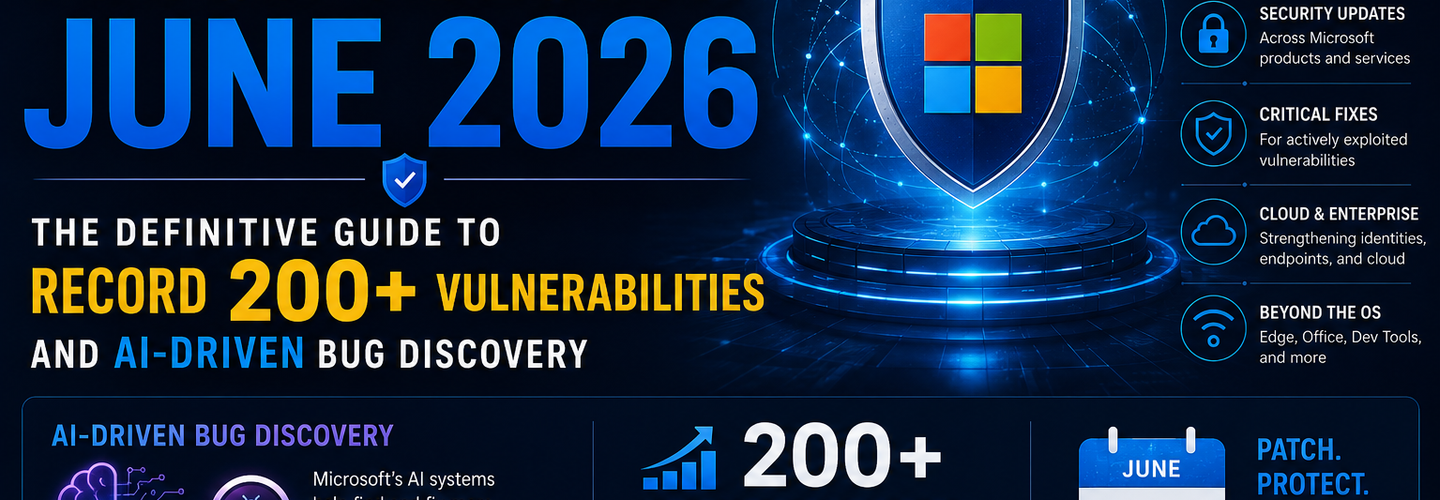
Microsoft Patch Tuesday June 2026: The Definitive Guide to Record 200+ Vulnerabilities and AI-Driven Bug Discovery
Security teams are accustomed to Microsoft's monthly Patch Tuesday updates, but a release containing more than 200 vulnerability fixes signals a rapidly changing threat landscape. What many organizations may not realize is that artificial intelligence is becoming one of the biggest forces driving vulnerability discovery — and June 2026’s update is proof. In this guide, you'll learn what these patches mean, how AI is transforming security research at an unprecedented scale, and what organizations should do next to stay protected.
## Key Takeaways
- ▸Microsoft’s June 2026 Patch Tuesday fixed a record 206 vulnerabilities, surpassing the previous record of 175 CVEs set in October 2025.
- ▸Artificial intelligence is accelerating vulnerability discovery, with Microsoft’s own MDASH system orchestrating over 100 AI agents to find 16 previously unknown Windows flaws.
- ▸Remote Code Execution and Privilege Escalation vulnerabilities remain the most dangerous enterprise security risks, with 38 critical flaws patched in this release.
- ▸AI-assisted security research has already led to the current number of CVEs shipped by Microsoft in 2026 exceeding the total for all of 2018.
- ▸The update includes three publicly disclosed zero-day vulnerabilities, including CVE-2026-49160 discovered with the help of OpenAI’s Codex agent.
- ▸Effective patch management requires moving beyond CVSS-only thinking to prioritize based on exploitability and business impact.
- ▸Organizations should implement continuous vulnerability assessment and automate patching pipelines to keep pace with the accelerating discovery cycle.
## What Is Microsoft’s Record-Breaking 200+ Vulnerability Patch Release?
Microsoft Patch Tuesday is the company’s monthly security update program that delivers fixes for vulnerabilities across Windows, Microsoft Office, Azure, and other Microsoft products.【Provided input】 The June 2026 Patch Tuesday release broke all previous records. According to Microsoft’s security update guide, the company addressed 206 unique CVEs in this single release — far surpassing the previous record of 175 vulnerabilities patched in October 2025.
The breakdown of these 206 vulnerabilities is telling. The update includes 38 critical-severity vulnerabilities, with the remainder rated as important. Among these critical flaws, five carry CVSS scores of 9.0 or higher on the 10-point scale. Dustin Childs, Head of Threat Awareness at Trend Micro’s Zero Day Initiative, noted: “I’ve been counting CVEs on Patch Tuesday since 2017, and this is by far the largest monthly release in that time.”
This isn’t an isolated spike. Nirwan Dogra, a Senior Software Engineer at Microsoft Security, confirmed that “The 200+ CVE count isn’t an anomaly. It’s the new baseline.”
## Why Does Microsoft’s 200+ Vulnerability Patch Matter?
The sheer volume of this security update has profound implications for enterprise security posture and operational readiness. Microsoft itself acknowledged that automation and AI-driven workflows are permanently altering the threat landscape, stating: “Automation tooling has matured. Researcher participation in our coordinated disclosure programs has broadened. Microsoft engineers and the wider security community alike are increasingly using AI to examine software more carefully and more often than was practical even a few years ago.”
From a risk perspective, the stakes are exceptionally high. Three vulnerabilities were publicly disclosed prior to Patch Tuesday, meaning attackers had advance knowledge of these flaws. Two of these zero-days stem from a highly publicized conflict with a researcher operating under the moniker “Nightmare Eclipse,” who published proof-of-concept code within hours of the release. Additionally, attackers were already actively exploiting two vulnerabilities before Microsoft shipped the patches — one in Exchange Server’s Outlook Web Access component and another privilege escalation flaw in Microsoft Defender.
This matters because every unpatched vulnerability represents a potential entry point for attackers. The window between disclosure and exploitation is shrinking rapidly. For more on how threat actors are evolving their techniques, check out our cyber threat intelligence resources for the latest reconnaissance patterns.
## What Types of Security Flaws Were Fixed in Microsoft’s Latest Update?
The June 2026 Patch Tuesday vulnerabilities span multiple categories, but certain types dominate the release. According to security researchers analyzing the update, the breakdown includes a significant concentration of Remote Code Execution (RCE) and Privilege Escalation (EoP) vulnerabilities.
Remote Code Execution (RCE): RCE vulnerabilities allow attackers to execute arbitrary code on a target system without authorized access.【Provided input】 In this release, 28 of the critical flaws are remote code execution bugs, meaning attackers could theoretically take complete control of an unpatched machine without any user interaction. Two near-maximum severity RCE flaws — CVE-2026-47291 in Windows HTTP.sys and CVE-2026-44815 in the Windows DHCP Client service — both carry CVSS scores of 9.8. Amol Sarwate, head of security research at Cohesity, warned: “CVE-2026-47291 should be of top priority because it allows unauthenticated attackers to remotely achieve full compromise without any user interaction, making it potentially wormable.”
Privilege Escalation: Privilege Escalation vulnerabilities enable attackers to gain higher levels of access than originally intended within a system.【Provided input】 One of the most concerning examples is CVE-2026-45586, an EoP bug in the Windows Collaborative Translation Framework (CTFMON) that allows attackers to gain SYSTEM-level privileges. This flaw was publicly disclosed by researcher “Nightmare Eclipse” under the name “GreenPlasma” prior to patching.
Denial-of-Service and Information Disclosure: CVE-2026-49160 is a denial-of-service flaw in HTTP.sys tied to an attack technique dubbed “HTTP/2 Bomb.” Microsoft credited this bug to OpenAI Group PBC’s Codex — one of the first publicly attributed cases of an AI system reporting a vulnerability in a major Patch Tuesday cycle. The update also includes 30 information disclosure vulnerabilities and 27 spoofing flaws.
Zero-Day Vulnerabilities: Three zero-day vulnerabilities were publicly disclosed before patches were available. Beyond CVE-2026-45586, CVE-2026-50507 enables bypass of Microsoft’s BitLocker security feature, allowing attackers with physical access to gain access to encrypted data. For organizations concerned about exposed attack surfaces, our attack surface management guide offers practical mitigation strategies.
## Which Vulnerabilities Pose the Highest Risk to Organizations?
Not all vulnerabilities are created equal. Security teams must prioritize based on exploitability and business impact rather than treating every CVE with equal urgency. According to Gartner, fewer than 10% of vulnerabilities are actually exploited in the wild, yet most are treated as urgent — leading to prioritization paralysis.
The highest-risk vulnerabilities in this release include:
Wormable RCE flaws: CVE-2026-45657 is a use-after-free flaw in the Windows kernel’s TCP/IP stack that scored 9.8 on the CVSS scale. An attacker needs no credentials and no user interaction to exploit it. Microsoft says the bug is wormable on some networks.
Publicly exploited flaws: Two vulnerabilities were actively exploited before patching. CVE-2026-42897 hits Exchange Server’s Outlook Web Access, and CISA added it to its Known Exploited Vulnerabilities catalog in May. CVE-2026-41091 let attackers escalate privileges through Microsoft Defender, which Microsoft patched with an emergency fix in May before the formal June update.
Pre-disclosed zero-days: Three vulnerabilities were publicly known before Patch Tuesday. Organizations should prioritize these immediately because attackers have already had time to develop exploits. For a deeper understanding of the most dangerous vulnerability categories, review our OWASP Top 10 vulnerabilities guide.
## How Is Artificial Intelligence Transforming Vulnerability Discovery?
AI-assisted vulnerability discovery uses machine learning and automated analysis techniques to identify software flaws faster than traditional manual methods.【Provided input】 Microsoft has embraced this transformation aggressively. The company unveiled MDASH (multi-model agentic scanning harness), an AI-powered vulnerability discovery platform that orchestrates more than 100 specialized AI agents across multiple models.
In its first run on Windows, MDASH identified 16 previously unknown vulnerabilities, including four critical remote code execution flaws in components such as the Windows kernel TCP/IP stack and the IKEv2 key management protocol. Microsoft credited the system with helping researchers find issues that would have taken months to identify manually.
AI’s impact extends beyond Microsoft’s internal efforts. In March 2026, XBOW — a fully autonomous AI penetration testing agent — discovered CVE-2026-21536, a CVSS 9.8 remote code execution vulnerability in a Microsoft cloud service. This marked the first widely recognized instance of an autonomous AI agent discovering a critical vulnerability in a major production system.
Tom Gallagher, VP of engineering at Microsoft Security Response Center, wrote that AI is accelerating “the scale and speed of vulnerability discovery.” To see how AI is being used in security assessments, explore our penetration testing methodology for a comprehensive framework.
## Why Are Security Researchers Finding More Vulnerabilities Than Ever Before?
The acceleration in vulnerability discovery stems from several converging factors, with AI serving as the primary catalyst. Microsoft’s security leadership acknowledged that AI tools are driving a surge in vulnerability discovery across the industry.
First, AI-powered code analysis tools allow researchers to audit codebases at unprecedented scale. Traditional manual code review might examine thousands of lines of code per day. AI tools can analyze millions of lines in the same timeframe. Second, automated fuzzing and static analysis techniques have matured significantly. Third, the security research community has expanded its use of AI-assisted workflows, from variant hunting to exploit development.
The results are measurable. Dustin Childs noted that “the current number of CVEs shipped by Microsoft this year exceeds the total number of CVEs shipped in all of 2018.” In fact, Microsoft has already shipped more CVEs in the first half of 2026 than in all of 2018.
This acceleration affects the entire vulnerability disclosure ecosystem. HackerOne, the largest bug bounty platform, reports a 76% jump in submissions year-over-year through March 2026. However, the share of submissions flagging genuine vulnerabilities remains steady at 25% — meaning security teams must sift through significantly more noise to find real issues.
## What Are the Benefits and Limitations of AI-Assisted Bug Discovery?
AI-assisted bug discovery offers substantial benefits but also introduces meaningful limitations that security professionals must understand.
Benefits: AI dramatically increases the speed and scale of vulnerability discovery. MDASH scored an 88.45% success rate on the public CyberGym benchmark of 1,507 real-world vulnerability reproduction tasks, roughly five points ahead of the next entry on the leaderboard. AI tools can also find vulnerabilities in components previously considered too complex for manual audit, such as hypervisor code and Kerberos. Additionally, AI agents can work continuously, running 24/7 scans that human researchers cannot match.
Limitations: AI bug hunting comes with significant challenges. Bug bounty programs report a surge in low-quality, AI-generated submissions that waste analyst time. HackerOne found that while submissions jumped 76%, genuine flaw reports remained at the same level (25%). There are also concerns about AI-discovered vulnerabilities being weaponized before patches are available — what security experts call the “disclosure dilemma.” As Daniel Stenberg, curl’s maintainer, noted, maintainer capacity may not keep pace with the flood of valid reports, and bad actors can use the same AI tools to find vulnerabilities before patches are deployed.
## Can AI Improve Vulnerability Management and Patch Prioritization?
Yes, AI can significantly improve vulnerability management and patch prioritization when implemented correctly. Traditional vulnerability management relies heavily on CVSS scores, which measure severity but not exploitability or business impact. Gartner predicts that by 2026, organizations prioritizing their security investments based on a continuous exposure management program will be three times less likely to suffer from a breach.
AI-powered vulnerability management solutions analyze multiple data sources to prioritize patches based on:
- ▸Active exploitation in the wild
- ▸Asset criticality to business operations
- ▸Exploit availability and sophistication
- ▸Attack path relevance to your specific environment
For organizations struggling with the volume of patches, Nirwan Dogra from Microsoft Security recommends moving toward risk-based vulnerability prioritization, automated patching pipelines, and focusing on flaws likely to be exploited. Tools like the vulnerability scanner tools available through ReconShield’s passive diagnostics suite can help organizations identify exposed assets and prioritize remediation based on actual risk rather than theoretical severity.
## How Should Organizations Respond to Large-Scale Security Updates?
Given the record-breaking volume of the June 2026 Patch Tuesday, organizations need a systematic response strategy. Security experts emphasize several immediate actions.
First, prioritize critical and actively exploited vulnerabilities. Start with the wormable RCE flaws (CVE-2026-45657, CVE-2026-47291, CVE-2026-44815) and the two actively exploited flaws (CVE-2026-42897, CVE-2026-41091). Systems facing the internet should be patched first, followed by identity infrastructure, privilege escalation paths, and endpoints.
Second, adopt a risk-based patching cadence. Not every vulnerability needs to be patched immediately. Dustin Childs advises sysadmins to adjust processes for prioritization and patch deployment based on the new volume of updates. Aim to patch critical vulnerabilities affecting internet-facing systems within 48 hours, but prioritize based on actual exploitability rather than CVSS scores alone.
Third, automate where possible. Manual patch management cannot scale to keep pace with 200+ monthly vulnerabilities. Implement automated patching pipelines for non-critical systems and use continuous vulnerability assessment tools to maintain visibility. For organizations concerned about exposed subdomains and hidden assets, our subdomain enumeration techniques guide can help identify previously unknown attack surfaces.
Fourth, implement continuous monitoring. Patch Tuesday is not a once-a-month event. Microsoft has indicated that out-of-band updates will become more common. Security teams need real-time visibility into their attack surface to respond to emerging threats between monthly patch cycles.
## What Does the Future of AI-Powered Cybersecurity Look Like?
The future of AI-powered cybersecurity is rapidly taking shape, with several clear trends emerging from Microsoft’s June 2026 release and industry developments.
Automated vulnerability research will become standard. Microsoft has already integrated MDASH findings directly into the Microsoft Defender Portal, creating a feedback loop where AI-discovered vulnerabilities inform defensive protections. Expect this pattern to accelerate as more organizations deploy AI-powered security testing internally.
Patch Tuesday volumes will continue growing. Microsoft has warned customers to expect larger Patch Tuesdays in the future. The company stated: “We expect releases to continue trending larger for some time.” Organizations should build this expectation into their security operations planning.
AI-powered defense systems will emerge. The same AI techniques that discover vulnerabilities can be used to develop AI-powered defense systems that predict attacks before they occur. However, this also introduces new risks. Gartner recently warned about AI application compromise, prompt injection, and software supply chain vulnerabilities as emerging threats that hackers will exploit.
The role of security researchers will evolve. Rather than being replaced, human researchers will increasingly work alongside AI agents. MDASH, for example, orchestrates over 100 specialized AI agents but still requires human validation and interpretation. The most effective security teams will be those that learn to leverage AI tools effectively.
## Tools and Best Practices for Vulnerability Management
Effective vulnerability management involves identifying, prioritizing, patching, and continuously monitoring security weaknesses across an organization’s technology environment.【Provided input】 The following practices and tools are essential for keeping pace with today’s accelerated discovery cycle.
Implement continuous vulnerability scanning. Traditional quarterly or monthly scans are no longer sufficient. ReconShield’s passive diagnostics suite provides non-intrusive security assessments across six core parameters: email authentication audit, SSL/TLS diagnostics, HTTP security headers, infrastructure exposure, DNS intelligence, and threat intelligence scanning.
Use threat intelligence to inform prioritization. Not all vulnerabilities carry the same risk. Our threat intelligence platform correlates vulnerability data with active exploitation patterns to help teams focus on the most urgent issues.
Conduct regular exposure assessments. Identify shadow IT, forgotten staging endpoints, and exposed administrative ports before attackers find them. The WHOIS lookup investigation tool can help verify domain ownership and detect potential domain hijacking attempts.
Maintain a continuous assessment practice. Security is not a one-time event. Continuous exposure management — including regular DNS audits, SSL/TLS verification, and email security configuration checks — reduces breach risk significantly. Organizations with mature vulnerability management programs are consistently better positioned to respond to record-breaking patch cycles like Microsoft’s June 2026 update.
## Conclusion
Microsoft’s June 2026 Patch Tuesday represents a watershed moment in cybersecurity. The record-breaking 206 vulnerabilities patched in a single release signal a permanent shift driven by artificial intelligence. AI-assisted bug discovery is accelerating the pace of vulnerability identification, compressing the timeline between a bug’s existence and its discovery. For security teams, this means adapting to a new normal of larger, more frequent patch updates.
The most dangerous vulnerabilities in this release — including wormable RCE flaws, actively exploited zero-days, and pre-disclosed privilege escalation bugs — demand immediate attention. Organizations that prioritize effectively, automate where possible, and maintain continuous visibility into their attack surfaces will weather this storm. Those that rely on outdated, manual processes will struggle.
The increasing use of artificial intelligence in cybersecurity is accelerating both vulnerability discovery and defensive security research.【Provided input】 The question is no longer whether AI will transform cybersecurity — the transformation is already here. The question is whether your organization is prepared to keep pace.
Stay informed about emerging threats and critical patches by following the latest cybersecurity news from ReconShield’s research division.
Written by Surendra Reddy, Cybersecurity Researcher & Founder, ReconShield. Surendra is an information security engineer specializing in OSINT methodology, internet telemetry mapping, and cryptographic domain security.
Reviewed by ReconShield Threat Research Team
## Analyst Commentary & Implementation Blueprint
Security advisory
Continuous security exposure assessment is critical to identifying public vulnerabilities before they are exploited. Organizations should maintain a passive inventory of all web servers, TLS configs, and open ports, ensuring that default configurations are eliminated and security advisories are actively implemented.
Hardened Security Configuration Blueprint
# General Security Hardening Directive
ServerTokens ProductOnly
ServerSignature Off
FileETag None
Actionable Mitigation Checklist
- ✔Perform passive asset inventories weekly.
- ✔Restrict administrative ports using local firewall controls.
- ✔Monitor active CVE alerts for exposed software.
Common Inquiries & FAQs
Why is passive scanning preferred for continuous auditing?
Passive audits do not cause operational impact or trigger firewall blocks, making them ideal for constant surveillance of internet-facing assets.
What should I do if a vulnerability is flagged?
Apply the latest vendor patches, restrict access to the resource via firewalls, or verify configuration flags to mitigate risks.
Surendra Reddy
Surendra Reddy is a cybersecurity researcher and founder of ReconShield, specializing in OSINT and defensive infrastructure analysis.
Connect on LinkedIn ↗// AUDIT BRIEFING DISCUSSION (2 COMMENTS)
Great breakdown of the passive infrastructure vectors. We recently audited our external DNS zones and found multiple dangling staging environments. Implementing wildcard certificates reduced our CT log leaks significantly.
Is there any automated tooling you recommend for daily crt.sh scraping? Manually checking CT logs is becoming unsustainable for our domain portfolio.
// MORE ARTICLES

Security Researchers Warn Critical n8n Flaws May Expose Automation Platforms to RCE
Researchers have disclosed critical vulnerabilities in n8n that could expose automation workflows and connected enterprise systems to remote code execution risks, prompting urgent patch recommendations for users and administrators.

How Agentic AI Is Changing Software Engineering and Expanding Mobile Attack Surfaces
Agentic AI is rapidly transforming software engineering workflows through automation and intelligent coding assistance, while cybersecurity experts warn of expanding mobile attack surfaces and emerging application security risks.
Microsoft Defender Zero-Day Patched: What IT Teams Need to Know
Microsoft patches RoguePlanet, a Defender zero-day (CVE-2026-50656) letting attackers gain SYSTEM access. Here's what IT teams need to know.