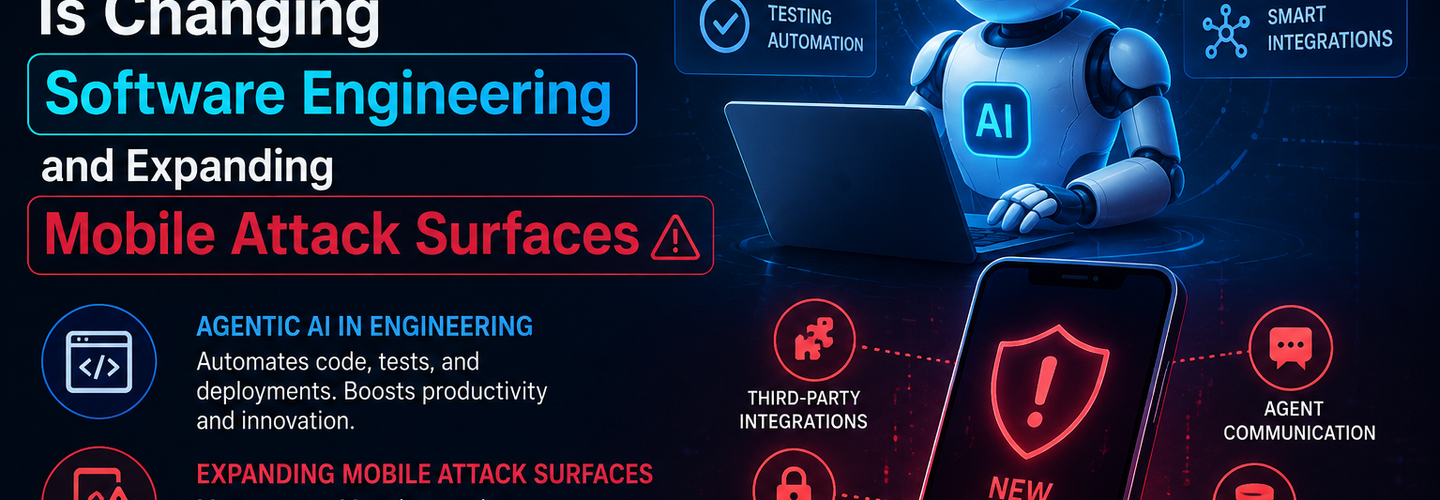
How Agentic AI Is Changing Software Engineering and Expanding Mobile Attack Surfaces
The software industry is entering a new development era shaped by autonomous artificial intelligence systems capable of planning, coding, debugging, testing, and deploying applications with limited human intervention. Often referred to as “agentic AI,” these systems are rapidly changing how software is built across enterprises, startups, and cloud-native development teams.
Technology firms are increasingly integrating AI agents into engineering pipelines to accelerate release cycles, automate repetitive coding tasks, and reduce operational overhead. Large language model (LLM)-driven coding assistants are no longer limited to generating snippets of code. Modern AI agents can now manage workflows, interact with APIs, conduct dependency analysis, review pull requests, and coordinate multi-step development operations.
While the productivity benefits are substantial, cybersecurity experts warn that the same automation capabilities are also creating new risks—particularly in the mobile application ecosystem, where software supply chains, third-party SDKs, and rapid deployment practices already present significant security challenges.
Security researchers and industry analysts say the rise of agentic AI could unintentionally widen mobile attack surfaces if organizations fail to establish robust governance, validation controls, and secure development practices around AI-assisted engineering.
## The Shift Toward Autonomous Software Development
Over the past year, major technology companies have accelerated investments in AI-powered development ecosystems. AI coding assistants are now embedded across cloud platforms, DevOps pipelines, integrated development environments (IDEs), and enterprise workflow systems.
Unlike traditional automation tools, agentic AI systems are designed to make decisions and execute tasks semi-autonomously. In software engineering, this may include:
- ▸Generating application logic
- ▸Refactoring codebases
- ▸Managing testing pipelines
- ▸Integrating APIs
- ▸Handling infrastructure configurations
- ▸Updating dependencies
- ▸Creating mobile application components
- ▸Reviewing software documentation
This transition is significantly reducing development time. According to multiple industry studies, developers using AI-assisted coding tools report measurable productivity gains, especially during repetitive engineering tasks and rapid prototyping phases.
However, cybersecurity teams are increasingly concerned that organizations may be prioritizing speed over secure software design.
“Agentic AI changes the velocity of development,” said one cloud security analyst at a mobile application security conference earlier this year. “The challenge is that security review processes often don’t scale at the same speed as autonomous code generation.”
The concern is not necessarily that AI systems are malicious, but rather that poorly governed AI-generated code may introduce hidden vulnerabilities, insecure dependencies, or configuration weaknesses into production environments faster than security teams can identify them.
## Mobile Ecosystems Face Expanding Risk Exposure
Mobile applications represent one of the most complex and interconnected areas of modern software development. Apps frequently rely on dozens of external libraries, analytics tools, advertising frameworks, payment integrations, and cloud APIs.
When agentic AI systems begin automatically integrating or modifying these components, the potential attack surface can grow rapidly.
Security researchers warn that several risk categories are emerging:
Insecure Code Generation
AI-generated code may occasionally introduce insecure logic patterns, insufficient input validation, weak authentication handling, or improper session management if outputs are not thoroughly reviewed by human developers.
While many AI coding platforms include safeguards, researchers note that generated code can still inherit insecure patterns from training data or produce implementations that function correctly but fail to meet secure coding standards.
In mobile environments, even small coding weaknesses can expose sensitive user information, authentication tokens, or backend API interactions.
Dependency and Supply Chain Risks
Agentic AI systems frequently recommend or automatically integrate third-party packages and libraries to accelerate development.
This creates additional exposure to software supply chain threats, particularly when open-source dependencies contain vulnerabilities, abandoned maintainers, or malicious updates.
The mobile ecosystem has already experienced growing concerns around compromised SDKs and vulnerable app components in recent years. AI-assisted dependency management could unintentionally amplify those risks if organizations lack proper software composition analysis (SCA) controls.
Misconfigured Cloud Services
Modern mobile applications are deeply connected to cloud infrastructure. AI agents tasked with provisioning backend resources or configuring APIs may inadvertently introduce security gaps through misconfigured storage buckets, exposed credentials, or overly permissive access controls.
Cloud security firms have repeatedly identified misconfiguration as one of the leading causes of data exposure incidents globally.
As organizations automate more infrastructure decisions through AI systems, experts say continuous configuration monitoring will become increasingly important.
Increased Development Velocity
One overlooked risk is operational rather than technical.
When software release cycles accelerate dramatically, security teams may struggle to maintain adequate code review, penetration testing, compliance validation, and risk assessment processes.
In some environments, AI-generated code may move into staging or production systems before manual verification occurs.
This creates what analysts describe as a “security visibility gap,” where organizations lose full awareness of how applications are being assembled internally.
## Why Mobile Attack Surfaces Are Growing
Mobile applications have evolved into gateways for banking, healthcare, communication, enterprise productivity, and digital identity services. As a result, attackers increasingly target mobile ecosystems for credential theft, financial fraud, surveillance, and data harvesting operations.
The introduction of agentic AI into mobile software engineering adds complexity to an already fragmented environment.
Several factors are contributing to expanding attack surfaces:
- ▸Faster release cycles
- ▸Greater reliance on third-party APIs
- ▸AI-generated integration logic
- ▸Increased cloud dependency
- ▸Rapid deployment of AI-assisted features
- ▸Expanding mobile device ecosystems
- ▸More connected backend infrastructure
Industry analysts say organizations adopting AI development workflows without strong governance frameworks could unintentionally increase exposure to security incidents.
“Autonomous development pipelines can improve efficiency tremendously,” said a mobile security consultant working with financial technology firms. “But if security validation becomes optional or inconsistent, the risk profile changes very quickly.”
## Technical Impact Analysis
From a defensive security perspective, agentic AI introduces both opportunities and challenges.
Positive Security Benefits
AI-assisted engineering can improve security operations in several ways:
- ▸Faster vulnerability remediation
- ▸Automated code scanning
- ▸Improved documentation generation
- ▸Enhanced anomaly detection
- ▸Streamlined patch management
- ▸Rapid detection of insecure dependencies
- ▸Better infrastructure monitoring
Some organizations are already using AI agents to identify outdated packages, recommend secure configurations, and automate compliance checks across mobile development environments.
AI can also help smaller development teams implement security best practices that previously required larger engineering resources.
Emerging Defensive Challenges
At the same time, defenders face new operational hurdles:
Reduced Human Oversight
As AI systems handle more development tasks autonomously, developers may become less familiar with underlying code structures and infrastructure configurations.
This can complicate incident response, auditing, and vulnerability remediation efforts.
AI Hallucinations in Code
Security researchers continue to observe occasional inaccuracies in AI-generated outputs, including references to non-existent packages, insecure implementations, or deprecated functions.
Without rigorous review processes, these errors could make their way into production applications.
Compliance and Regulatory Pressure
Industries handling sensitive data—including healthcare, finance, and government sectors—face growing scrutiny over software transparency and AI governance.
Regulators worldwide are increasingly examining how organizations deploy AI systems within critical digital infrastructure.
For mobile applications processing personal or financial information, inadequate oversight of AI-generated components could create legal and compliance risks.
## Industry Implications
The rise of agentic AI is reshaping multiple sectors simultaneously.
Enterprise Software Development
Large enterprises are rapidly integrating AI copilots into internal engineering workflows. While this improves operational efficiency, it also requires updated secure development lifecycle (SDLC) policies and stronger governance standards.
Organizations are now being forced to rethink:
- ▸Code review policies
- ▸AI access permissions
- ▸Development environment segmentation
- ▸Supply chain validation
- ▸Risk management frameworks
Mobile Application Vendors
Mobile app publishers face increasing pressure to deliver new features quickly while maintaining strong security standards.
AI-assisted development may shorten product timelines, but vendors that neglect security validation could face reputational damage, regulatory scrutiny, or consumer trust issues following data exposure incidents.
Cybersecurity Industry
Security vendors are already adapting products to monitor AI-assisted development environments.
New categories of security tooling are emerging around:
- ▸AI governance
- ▸AI code auditing
- ▸Automated software composition analysis
- ▸AI-driven threat detection
- ▸Autonomous security validation
Analysts expect significant investment growth in these sectors over the next several years.
## Why This Matters
The growing adoption of agentic AI represents more than a technological shift—it fundamentally changes how software is created, maintained, and secured.
Mobile applications increasingly serve as the primary interface between users and digital services. Banking apps, healthcare platforms, workplace collaboration tools, and government services all rely heavily on mobile ecosystems.
If security oversight fails to keep pace with AI-driven development speed, vulnerabilities could spread across applications at scale.
The issue is especially important because mobile applications often process highly sensitive data, including:
- ▸Personal information
- ▸Financial records
- ▸Authentication credentials
- ▸Healthcare data
- ▸Location services
- ▸Corporate communications
Cybersecurity experts warn that organizations adopting AI-driven development without mature security programs may unintentionally create larger and more complex attack surfaces.
The challenge is not the existence of AI itself, but the lack of governance surrounding its implementation.
## How Users Can Stay Safe
Although much of the responsibility falls on software vendors and enterprises, users can still take steps to reduce mobile security risks.
Keep Applications Updated
Install app updates promptly to ensure the latest security fixes and vulnerability patches are applied.
Download Apps From Trusted Sources
Use official app marketplaces and avoid sideloading applications from unverified websites or third-party stores.
Review App Permissions
Regularly audit mobile app permissions and disable unnecessary access to sensitive device features such as location services, contacts, microphones, or cameras.
Enable Multi-Factor Authentication
Where possible, enable MFA to protect accounts even if credentials become exposed.
Monitor Unusual Activity
Watch for unexpected login alerts, suspicious account behavior, or unauthorized transactions.
Use Mobile Security Solutions
Enterprise users and organizations should consider mobile threat defense (MTD) platforms capable of detecting risky applications, insecure network activity, and device-level threats.
## Official Responses and Industry Guidance
Technology companies, standards organizations, and cybersecurity agencies are increasingly emphasizing secure AI governance.
Several major cloud providers have introduced updated AI security frameworks focused on:
- ▸Responsible AI deployment
- ▸Secure software development
- ▸AI model governance
- ▸Infrastructure monitoring
- ▸Access control policies
Meanwhile, cybersecurity agencies continue encouraging organizations to adopt secure-by-design principles when integrating AI into development pipelines.
Industry groups have also emphasized the importance of:
- ▸Human oversight
- ▸Secure code review
- ▸Continuous vulnerability scanning
- ▸Software bill of materials (SBOM) implementation
- ▸Zero-trust architecture
- ▸Supply chain monitoring
Security leaders say organizations should treat AI-generated code with the same scrutiny applied to human-written software.
## Sources & References
- ▸OWASP Mobile Application Security Project
- ▸CISA Secure by Design Guidance
- ▸NIST AI Risk Management Framework
- ▸OWASP Software Supply Chain Security Guidance
- ▸Google Android Security Overview
- ▸ENISA Threat Landscape Reports
## Conclusion
Agentic AI is rapidly redefining software engineering by automating tasks that once required extensive manual effort. For enterprises under pressure to innovate faster, the technology offers substantial operational advantages and the potential to streamline mobile application development at unprecedented scale.
At the same time, the cybersecurity implications are becoming harder to ignore.
As AI systems gain greater autonomy within development pipelines, organizations must ensure that security governance evolves alongside automation. Faster coding workflows cannot come at the expense of secure architecture, dependency validation, or responsible oversight.
The future of software engineering will almost certainly involve deeper collaboration between humans and autonomous AI systems. The organizations that succeed will be those capable of balancing innovation speed with resilient cybersecurity practices—especially in the increasingly sensitive and interconnected mobile ecosystem.
Read More:
Security Researchers Warn Critical n8n Flaws May Expose Automation Platforms to RCE
Project Glasswing Evolves as Anthropic Enables Wider Sharing of Mythos Vulnerability Findings
IRDAI Orders Insurance Firms to Strengthen Defences Against AI-Powered Cyberattacks by May 22
Cybersecurity Analysts Examine Potential Risks Following Claude Mythos AI Developments
New WordPress Plugin Vulnerability Raises Risk of Unauthorized Website Access
## Analyst Commentary & Implementation Blueprint
Security advisory
Continuous security exposure assessment is critical to identifying public vulnerabilities before they are exploited. Organizations should maintain a passive inventory of all web servers, TLS configs, and open ports, ensuring that default configurations are eliminated and security advisories are actively implemented.
Hardened Security Configuration Blueprint
# General Security Hardening Directive
ServerTokens ProductOnly
ServerSignature Off
FileETag None
Actionable Mitigation Checklist
- ✔Perform passive asset inventories weekly.
- ✔Restrict administrative ports using local firewall controls.
- ✔Monitor active CVE alerts for exposed software.
Common Inquiries & FAQs
Why is passive scanning preferred for continuous auditing?
Passive audits do not cause operational impact or trigger firewall blocks, making them ideal for constant surveillance of internet-facing assets.
What should I do if a vulnerability is flagged?
Apply the latest vendor patches, restrict access to the resource via firewalls, or verify configuration flags to mitigate risks.
Surendra Reddy
Surendra Reddy is a cybersecurity researcher and founder of ReconShield, specializing in OSINT and defensive infrastructure analysis.
Connect on LinkedIn ↗// AUDIT BRIEFING DISCUSSION (2 COMMENTS)
Great breakdown of the passive infrastructure vectors. We recently audited our external DNS zones and found multiple dangling staging environments. Implementing wildcard certificates reduced our CT log leaks significantly.
Is there any automated tooling you recommend for daily crt.sh scraping? Manually checking CT logs is becoming unsustainable for our domain portfolio.
// MORE ARTICLES
Security Researchers Warn Critical n8n Flaws May Expose Automation Platforms to RCE
Researchers have disclosed critical vulnerabilities in n8n that could expose automation workflows and connected enterprise systems to remote code execution risks, prompting urgent patch recommendations for users and administrators.

Critical Tenda Router Backdoor (CVE-2026-11405): Check If Your Device Is Vulnerable Now
CVE-2026-11405 is an unpatched Tenda router backdoor granting full admin access without a password. Check if your model is affected now.
Microsoft Defender Zero-Day Patched: What IT Teams Need to Know
Microsoft patches RoguePlanet, a Defender zero-day (CVE-2026-50656) letting attackers gain SYSTEM access. Here's what IT teams need to know.