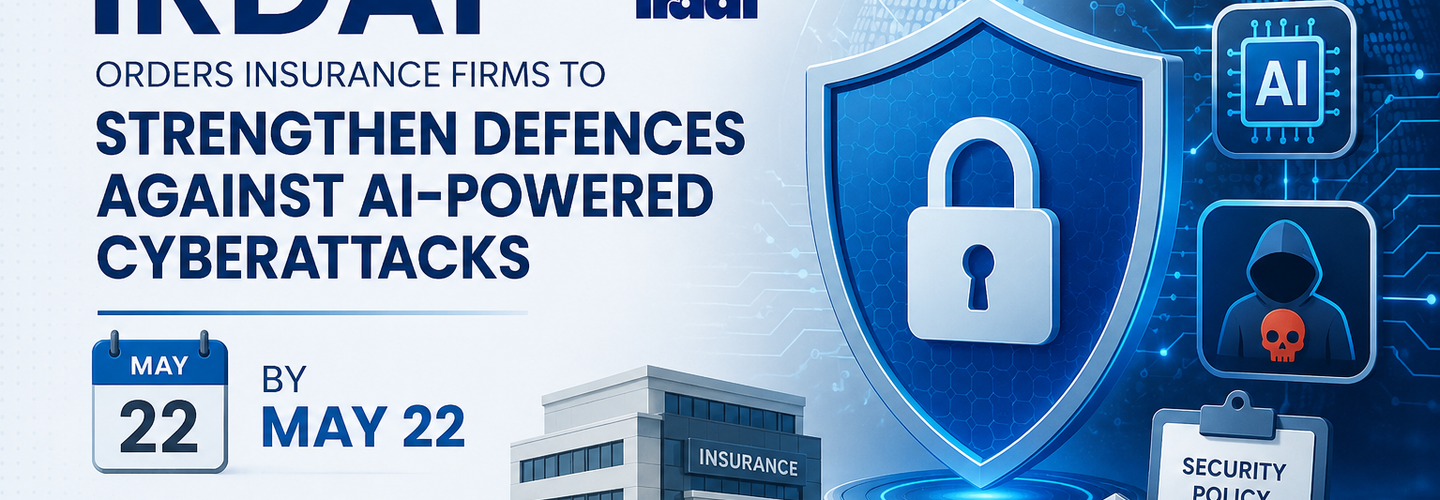
IRDAI Orders Insurance Firms to Strengthen Defences Against AI-Powered Cyberattacks by May 22
India’s insurance sector is facing growing pressure to modernize its cybersecurity posture as artificial intelligence reshapes the threat landscape. In a fresh warning to insurers, the Insurance Regulatory and Development Authority of India (IRDAI) has directed insurance companies to reinforce their cyber resilience against AI-powered attacks and submit preparedness updates by May 22.
The move highlights rising concerns within the financial ecosystem over the rapid use of generative AI, automated phishing systems, deepfake technologies, and machine-learning-driven cyber campaigns targeting critical sectors. Insurers, which manage vast volumes of sensitive financial and healthcare data, are increasingly being viewed as high-value targets by cybercriminal groups seeking financial gain, identity theft opportunities, or operational disruption.
Industry experts say the regulator’s latest directive reflects a broader shift in how governments and financial watchdogs worldwide are responding to AI-enabled cyber risks.
## Rising Concern Over AI-Driven Cyber Threats
Cybersecurity teams across the insurance industry have spent the past year responding to a sharp increase in sophisticated attacks that leverage artificial intelligence to improve scale, speed, and social engineering accuracy.
Unlike traditional phishing attempts riddled with grammatical errors and generic messaging, AI-assisted campaigns can now generate convincing emails, customer impersonation attempts, and multilingual scams within seconds. Security analysts warn that threat actors are increasingly using AI tools to automate reconnaissance, improve credential theft operations, and craft realistic fraud scenarios aimed at both employees and customers.
The insurance industry remains especially vulnerable because of the sensitive information it stores, including:
- ▸Personally identifiable information (PII)
- ▸Medical records
- ▸Banking details
- ▸Claims documentation
- ▸Corporate financial records
- ▸Policyholder authentication data
According to multiple global cybersecurity reports, financial services and insurance organizations remain among the most targeted sectors for ransomware, data theft, and business email compromise attacks.
The IRDAI directive reportedly urges insurers to review their cybersecurity governance frameworks, improve incident response readiness, strengthen endpoint security, and evaluate third-party vendor risks associated with AI systems and cloud platforms.
## Why Regulators Are Focusing on AI Risks
Artificial intelligence has rapidly become a double-edged sword for enterprises. While insurers increasingly rely on AI for fraud detection, underwriting automation, customer service, and claims processing, cybercriminals are adopting the same technologies for malicious purposes.
Security researchers have observed several troubling trends over the past 18 months:
- ▸AI-generated phishing emails with high success rates
- ▸Deepfake voice scams targeting finance departments
- ▸Automated credential stuffing attacks
- ▸AI-enhanced malware obfuscation techniques
- ▸Synthetic identity fraud
- ▸Intelligent social engineering campaigns
For regulators, the concern is not merely about isolated cyber incidents. The larger issue is systemic financial stability. A successful cyberattack against a major insurer could potentially affect millions of policyholders, disrupt claims processing, delay healthcare reimbursements, or expose large-scale customer data.
Financial regulators globally are now treating cybersecurity as an operational resilience issue rather than a purely technical concern.
The IRDAI’s warning aligns with similar initiatives from regulators in Europe, Singapore, the United States, and the United Kingdom, where financial institutions are being pushed to adopt stronger cyber governance and AI risk management practices.
## Technical Impact Analysis
The growing adoption of AI in cyber operations significantly changes the defensive challenges faced by insurance companies.
Traditional cybersecurity models often rely on detecting known indicators of compromise or suspicious behavior patterns. However, AI-assisted attacks can dynamically adapt, generate unique content, and bypass static detection mechanisms.
Security analysts say several areas are becoming particularly concerning for insurers.
Business Email Compromise (BEC)
Insurance firms rely heavily on email communication for claims processing, policy approvals, and financial operations. AI-generated impersonation campaigns can mimic executives, partners, or customers with increasing realism, raising the risk of fraudulent transactions or credential theft.
Customer Data Exposure
Insurance databases contain highly valuable identity and healthcare information. Data breaches involving insurers can have long-term consequences for affected individuals, including identity fraud, financial scams, and targeted phishing attacks.
Third-Party Vendor Risks
Modern insurers depend extensively on cloud providers, analytics vendors, and software supply chains. Weaknesses in external systems can create indirect exposure pathways for attackers.
Deepfake-Enabled Fraud
Voice cloning and synthetic media technologies are becoming increasingly accessible. Cybersecurity firms have warned that AI-generated audio impersonation attacks targeting financial approvals and customer verification processes are likely to increase.
Operational Disruption
Ransomware groups continue targeting critical business infrastructure. In the insurance sector, prolonged outages could interrupt claims processing, policy issuance, and customer support operations.
Experts believe organizations that fail to modernize security monitoring and identity verification systems may struggle to detect AI-enhanced attack patterns quickly enough.
## Industry Implications for India’s Insurance Sector
The IRDAI directive could accelerate cybersecurity spending across India’s insurance market, especially among firms that have traditionally treated cybersecurity as a compliance requirement rather than a strategic business priority.
India’s insurance industry has undergone rapid digital transformation over the past decade. Mobile applications, online onboarding systems, digital claims platforms, and API-driven financial ecosystems have significantly improved customer convenience. However, this digital expansion has also increased the attack surface.
Security consultants expect insurers to prioritize investments in:
- ▸Zero-trust architecture
- ▸Multi-factor authentication
- ▸AI-assisted threat detection
- ▸Identity verification controls
- ▸Security awareness training
- ▸Cloud security posture management
- ▸Incident response simulations
- ▸Third-party risk monitoring
The regulator’s warning may also influence board-level governance discussions. Increasingly, cybersecurity is being treated as a business continuity issue rather than solely an IT responsibility.
Several industry analysts note that insurers themselves may face growing cyber insurance exposure as AI-related incidents increase. Claims associated with data breaches, digital fraud, ransomware events, and business interruption could rise significantly in the coming years.
## Why This Matters
The IRDAI directive is important because it reflects a larger reality: AI-powered cyber threats are no longer theoretical.
Cybercriminals are actively integrating artificial intelligence into fraud operations, phishing campaigns, and identity manipulation schemes. Financial institutions, healthcare systems, insurers, and government agencies are all being forced to adapt rapidly.
For consumers, the risks extend beyond corporate data breaches. Compromised insurance data can expose medical histories, financial identities, and sensitive personal records that may be abused for years after an incident occurs.
For businesses, cyber resilience is increasingly tied to customer trust. Insurance companies operate on credibility, reliability, and data protection. A major cybersecurity incident can trigger regulatory scrutiny, reputational damage, legal challenges, and customer attrition.
The IRDAI’s intervention signals that regulators expect insurers to proactively prepare for AI-era cyber threats rather than react after incidents occur.
## How Users Can Stay Safe
Although insurers carry primary responsibility for protecting customer information, policyholders should also remain cautious about evolving cyber threats.
Cybersecurity experts recommend the following precautions:
Enable Multi-Factor Authentication
Customers should activate MFA on insurance accounts whenever possible. Additional verification layers significantly reduce account compromise risks.
Verify Communications Carefully
Users should remain cautious of unexpected calls, emails, or messages requesting financial information, OTPs, or login credentials. AI-generated scams may appear convincing.
Monitor Financial and Insurance Activity
Regularly reviewing policy activity, claims notifications, and linked banking transactions can help identify suspicious behavior early.
Use Strong, Unique Passwords
Reusing passwords across platforms increases exposure if one account becomes compromised.
Stay Alert for Deepfake Scams
Voice impersonation and fake executive calls are becoming more common. Consumers and employees should independently verify unusual requests involving payments or sensitive data.
Update Devices and Applications
Keeping systems patched reduces exposure to known security vulnerabilities commonly exploited in cyberattacks.
Avoid Sharing Excessive Personal Information
Cybercriminals frequently combine publicly available data with AI-generated social engineering tactics to build highly convincing scams.
## Official Responses and Industry Reaction
While specific implementation details may vary among insurers, cybersecurity professionals broadly welcomed the IRDAI’s decision as a timely intervention.
Industry observers say regulators are increasingly recognizing that AI-related cyber risks require continuous oversight rather than one-time compliance checks.
Several financial cybersecurity experts have emphasized the need for organizations to improve cyber resilience through regular security assessments, incident simulations, employee training, and coordinated response planning.
Government agencies and cybersecurity bodies globally have also issued repeated warnings about AI-assisted phishing campaigns and synthetic identity fraud.
In recent months, financial regulators in multiple countries have intensified scrutiny of operational resilience frameworks amid concerns that AI could significantly amplify existing cyber threats.
The insurance sector is expected to face growing expectations around transparency, incident reporting, and third-party risk management in the years ahead.
## Sources & References
- ▸Insurance Regulatory and Development Authority of India (IRDAI) advisories
- ▸Cybersecurity and Infrastructure Security Agency (CISA)
- ▸IBM X-Force Threat Intelligence reports
- ▸World Economic Forum cybersecurity assessments
- ▸Financial Stability Institute operational resilience guidance
- ▸Industry research from cybersecurity firms monitoring AI-enabled threats
- ▸Public advisories related to phishing, ransomware, and financial sector cyber risks
## Conclusion
The IRDAI’s directive to strengthen defenses against AI-powered cyberattacks underscores a significant shift in the cybersecurity priorities of India’s financial sector.
Artificial intelligence is rapidly transforming both enterprise innovation and cybercriminal operations. As insurers expand digital services and process increasing volumes of sensitive customer data, the pressure to improve cyber resilience will only intensify.
For insurance companies, the message from regulators is clear: cybersecurity preparedness can no longer be treated as a secondary operational concern. AI-driven threats are evolving faster, becoming more convincing, and targeting critical sectors with growing precision.
The organizations that adapt early — by strengthening governance, modernizing detection systems, improving employee awareness, and investing in resilient infrastructure — will likely be better positioned to navigate the next phase of the cyber threat landscape.
Read More:
Cybersecurity Agencies Warn Users Against New Digital Fraud Tactics
CISA Warns of Active Exploitation of Microsoft Exchange Server Spoofing Vulnerability
Critical NGINX Vulnerability Under Active Exploitation, Security Teams Urged to Patch Immediately
Security Researchers Warn Critical n8n Flaws May Expose Automation Platforms to RCE
Project Glasswing Evolves as Anthropic Enables Wider Sharing of Mythos Vulnerability Findings
## Analyst Commentary & Implementation Blueprint
Security advisory
Continuous security exposure assessment is critical to identifying public vulnerabilities before they are exploited. Organizations should maintain a passive inventory of all web servers, TLS configs, and open ports, ensuring that default configurations are eliminated and security advisories are actively implemented.
Hardened Security Configuration Blueprint
# General Security Hardening Directive
ServerTokens ProductOnly
ServerSignature Off
FileETag None
Actionable Mitigation Checklist
- ✔Perform passive asset inventories weekly.
- ✔Restrict administrative ports using local firewall controls.
- ✔Monitor active CVE alerts for exposed software.
Common Inquiries & FAQs
Why is passive scanning preferred for continuous auditing?
Passive audits do not cause operational impact or trigger firewall blocks, making them ideal for constant surveillance of internet-facing assets.
What should I do if a vulnerability is flagged?
Apply the latest vendor patches, restrict access to the resource via firewalls, or verify configuration flags to mitigate risks.
Surendra Reddy
Surendra Reddy is a cybersecurity researcher and founder of ReconShield, specializing in OSINT and defensive infrastructure analysis.
Connect on LinkedIn ↗// AUDIT BRIEFING DISCUSSION (2 COMMENTS)
Great breakdown of the passive infrastructure vectors. We recently audited our external DNS zones and found multiple dangling staging environments. Implementing wildcard certificates reduced our CT log leaks significantly.
Is there any automated tooling you recommend for daily crt.sh scraping? Manually checking CT logs is becoming unsustainable for our domain portfolio.
// MORE ARTICLES
Security Researchers Warn Critical n8n Flaws May Expose Automation Platforms to RCE
Researchers have disclosed critical vulnerabilities in n8n that could expose automation workflows and connected enterprise systems to remote code execution risks, prompting urgent patch recommendations for users and administrators.
How Agentic AI Is Changing Software Engineering and Expanding Mobile Attack Surfaces
Agentic AI is rapidly transforming software engineering workflows through automation and intelligent coding assistance, while cybersecurity experts warn of expanding mobile attack surfaces and emerging application security risks.

Critical Tenda Router Backdoor (CVE-2026-11405): Check If Your Device Is Vulnerable Now
CVE-2026-11405 is an unpatched Tenda router backdoor granting full admin access without a password. Check if your model is affected now.