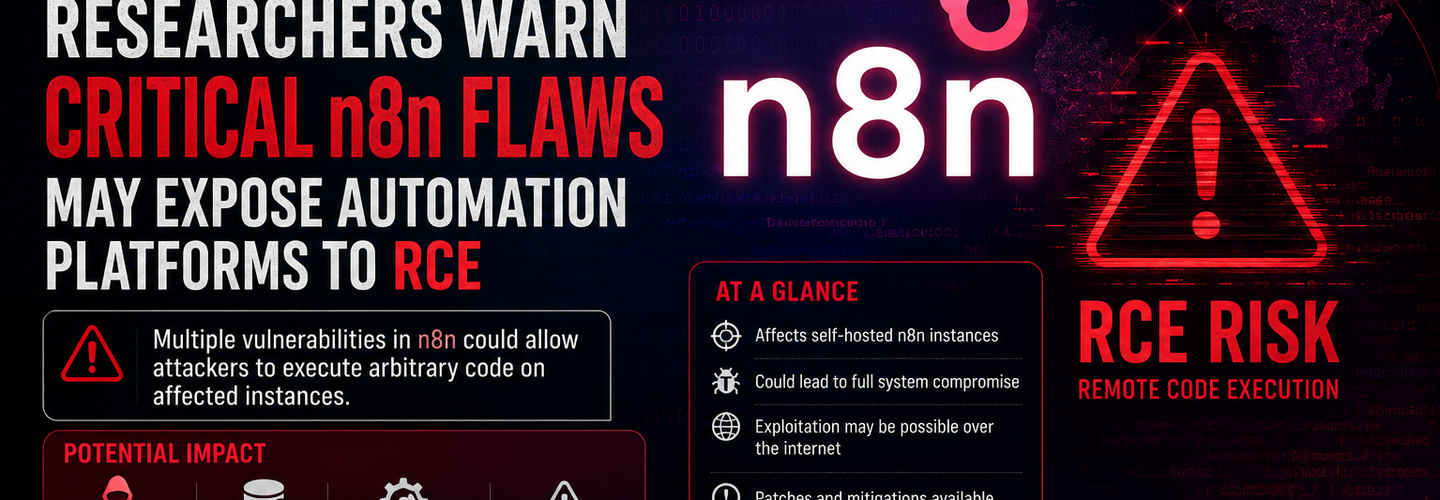
Security Researchers Warn Critical n8n Flaws May Expose Automation Platforms to RCE
Workflow automation platform n8n is facing increased security scrutiny after researchers disclosed a set of critical vulnerabilities that could potentially expose enterprise environments to remote code execution (RCE) risks. The findings have triggered concern among cybersecurity professionals because n8n is widely used to automate business processes, connect APIs, handle sensitive workflows, and integrate cloud applications across production environments.
Security analysts warn that vulnerabilities affecting automation platforms carry uniquely high risk. Unlike isolated software components, automation tools often maintain privileged access to databases, cloud services, internal APIs, authentication tokens, messaging systems, and enterprise infrastructure. A compromise involving these platforms can therefore create downstream exposure far beyond a single application instance.
The newly disclosed issues reportedly impact certain workflow nodes and execution mechanisms within n8n deployments, prompting urgent calls for organizations to review configurations, apply updates, and restrict unnecessary exposure. While researchers have avoided publishing offensive exploitation details, defenders say the vulnerabilities highlight broader security concerns surrounding rapidly growing automation ecosystems.
The disclosure arrives at a time when businesses across industries are accelerating adoption of low-code and no-code automation technologies to streamline operations, reduce manual workloads, and integrate AI-driven processes into enterprise workflows.
As organizations increasingly rely on interconnected automation platforms, security experts say the attack surface surrounding workflow orchestration tools is expanding rapidly.
## Threat Overview
n8n has emerged as a popular workflow automation platform due to its flexibility, self-hosting capabilities, open-source ecosystem, and support for hundreds of integrations. Enterprises use it to automate tasks involving cloud infrastructure, DevOps operations, ticketing systems, financial workflows, customer data processing, marketing automation, and AI integrations.
Researchers analyzing the newly disclosed vulnerabilities warn that affected environments could face elevated risk if internet-accessible instances remain unpatched or improperly configured.
The core concern centers on the possibility that malicious activity targeting vulnerable workflow components could allow unauthorized execution of code within affected environments under specific conditions.
Because automation platforms routinely interact with privileged systems and sensitive business logic, even limited compromise scenarios could create substantial operational and security implications.
Threat intelligence analysts note that attackers increasingly target automation and orchestration platforms because they often serve as centralized hubs connecting multiple enterprise services.
“Automation systems effectively become digital control planes for organizations,” one cloud security researcher explained in commentary shared following the disclosure. “If a threat actor compromises the orchestration layer, they may gain indirect visibility into numerous interconnected services and workflows.”
Security professionals also warn that workflow automation platforms sometimes receive less scrutiny than traditional enterprise applications despite maintaining extensive permissions across production environments.
This mismatch between operational importance and security maturity has become a growing concern across the cybersecurity industry.
## Technical Impact Analysis
Although full technical specifics remain limited in public reporting, researchers say the vulnerabilities could impact the integrity and security of workflow execution environments.
Automation platforms like n8n frequently process:
- ▸API credentials
- ▸OAuth tokens
- ▸Database connections
- ▸Cloud infrastructure secrets
- ▸Internal service communications
- ▸Business automation logic
- ▸AI and machine learning workflows
- ▸DevOps orchestration tasks
If attackers gain unauthorized execution capabilities within these environments, the resulting exposure may extend well beyond the automation platform itself.
Security experts emphasize that the severity of the risk often depends on how organizations deploy and secure automation infrastructure. Self-hosted deployments with broad internal network access, excessive permissions, or internet exposure may face greater potential impact.
Cloud-native environments could also encounter elevated risks because automation systems commonly integrate with:
- ▸Kubernetes clusters
- ▸CI/CD pipelines
- ▸Cloud storage platforms
- ▸Identity management systems
- ▸Messaging queues
- ▸Enterprise SaaS platforms
Researchers warn that automation nodes capable of handling dynamic inputs or executing workflow logic may introduce additional security considerations if not properly sandboxed or restricted.
The incident reflects a broader trend in enterprise cybersecurity where operational efficiency tools increasingly become attractive targets for threat actors.
Historically, attackers focused heavily on endpoints, VPNs, email servers, and web applications. However, modern campaigns are increasingly targeting technologies that centralize access to multiple enterprise services.
Automation platforms fall directly into that category.
According to industry analysts, organizations sometimes underestimate the sensitivity of workflow orchestration systems because they are viewed primarily as productivity tools rather than critical infrastructure.
That assumption can create dangerous blind spots.
## Industry Implications
The disclosure has wider implications for organizations adopting automation-first operational strategies.
Low-code and no-code platforms have experienced explosive enterprise adoption over the past several years. Businesses seeking faster digital transformation initiatives increasingly rely on automation systems to connect fragmented applications and reduce operational overhead.
Research firms estimate that workflow automation adoption continues to grow rapidly across industries including:
- ▸Financial services
- ▸Healthcare
- ▸Retail
- ▸Telecommunications
- ▸Manufacturing
- ▸Government
- ▸Logistics
- ▸SaaS and cloud providers
At the same time, cybersecurity teams are struggling to maintain visibility into sprawling automation ecosystems that often include hundreds of interconnected workflows.
Security leaders warn that automation sprawl can introduce several challenges:
- ▸Excessive credential exposure
- ▸Overprivileged service accounts
- ▸Weak segmentation
- ▸Shadow IT automation
- ▸Unmonitored third-party integrations
- ▸Poor secrets management
- ▸Inconsistent access controls
The newly disclosed n8n vulnerabilities may intensify industry discussions around governance and security standards for workflow automation platforms.
Analysts also expect regulators and cyber insurers to pay closer attention to orchestration security as automation becomes deeply integrated into critical business operations.
The incident further highlights growing concerns surrounding AI-driven automation environments. Many organizations now connect automation platforms directly with generative AI services, document processing systems, and decision-support workflows.
Compromise involving those systems could introduce both operational disruption and data security concerns.
Cybersecurity experts say organizations must begin treating workflow orchestration platforms as high-value infrastructure assets rather than auxiliary productivity tools.
## Why This Matters
The n8n vulnerabilities matter because automation platforms increasingly sit at the center of enterprise operations.
Modern businesses depend on interconnected systems that continuously exchange data between cloud services, internal infrastructure, SaaS applications, and external APIs. Workflow orchestration tools make those connections possible — but they also create centralized points of exposure.
A security weakness affecting an automation platform can potentially impact multiple business functions simultaneously.
The incident also demonstrates how the enterprise attack surface is evolving.
Threat actors are no longer focused solely on traditional targets such as email servers or VPN gateways. Instead, they are increasingly interested in platforms that provide indirect access to broader ecosystems of data and services.
Automation tools often hold exactly that type of access.
Security researchers say the growing convergence of automation, AI, cloud infrastructure, and API ecosystems means orchestration security will become one of the defining enterprise cybersecurity challenges of the next several years.
Organizations that fail to implement strong governance around automation platforms may face heightened operational and compliance risks.
The situation additionally reinforces the importance of secure-by-default configurations, least-privilege access controls, and continuous infrastructure monitoring.
## How Users Can Stay Safe
Cybersecurity experts recommend several defensive measures for organizations using n8n or similar workflow automation platforms.
1. Apply Security Updates Immediately
Organizations should review official vendor advisories and apply available patches or updates as soon as possible.
Internet-facing automation platforms should receive accelerated remediation prioritization due to their elevated exposure risk.
2. Restrict Public Exposure
Security teams should avoid exposing workflow management interfaces directly to the public internet unless absolutely necessary.
Where exposure is required, organizations should implement:
- ▸Multi-factor authentication
- ▸IP allowlisting
- ▸VPN protections
- ▸Reverse proxy filtering
- ▸Zero-trust access controls
Reducing external accessibility significantly lowers attack surface exposure.
3. Audit Workflow Permissions
Administrators should review all automation workflows and integrations for excessive privileges.
Security teams should identify:
- ▸Overprivileged service accounts
- ▸Unused integrations
- ▸Stale API credentials
- ▸Excessive token permissions
- ▸Broad infrastructure access
Least-privilege principles remain essential for limiting potential damage during compromise scenarios.
4. Improve Secrets Management
Automation platforms frequently store sensitive credentials. Organizations should ensure secrets are protected using enterprise-grade credential management systems.
Experts recommend:
- ▸Credential rotation
- ▸Secret vault integration
- ▸Short-lived authentication tokens
- ▸Encryption for stored secrets
- ▸Segmented access controls
5. Increase Monitoring and Logging
Security operations teams should monitor automation infrastructure for suspicious behavior, including:
- ▸Unauthorized workflow changes
- ▸Unusual execution patterns
- ▸Unexpected outbound communications
- ▸Privilege escalation attempts
- ▸New integrations or tokens
- ▸Configuration anomalies
Behavioral monitoring can help identify compromise attempts early.
6. Segment Critical Infrastructure
Workflow automation systems should not maintain unrestricted access across enterprise networks.
Network segmentation and infrastructure isolation can significantly reduce blast radius if compromise occurs.
7. Conduct Regular Security Reviews
Organizations should include automation platforms within routine penetration testing, vulnerability scanning, and security assessments.
Security experts say orchestration environments are frequently overlooked during enterprise risk evaluations.
## Official Responses
Security researchers and infrastructure defenders have urged organizations to review affected deployments immediately following disclosure of the vulnerabilities.
The n8n community and maintainers have reportedly been working to address identified issues through updates, mitigation guidance, and security improvements aimed at reducing exposure risks.
Several cybersecurity firms have also published defensive guidance focused on automation platform security and workflow governance.
Meanwhile, enterprise defenders are increasingly incorporating workflow orchestration tools into broader threat modeling exercises.
Industry analysts say this trend will likely accelerate as automation adoption continues expanding across enterprise environments.
Cloud security experts additionally expect organizations to place greater emphasis on securing API integrations and machine-to-machine communications connected to workflow platforms.
## Sources & References
- ▸Official n8n security advisories and release notes
- ▸Threat intelligence reporting from cloud security researchers
- ▸Industry analysis on workflow orchestration security
- ▸Enterprise cybersecurity guidance on automation governance
- ▸Public advisories from cybersecurity agencies and infrastructure defenders
- ▸Security best practices for API and secrets management
## Conclusion
The disclosure of critical vulnerabilities affecting n8n underscores a growing reality in modern cybersecurity: automation platforms have become essential infrastructure — and increasingly attractive targets.
As businesses accelerate adoption of workflow orchestration technologies, the security risks surrounding interconnected systems continue to expand. Platforms that automate business logic, connect cloud services, and manage sensitive workflows now represent high-value assets within enterprise environments.
For defenders, the lesson is clear.
Automation security can no longer be treated as a secondary operational concern. Organizations must apply the same rigor to workflow platforms that they already use for cloud infrastructure, identity systems, and internet-facing applications.
Rapid patching, strong access controls, continuous monitoring, and proper governance remain critical defenses against emerging threats targeting automation ecosystems.
With workflow automation now deeply embedded across enterprise operations, proactive security measures will play a central role in reducing future risk exposure.
Read More:
₹152 Crore Cyber Scam Exposed Across 14 States – How Mule Accounts Fueled Massive Fraud
First Public macOS Kernel Exploit on Apple M5 Developed Using Mythos Preview in Just Five Days
SEBI Creates AI Cyber Defense Task Force to Protect India’s Financial Markets
Cybersecurity Agencies Warn Users Against New Digital Fraud Tactics
CISA Warns of Active Exploitation of Microsoft Exchange Server Spoofing Vulnerability
Critical NGINX Vulnerability Under Active Exploitation, Security Teams Urged to Patch Immediately
## Analyst Commentary & Implementation Blueprint
Security advisory
Continuous security exposure assessment is critical to identifying public vulnerabilities before they are exploited. Organizations should maintain a passive inventory of all web servers, TLS configs, and open ports, ensuring that default configurations are eliminated and security advisories are actively implemented.
Hardened Security Configuration Blueprint
# General Security Hardening Directive
ServerTokens ProductOnly
ServerSignature Off
FileETag None
Actionable Mitigation Checklist
- ✔Perform passive asset inventories weekly.
- ✔Restrict administrative ports using local firewall controls.
- ✔Monitor active CVE alerts for exposed software.
Common Inquiries & FAQs
Why is passive scanning preferred for continuous auditing?
Passive audits do not cause operational impact or trigger firewall blocks, making them ideal for constant surveillance of internet-facing assets.
What should I do if a vulnerability is flagged?
Apply the latest vendor patches, restrict access to the resource via firewalls, or verify configuration flags to mitigate risks.
Surendra Reddy
Surendra Reddy is a cybersecurity researcher and founder of ReconShield, specializing in OSINT and defensive infrastructure analysis.
Connect on LinkedIn ↗// AUDIT BRIEFING DISCUSSION (2 COMMENTS)
Great breakdown of the passive infrastructure vectors. We recently audited our external DNS zones and found multiple dangling staging environments. Implementing wildcard certificates reduced our CT log leaks significantly.
Is there any automated tooling you recommend for daily crt.sh scraping? Manually checking CT logs is becoming unsustainable for our domain portfolio.
// MORE ARTICLES

How Agentic AI Is Changing Software Engineering and Expanding Mobile Attack Surfaces
Agentic AI is rapidly transforming software engineering workflows through automation and intelligent coding assistance, while cybersecurity experts warn of expanding mobile attack surfaces and emerging application security risks.

Critical Tenda Router Backdoor (CVE-2026-11405): Check If Your Device Is Vulnerable Now
CVE-2026-11405 is an unpatched Tenda router backdoor granting full admin access without a password. Check if your model is affected now.
Microsoft Defender Zero-Day Patched: What IT Teams Need to Know
Microsoft patches RoguePlanet, a Defender zero-day (CVE-2026-50656) letting attackers gain SYSTEM access. Here's what IT teams need to know.