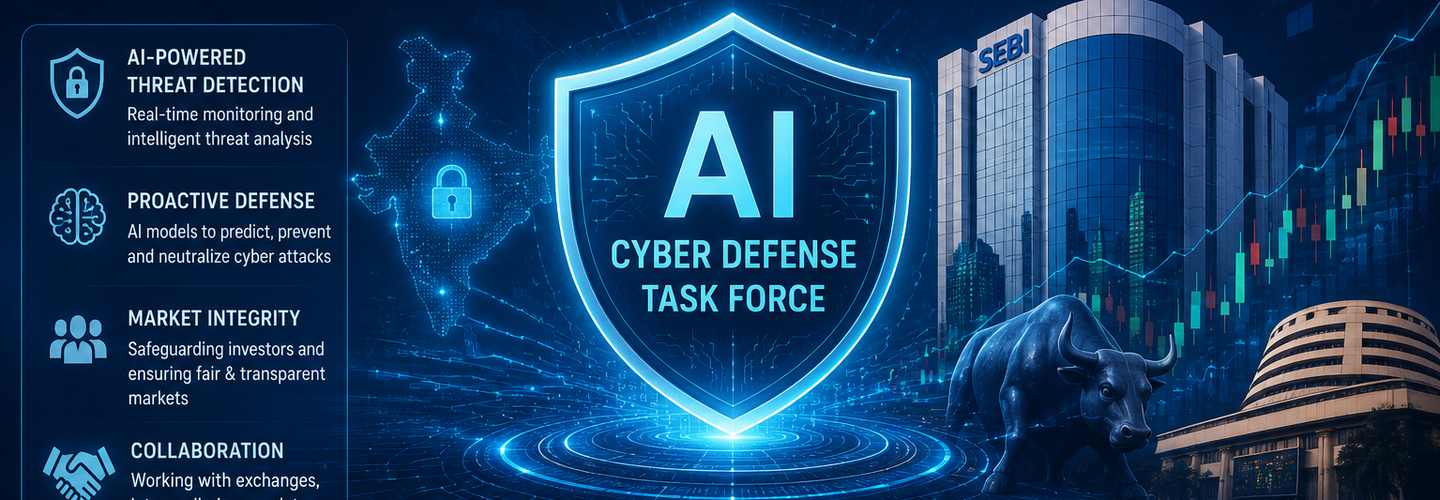
SEBI Creates AI Cyber Defense Task Force to Protect India’s Financial Markets
India’s capital markets regulator, Securities and Exchange Board of India (SEBI), has announced the formation of a dedicated Artificial Intelligence (AI) Cyber Defense Task Force to strengthen cybersecurity across the country’s financial ecosystem. The move comes amid rising concerns over AI-powered cyberattacks targeting stock exchanges, brokerages, fintech platforms, and investor data systems.
The initiative marks one of India’s most significant steps toward building AI-driven cyber resilience in financial markets and protecting critical digital infrastructure from increasingly sophisticated threats.
## Why SEBI Is Creating an AI Cyber Defense Task Force
India’s financial markets have rapidly digitized over the last decade. Millions of retail investors now rely on online trading platforms, mobile apps, UPI-linked investments, and cloud-based financial services.
While this digital transformation has improved accessibility, it has also expanded the cyberattack surface.
Cybercriminals are increasingly using AI to:
- ▸Launch automated phishing campaigns
- ▸Generate convincing deepfake voices and videos
- ▸Bypass traditional fraud detection systems
- ▸Conduct AI-assisted financial scams
- ▸Target algorithmic trading platforms
- ▸Exploit vulnerabilities in APIs and cloud infrastructure
SEBI’s newly formed task force aims to proactively identify, assess, and mitigate these evolving threats before they disrupt India’s financial stability.
## Key Objectives of the Task Force
According to industry discussions and regulatory priorities, the AI Cyber Defense Task Force is expected to focus on several core areas:
1. AI-Based Threat Detection
The task force will likely encourage financial institutions to adopt AI-powered monitoring systems capable of detecting abnormal activity in real time.
These systems can identify:
- ▸Suspicious login attempts
- ▸Automated bot attacks
- ▸Market manipulation patterns
- ▸Insider threat indicators
- ▸Unusual trading behaviors
Real-time AI analytics may help reduce incident response times significantly.
2. Protection Against Deepfake Financial Fraud
Deepfake-enabled scams are emerging as a major risk for banks and trading platforms globally.
Attackers can now imitate:
- ▸Executive voices
- ▸Customer support agents
- ▸Financial advisors
- ▸Video KYC sessions
SEBI’s initiative could help establish verification frameworks and authentication standards to counter AI-generated impersonation attacks.
## Rising Cybersecurity Risks in India’s Financial Sector
India’s financial sector has become a prime target for cybercriminals due to its massive digital user base and rapidly expanding fintech ecosystem.
Recent years have witnessed:
- ▸Data breaches at financial institutions
- ▸Trading app disruptions
- ▸Phishing campaigns targeting investors
- ▸SIM-swap attacks
- ▸Cryptocurrency-related scams
- ▸Ransomware incidents against enterprises
As AI lowers the barrier for cybercriminals, attacks are becoming faster, more scalable, and harder to detect.
Security experts warn that traditional rule-based defenses are no longer sufficient against AI-native threats.
## Focus on Market Infrastructure Protection
The SEBI task force is also expected to strengthen the security posture of critical market infrastructure institutions such as:
- ▸Stock exchanges
- ▸Clearing corporations
- ▸Depositories
- ▸Mutual fund platforms
- ▸Brokerage firms
Any major cyberattack against these systems could:
- ▸Disrupt trading activity
- ▸Impact investor confidence
- ▸Trigger financial instability
- ▸Cause massive data exposure
By integrating AI-driven cyber intelligence and advanced analytics, regulators aim to improve operational resilience across the entire market ecosystem.
## Collaboration With Industry and Government Agencies
The AI Cyber Defense Task Force is likely to collaborate with:
- ▸Cybersecurity companies
- ▸Financial institutions
- ▸CERT-In
- ▸Technology experts
- ▸AI researchers
- ▸Cloud providers
Such collaboration is essential because cyber threats evolve faster than conventional regulatory processes.
Experts believe public-private partnerships will play a critical role in:
- ▸Threat intelligence sharing
- ▸Incident response coordination
- ▸AI governance
- ▸Cybersecurity training
- ▸Security standards development
## AI Governance and Regulatory Oversight
One major concern surrounding AI adoption is the potential misuse of AI systems themselves.
SEBI may also focus on:
- ▸Ethical AI usage
- ▸AI transparency requirements
- ▸Algorithm accountability
- ▸Bias detection
- ▸Security testing for AI models
Financial institutions increasingly rely on AI for:
- ▸Risk scoring
- ▸Fraud detection
- ▸Trading automation
- ▸Customer onboarding
- ▸Compliance monitoring
Without proper oversight, vulnerable or manipulated AI systems could create new security and financial risks.
## Cybersecurity Awareness for Investors
The regulator’s initiative may also lead to stronger awareness campaigns aimed at retail investors.
Users are being advised to:
- ▸Avoid clicking suspicious investment links
- ▸Verify trading platform communications
- ▸Enable multi-factor authentication
- ▸Monitor account activity regularly
- ▸Beware of AI-generated scam calls and messages
Cybersecurity experts emphasize that human awareness remains one of the strongest defenses against financial fraud.
## Global Trend Toward AI Cyber Defense
SEBI’s move reflects a broader global trend where regulators and financial institutions are adopting AI-based cybersecurity strategies.
Organizations worldwide are increasingly investing in:
- ▸AI-driven Security Operations Centers (SOCs)
- ▸Behavioral analytics
- ▸Automated incident response
- ▸Predictive threat intelligence
- ▸Zero-trust security models
Countries such as the United States, Singapore, and the United Kingdom have also intensified focus on protecting financial systems against AI-enhanced cyber threats.
India’s initiative signals that regulators are taking the evolving threat landscape seriously.
## What This Means for India’s Financial Ecosystem
The creation of the AI Cyber Defense Task Force could have long-term implications for:
- ▸Financial cybersecurity standards
- ▸Regulatory compliance requirements
- ▸AI governance policies
- ▸Fintech security investments
- ▸Incident reporting frameworks
Market participants may soon face stricter cybersecurity audits and AI risk management requirements.
For investors and businesses alike, the initiative highlights the growing importance of cyber resilience in an AI-driven economy.
## Final Thoughts
As cybercriminals increasingly weaponize artificial intelligence, regulators can no longer rely solely on traditional security frameworks. SEBI’s decision to establish an AI Cyber Defense Task Force represents a proactive step toward safeguarding India’s rapidly digitizing financial markets.
The initiative demonstrates a clear recognition that future cyber defense strategies must combine advanced technology, regulatory oversight, industry collaboration, and investor awareness.
With financial systems becoming more interconnected and AI-driven, building cyber resilience is no longer optional — it is essential for maintaining trust, stability, and security in India’s digital economy.
Read More:
Foxconn Cyberattack: Hackers Claim Apple & Google Data Stolen
Arctic Wolf Launches AI Mobile Threat Defense
The Mythos Stress Test: Are Indian Banks & Fintechs Ready for AI-Native Cyber Threats?
India Lost ₹52,000 Crore to Cyber Frauds in 5 Years – Govt Tightens Telecom Security
₹152 Crore Cyber Scam Exposed Across 14 States – How Mule Accounts Fueled Massive Fraud
First Public macOS Kernel Exploit on Apple M5 Developed Using Mythos Preview in Just Five Days
## Analyst Commentary & Implementation Blueprint
Security advisory
Continuous security exposure assessment is critical to identifying public vulnerabilities before they are exploited. Organizations should maintain a passive inventory of all web servers, TLS configs, and open ports, ensuring that default configurations are eliminated and security advisories are actively implemented.
Hardened Security Configuration Blueprint
# General Security Hardening Directive
ServerTokens ProductOnly
ServerSignature Off
FileETag None
Actionable Mitigation Checklist
- ✔Perform passive asset inventories weekly.
- ✔Restrict administrative ports using local firewall controls.
- ✔Monitor active CVE alerts for exposed software.
Common Inquiries & FAQs
Why is passive scanning preferred for continuous auditing?
Passive audits do not cause operational impact or trigger firewall blocks, making them ideal for constant surveillance of internet-facing assets.
What should I do if a vulnerability is flagged?
Apply the latest vendor patches, restrict access to the resource via firewalls, or verify configuration flags to mitigate risks.
Surendra Reddy
Surendra Reddy is a cybersecurity researcher and founder of ReconShield, specializing in OSINT and defensive infrastructure analysis.
Connect on LinkedIn ↗// AUDIT BRIEFING DISCUSSION (2 COMMENTS)
Great breakdown of the passive infrastructure vectors. We recently audited our external DNS zones and found multiple dangling staging environments. Implementing wildcard certificates reduced our CT log leaks significantly.
Is there any automated tooling you recommend for daily crt.sh scraping? Manually checking CT logs is becoming unsustainable for our domain portfolio.
// MORE ARTICLES
Security Researchers Warn Critical n8n Flaws May Expose Automation Platforms to RCE
Researchers have disclosed critical vulnerabilities in n8n that could expose automation workflows and connected enterprise systems to remote code execution risks, prompting urgent patch recommendations for users and administrators.
How Agentic AI Is Changing Software Engineering and Expanding Mobile Attack Surfaces
Agentic AI is rapidly transforming software engineering workflows through automation and intelligent coding assistance, while cybersecurity experts warn of expanding mobile attack surfaces and emerging application security risks.

Critical Tenda Router Backdoor (CVE-2026-11405): Check If Your Device Is Vulnerable Now
CVE-2026-11405 is an unpatched Tenda router backdoor granting full admin access without a password. Check if your model is affected now.