
Foxconn Cyberattack: Hackers Claim Apple & Google Data Stolen
KEY HIGHLIGHTS
- ▸Hackers targeted Foxconn, one of the world's largest electronics manufacturers and a key supplier to Apple, Google, and other tech giants.
- ▸Threat actors claim to have exfiltrated sensitive corporate and partner data, though the full scope remains under investigation.
- ▸Supply chain attacks are rising sharply — 61% of enterprises reported a third-party-related breach in the past two years.
- ▸Even if you're not Foxconn, your organization is at risk if it shares data with vendors who lack robust security controls.
- ▸Compromised partner data can include contracts, product specs, employee PII, and customer records — all valuable on dark web markets.
- ▸Immediate steps include auditing vendor access, enforcing least-privilege policies, and monitoring for credential leaks tied to your domain.
- ▸Regulatory bodies may require breach notification if personal data of EU or US citizens was involved, raising compliance stakes.
## Foxconn Cyberattack: Hackers Claim Apple & Google Data Stolen
When Your Supplier Gets Breached, So Do You
What happens when the company that builds your iPhone gets hacked? You find out — sometimes weeks later, sometimes never.
Foxconn, the Taiwanese manufacturing giant behind devices for Apple, Google, Microsoft, and dozens of other global brands, has been hit by a significant cyberattack. Threat actors are claiming they successfully exfiltrated sensitive corporate data belonging to Foxconn and its high-profile clients.
This isn't just a Foxconn problem. It's a stark reminder that your cybersecurity posture is only as strong as your weakest vendor.
What Is the Foxconn Cyberattack?
Foxconn Technology Group — officially Hon Hai Precision Industry — is the world's largest contract electronics manufacturer, employing over 1.2 million people across global facilities.
In this latest incident, a threat actor group claimed responsibility for breaching Foxconn's systems and stealing data they allege includes proprietary files tied to Apple and Google data. The attackers reportedly published samples on a dark web leak site to verify their claims — a common tactic used to pressure victims into paying ransoms or accepting negotiations.
The breach method is still being analyzed, but early indicators point to a combination of phishing and exploitation of unpatched vulnerabilities in Foxconn's network perimeter — a pattern consistent with ransomware-affiliated groups operating in 2025.
Foxconn has not yet issued a comprehensive public disclosure, which itself raises red flags under GDPR and US state-level breach notification laws.
Why This Breach Matters Beyond Foxconn
Foxconn doesn't just make hardware. It stores, processes, and transmits enormous volumes of sensitive data on behalf of its clients — product blueprints, supply contracts, employee records, and potentially customer PII.
When a manufacturer of this scale is compromised, the blast radius extends far beyond its own walls.
According to the 2024 Verizon Data Breach Investigations Report, 15% of all breaches involved a third party, with manufacturing ranked among the top five most targeted industries globally.
For Apple and Google, the implications could include leaked product roadmaps, intellectual property exposure, or contractual data that could be weaponized by competitors or nation-state actors. For everyday users, the risk is more subtle but real: if employee or partner credential data is in those stolen files, it can fuel phishing campaigns targeting you directly.
Supply chain cyber attacks are not new — SolarWinds taught us that in 2020. But Foxconn's scale makes this incident categorically different.
How This Type of Attack Works
Modern third-party vendor breaches follow a recognizable kill chain. Understanding it helps defenders interrupt it.
Initial Access: Attackers typically gain entry through spear-phishing emails targeting employees, brute-forcing exposed remote desktop services, or exploiting unpatched VPNs. Manufacturing environments often run legacy systems that lag significantly on patch cycles.
Lateral Movement: Once inside, attackers map the network, escalate privileges, and move toward data repositories — ERP systems, shared file servers, and cloud storage buckets are primary targets.
Data Exfiltration: Before deploying ransomware (if at all), sophisticated groups now prioritize data exfiltration — copying files quietly over days or weeks. This is called "double extortion": encrypt the data AND threaten to publish it.
Leak Site Pressure: Publishing proof-of-breach samples on dark web forums is a calculated pressure tactic. It signals to the victim that the attacker is serious, and to potential buyers that the data exists.
This methodology is consistent with groups like LockBit, Cl0p, and BlackCat/ALPHV — all of which have targeted manufacturing sector firms in 2024–2025.
How to Protect Your Organization from Supply Chain Attacks
You may not control Foxconn's security stack — but you control your exposure to vendors like it. Here's what security leaders should do now.
1. Conduct a Vendor Risk Assessment Map every third party that has access to your data or systems. Prioritize vendors by data sensitivity and access level. Use frameworks like NIST SP 800-161 or ISO 27036 for structured evaluation.
2. Enforce Least-Privilege Access Vendors should only access what they absolutely need. Segment your network so a compromised vendor can't pivot to core systems. Zero Trust Architecture is no longer optional.
3. Monitor for Credential Leaks Use dark web monitoring tools to detect if employee or vendor credentials tied to your domain appear in breach dumps. Early detection is the difference between containment and catastrophe.
4. Review Your Incident Response Plan If a key vendor is breached, do you have a playbook? Define escalation paths, communication protocols, and data isolation procedures before you need them.
5. Demand Contractual Security Standards Include cybersecurity requirements in vendor contracts — mandatory MFA, encryption at rest and in transit, breach notification timelines, and the right to audit.
Supply Chain Attacks: 2024–2025 Threat Landscape
The Foxconn incident isn't anomalous — it's part of an accelerating trend.
According to Gartner, by 2025, 45% of organizations worldwide will have experienced a software or hardware supply chain attack — a threefold increase from 2021. The manufacturing sector has become a preferred target because it sits at the intersection of intellectual property, operational technology (OT), and global logistics data.
In 2024 alone, notable corporate data theft incidents included the MOVEit ripple effects still impacting downstream vendors, the Change Healthcare attack disrupting US healthcare supply chains, and multiple ransomware hits on Asian electronics manufacturers supplying Western markets.
Threat actors increasingly target suppliers rather than end-companies because suppliers often have weaker defenses but equivalent data access. It's the path of least resistance into a high-value environment.
Nation-state actors from China, Russia, and North Korea have been attributed to multiple manufacturing-sector intrusions in 2024, according to CISA advisories — adding a geopolitical dimension to what might look like a purely criminal act.
Conclusion
The Foxconn cyberattack is a case study in why perimeter security alone fails in a connected business world. Your data lives in systems you don't own, managed by people you didn't hire, secured by policies you didn't write.
That's the reality of modern enterprise operations — and it's exactly what threat actors exploit.
For security professionals, this is a call to pressure-test your vendor risk program. For IT admins, it's a prompt to audit third-party access immediately. For privacy-conscious users, it's a reminder that your data can be exposed without you ever making a mistake.
Supply chain security isn't a checkbox. It's a continuous discipline — and the Foxconn breach just raised the stakes for everyone.
FAQ Section
Q: Was Apple or Google directly hacked in the Foxconn cyberattack? A: Based on current claims, Apple and Google were not directly breached. The attackers targeted Foxconn's systems, where data related to these companies may be stored as part of manufacturing and supply relationships. The full scope of what data was accessed is still under investigation.
Q: What type of data was stolen in the Foxconn breach? A: Threat actors claim to have stolen corporate files that may include product-related documents, contractual data, and internal records associated with Foxconn's clients. Specific details haven't been officially confirmed, but dark web samples suggest the data is genuine.
Q: How does a supply chain cyberattack affect regular users? A: If vendor breach data includes employee credentials, customer records, or PII, that information can be used in targeted phishing campaigns or sold to identity thieves. Users may receive fraudulent emails or find their data in future credential dumps without ever being directly targeted.
Q: What should companies do immediately after a third-party vendor breach? A: Isolate shared access points, reset any credentials the vendor had access to, review logs for unusual lateral movement, and notify your legal team about potential breach disclosure obligations. Engage your incident response plan immediately.
Q: Is Foxconn required to notify affected companies and regulators? A: Depending on the jurisdiction, yes. If the stolen data includes personal information of EU residents, GDPR mandates notification within 72 hours. US state laws like CCPA have similar requirements. Affected partner companies — including Apple and Google — may also trigger their own disclosure obligations.
Read More:
PHP SOAP Vulnerabilities Enable Remote Code Execution
Google Reports North Korean Hackers Using AI to Target Cybersecurity Blind Spots
## Analyst Commentary & Implementation Blueprint
Security advisory
Continuous security exposure assessment is critical to identifying public vulnerabilities before they are exploited. Organizations should maintain a passive inventory of all web servers, TLS configs, and open ports, ensuring that default configurations are eliminated and security advisories are actively implemented.
Hardened Security Configuration Blueprint
# General Security Hardening Directive
ServerTokens ProductOnly
ServerSignature Off
FileETag None
Actionable Mitigation Checklist
- ✔Perform passive asset inventories weekly.
- ✔Restrict administrative ports using local firewall controls.
- ✔Monitor active CVE alerts for exposed software.
Common Inquiries & FAQs
Why is passive scanning preferred for continuous auditing?
Passive audits do not cause operational impact or trigger firewall blocks, making them ideal for constant surveillance of internet-facing assets.
What should I do if a vulnerability is flagged?
Apply the latest vendor patches, restrict access to the resource via firewalls, or verify configuration flags to mitigate risks.
Surendra Reddy
Surendra Reddy is a cybersecurity researcher and founder of ReconShield, specializing in OSINT and defensive infrastructure analysis.
Connect on LinkedIn ↗// AUDIT BRIEFING DISCUSSION (2 COMMENTS)
Great breakdown of the passive infrastructure vectors. We recently audited our external DNS zones and found multiple dangling staging environments. Implementing wildcard certificates reduced our CT log leaks significantly.
Is there any automated tooling you recommend for daily crt.sh scraping? Manually checking CT logs is becoming unsustainable for our domain portfolio.
// MORE ARTICLES
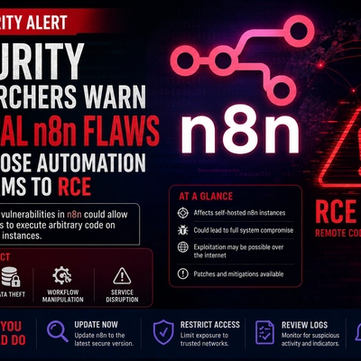
Security Researchers Warn Critical n8n Flaws May Expose Automation Platforms to RCE
Researchers have disclosed critical vulnerabilities in n8n that could expose automation workflows and connected enterprise systems to remote code execution risks, prompting urgent patch recommendations for users and administrators.

How Agentic AI Is Changing Software Engineering and Expanding Mobile Attack Surfaces
Agentic AI is rapidly transforming software engineering workflows through automation and intelligent coding assistance, while cybersecurity experts warn of expanding mobile attack surfaces and emerging application security risks.

₹250 Crore Cyber Scam Busted: Gujarat Police Arrest 19, Including MBA Student
Gujarat Police bust a ₹250 crore cyber fraud network, arresting 19 including an MBA student. Here's how the mule account scam worked.