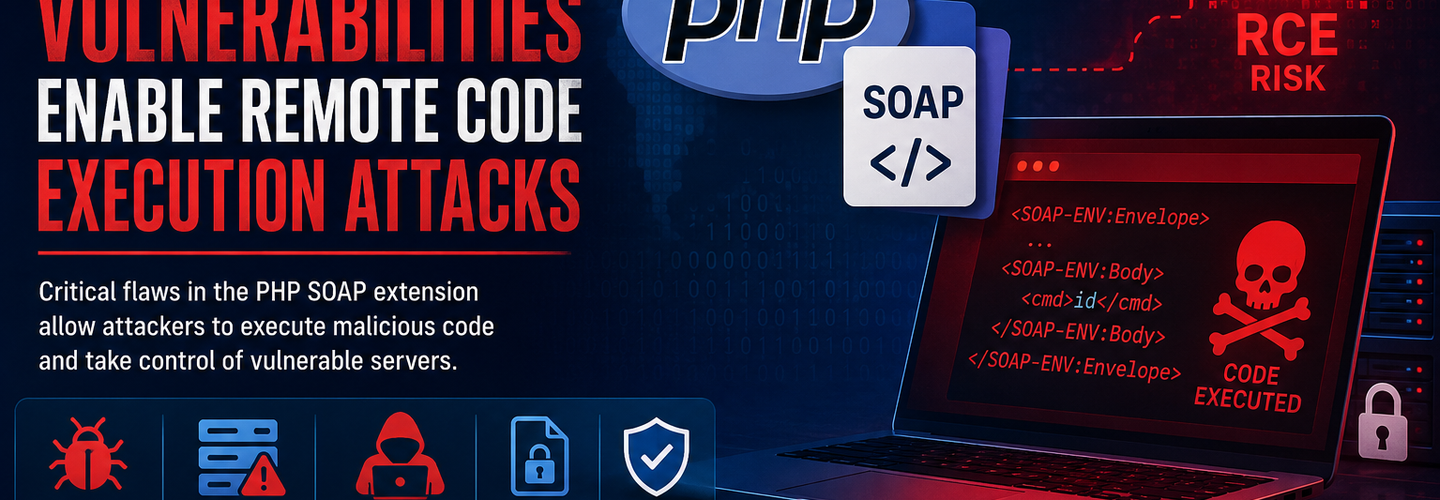
PHP SOAP Vulnerabilities Enable Remote Code Execution
## KEY HIGHLIGHTS
- ▸Critical vulnerabilities in the PHP SOAP extension can enable remote code execution attacks.
- ▸Attackers may exploit crafted SOAP requests to compromise vulnerable servers remotely.
- ▸The flaws primarily impact enterprise applications using SOAP-based web services.
- ▸Unpatched PHP deployments increase the risk of ransomware and data theft incidents.
- ▸Memory corruption and deserialization weaknesses are common exploitation vectors.
- ▸Organizations should immediately update PHP versions and restrict SOAP exposure.
- ▸Monitoring abnormal XML requests can help detect active exploitation attempts.
PHP SOAP Vulnerabilities Enable Remote Code Execution
## Introduction
A newly disclosed set of PHP SOAP vulnerabilities has raised serious concerns for organizations running PHP-based web services. Security researchers warn that attackers can exploit these flaws to execute malicious code remotely without authentication.
SOAP may feel outdated compared to REST APIs, but many enterprise systems still rely on it for financial platforms, healthcare applications, and internal integrations. That makes these vulnerabilities particularly dangerous.
According to recent industry reports, PHP powers nearly 75% of websites using server-side scripting technologies. Even a small percentage of exposed SOAP services creates a massive attack surface.
For IT administrators and security teams, the message is clear: vulnerable PHP SOAP implementations can become an entry point for full server compromise.
## What Are PHP SOAP Extension Vulnerabilities?
The PHP SOAP extension allows applications to exchange structured XML messages using the SOAP protocol. It is widely used in enterprise environments where legacy integrations remain active.
The problem arises when the extension improperly handles malicious SOAP requests. Attackers can abuse weaknesses in XML parsing, memory management, or object handling mechanisms.
In several reported cases, researchers identified flaws capable of triggering:
- ▸Memory corruption
- ▸Arbitrary file access
- ▸Denial-of-service conditions
- ▸Remote code execution attacks
One major concern involves unsafe deserialization behaviors. Crafted XML payloads can manipulate application logic and force the server to execute unauthorized commands.
A similar exploitation method was observed in previous enterprise middleware attacks, including vulnerabilities targeting Java SOAP services and Microsoft Exchange integrations.
Cybersecurity analysts note that SOAP-based applications often receive less security scrutiny than modern APIs. That increases the likelihood of overlooked vulnerabilities remaining active in production systems.
## Why These Vulnerabilities Matter
The impact of remote code execution attacks is severe because attackers can gain direct control over affected servers.
Once compromised, systems may be used for:
- ▸Deploying ransomware
- ▸Stealing sensitive databases
- ▸Establishing persistence
- ▸Moving laterally inside enterprise networks
- ▸Hosting phishing infrastructure
In 2024, ransomware attacks exploiting public-facing services increased by more than 30%, according to multiple threat intelligence reports. Attackers increasingly target exposed middleware and outdated server components.
SOAP services are especially attractive because they often process highly privileged internal operations.
Consider a financial organization using SOAP APIs for transaction processing. If attackers compromise the SOAP service, they may gain access to backend databases, authentication systems, or payment workflows.
A real-world example occurred when threat actors exploited insecure XML processing in enterprise middleware platforms to gain unauthorized server access. The attackers later deployed cryptominers and credential-stealing malware.
Another issue is visibility. Many organizations do not realize SOAP endpoints remain publicly accessible. These services may operate quietly for years without security reviews.
That creates ideal conditions for opportunistic attackers scanning the internet for vulnerable PHP servers.
## How Remote Code Execution Attacks Work
Most PHP security flaws in SOAP environments follow a predictable exploitation chain.
1. Discovery of Exposed SOAP Endpoints
Attackers first scan internet-facing applications for SOAP services. Common indicators include WSDL files and XML response structures.
Automated tools can identify vulnerable endpoints within minutes.
2. Delivery of Malicious XML Payloads
The attacker sends specially crafted SOAP requests designed to trigger weaknesses in the PHP SOAP parser.
These payloads may exploit:
- ▸Buffer overflows
- ▸XML entity processing
- ▸Use-after-free conditions
- ▸Object injection flaws
3. Triggering Memory Corruption
Once processed, the malicious payload corrupts memory structures inside the PHP runtime.
This can allow attackers to redirect execution flow and run arbitrary commands.
4. Remote Code Execution
After successful exploitation, attackers gain the ability to execute shell commands remotely.
From there, they may install malware, create admin accounts, or exfiltrate sensitive data.
Security telemetry from 2025 shows that web application exploitation remains one of the top initial access vectors in enterprise breaches.
Researchers also observed increasing use of AI-assisted vulnerability scanning tools, enabling attackers to discover exposed SOAP services faster than before.
## How to Protect Against PHP SOAP Exploits
Organizations using SOAP services should treat these vulnerabilities as high priority.
Update PHP Immediately
The first and most important step is patching vulnerable PHP versions.
Apply official security updates as soon as they become available. Unsupported PHP releases should be retired immediately.
Restrict SOAP Exposure
Public-facing SOAP endpoints should be minimized whenever possible.
If SOAP services are only needed internally, restrict access using:
- ▸VPNs
- ▸IP allowlists
- ▸Zero Trust policies
- ▸API gateways
Disable Unused SOAP Components
Many servers enable the SOAP extension by default even when applications do not require it.
Disabling unused extensions reduces the overall attack surface.
Deploy Web Application Firewalls
Modern WAF solutions can help identify malicious XML requests and suspicious payload patterns.
Rules designed for XML-based attacks can block exploitation attempts before they reach the application.
Monitor Logs and XML Traffic
Security teams should monitor for:
- ▸Unusual SOAP requests
- ▸Large XML payloads
- ▸Repeated parsing failures
- ▸Unexpected outbound connections
Early detection significantly reduces breach impact.
Conduct Security Audits
Legacy integrations often escape regular assessments.
Periodic penetration testing and configuration reviews help identify exposed SOAP services before attackers do.
A 2025 enterprise security survey found that organizations performing quarterly vulnerability assessments reduced critical exposure windows by nearly 40%.
## Recent Trends
Threat actors are increasingly targeting overlooked enterprise technologies rather than mainstream applications alone.
Recent trends show:
- ▸XML and SOAP exploitation attempts increased significantly in enterprise environments during 2024.
- ▸Nearly 60% of organizations still maintain at least one legacy SOAP-based integration.
- ▸Remote exploitation vulnerabilities remain among the most weaponized attack categories.
- ▸Internet-wide scanning activity for vulnerable web services continues to rise.
Security vendors also reported growth in automated exploit frameworks capable of targeting PHP services within hours of public vulnerability disclosure.
This rapid weaponization shortens the patching window dramatically.
Researchers warn that organizations relying on legacy infrastructure face elevated risks because older systems often lack modern security controls.
For defenders, proactive asset discovery is becoming just as important as patch management itself.
## Conclusion
Critical PHP SOAP vulnerabilities highlight the persistent risks associated with legacy web technologies. Although SOAP services are less visible today, they remain deeply embedded in enterprise environments.
Attackers understand that outdated integrations frequently contain weak security controls and limited monitoring. That makes vulnerable SOAP endpoints attractive targets for remote code execution attacks.
Organizations should immediately audit PHP deployments, patch exposed systems, and restrict unnecessary SOAP access. Security teams must also improve visibility into legacy services operating across their infrastructure.
Ignoring these vulnerabilities could leave critical systems exposed to ransomware, data theft, and full server compromise.
## FAQ SECTION
Q: What are PHP SOAP vulnerabilities?
A: PHP SOAP vulnerabilities are security flaws affecting the PHP SOAP extension that processes XML-based SOAP requests. Attackers may exploit these weaknesses to trigger remote code execution or server compromise.
Q: How dangerous are remote code execution attacks?
A: Remote code execution attacks are considered critical because attackers can run malicious commands directly on vulnerable systems. This may lead to ransomware deployment, data theft, or complete server takeover.
Q: Which systems are most at risk from PHP SOAP exploits?
A: Enterprise applications using legacy SOAP integrations are most vulnerable. Financial services, healthcare systems, and older internal APIs commonly rely on the PHP SOAP extension.
Q: How can organizations protect against PHP SOAP vulnerabilities?
A: Organizations should patch PHP immediately, disable unused SOAP services, restrict endpoint exposure, and monitor suspicious XML traffic for exploitation attempts.
Q: Are SOAP services still widely used today?
A: Yes. Despite the rise of REST APIs, many enterprises still depend on SOAP for legacy integrations and backend communication, making SOAP security highly relevant.
Read More:
Pentagon’s CYBERCOM Requests Massive AI Funding Jump for Cybersecurity
Google Reports North Korean Hackers Using AI to Target Cybersecurity Blind Spots
## Analyst Commentary & Implementation Blueprint
Security advisory
Continuous security exposure assessment is critical to identifying public vulnerabilities before they are exploited. Organizations should maintain a passive inventory of all web servers, TLS configs, and open ports, ensuring that default configurations are eliminated and security advisories are actively implemented.
Hardened Security Configuration Blueprint
# General Security Hardening Directive
ServerTokens ProductOnly
ServerSignature Off
FileETag None
Actionable Mitigation Checklist
- ✔Perform passive asset inventories weekly.
- ✔Restrict administrative ports using local firewall controls.
- ✔Monitor active CVE alerts for exposed software.
Common Inquiries & FAQs
Why is passive scanning preferred for continuous auditing?
Passive audits do not cause operational impact or trigger firewall blocks, making them ideal for constant surveillance of internet-facing assets.
What should I do if a vulnerability is flagged?
Apply the latest vendor patches, restrict access to the resource via firewalls, or verify configuration flags to mitigate risks.
Surendra Reddy
Surendra Reddy is a cybersecurity researcher and founder of ReconShield, specializing in OSINT and defensive infrastructure analysis.
Connect on LinkedIn ↗// AUDIT BRIEFING DISCUSSION (2 COMMENTS)
Great breakdown of the passive infrastructure vectors. We recently audited our external DNS zones and found multiple dangling staging environments. Implementing wildcard certificates reduced our CT log leaks significantly.
Is there any automated tooling you recommend for daily crt.sh scraping? Manually checking CT logs is becoming unsustainable for our domain portfolio.
// MORE ARTICLES
Security Researchers Warn Critical n8n Flaws May Expose Automation Platforms to RCE
Researchers have disclosed critical vulnerabilities in n8n that could expose automation workflows and connected enterprise systems to remote code execution risks, prompting urgent patch recommendations for users and administrators.

How Agentic AI Is Changing Software Engineering and Expanding Mobile Attack Surfaces
Agentic AI is rapidly transforming software engineering workflows through automation and intelligent coding assistance, while cybersecurity experts warn of expanding mobile attack surfaces and emerging application security risks.

Critical Tenda Router Backdoor (CVE-2026-11405): Check If Your Device Is Vulnerable Now
CVE-2026-11405 is an unpatched Tenda router backdoor granting full admin access without a password. Check if your model is affected now.