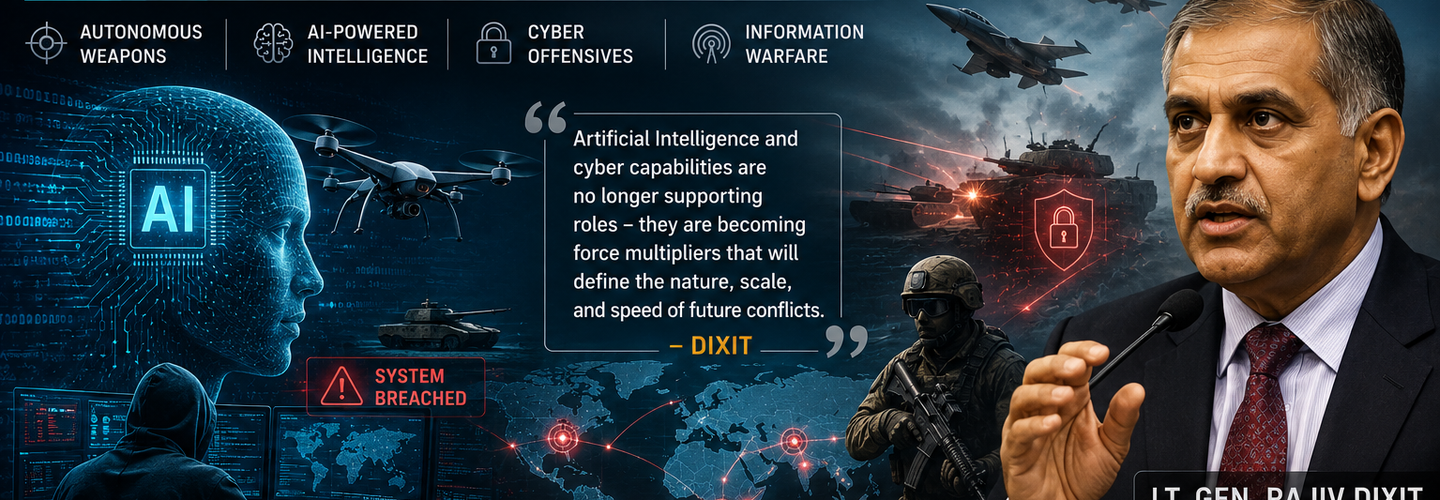
AI & Cyber Warfare Will Shape Future Conflicts: Dixit
KEY HIGHLIGHTS
- ▸Air Marshal Ashutosh Dixit, Chief of Integrated Defence Staff, declared that future conflicts will be decided not just by fighter jets, but by AI, cyber warfare, autonomous systems, and industrial resilience.
- ▸His remarks came at a Mumbai conclave on May 7, 2026 the first anniversary of Operation Sindoor underscoring how India's indigenous defence capability is being stress-tested in real conflicts.
- ▸India's defence exports have surpassed ₹39,000 crore, with over ₹5 lakh crore in approved projects mandating Indian-made systems.
- ▸Only 20% of modern conflicts are now determined by platform superiority; supply chain strength, rapid innovation, and MSME integration are now equally decisive factors.
- ▸Dixit confirmed that manned fighter jets will remain relevant for at least the next century, but the near-term shift will be toward Manned-Unmanned Teaming (MUMT).
- ▸Cyber vulnerabilities in autonomous systems including jamming resistance and secure communications remain the primary barrier to fully unmanned combat aircraft.
- ▸India's IAF plans to launch 52 satellites in the coming year, 31 built by private firms, to dramatically expand space-based surveillance and ISR capabilities.
The Battlefield Has Moved. Has Your Security Strategy?
The wars of the next decade won't be won in the sky alone. They'll be won or lost in server rooms, data pipelines, electromagnetic spectrums, and AI inference engines operating faster than any human can react.
That was the core message from Air Marshal Ashutosh Dixit, Chief of Integrated Defence Staff (CISC), speaking at a high-level defence conclave in Mumbai on May 7, 2026 exactly one year after Operation Sindoor reshaped India's perception of modern warfare.
His warning applies as much to corporate security teams and critical infrastructure operators as it does to military planners.
What Air Marshal Dixit Actually Said and Why It Matters
Delivering the inaugural keynote at the Brahma Research Foundation (BRF) conclave on Atmanirbharta in Defence, Air Marshal Dixit stated that modern conflicts will be shaped not only by platforms such as fighter aircraft and warships, but also by AI, cyber warfare, autonomous systems, drones, advanced electronics, and industrial resilience.
This is a significant strategic reframe from a serving military chief — not a think-tank analyst, not a vendor selling solutions. The man responsible for India's integrated defence architecture is publicly acknowledging that conventional military hardware is no longer sufficient on its own.
Dixit stressed that future warfare would be shaped by strategic superiority rooted in resilient supply chains, rapid innovation, scalable manufacturing, and robust participation from micro, small and medium enterprises.
Read that again: supply chain resilience and scalable manufacturing are now listed alongside fighter jets as determinants of battlefield outcomes. That's a direct lesson drawn from Operation Sindoor and from watching Ukraine, Azerbaijan, and Israel fight wars defined as much by logistics and electronic warfare as by air power.
Operation Sindoor: The Real-World Case Study
The event coincided with the first anniversary of Operation Sindoor, launched on May 7, 2025, in response to a terrorist attack in Jammu and Kashmir's Pahalgam that killed 26 people. The Indian Air Force, using loitering munitions and precision-guided weapons supported by artillery, struck nine terror-related sites in Pakistan.
Dixit described Operation Sindoor as a defining demonstration of India's growing indigenous military capability. The operation deployed loitering munitions essentially autonomous kamikaze drones alongside precision-guided weapons and real-time ISR integration.
This wasn't legacy warfare. It was a preview of what combined AI-enabled, multi-domain conflict looks like in practice. The cyber dimension, electronic warfare jamming, and signals intelligence all ran in parallel to the kinetic strikes.
For cybersecurity professionals, this is the operational proof point that digital and physical warfare are now permanently fused. An adversary that can compromise command-and-control communications, spoof GPS coordinates, or inject false sensor data changes the outcome of kinetic operations without firing a single shot.
Why Cyber Warfare Is Now a First-Tier Military Capability
Air Marshal Dixit emphasized that future conflicts would increasingly require simultaneous operations across various domains such as land, air, sea, cyber, and space. Joint planning and integrated operations are vital for achieving operational success.
Cyber is no longer a support function for military operations it's a primary domain of conflict with its own offensive and defensive strategies.
"ISR is central to modern conflict. Remotely Operated Systems, as demonstrated in Ukraine and West Asia, have changed the nature of warfare," Dixit stated.
Intelligence, Surveillance, and Reconnaissance historically the domain of satellites and reconnaissance aircraft now includes cyber-enabled signals intelligence, AI-driven pattern recognition, and adversarial network penetration. The nation or organisation that controls the information layer controls the battlefield.
The implications for critical infrastructure operators in India are direct. Power grids, financial systems, communications networks, and logistics chains are all valid targets in a cyber-kinetic conflict. Hardening these systems isn't a compliance exercise it's national security work.
The Role of AI: Both the Threat and the Defence
Dixit advocated for enhanced collaboration with the private sector, declaring that India's technology industry must spearhead the development of multispectral, all-weather systems integrated with artificial intelligence. He highlighted that AI-driven imaging and predictive threat analytics could transition surveillance efforts from passive to intelligent.
On the autonomous systems front, Dixit's position is nuanced and operationally grounded. He firmly dismissed the idea that the era of fighter jets is ending, asserting that fighter jets will remain relevant for at least the next century, while stating that the future of aerial warfare lies in Manned-Unmanned Teaming (MUMT).
The reason isn't sentimentality for manned platforms. It's cybersecurity. Fully autonomous fighters require breakthroughs in AI to handle complex scenarios, robust cybersecurity to counter jamming, and reliable communication links in contested environments.
This is the paradox at the heart of military AI: the same connected, data-driven systems that make autonomous platforms powerful also make them vulnerable to cyber attack. An unmanned aircraft that can be jammed, spoofed, or hijacked via compromised communications links is a liability, not an asset.
Integrating drones with manned platforms enables seamless sensor fusion, shared mission tasks, and force multiplication improving combat effectiveness and lowering risk to human life. MUMT is the answer precisely because it keeps human judgment in the loop on high-stakes decisions while leveraging AI for speed and scale on lower-order tasks.
How to Prepare: Lessons for Security Leaders
Dixit's address wasn't just military doctrine. It was a roadmap for how organisations public and private need to think about security in a multi-domain threat environment.
1. Treat Cyber as a Combat Domain, Not a Support Function In modern conflict, cyber attacks precede and accompany kinetic operations. Security Operations Centres need to operate with the same real-time responsiveness as military command centres not as reactive IT help desks.
2. Build Resilient Supply Chains Dixit urged MSMEs to evolve from being conventional vendors into long-term strategic partners embedded in the national security architecture. For private organisations, this translates directly: your supply chain security is your security. A compromised vendor is a compromised perimeter.
3. Invest in AI-Powered Surveillance and Threat Detection Dixit called for AI-driven imaging seekers and predictive threat analytics that can shift surveillance from passive to intelligent, noting that interoperability and scalability will define future systems. The same principle applies to enterprise security: passive logging is insufficient. AI-enabled behavioural analytics and predictive threat modelling are the new baseline.
4. Secure Autonomous and Connected Systems Every drone, IoT sensor, industrial controller, or AI inference system connected to a network is a potential attack surface. Organisations deploying autonomous or semi-autonomous systems must embed zero trust principles at the architecture level — not as an afterthought.
5. Develop a Multi-Domain Incident Response Plan Modern attacks don't respect domain boundaries. A ransomware attack on a logistics provider can ground aircraft. A GPS spoofing campaign can disrupt port operations. Incident response plans must account for cross-domain escalation scenarios.
2025–2026: The Threat Landscape Confirming Dixit's Warning
The strategic picture Dixit described isn't theoretical it's already in motion.
Citing lessons from global conflicts such as the Armenia &Azerbaijan war, the Russia-Ukraine war, and the Israel-Hamas hostilities, as well as India's own Operation Sindoor, Dixit highlighted how timely intelligence and advanced surveillance consistently shift the tide in favour of the better-prepared side.
In the Russia &Ukraine conflict, cyber attacks on Ukraine's power grid, satellite communications, and logistics systems ran in parallel with missile strikes a live demonstration of cyber-kinetic warfare at national scale. Air Marshal Dixit addressed psychological narratives as a distinct warfare dimension, noting that media reporting during operations like Operation Sindoor plays a kind of psychological warfare role in shaping public perception.
On India's own capability trajectory: the Indian Air Force plans to launch 52 satellites in the coming year 31 of which will be built by private firms — to boost space-based surveillance capabilities. That's a massive expansion of ISR capacity, and it will generate an equally massive volume of data requiring AI-driven processing and cyber-hardened transmission pipelines.
Meanwhile, India's defence exports have crossed ₹39,000 crore, while defence projects worth over ₹5 lakh crore approved in recent years carry a specific mandate for Indian-made systems. Atmanirbharta isn't aspirational anymore it's procurement policy.
Conclusion
Air Marshal Dixit's remarks at the BRF conclave are more than a military briefing. They're a strategic signal that the distinction between military cybersecurity and enterprise cybersecurity is collapsing.
The same AI systems, the same communication networks, the same cloud infrastructure, and the same supply chains that power civilian organisations are the foundations of modern military capability. Attacking one increasingly means attacking both.
For security professionals and IT leaders across India and the broader APAC region, Dixit's message is clear: the future belongs to organisations that invest in AI-readiness, cyber resilience, and multi-domain threat visibility now, not after the next incident forces the issue.
The fighter jet still matters. But the next war will be decided before a single aircraft takes off.
FAQ Section
Q: What did Air Marshal Ashutosh Dixit say about AI and cyber warfare? A: Speaking at the BRF conclave in Mumbai in May 2026, Dixit stated that modern conflicts will be shaped not only by fighter aircraft and warships but also by AI, cyber warfare, autonomous systems, drones, and industrial resilience. He identified these capabilities as equally decisive as traditional military hardware in future conflicts.
Q: What is Operation Sindoor and why is it relevant to cyber warfare? A: Operation Sindoor was an Indian Air Force operation launched on May 7, 2025, targeting nine terror-related sites in Pakistan following a deadly terrorist attack in Pahalgam. It employed loitering munitions, precision-guided weapons, and advanced ISR — demonstrating how modern kinetic operations are inseparable from cyber, electronic, and AI-enabled capabilities.
Q: Will manned fighter jets become obsolete due to AI and drones? A: According to Air Marshal Dixit, no — manned jets will remain relevant for at least the next century. The key barrier to fully autonomous combat aircraft is cybersecurity: autonomous systems are vulnerable to jamming, GPS spoofing, and communication link compromise. The near-term future is Manned-Unmanned Teaming (MUMT), not full autonomy.
Q: How should Indian enterprises respond to the rise of cyber warfare? A: Enterprises should treat cyber operations as a primary risk domain — not an IT support function. This means deploying AI-powered threat detection, securing supply chains with zero trust principles, building cross-domain incident response plans, and investing in autonomous system security. India's critical infrastructure sits at the intersection of military and civilian risk.
Q: What is Manned-Unmanned Teaming and why does it matter for cyber security? A: MUMT refers to the integration of manned aircraft with autonomous drone wingmen, sharing sensor data and mission tasks. From a cybersecurity perspective, MUMT systems represent complex attack surfaces compromising their data links, GPS inputs, or AI decision systems could neutralise their effectiveness. Securing these integrated systems is one of the defining cybersecurity challenges of the next decade.
Read More:
PHP SOAP Vulnerabilities Enable Remote Code Execution
Google Reports North Korean Hackers Using AI to Target Cybersecurity Blind Spots
UK Cybercrime Reform Protects Ethical Hackers
Foxconn Cyberattack: Hackers Claim Apple & Google Data Stolen
## Analyst Commentary & Implementation Blueprint
Security advisory
Continuous security exposure assessment is critical to identifying public vulnerabilities before they are exploited. Organizations should maintain a passive inventory of all web servers, TLS configs, and open ports, ensuring that default configurations are eliminated and security advisories are actively implemented.
Hardened Security Configuration Blueprint
# General Security Hardening Directive
ServerTokens ProductOnly
ServerSignature Off
FileETag None
Actionable Mitigation Checklist
- ✔Perform passive asset inventories weekly.
- ✔Restrict administrative ports using local firewall controls.
- ✔Monitor active CVE alerts for exposed software.
Common Inquiries & FAQs
Why is passive scanning preferred for continuous auditing?
Passive audits do not cause operational impact or trigger firewall blocks, making them ideal for constant surveillance of internet-facing assets.
What should I do if a vulnerability is flagged?
Apply the latest vendor patches, restrict access to the resource via firewalls, or verify configuration flags to mitigate risks.
Surendra Reddy
Surendra Reddy is a cybersecurity researcher and founder of ReconShield, specializing in OSINT and defensive infrastructure analysis.
Connect on LinkedIn ↗// AUDIT BRIEFING DISCUSSION (2 COMMENTS)
Great breakdown of the passive infrastructure vectors. We recently audited our external DNS zones and found multiple dangling staging environments. Implementing wildcard certificates reduced our CT log leaks significantly.
Is there any automated tooling you recommend for daily crt.sh scraping? Manually checking CT logs is becoming unsustainable for our domain portfolio.
// MORE ARTICLES

Security Researchers Warn Critical n8n Flaws May Expose Automation Platforms to RCE
Researchers have disclosed critical vulnerabilities in n8n that could expose automation workflows and connected enterprise systems to remote code execution risks, prompting urgent patch recommendations for users and administrators.

How Agentic AI Is Changing Software Engineering and Expanding Mobile Attack Surfaces
Agentic AI is rapidly transforming software engineering workflows through automation and intelligent coding assistance, while cybersecurity experts warn of expanding mobile attack surfaces and emerging application security risks.

Critical Tenda Router Backdoor (CVE-2026-11405): Check If Your Device Is Vulnerable Now
CVE-2026-11405 is an unpatched Tenda router backdoor granting full admin access without a password. Check if your model is affected now.