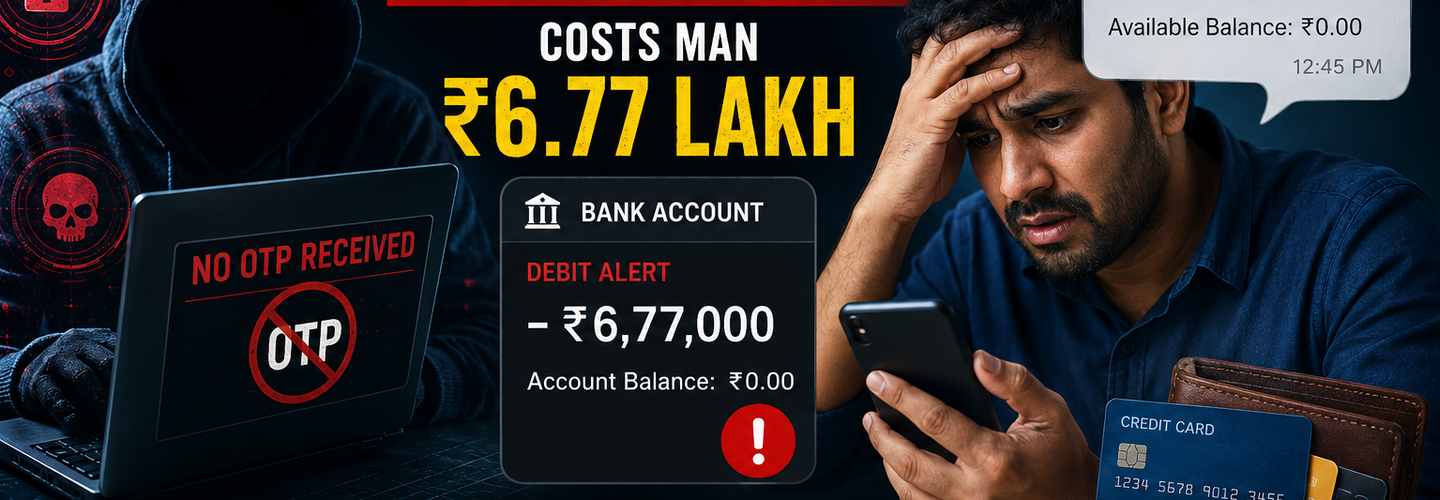
Cyber Fraud Without OTP Costs Man ₹6.77 Lakh
## KEY HIGHLIGHTS
- ▸A victim reportedly lost ₹6.77 lakh without receiving any OTP or banking alert.
- ▸Cybercriminals increasingly exploit remote access apps and phishing techniques.
- ▸OTP-less fraud often targets mobile banking sessions and linked payment apps.
- ▸SIM swap attacks and banking malware can bypass traditional authentication methods.
- ▸India recorded a sharp rise in digital payment fraud cases in 2024–2025.
- ▸Security experts recommend device-level protection alongside banking safeguards.
- ▸Fast reporting to banks and cybercrime authorities improves fund recovery chances.
A man reportedly lost ₹6.77 lakh in a cyber fraud without OTP verification, raising serious concerns about modern banking security. Most users believe OTPs are the final barrier against unauthorized transactions. Cases like this prove otherwise.
According to India’s National Cyber Crime Reporting Portal, financial cybercrime complaints crossed hundreds of thousands annually, with mobile banking scams leading the trend. Attackers are evolving faster than traditional user awareness campaigns.
The absence of an OTP often creates confusion. Victims assume banks are responsible, while investigators discover deeper technical manipulation behind the scenes.
## What Is Cyber Fraud Without OTP?
Cyber fraud without OTP refers to unauthorized financial transactions where money is withdrawn or transferred without the victim entering a one-time password.
Traditionally, banks use OTPs as a second authentication layer. However, cybercriminals now exploit methods that bypass or manipulate this system entirely.
Common attack methods include:
- ▸Session hijacking
- ▸SIM swap fraud
- ▸Mobile malware infections
- ▸Remote access application abuse
- ▸Banking trojans
- ▸Phishing-linked credential theft
In many incidents, victims unknowingly grant access to their devices. Once attackers gain control, they can operate banking applications directly from the authenticated session.
A 2025 cybersecurity industry report showed that mobile banking malware attacks increased by more than 30% globally compared to the previous year.
One common misconception is that OTP absence means no compromise occurred. In reality, fraudsters often exploit already authenticated sessions or linked payment approvals.
## Why This Incident Matters
The reported ₹6.77 lakh loss highlights a growing weakness in digital banking trust models. Many users rely entirely on SMS alerts and OTP verification for safety.
That assumption is dangerous.
India’s rapid digital payment growth has created a larger attack surface. UPI transactions alone crossed billions monthly in 2025, making financial apps a prime target for attackers.
For enterprises and security teams, these scams demonstrate three major risks:
1. Mobile Devices Are the New Attack Vector
Cybercriminals increasingly target smartphones instead of traditional desktop systems. Banking apps, stored credentials, and SMS access make phones highly valuable.
2. Social Engineering Still Works
Many attacks begin with fake customer support calls, phishing links, or “KYC update” requests.
Victims often install remote access apps believing they are receiving technical assistance.
3. Authentication Alone Is Not Enough
Multi-factor authentication helps, but compromised devices can still enable fraudulent transactions.
Security professionals now focus on behavioral monitoring, device fingerprinting, and anomaly detection rather than relying solely on OTP systems.
A real-world example involved fraudsters impersonating telecom representatives to perform SIM swap attacks. Once the victim’s mobile number was transferred, attackers intercepted banking communications and drained accounts within hours.
## How OTP-Less Banking Fraud Works
Cybercriminals use multiple techniques to execute online banking scams without triggering OTP verification.
Remote Access App Exploitation
Attackers convince victims to install remote support applications.
Once installed, criminals gain visibility and control over the device screen. If the banking app is already logged in, transactions can proceed directly.
Some malware variants even suppress notifications and banking alerts.
Session Hijacking
In session hijacking attacks, criminals steal active authentication tokens from infected devices.
This allows them to bypass login verification entirely.
According to cybersecurity researchers, session-based attacks rose significantly during 2024 due to increased mobile browser vulnerabilities.
SIM Swap Fraud
SIM swap fraud occurs when attackers convince telecom providers to transfer a victim’s number to a new SIM card.
After takeover, attackers intercept calls, OTPs, and banking recovery messages.
India has witnessed several high-profile SIM swap fraud cases targeting both individuals and business executives.
Banking Malware
Modern banking trojans target Android devices aggressively.
These malicious applications overlay fake banking login pages, capture credentials, and manipulate transactions silently in the background.
Some advanced malware can even delete SMS alerts automatically.
## Best Practices to Protect Yourself
Protecting against digital payment fraud requires layered security practices.
Avoid Remote Access Apps
Never install remote control applications at the request of unknown callers.
Banks rarely ask customers to download support tools.
Enable Banking App Security Features
Use biometric authentication, transaction limits, and device binding whenever available.
Biometric verification reduces unauthorized access risks significantly.
Monitor Banking Activity Frequently
Do not rely only on SMS alerts.
Review account statements and transaction logs daily, especially for high-value accounts.
Secure Your Mobile Device
Install trusted mobile security software and keep operating systems updated.
Research shows outdated Android devices face substantially higher malware infection rates.
Beware of Phishing Links
Avoid clicking unknown links received through SMS, email, or messaging platforms.
Many phishing sites mimic legitimate bank portals convincingly.
Use Separate Devices for Banking
Security professionals increasingly recommend dedicated devices for financial transactions.
This reduces exposure to social media malware and malicious applications.
Report Fraud Immediately
Victims should contact banks and India’s cybercrime helpline immediately after detecting suspicious transactions.
Rapid reporting improves the likelihood of freezing fraudulent transfers.
## Recent Trends
Financial cybercrime continues to grow globally.
Recent cybersecurity data indicates:
- ▸Mobile banking malware attacks increased by over 30% in 2025.
- ▸Phishing-related banking scams remain among the top causes of financial fraud.
- ▸India continues to rank among the highest-targeted countries for digital payment attacks.
- ▸UPI-related fraud complaints have surged alongside digital transaction growth.
- ▸Remote access scams increasingly target elderly users and first-time digital banking customers.
Cybersecurity experts also warn about AI-powered phishing campaigns. Fraudsters now generate highly convincing fake support messages and voice impersonations.
Financial institutions are responding with:
- ▸AI-based fraud detection systems
- ▸Behavioral analytics
- ▸Risk-based authentication
- ▸Device intelligence monitoring
- ▸Real-time transaction scoring
Still, user awareness remains the strongest defense layer.
## Conclusion
The ₹6.77 lakh banking cybercrime incident demonstrates how attackers are bypassing traditional security expectations. OTPs alone no longer guarantee protection.
Modern cyber fraud combines technical exploitation with psychological manipulation. Attackers target user trust, mobile devices, and weak digital habits.
For individuals, the priority should be proactive monitoring and cautious device usage. For organizations, stronger fraud analytics and customer awareness programs are essential.
As digital banking adoption expands, cybercriminals will continue refining methods that exploit convenience-driven ecosystems.
## FAQ SECTION
Q: How can money be stolen without receiving an OTP?
A: Attackers may use session hijacking, banking malware, or remote access tools to exploit already authenticated banking sessions. In many cyber fraud without OTP cases, victims unknowingly give attackers device access.
Q: What is the most common OTP bypass scam?
A: Remote access scams and SIM swap attacks are among the most common OTP bypass techniques. Fraudsters manipulate users or telecom systems to gain transaction control.
Q: Can banking malware affect Android phones?
A: Yes. Android banking malware is a major cybersecurity threat. Malicious apps can steal credentials, intercept SMS alerts, and manipulate transactions silently.
Q: What should I do after unauthorized bank transactions?
A: Immediately contact your bank, block cards and online banking access, and report the incident through the national cybercrime portal or helpline.
Q: Are UPI transactions vulnerable to cyber fraud?
A: Yes. UPI systems are frequently targeted through phishing attacks, fake payment requests, and social engineering scams linked to digital payment fraud.
Read More:
PHP SOAP Vulnerabilities Enable Remote Code Execution
Google Reports North Korean Hackers Using AI to Target Cybersecurity Blind Spots
UK Cybercrime Reform Protects Ethical Hackers
Foxconn Cyberattack: Hackers Claim Apple & Google Data Stolen
## Analyst Commentary & Implementation Blueprint
Security advisory
Continuous security exposure assessment is critical to identifying public vulnerabilities before they are exploited. Organizations should maintain a passive inventory of all web servers, TLS configs, and open ports, ensuring that default configurations are eliminated and security advisories are actively implemented.
Hardened Security Configuration Blueprint
# General Security Hardening Directive
ServerTokens ProductOnly
ServerSignature Off
FileETag None
Actionable Mitigation Checklist
- ✔Perform passive asset inventories weekly.
- ✔Restrict administrative ports using local firewall controls.
- ✔Monitor active CVE alerts for exposed software.
Common Inquiries & FAQs
Why is passive scanning preferred for continuous auditing?
Passive audits do not cause operational impact or trigger firewall blocks, making them ideal for constant surveillance of internet-facing assets.
What should I do if a vulnerability is flagged?
Apply the latest vendor patches, restrict access to the resource via firewalls, or verify configuration flags to mitigate risks.
Surendra Reddy
Surendra Reddy is a cybersecurity researcher and founder of ReconShield, specializing in OSINT and defensive infrastructure analysis.
Connect on LinkedIn ↗// AUDIT BRIEFING DISCUSSION (2 COMMENTS)
Great breakdown of the passive infrastructure vectors. We recently audited our external DNS zones and found multiple dangling staging environments. Implementing wildcard certificates reduced our CT log leaks significantly.
Is there any automated tooling you recommend for daily crt.sh scraping? Manually checking CT logs is becoming unsustainable for our domain portfolio.
// MORE ARTICLES

₹250 Crore Cyber Scam Busted: Gujarat Police Arrest 19, Including MBA Student
Gujarat Police bust a ₹250 crore cyber fraud network, arresting 19 including an MBA student. Here's how the mule account scam worked.

Chrome 149 Released With Critical Security Fixes for Windows, macOS, and Linux
Chrome 149 is out with critical security fixes for Windows, macOS, and Linux. Learn what's patched, the risks of waiting, and how to update Chrome now.

Billions of Passwords at Risk After Massive Infostealer Data Leak
Billions of passwords are at risk after a massive infostealer data leak. Learn how the breach happened, who's exposed, and how to secure your accounts now.