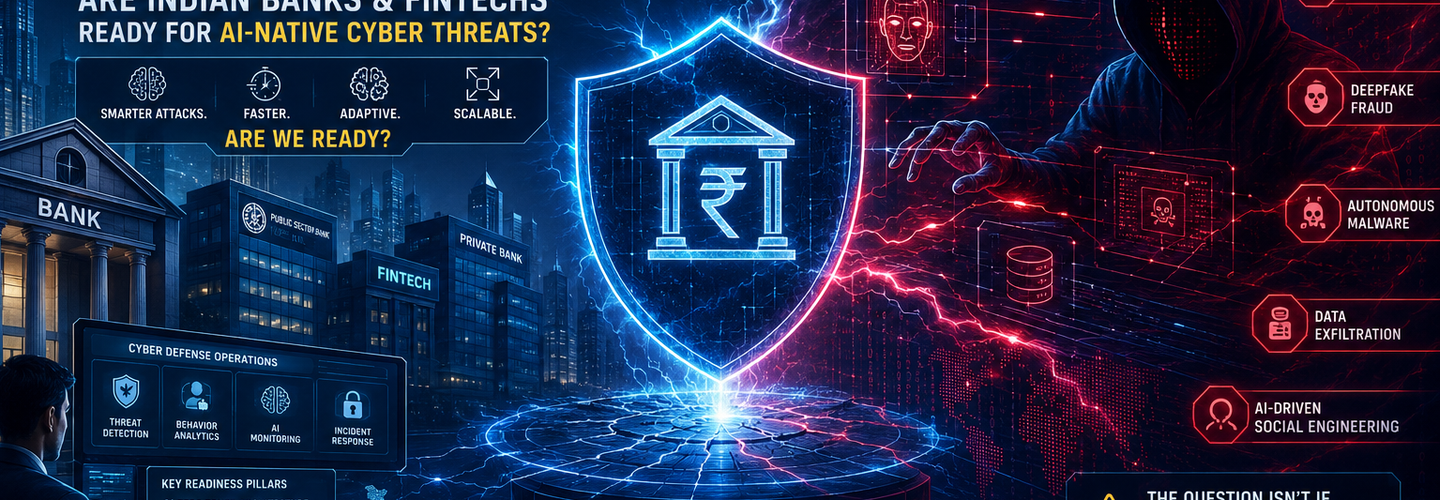
The Mythos Stress Test: Are Indian Banks & Fintechs Ready for AI-Native Cyber Threats?
Anthropic’s frontier AI model “Mythos” is rapidly becoming a global wake-up call for the banking sector. Regulators, central banks, and financial institutions across the U.S., Europe, and Asia are warning that AI-native cyber threats may soon overwhelm traditional security operations. Reuters reported that major U.S. banks are already rushing to patch vulnerabilities identified by Mythos at unprecedented speed.
For India’s fast-growing fintech and banking ecosystem, the implications are profound.
India has become one of the world’s most digitally connected financial economies through:
- ▸UPI infrastructure
- ▸open banking APIs
- ▸digital lending
- ▸neo-banking
- ▸Aadhaar-linked financial systems
- ▸cloud-native fintech architectures
But these same innovations also expand the attack surface.
The central question is no longer whether AI will transform cyber warfare in finance. The question is whether Indian financial institutions can adapt fast enough before AI-driven attackers begin exploiting systemic weaknesses at machine speed.
## Why Mythos Changes the Threat Landscape
Unlike conventional cyber tools, Mythos reportedly excels at:
- ▸chaining together low-risk vulnerabilities
- ▸analyzing legacy infrastructure
- ▸auditing proprietary and open-source code
- ▸accelerating exploit discovery timelines
Reuters reported that banks using Mythos discovered “hundreds to thousands” of vulnerabilities that previously might have taken weeks or months to uncover.
This represents a fundamental shift:
cyber risk is moving from human-speed attacks to AI-speed exploitation.
Traditional security models rely heavily on:
- ▸manual triage
- ▸scheduled patch cycles
- ▸fragmented SOC operations
- ▸reactive threat detection
AI-native threats compress these timelines dramatically.
## Why Indian Fintechs Are Especially Exposed
India’s fintech ecosystem is among the world’s fastest growing, but many organizations face structural cybersecurity challenges:
- ▸rapid scaling
- ▸outsourced infrastructure
- ▸API-heavy architectures
- ▸fragmented vendor ecosystems
- ▸inconsistent cyber maturity
Large Indian banks may have mature SOCs and compliance programs, but smaller fintechs often prioritize growth over resilience.
This creates ideal conditions for AI-assisted attacks.
Key Exposure Areas
1. API Vulnerabilities
Fintech ecosystems rely heavily on:
- ▸payment APIs
- ▸identity verification APIs
- ▸third-party integrations
AI systems can rapidly identify weak authentication flows, misconfigured endpoints, and token leakage patterns.
2. Legacy Banking Infrastructure
Many Indian banks still operate hybrid environments combining:
- ▸modern cloud systems
- ▸decades-old core banking infrastructure
Global regulators have warned that legacy technology stacks are particularly vulnerable to advanced AI-assisted vulnerability discovery.
3. Supply Chain Risks
Fintechs increasingly depend on:
- ▸cloud vendors
- ▸SaaS providers
- ▸analytics tools
- ▸external SDKs
AI-driven attacks targeting shared vendors could create correlated failures across multiple institutions simultaneously.
The IMF recently warned that frontier AI models could trigger “systemic” cyber shocks across the financial system.
## India’s Regulators Are Already Concerned
Indian authorities are beginning to acknowledge the seriousness of AI-native cyber threats.
Financial Services Secretary M. Nagaraju recently warned banks to strengthen operational resilience against risks associated with advanced AI models like Mythos.
Finance Minister Nirmala Sitharaman has also urged financial institutions to improve cyber preparedness and real-time threat coordination in response to evolving AI risks.
These warnings reflect a broader global trend:
- ▸regulators are worried
- ▸banks are racing to patch systems
- ▸AI capabilities are evolving faster than governance models
## The Real Challenge: AI vs Human-Speed Security
One of the biggest problems facing financial institutions is operational speed.
Traditional banking security operates through:
- ▸compliance cycles
- ▸manual audits
- ▸quarterly reviews
- ▸delayed patch management
AI-native cyber threats do not.
Reuters quoted industry leaders warning that banks may now need to patch vulnerabilities within days instead of weeks.
For Indian fintechs operating lean engineering teams, this creates severe pressure.
## Can Indian Institutions Defend Themselves?
The answer depends on how quickly organizations evolve in five critical areas.
1. AI-Powered Defense
Financial institutions will increasingly require:
- ▸AI-assisted SOC operations
- ▸automated threat correlation
- ▸behavioral analytics
- ▸AI-driven anomaly detection
Human-only defense models will struggle against AI-speed attackers.
2. Real-Time Threat Intelligence
Static security monitoring is no longer sufficient.
Organizations need:
- ▸continuous vulnerability intelligence
- ▸automated risk scoring
- ▸external attack surface monitoring
- ▸live threat correlation
3. Faster Patch Management
Patch cycles must become dramatically faster.
This is especially important for:
- ▸exposed APIs
- ▸authentication systems
- ▸third-party integrations
- ▸internet-facing assets
4. Zero Trust Architecture
Perimeter-based security models are becoming obsolete.
Banks and fintechs should move toward:
- ▸least privilege access
- ▸continuous verification
- ▸identity-centric security
- ▸microsegmentation
5. Cyber Resilience Over Prevention
Modern cyber strategy must assume:
breaches are inevitable.
The real differentiator becomes:
- ▸detection speed
- ▸containment
- ▸recovery capability
- ▸operational continuity
## Why Smaller Fintechs Face Greater Risk
Large banks may eventually acquire:
- ▸frontier AI security tools
- ▸advanced SOC capabilities
- ▸dedicated AI risk teams
Smaller fintechs may not.
Reuters noted that access barriers to advanced AI systems remain extremely high due to:
- ▸cost
- ▸compute requirements
- ▸technical complexity
This creates a widening cyber capability gap.
In India’s fintech ecosystem, smaller firms may become the weakest links in interconnected financial supply chains.
## The Next 3 Years Could Redefine Financial Cybersecurity
The Mythos debate is not just about one AI model.
Industry leaders are already warning that more advanced successors are inevitable.
The financial sector is entering an era where:
- ▸AI discovers vulnerabilities
- ▸AI prioritizes targets
- ▸AI accelerates exploit development
- ▸AI enables coordinated attacks at scale
This changes the economics of cyber warfare entirely.
## Why This Matters
India’s digital finance revolution has transformed accessibility, inclusion, and innovation. But it has also created one of the world’s largest interconnected financial attack surfaces.
If AI-native cyber threats evolve faster than institutional defenses:
- ▸payment systems could face disruption
- ▸customer trust could erode
- ▸systemic cyber risk could increase significantly
The institutions that survive this transition will not necessarily be the largest.
They will be the fastest to adapt.
## How Indian Banks & Fintechs Can Stay Prepared
- ▸Invest in AI-assisted cybersecurity operations
- ▸Reduce dependency on legacy systems
- ▸Continuously monitor external attack surfaces
- ▸Strengthen API security governance
- ▸Accelerate vulnerability patching cycles
- ▸Conduct AI-focused cyber stress testing
- ▸Improve vendor and supply chain security
- ▸Build rapid incident response capabilities
- ▸Train teams on AI-native threat scenarios
- ▸Adopt zero trust security frameworks
Read More:
PHP SOAP Vulnerabilities Enable Remote Code Execution
Google Reports North Korean Hackers Using AI to Target Cybersecurity Blind Spots
UK Cybercrime Reform Protects Ethical Hackers
Foxconn Cyberattack: Hackers Claim Apple & Google Data Stolen
## Analyst Commentary & Implementation Blueprint
Security advisory
Continuous security exposure assessment is critical to identifying public vulnerabilities before they are exploited. Organizations should maintain a passive inventory of all web servers, TLS configs, and open ports, ensuring that default configurations are eliminated and security advisories are actively implemented.
Hardened Security Configuration Blueprint
# General Security Hardening Directive
ServerTokens ProductOnly
ServerSignature Off
FileETag None
Actionable Mitigation Checklist
- ✔Perform passive asset inventories weekly.
- ✔Restrict administrative ports using local firewall controls.
- ✔Monitor active CVE alerts for exposed software.
Common Inquiries & FAQs
Why is passive scanning preferred for continuous auditing?
Passive audits do not cause operational impact or trigger firewall blocks, making them ideal for constant surveillance of internet-facing assets.
What should I do if a vulnerability is flagged?
Apply the latest vendor patches, restrict access to the resource via firewalls, or verify configuration flags to mitigate risks.
Surendra Reddy
Surendra Reddy is a cybersecurity researcher and founder of ReconShield, specializing in OSINT and defensive infrastructure analysis.
Connect on LinkedIn ↗// AUDIT BRIEFING DISCUSSION (2 COMMENTS)
Great breakdown of the passive infrastructure vectors. We recently audited our external DNS zones and found multiple dangling staging environments. Implementing wildcard certificates reduced our CT log leaks significantly.
Is there any automated tooling you recommend for daily crt.sh scraping? Manually checking CT logs is becoming unsustainable for our domain portfolio.
// MORE ARTICLES
Security Researchers Warn Critical n8n Flaws May Expose Automation Platforms to RCE
Researchers have disclosed critical vulnerabilities in n8n that could expose automation workflows and connected enterprise systems to remote code execution risks, prompting urgent patch recommendations for users and administrators.
How Agentic AI Is Changing Software Engineering and Expanding Mobile Attack Surfaces
Agentic AI is rapidly transforming software engineering workflows through automation and intelligent coding assistance, while cybersecurity experts warn of expanding mobile attack surfaces and emerging application security risks.
Critical Tenda Router Backdoor (CVE-2026-11405): Check If Your Device Is Vulnerable Now
CVE-2026-11405 is an unpatched Tenda router backdoor granting full admin access without a password. Check if your model is affected now.