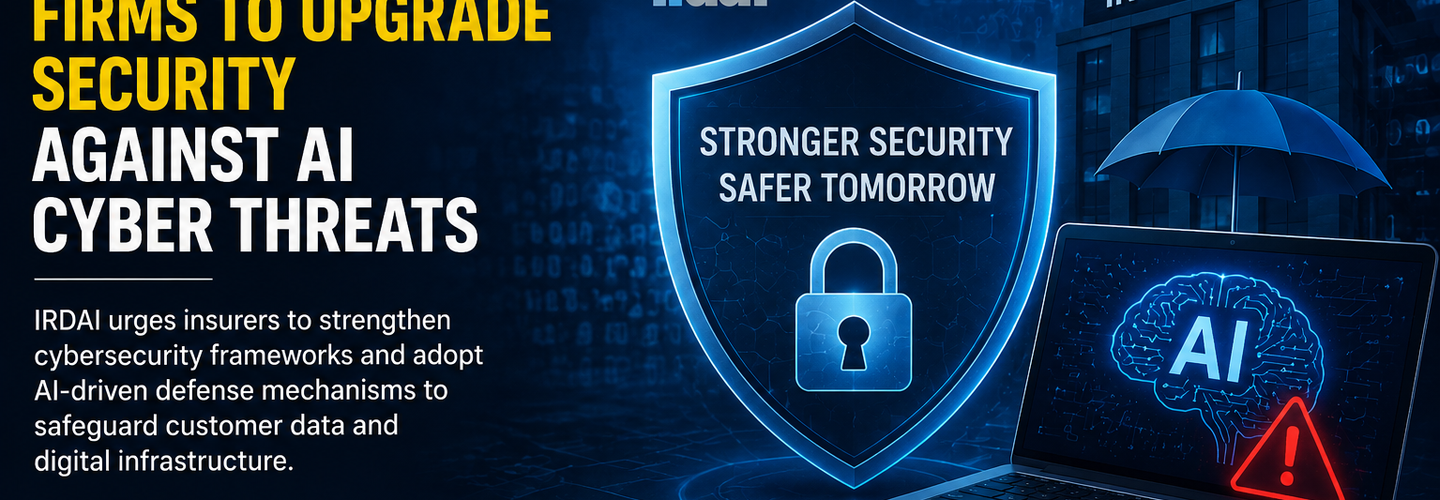
IRDAI Pushes Insurance Firms to Upgrade Security Against AI Cyber Threats
India’s insurance industry is facing increasing pressure to strengthen cybersecurity defenses as artificial intelligence rapidly transforms the global threat landscape. The Insurance Regulatory and Development Authority of India (IRDAI) has reportedly instructed insurance companies to upgrade their cyber resilience frameworks and improve protection against emerging AI-powered cyber threats.
The directive comes at a time when financial institutions worldwide are experiencing a surge in sophisticated cyberattacks involving artificial intelligence, automation, deepfake technology, and advanced phishing campaigns. Regulators are becoming increasingly concerned that traditional cybersecurity systems may no longer be sufficient against rapidly evolving attack techniques.
For India’s insurance sector, which handles massive volumes of sensitive financial, personal, and healthcare-related data, the risks are particularly significant.
## Why the Insurance Sector Is a Prime Cyber Target
Insurance companies have become attractive targets for cybercriminals because they store extensive amounts of valuable customer information, including:
- ▸Identity documents
- ▸Financial records
- ▸Payment information
- ▸Medical and health-related data
- ▸Corporate policy information
- ▸Customer communication details
Unlike many other industries, insurers often maintain long-term records spanning years or decades, making them highly valuable for attackers seeking to commit identity theft, financial fraud, or extortion.
In recent years, global insurance firms have experienced:
- ▸Ransomware attacks
- ▸Data breaches
- ▸Credential theft incidents
- ▸Third-party supply chain compromises
- ▸Cloud infrastructure attacks
- ▸Social engineering scams
As insurers continue digitizing services and expanding online platforms, their attack surface has also grown significantly.
## AI Is Changing the Cyber Threat Landscape
Artificial intelligence is now reshaping how cyberattacks are conducted. Cybersecurity experts warn that attackers are increasingly using AI tools to automate malicious operations, making attacks faster, more scalable, and harder to detect.
Some of the most concerning AI-driven threats include:
AI-Powered Phishing Campaigns
Traditional phishing emails often contain spelling mistakes or suspicious wording. AI-generated phishing messages, however, can mimic professional communication styles, corporate branding, and even writing patterns of executives or colleagues.
Attackers can now generate highly convincing emails at scale, dramatically increasing the success rate of phishing operations.
Deepfake Voice and Video Fraud
Deepfake technology allows attackers to create realistic audio or video impersonations of company executives, financial officers, or customer service representatives.
Cybersecurity researchers have already documented cases where deepfake voice calls were allegedly used to trick employees into authorizing fraudulent financial transactions.
For insurers, deepfake scams could potentially impact:
- ▸Claims processing
- ▸Customer verification
- ▸Internal approvals
- ▸Financial authorizations
Automated Malware Development
AI tools are also being used to create adaptive malware capable of changing behavior to avoid detection by traditional antivirus solutions.
Some malware families now reportedly use AI-assisted techniques to:
- ▸Evade endpoint security systems
- ▸Identify vulnerabilities
- ▸Automate lateral movement
- ▸Optimize ransomware deployment
AI-Assisted Credential Attacks
Cybercriminals increasingly use AI to automate password guessing, credential stuffing, and user behavior analysis.
This can significantly accelerate attacks against poorly secured accounts or systems lacking multi-factor authentication.
## IRDAI’s Growing Focus on Cybersecurity
The latest push from IRDAI reflects broader efforts by Indian regulators to strengthen cybersecurity across critical financial infrastructure sectors.
Financial services organizations are increasingly being asked to:
- ▸Improve cyber governance
- ▸Enhance incident response capabilities
- ▸Conduct regular security audits
- ▸Strengthen third-party vendor oversight
- ▸Implement advanced monitoring systems
- ▸Improve employee cybersecurity awareness
According to reports, insurers may also need to provide compliance updates and demonstrate that adequate cybersecurity controls are in place.
The regulator’s concerns align with broader global trends, as governments and financial authorities worldwide seek to prepare industries for increasingly sophisticated digital threats.
## The Rising Cost of Cyberattacks
Cyberattacks against financial institutions can cause severe operational and financial damage.
For insurers, consequences may include:
- ▸Customer data exposure
- ▸Regulatory penalties
- ▸Service outages
- ▸Financial fraud losses
- ▸Legal liabilities
- ▸Reputational damage
- ▸Loss of customer trust
The growing use of ransomware is especially concerning. Attackers often target financial institutions because they are considered more likely to pay extortion demands to restore critical operations quickly.
In some cases, ransomware groups not only encrypt systems but also steal sensitive data before launching attacks, increasing pressure on victims.
## Third-Party and Supply Chain Risks
Modern insurance companies rely heavily on external vendors, cloud platforms, analytics providers, and digital service partners.
While these partnerships improve operational efficiency, they also create additional cybersecurity risks.
Third-party vendors may have:
- ▸Weak access controls
- ▸Vulnerable software systems
- ▸Misconfigured cloud environments
- ▸Insufficient security monitoring
Attackers frequently exploit smaller vendors as entry points into larger financial organizations.
Cybersecurity professionals emphasize that insurers must now secure not only their own infrastructure but also their broader digital ecosystem.
## Human Error Remains a Major Weakness
Despite advances in cybersecurity technologies, human error continues to be one of the leading causes of security incidents.
Employees may unknowingly:
- ▸Click malicious links
- ▸Open infected attachments
- ▸Share credentials
- ▸Approve fraudulent requests
- ▸Fall victim to social engineering
AI-generated scams are becoming increasingly realistic, making employee awareness training more important than ever.
Security experts recommend regular:
- ▸Phishing simulation exercises
- ▸Cybersecurity awareness programs
- ▸Incident response drills
- ▸Executive-level cyber risk training
Organizations with strong employee awareness programs are generally better positioned to detect suspicious activity early.
## Recommended Security Measures for Insurers
Cybersecurity professionals recommend a layered defense strategy to reduce exposure to AI-powered attacks.
Implement Zero-Trust Security
Zero-trust architecture assumes that no user or device should automatically be trusted, even inside corporate networks.
This approach includes:
- ▸Continuous identity verification
- ▸Strict access controls
- ▸Device authentication
- ▸Network segmentation
Deploy AI-Driven Threat Detection
As attackers use AI, defenders are increasingly adopting AI-powered security tools capable of detecting:
- ▸Unusual login behavior
- ▸Abnormal network traffic
- ▸Suspicious account activity
- ▸Potential insider threats
Advanced security analytics can help identify attacks earlier and reduce response times.
Strengthen Multi-Factor Authentication (MFA)
MFA remains one of the most effective defenses against credential theft attacks.
Organizations should enable MFA across:
- ▸Employee accounts
- ▸Administrative systems
- ▸Remote access services
- ▸Customer-facing portals
Improve Incident Response Readiness
Rapid response is critical during cyber incidents.
Insurance firms should maintain:
- ▸Incident response playbooks
- ▸Backup recovery systems
- ▸Crisis communication plans
- ▸Threat intelligence partnerships
Frequent testing of response procedures can help reduce operational disruption during attacks.
## India’s Financial Sector Under Increasing Pressure
India has witnessed a steady rise in cybercrime incidents targeting financial services organizations, fintech platforms, and digital payment systems.
As digital adoption grows rapidly, regulators are placing greater emphasis on:
- ▸Data protection
- ▸Operational resilience
- ▸Cyber governance
- ▸Consumer trust
- ▸Risk management
The insurance industry plays a critical role in India’s financial ecosystem, making cybersecurity a national economic concern rather than just a technical issue.
## The Future of AI and Cybersecurity
Artificial intelligence presents both opportunities and risks for cybersecurity.
While AI can help defenders automate threat detection and improve security operations, attackers are also leveraging the same technologies to increase the sophistication of cyberattacks.
Experts believe the future cybersecurity landscape will involve:
- ▸AI-vs-AI security battles
- ▸Autonomous threat detection systems
- ▸Advanced behavioral analytics
- ▸Real-time risk scoring
- ▸Faster automated incident response
Organizations that fail to modernize security operations may struggle to defend against next-generation cyber threats.
## Final Thoughts
IRDAI’s push for stronger cybersecurity measures highlights the growing urgency surrounding AI-driven threats in India’s insurance sector. As cybercriminals adopt increasingly advanced technologies, insurers must move beyond traditional security approaches and invest in modern cyber resilience strategies.
The combination of AI-powered phishing, ransomware, deepfakes, and automated attacks is creating new challenges for financial institutions worldwide. For insurers, protecting customer trust and sensitive data will require continuous investment in cybersecurity infrastructure, employee awareness, and proactive threat monitoring.
As regulatory scrutiny intensifies, insurance companies are expected to accelerate cybersecurity modernization efforts to stay ahead of evolving threats and strengthen operational resilience in an increasingly digital world.
For the latest cybersecurity news, AI threat intelligence, and financial sector security updates, stay connected with ReconShield.
Read More:
₹152 Crore Cyber Scam Exposed Across 14 States – How Mule Accounts Fueled Massive Fraud
First Public macOS Kernel Exploit on Apple M5 Developed Using Mythos Preview in Just Five Days
SEBI Creates AI Cyber Defense Task Force to Protect India’s Financial Markets
Cybersecurity Agencies Warn Users Against New Digital Fraud Tactics
CISA Warns of Active Exploitation of Microsoft Exchange Server Spoofing Vulnerability
## Analyst Commentary & Implementation Blueprint
Security advisory
Continuous security exposure assessment is critical to identifying public vulnerabilities before they are exploited. Organizations should maintain a passive inventory of all web servers, TLS configs, and open ports, ensuring that default configurations are eliminated and security advisories are actively implemented.
Hardened Security Configuration Blueprint
# General Security Hardening Directive
ServerTokens ProductOnly
ServerSignature Off
FileETag None
Actionable Mitigation Checklist
- ✔Perform passive asset inventories weekly.
- ✔Restrict administrative ports using local firewall controls.
- ✔Monitor active CVE alerts for exposed software.
Common Inquiries & FAQs
Why is passive scanning preferred for continuous auditing?
Passive audits do not cause operational impact or trigger firewall blocks, making them ideal for constant surveillance of internet-facing assets.
What should I do if a vulnerability is flagged?
Apply the latest vendor patches, restrict access to the resource via firewalls, or verify configuration flags to mitigate risks.
Surendra Reddy
Surendra Reddy is a cybersecurity researcher and founder of ReconShield, specializing in OSINT and defensive infrastructure analysis.
Connect on LinkedIn ↗// AUDIT BRIEFING DISCUSSION (2 COMMENTS)
Great breakdown of the passive infrastructure vectors. We recently audited our external DNS zones and found multiple dangling staging environments. Implementing wildcard certificates reduced our CT log leaks significantly.
Is there any automated tooling you recommend for daily crt.sh scraping? Manually checking CT logs is becoming unsustainable for our domain portfolio.
// MORE ARTICLES
Security Researchers Warn Critical n8n Flaws May Expose Automation Platforms to RCE
Researchers have disclosed critical vulnerabilities in n8n that could expose automation workflows and connected enterprise systems to remote code execution risks, prompting urgent patch recommendations for users and administrators.
How Agentic AI Is Changing Software Engineering and Expanding Mobile Attack Surfaces
Agentic AI is rapidly transforming software engineering workflows through automation and intelligent coding assistance, while cybersecurity experts warn of expanding mobile attack surfaces and emerging application security risks.

Critical Tenda Router Backdoor (CVE-2026-11405): Check If Your Device Is Vulnerable Now
CVE-2026-11405 is an unpatched Tenda router backdoor granting full admin access without a password. Check if your model is affected now.