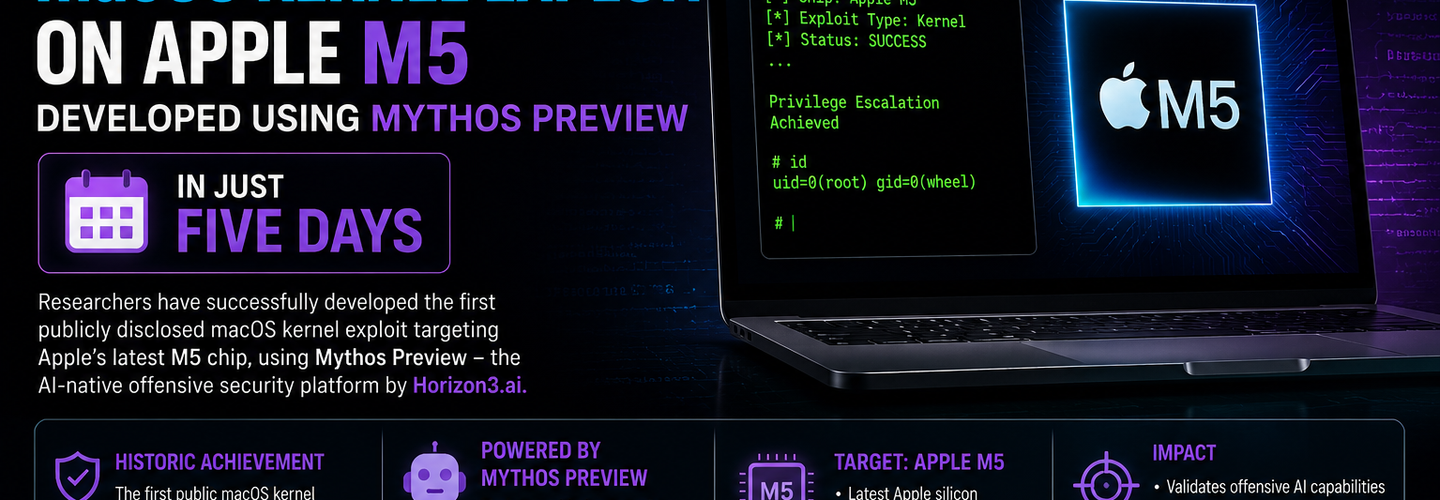
First Public macOS Kernel Exploit on Apple M5 Developed Using Mythos Preview in Just Five Days
AI-Assisted Exploit Development Raises New Cybersecurity Concerns
Cybersecurity researchers have reportedly demonstrated the first public macOS kernel exploit targeting Apple’s next-generation M5 architecture using an AI-assisted security platform known as Mythos Preview. According to reports, the exploit chain was prepared in just five days, highlighting how artificial intelligence could dramatically accelerate vulnerability research and exploit development.
The incident has sparked serious discussion within the cybersecurity community about the growing role of AI in offensive security research, exploit engineering, and advanced threat development.
While the exploit was reportedly developed for research purposes, experts warn that AI-assisted cyber capabilities could significantly lower the barrier for sophisticated attack creation in the future.
What Is A macOS Kernel Exploit?
A kernel exploit targets the core layer of an operating system responsible for managing hardware, memory, permissions, and system-level processes.
Successful kernel exploitation may allow attackers to:
- ▸Gain elevated privileges
- ▸Execute arbitrary code
- ▸Bypass security protections
- ▸Access sensitive system resources
- ▸Deploy persistent malware
- ▸Escape application sandboxes
Kernel vulnerabilities are considered extremely valuable because they can provide deep system-level access that bypasses normal security controls.
In Apple’s ecosystem, kernel-level vulnerabilities are especially important due to the company’s strong hardware-software security integration.
Why Apple M5 Security Matters
Apple’s M-series chips are widely recognized for their advanced security architecture, performance optimization, and integrated hardware protections.
The upcoming M5 platform is expected to introduce:
- ▸Enhanced memory protections
- ▸Improved hardware isolation
- ▸Stronger sandboxing mechanisms
- ▸Advanced secure boot systems
- ▸Better exploit mitigation technologies
Because Apple devices are heavily used across enterprise environments, creative industries, and high-value user groups, security researchers and threat actors alike closely monitor macOS exploit developments.
A publicly demonstrated kernel exploit targeting Apple’s latest architecture would represent a significant milestone in modern exploit research.
How Mythos Preview Accelerated Exploit Development
According to reports, researchers leveraged Mythos Preview, an AI-assisted cybersecurity research platform, to help analyze vulnerabilities, automate exploit development workflows, and accelerate debugging processes.
AI-assisted security tools may support researchers by:
- ▸Identifying vulnerable code patterns
- ▸Automating fuzzing analysis
- ▸Suggesting exploitation paths
- ▸Generating proof-of-concept code
- ▸Accelerating reverse engineering
- ▸Assisting with kernel memory analysis
Traditionally, developing reliable kernel exploits can take weeks or months of intensive manual research. The claim that a public exploit was prepared in just five days demonstrates how AI could reshape offensive and defensive cybersecurity operations.
AI Is Transforming Cybersecurity Research
Artificial intelligence is increasingly influencing both cyber defense and cyber offense.
Security researchers now use AI for:
- ▸Threat detection
- ▸Malware analysis
- ▸Vulnerability discovery
- ▸Security automation
- ▸Incident response
- ▸Code auditing
At the same time, cybercriminals are also experimenting with AI-driven attack methods including:
- ▸Automated phishing
- ▸Deepfake scams
- ▸AI-generated malware
- ▸Social engineering automation
- ▸Exploit generation assistance
Experts warn that the speed advantage offered by AI may create major challenges for traditional cybersecurity defense strategies.
Public Exploit Disclosure Raises Security Questions
Public disclosure of advanced exploits often creates debate within the cybersecurity community.
Supporters argue that responsible disclosure helps:
- ▸Improve security research transparency
- ▸Strengthen defensive testing
- ▸Accelerate patch development
- ▸Enhance public awareness
Critics warn that public exploit availability may:
- ▸Increase attack risks
- ▸Enable copycat threat actors
- ▸Accelerate zero-day exploitation
- ▸Pressure organizations before patches are deployed
The balance between offensive research and responsible disclosure remains one of cybersecurity’s most debated topics.
Apple’s Security Ecosystem Under Constant Pressure
Apple continues to invest heavily in platform security through:
- ▸Hardware-based protections
- ▸Secure Enclave technologies
- ▸Memory safety improvements
- ▸Lockdown Mode
- ▸Kernel isolation mechanisms
- ▸Rapid security patch deployment
However, advanced threat actors and security researchers continuously attempt to bypass these protections through sophisticated exploit chains.
State-sponsored groups, cybercriminal organizations, and exploit brokers all place high value on reliable macOS and iOS exploitation techniques.
Why AI-Assisted Exploit Development Is Concerning
The rapid development timeline associated with the reported M5 exploit demonstrates how AI may reduce technical barriers in advanced cybersecurity research.
Potential long-term risks include:
## Faster Zero-Day Development
AI could help attackers identify and weaponize vulnerabilities more quickly.
## Lower Entry Barriers
Less experienced threat actors may gain access to advanced exploit development capabilities.
## Automated Vulnerability Discovery
AI systems can analyze massive codebases faster than human researchers alone.
## Increased Supply-Chain Risks
AI-generated exploit tools could target widely used software ecosystems at scale.
Security analysts believe AI-assisted offensive capabilities could become one of the defining cybersecurity challenges of the next decade.
Organizations Must Prepare For AI-Native Threats
As AI accelerates exploit development, organizations should strengthen their cybersecurity posture by implementing:
- ▸Continuous vulnerability management
- ▸Zero-trust security models
- ▸Endpoint detection and response (EDR)
- ▸Rapid patch management
- ▸Threat intelligence monitoring
- ▸Kernel-level protection tools
- ▸AI-assisted defensive security systems
Cyber resilience increasingly depends on the ability to detect and respond to threats in real time.
Ethical Security Research Remains Critical
Despite growing concerns, ethical cybersecurity research remains essential for identifying weaknesses before malicious actors exploit them.
Responsible security researchers help:
- ▸Improve software security
- ▸Identify architectural weaknesses
- ▸Strengthen exploit mitigations
- ▸Support vulnerability disclosure programs
- ▸Advance defensive security knowledge
The challenge for the industry is ensuring that AI-powered research tools are used responsibly and ethically.
Final Thoughts
The reported development of the first public macOS kernel exploit targeting Apple’s M5 architecture using Mythos Preview in just five days represents a major moment in AI-assisted cybersecurity research.
While the exploit was reportedly created within a research context, the incident highlights how artificial intelligence could dramatically accelerate vulnerability discovery and exploit engineering capabilities across the cybersecurity landscape.
As AI continues transforming offensive and defensive security operations, organizations, software vendors, and governments will need to adapt quickly to a future where cyber threats evolve at machine speed.
## FAQs
What is a macOS kernel exploit?
A macOS kernel exploit targets the operating system’s core layer to gain elevated privileges or bypass security protections.
Why is the Apple M5 exploit significant?
It reportedly represents the first public kernel exploit developed for Apple’s next-generation M5 architecture.
What is Mythos Preview?
Mythos Preview is described as an AI-assisted cybersecurity research platform used to accelerate exploit development workflows.
Why are AI-assisted exploits concerning?
AI can speed up vulnerability discovery, automate exploit generation, and lower technical barriers for advanced cyberattacks.
Did the exploit affect Apple users directly?
There is currently no public indication that the exploit was used in active attacks against users.
Read More:
Foxconn Cyberattack: Hackers Claim Apple & Google Data Stolen
Arctic Wolf Launches AI Mobile Threat Defense
The Mythos Stress Test: Are Indian Banks & Fintechs Ready for AI-Native Cyber Threats?
India Lost ₹52,000 Crore to Cyber Frauds in 5 Years – Govt Tightens Telecom Security
₹152 Crore Cyber Scam Exposed Across 14 States – How Mule Accounts Fueled Massive Fraud
## Analyst Commentary & Implementation Blueprint
Security advisory
Continuous security exposure assessment is critical to identifying public vulnerabilities before they are exploited. Organizations should maintain a passive inventory of all web servers, TLS configs, and open ports, ensuring that default configurations are eliminated and security advisories are actively implemented.
Hardened Security Configuration Blueprint
# General Security Hardening Directive
ServerTokens ProductOnly
ServerSignature Off
FileETag None
Actionable Mitigation Checklist
- ✔Perform passive asset inventories weekly.
- ✔Restrict administrative ports using local firewall controls.
- ✔Monitor active CVE alerts for exposed software.
Common Inquiries & FAQs
Why is passive scanning preferred for continuous auditing?
Passive audits do not cause operational impact or trigger firewall blocks, making them ideal for constant surveillance of internet-facing assets.
What should I do if a vulnerability is flagged?
Apply the latest vendor patches, restrict access to the resource via firewalls, or verify configuration flags to mitigate risks.
Surendra Reddy
Surendra Reddy is a cybersecurity researcher and founder of ReconShield, specializing in OSINT and defensive infrastructure analysis.
Connect on LinkedIn ↗// AUDIT BRIEFING DISCUSSION (2 COMMENTS)
Great breakdown of the passive infrastructure vectors. We recently audited our external DNS zones and found multiple dangling staging environments. Implementing wildcard certificates reduced our CT log leaks significantly.
Is there any automated tooling you recommend for daily crt.sh scraping? Manually checking CT logs is becoming unsustainable for our domain portfolio.
// MORE ARTICLES

Security Researchers Warn Critical n8n Flaws May Expose Automation Platforms to RCE
Researchers have disclosed critical vulnerabilities in n8n that could expose automation workflows and connected enterprise systems to remote code execution risks, prompting urgent patch recommendations for users and administrators.

How Agentic AI Is Changing Software Engineering and Expanding Mobile Attack Surfaces
Agentic AI is rapidly transforming software engineering workflows through automation and intelligent coding assistance, while cybersecurity experts warn of expanding mobile attack surfaces and emerging application security risks.

Critical Tenda Router Backdoor (CVE-2026-11405): Check If Your Device Is Vulnerable Now
CVE-2026-11405 is an unpatched Tenda router backdoor granting full admin access without a password. Check if your model is affected now.