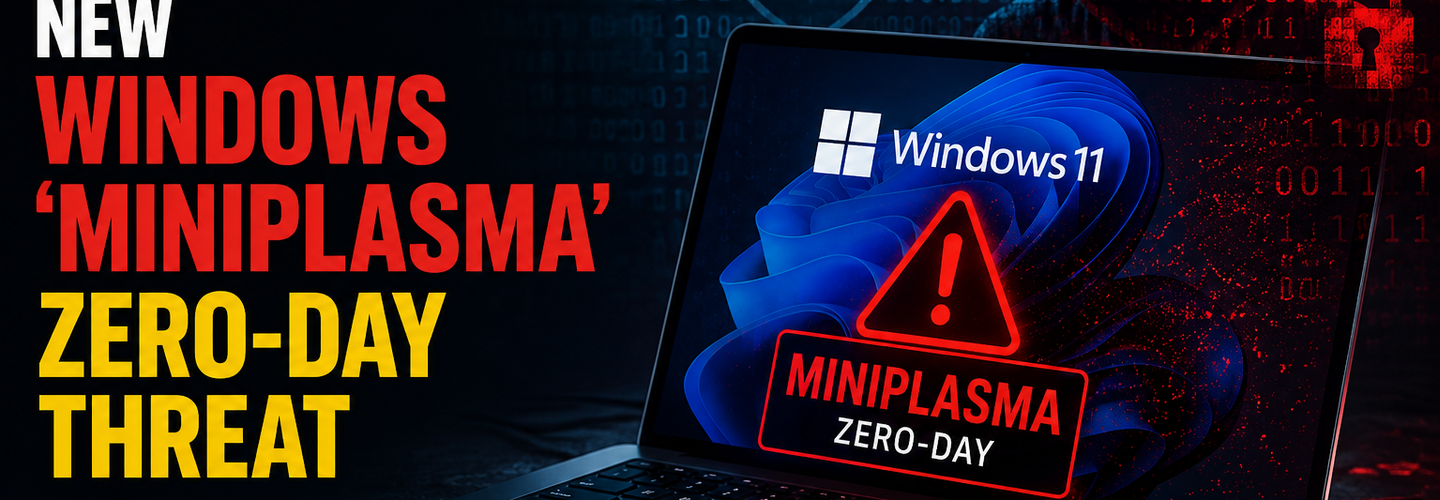
Cybersecurity Experts Warn of New Windows ‘MiniPlasma’ Zero-Day Threat
A newly disclosed Windows privilege escalation vulnerability known as MiniPlasma is drawing significant attention across the cybersecurity industry after researchers revealed that attackers may be able to gain NT AUTHORITY\SYSTEM privileges even on fully patched Windows systems. The disclosure has become more concerning because a public proof-of-concept (PoC) exploit is already circulating online, potentially increasing the risk of real-world attacks.
Security experts warn that privilege escalation vulnerabilities remain one of the most dangerous components of modern cyberattacks. While such flaws do not usually provide initial access by themselves, they often allow attackers to transform a limited compromise into full administrative control of a targeted device or enterprise environment.
The MiniPlasma vulnerability reportedly affects the Windows Cloud Filter driver (cldflt.sys), a Windows component associated with cloud file synchronization and storage operations. Researchers claim the exploit abuses weaknesses involving undocumented APIs and registry manipulation methods to elevate privileges.
## What Is MiniPlasma?
MiniPlasma is described as a local privilege escalation (LPE) vulnerability capable of allowing users with restricted access to elevate permissions to the highest privilege level available in Windows systems.
According to publicly shared technical details, the exploit may be linked to a previously reported vulnerability tracked as CVE-2020-17103, which was originally identified by Google Project Zero researcher James Forshaw in 2020. Researchers believe the newly disclosed exploit could represent either:
- ▸A bypass of an earlier patch,
- ▸A regression introduced in later Windows updates,
- ▸Or a separate zero-day vulnerability affecting similar functionality.
The researcher behind the disclosure, reportedly using the online aliases Chaotic Eclipse and Nightmare Eclipse, publicly released exploit code and demonstration materials. The release of PoC code means both defenders and malicious actors can study the exploit, increasing urgency for organizations to strengthen monitoring and mitigation efforts.
## Why Privilege Escalation Vulnerabilities Matter
Privilege escalation flaws are considered highly dangerous because attackers often use them during the later stages of a cyber intrusion. In many incidents, attackers first gain low-level access through phishing emails, malicious downloads, compromised credentials, or vulnerable applications. Once inside, they attempt to escalate privileges to gain broader control of the system.
If MiniPlasma exploitation succeeds, attackers could potentially:
- ▸Disable antivirus or endpoint security tools,
- ▸Access sensitive credentials,
- ▸Move laterally across enterprise networks,
- ▸Modify protected files and services,
- ▸Install persistent malware or backdoors,
- ▸Or deploy ransomware more effectively.
SYSTEM-level privileges effectively provide attackers with unrestricted control over a Windows machine, allowing them to bypass many built-in security restrictions.
Cybersecurity professionals emphasize that even organizations with strong perimeter defenses remain vulnerable if attackers can chain privilege escalation flaws with other attack techniques.
## Public PoC Exploit Increases Risk
One of the most concerning aspects of the MiniPlasma disclosure is the public availability of exploit code. Once proof-of-concept exploits become publicly accessible, threat actors often attempt to adapt them into real-world attack campaigns.
Historically, publicly released PoCs have accelerated exploitation activity because attackers no longer need to independently discover or develop advanced exploitation techniques. Instead, they can modify existing code and integrate it into malware or intrusion frameworks.
Security researchers remain divided on the practice of releasing exploit code before vendors issue patches. Some experts argue that public disclosure pressures vendors into responding faster and helps defenders validate their security controls. Others warn that weaponized PoCs may increase risk for organizations before fixes become available.
The MiniPlasma case has reignited this debate within the cybersecurity community.
## Reports Suggest Fully Patched Systems May Be Vulnerable
Researchers involved in the disclosure claim that the exploit reportedly works against fully updated Windows 11 systems, including systems running the latest May 2026 security updates.
If accurate, this would make MiniPlasma particularly serious because many organizations rely heavily on regular patch management as a primary defense mechanism.
However, researchers also observed that the exploit reportedly fails on some Windows Insider Canary builds, suggesting Microsoft may already be testing internal mitigations or architectural changes that address the issue.
At the time of writing, Microsoft has not publicly confirmed whether:
- ▸MiniPlasma represents a completely new zero-day vulnerability,
- ▸An incomplete patch bypass,
- ▸Or a regression in previously fixed functionality.
Organizations are therefore advised to closely monitor official Microsoft security advisories and Patch Tuesday announcements for future updates.
## Growing Trend of Windows Zero-Day Disclosures
The MiniPlasma disclosure arrives amid increasing concern over Windows privilege escalation vulnerabilities and public exploit releases during 2026.
Recent months have seen several high-profile vulnerability disclosures affecting Windows systems, including exploit names such as:
- ▸YellowKey,
- ▸GreenPlasma,
- ▸RedSun,
- ▸And BlueHammer.
Many of these disclosures involved publicly released PoC exploits or detailed technical writeups that allowed researchers and attackers alike to study exploitation methods.
Cybersecurity analysts note that attackers increasingly chain multiple vulnerabilities together. For example, a phishing email or browser exploit may provide initial access, while a local privilege escalation vulnerability like MiniPlasma could then help attackers gain full system control.
This layered attack approach has become common in ransomware operations, advanced persistent threat (APT) campaigns, and targeted enterprise intrusions.
## Recommended Mitigation and Defense Strategies
Until Microsoft releases official guidance or a security patch, organizations are encouraged to focus on reducing post-exploitation opportunities and improving detection capabilities.
Security experts recommend the following measures:
Enforce Least-Privilege Access
Limiting administrative privileges reduces the ability of attackers to escalate privileges after gaining initial access. Users should only have access necessary for their specific roles.
Strengthen Endpoint Monitoring
Endpoint Detection and Response (EDR) solutions can help identify suspicious privilege escalation behavior, registry modifications, or unusual process activity associated with exploitation attempts.
Restrict Local Administrator Rights
Reducing the number of users with local administrator access can help minimize the impact of privilege escalation attacks.
Monitor Registry Changes
Because researchers claim the exploit abuses registry manipulation techniques, organizations should monitor unusual registry modifications involving sensitive Windows components.
Keep Security Tools Updated
While no official patch may yet exist, updated antivirus and EDR signatures may help detect exploitation attempts or suspicious activity linked to known PoCs.
Segment High-Risk Systems
Critical infrastructure systems and sensitive enterprise assets should be isolated where possible to reduce lateral movement opportunities in the event of compromise.
Improve Threat Hunting
Security teams should proactively search for indicators of privilege escalation attempts and unusual SYSTEM-level process activity within enterprise environments.
## Why Organizations Should Take This Seriously
Even though MiniPlasma requires some level of initial access, the vulnerability could still pose substantial risks in enterprise environments.
Many modern cyberattacks involve multi-stage intrusion chains. Attackers frequently combine:
- ▸Credential theft,
- ▸Social engineering,
- ▸Malware delivery,
- ▸Browser vulnerabilities,
- ▸And privilege escalation exploits
to achieve deeper compromise within networks.
In such scenarios, privilege escalation vulnerabilities become critical because they allow attackers to bypass restrictions and gain broader persistence.
Cybersecurity experts warn that attackers are increasingly targeting core operating system components because such vulnerabilities often provide reliable paths to SYSTEM-level access.
## Final Thoughts
The disclosure of the MiniPlasma exploit highlights the ongoing challenges of securing complex operating system components against advanced exploitation techniques. With public proof-of-concept code already available, organizations may face increased probing, testing, and exploitation attempts in the coming weeks.
While Microsoft continues investigating the issue, organizations should focus on strong endpoint monitoring, least-privilege policies, rapid detection capabilities, and proactive threat hunting to minimize potential exposure.
As cyber threats continue evolving, privilege escalation vulnerabilities remain a critical concern because they enable attackers to turn relatively minor compromises into full-scale system takeovers.
For the latest cybersecurity alerts, threat intelligence updates, Windows vulnerability news, and enterprise security analysis, stay connected with ReconShield.
Read More:
₹152 Crore Cyber Scam Exposed Across 14 States – How Mule Accounts Fueled Massive Fraud
First Public macOS Kernel Exploit on Apple M5 Developed Using Mythos Preview in Just Five Days
SEBI Creates AI Cyber Defense Task Force to Protect India’s Financial Markets
Cybersecurity Agencies Warn Users Against New Digital Fraud Tactics
CISA Warns of Active Exploitation of Microsoft Exchange Server Spoofing Vulnerability
## Analyst Commentary & Implementation Blueprint
Security advisory
Continuous security exposure assessment is critical to identifying public vulnerabilities before they are exploited. Organizations should maintain a passive inventory of all web servers, TLS configs, and open ports, ensuring that default configurations are eliminated and security advisories are actively implemented.
Hardened Security Configuration Blueprint
# General Security Hardening Directive
ServerTokens ProductOnly
ServerSignature Off
FileETag None
Actionable Mitigation Checklist
- ✔Perform passive asset inventories weekly.
- ✔Restrict administrative ports using local firewall controls.
- ✔Monitor active CVE alerts for exposed software.
Common Inquiries & FAQs
Why is passive scanning preferred for continuous auditing?
Passive audits do not cause operational impact or trigger firewall blocks, making them ideal for constant surveillance of internet-facing assets.
What should I do if a vulnerability is flagged?
Apply the latest vendor patches, restrict access to the resource via firewalls, or verify configuration flags to mitigate risks.
Surendra Reddy
Surendra Reddy is a cybersecurity researcher and founder of ReconShield, specializing in OSINT and defensive infrastructure analysis.
Connect on LinkedIn ↗// AUDIT BRIEFING DISCUSSION (2 COMMENTS)
Great breakdown of the passive infrastructure vectors. We recently audited our external DNS zones and found multiple dangling staging environments. Implementing wildcard certificates reduced our CT log leaks significantly.
Is there any automated tooling you recommend for daily crt.sh scraping? Manually checking CT logs is becoming unsustainable for our domain portfolio.
// MORE ARTICLES
Security Researchers Warn Critical n8n Flaws May Expose Automation Platforms to RCE
Researchers have disclosed critical vulnerabilities in n8n that could expose automation workflows and connected enterprise systems to remote code execution risks, prompting urgent patch recommendations for users and administrators.

How Agentic AI Is Changing Software Engineering and Expanding Mobile Attack Surfaces
Agentic AI is rapidly transforming software engineering workflows through automation and intelligent coding assistance, while cybersecurity experts warn of expanding mobile attack surfaces and emerging application security risks.
Microsoft Defender Zero-Day Patched: What IT Teams Need to Know
Microsoft patches RoguePlanet, a Defender zero-day (CVE-2026-50656) letting attackers gain SYSTEM access. Here's what IT teams need to know.