WHOIS for Threat Intelligence: How to Use Domain Registration Data for Attribution and Campaign Tracking (2026)
Summarize this blog post with: ChatGPT | Perplexity | Claude | Grok
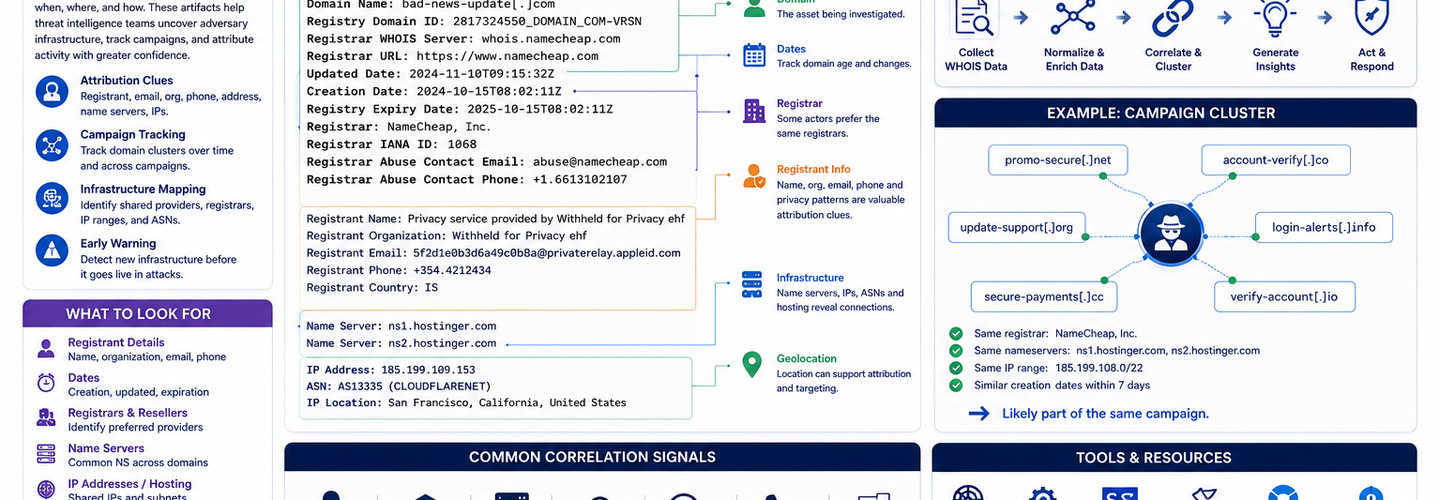
WHOIS registration data is one of the most underutilized threat intelligence sources available to security analysts — and the most directly actionable. When a malicious campaign uses multiple domains, those domains almost always share registration fingerprints: the same registrar, name server provider, registration date range, or (in pre-GDPR archives) the same email address or phone number. A threat intelligence analyst who can spot these patterns can cluster dozens of apparently unrelated domains into a single campaign, attribute that campaign to a known threat actor group, and produce an IOC package that blocks the entire campaign footprint at once. In this guide, you'll learn exactly how to extract maximum threat intelligence value from WHOIS registration data — how to build threat actor profiles, spot campaign patterns, attribute infrastructure, and integrate WHOIS data into your threat intelligence workflows.
## Key Takeaways
- ▸WHOIS registration data is the most visible infrastructure layer — every domain leaves a registration trail that persists even after the domain is taken down, making it the ideal foundation for threat actor attribution.
- ▸The most analytically powerful WHOIS field for threat intelligence is the creation date — phishing campaigns deploy dozens of fresh domains within a narrow time window, creating a temporal clustering signal that enables campaign scope identification.
- ▸Registrar clustering is a reliable threat actor indicator — certain registrars are disproportionately used by specific threat actor groups, making registrar identity alone sufficient to suspect attribution between domains.
- ▸Name server provider clustering identifies shared infrastructure — threat actors using the same bulletproof hosting provider's name servers across multiple domains are clusterable into campaign families even when registrant data is redacted.
- ▸Historical WHOIS archives (pre-2018) contain registrant contact information that enables direct attribution — email addresses and phone numbers found in historical archives can be correlated with known threat actor infrastructure and criminal forums.
- ▸WHOIS monitoring of known threat actor infrastructure surfaces newly registered attack domains within days — a threat actor group that previously registered 50 domains now registers a new one; WHOIS pattern matching flags it immediately.
- ▸WHOIS data enables rapid false-positive reduction in automated threat detection — a brand-new domain impersonating your organization has a 99% probability of being phishing if created within 48 hours of a detected campaign; established domains registering for the same impersonation have a very different risk profile.
## What Makes WHOIS Valuable for Threat Intelligence
WHOIS data is valuable for threat intelligence because it provides stable, public, indexed attribution information that threat actors cannot easily modify after the fact — unlike IP addresses (which rotate constantly across cloud providers), email headers (which are spoofed), or infrastructure (which can be rapidly redeployed), WHOIS records create a permanent registration trail tied to the domain name itself.
Every domain registration leaves a record: when it was registered, by whom (even if privacy-protected, the registrar has the underlying data), through which registrar, on which name servers, and what expiry date. This data is queryable historically through archives, and comparison between domains reveals patterns that threat actors struggle to hide even with privacy protection.
The intelligence value scales with volume. A single malicious domain's WHOIS record provides limited insight. A threat actor group's portfolio of 50 domains analyzed together through WHOIS data reveals the operational patterns — registrar preferences, name server providers, registration date clustering, and (pre-GDPR) shared contact data — that enable reliable attribution and campaign scope mapping.
The threat intelligence value of WHOIS increases as GDPR makes current registrant data unavailable — because registrars are required to redact personal information from public WHOIS for EU-based registrants, WHOIS-based attribution must now rely on the metadata that GDPR does not redact: creation dates, registrar identity, name servers, and EPP status codes. These metadata fields are more reliable attribution signals anyway, because they are harder to manipulate than contact data.
## Building Threat Actor Profiles Through WHOIS Registration Patterns
A threat actor profile built from WHOIS patterns provides durable attribution that survives infrastructure changes, domain takedowns, and operational pivot — because it is based on registration behavior that, once established, is difficult to change significantly.
Registrar Preference
Certain threat actor groups consistently prefer specific registrars — not because of technical reasons, but because of operational convenience or historical accident. Once a threat actor chooses a registrar that accepts cryptocurrency payments, maintains minimal verification, and has permissive abuse policies, that registrar becomes the default for all future domain registrations.
Example: A threat actor group known for ransomware campaigns historically registered domains through registrar A, which accepts anonymous payment. When infrastructure is discovered, the group's entire operational domain portfolio shows registrar A clustering. When a newly registered domain appears with registrar A and creation date matching the group's known campaign windows, high-confidence attribution is possible without any other signals.
Cross-reference newly observed malicious domains against known threat actor registrar preferences. If a domain created during a known campaign period uses the same registrar as documented infrastructure from the same group, the probability of attribution increases substantially.
Name Server Clustering
Threat actor groups often use the same bulletproof hosting provider's name servers across multiple domains — either because that provider's specific DNS setup benefits their operational security, or simply out of operational inertia once they identify a suitable provider.
Example: A threat actor group using name servers ns1.bulletproofhosting-provider.ru and ns2.bulletproofhosting-provider.ru for 15 known malicious domains registers a 16th domain with identical name servers. Without any other signals, the name server clustering alone provides high-confidence attribution.
Create a baseline of known-malicious infrastructure's name server providers. Query newly discovered phishing or malware domains for their name servers. Match against the baseline. Domains sharing name servers with known infrastructure are presumptively operated by the same actor.
Registration Date Clustering
Phishing and malware campaigns deploy dozens of domains within a narrow time window — typically within 24–72 hours of campaign launch. This temporal clustering is one of the strongest indicators that unrelated-appearing domains are actually part of the same campaign.
Example: Your threat intelligence team discovers a phishing email impersonating your organization with domain impersonation.com, registered on June 8. Over the next 48 hours, domain monitoring discovers impersonation.net, impersonation.org, impersonation.io, impersonation-secure.com, and impersonation-login.com — all registered within the June 8–9 window. The creation date clustering strongly suggests a single attacker preparing multiple lookalike domains for a coordinated campaign.
Implement automated monitoring that queries WHOIS for newly registered domains matching your organization's trademark patterns. Flag any cluster of similar domains registered within 24–72 hours of each other with high suspicion of coordinated campaign preparation.
Shared Historical Contact Data
In pre-GDPR WHOIS archives, threat actor groups frequently reused email addresses, phone numbers, and organizational affiliations across multiple domain registrations — a powerful attribution signal that survives domain takedowns and registrar changes.
Example: Historical WHOIS archives contain registrations for 8 known malicious domains, all using the email address attacker@anonymousmail.ru. A newly discovered phishing domain, when queried in historical archives, shows the same email address in a registration from 2 years prior. Direct attribution to the known actor group.
Query historical WHOIS databases (DomainTools, SecurityTrails, WhoisXML API) for contact data found in known threat actor infrastructure. Build an email/phone/organization database of registrant data associated with the group. When new infrastructure is discovered, search for matching contact information in the current WHOIS and historical archives. Matches enable rapid, high-confidence attribution.
## WHOIS-Based Campaign Mapping and Scope Identification
Once you have attributed domains to a specific threat actor or campaign, WHOIS data enables rapid identification of the full campaign scope — discovering additional domains the attacker controls that may not yet have triggered email security or threat detection systems.
Pattern-Based Subdomain Discovery
When you discover that a malicious campaign registered domain1.com, domain2.net, and domain3.org all on the same date through the same registrar with the same name servers, the pattern provides enough specificity to predict additional undetected domains the attacker likely registered.
Query WHOIS for all domains registered by the same registrar within a ±1 day window of the known campaign domains. Filter by name server providers. Cross-reference against threat intelligence to identify which additional domains belong to the attacker. You will discover domains that have not yet been reported to security researchers or added to threat feeds.
Registrant Email Reuse Detection
Query historical WHOIS archives for the registrant email addresses from known malicious domains. Search for all other domains registered with the same email. The full list of results is the presumptive campaign footprint.
Example: A ransomware affiliate registers payment-processing domains under the email attacker-group@anonymousmail.ru. The historical WHOIS query for that email returns 23 total domain registrations. Security monitoring of all 23 domains provides the full infrastructure scope and detection across multiple attack vectors simultaneously.
Name Server Provider Enumeration
For known malicious domains, extract the authoritative name servers. Query the hosting provider's name space for all domains using those servers. Many bulletproof hosting providers maintain DNS that resolves thousands of malicious domains. A comprehensive query provides the full customer portfolio for that provider, from which you can filter down to the specific threat actor group.
## Integrating WHOIS Into Your Threat Intelligence Workflow
WHOIS intelligence is most valuable when it is systematically integrated into threat intelligence operations — creating feedback loops where new domain discoveries lead to WHOIS-based campaign mapping, which leads to additional domain discoveries.
Automated WHOIS Monitoring for Known Threat Actors
Maintain a list of registrars, name server providers, and (where pre-2018 archives provide them) email addresses used by known threat actor groups. Run automated daily WHOIS queries on newly registered domains matching your organization's trademark patterns. Flag any domains that match the known actor's registration profile. Escalate for rapid blocking.
This approach detects campaigns before they achieve sufficient scale to trigger volume-based threat detection. A brand-new domain registered within 24 hours of your organization's name by an attacker's known registrar can be blocked immediately rather than after the first thousand phishing emails are delivered.
WHOIS Baseline Maintenance
For every significant cybersecurity incident involving adversary infrastructure, extract and document WHOIS registration patterns:
- ▸Registrar
- ▸Name servers
- ▸EPP status codes
- ▸Creation date
- ▸Registrant organization (if available)
- ▸Any shared contact data with other known incidents
Build a structured database of these patterns, tagged by threat actor group or campaign family. Use this database for pattern matching when new malicious infrastructure is discovered.
Cross-Referencing With VirusTotal and UrlScan
Both VirusTotal and UrlScan accept domain inputs and return any security vendor verdicts, malware associations, and (via integration with passive DNS services) historical resolution data. This data is often submitted alongside WHOIS queries as part of analyst research workflow.
A complete malicious domain investigation combines:
- ▸WHOIS registration data (ReconShield WHOIS Intelligence tool)
- ▸VirusTotal vendor verdicts and file associations
- ▸URLScan passive analysis and screenshot history
- ▸IP reputation (ReconShield IP Reputation tool)
- ▸Passive DNS resolution history
- ▸SSL certificate analysis (ReconShield SSL/TLS Checker)
Each data source contributes a piece; the complete picture emerges from correlation.
## Common WHOIS Intelligence Mistakes and How to Avoid Them
The most common WHOIS-based attribution mistakes are: assuming a single WHOIS signal is sufficient for high-confidence attribution, treating privacy-protected WHOIS as uninformative, and failing to cross-reference with historical archives.
Mistake 1 — Single Registrar Attribution: A domain shares a registrar with known threat actor infrastructure and is immediately attributed to that group. However, the registrar has thousands of customers, many legitimate. Registrar alone is a weak signal and requires correlation with other patterns (name servers, creation date, IP reputation) before high-confidence attribution.
Correct approach: Registrar + name servers + creation date ± 1 day = stronger signal. Registrar + name servers + creation date + IP reputation bulletproof provider = high-confidence signal.
Mistake 2 — Privacy-Protected WHOIS as Dead End: A domain's public WHOIS is fully privacy-protected, so the analyst assumes no attribution is possible without private investigator access or law enforcement cooperation. However, the domain's creation date, registrar, and name servers are still visible and fully queryable. The metadata is sufficient for campaign clustering.
Correct approach: Use visible metadata (creation date, registrar, name servers, EPP codes) for pattern matching. Query historical WHOIS for the domain (might have non-private data from before privacy protection was activated). Use complementary intelligence sources (IP reputation, SSL certificates, passive DNS) to triangulate attribution.
Mistake 3 — Ignoring Historical Archives: A domain is fully privacy-protected in current WHOIS, so historical WHOIS is not queried. However, the same domain, if registered before 2018 and never updated, contains the original registrant email address that GDPR now requires to be redacted from current public WHOIS. The email is in the historical archives and is shared with other malicious domains operated by the same actor.
Correct approach: Always query historical WHOIS archives for any domain older than 2018. The recovered contact data is often the key attribution link.
## Building a Threat Actor WHOIS Profile: Complete Example
To illustrate how WHOIS-based threat intelligence works in practice, here is a complete hypothetical example of building a threat actor profile from WHOIS data.
Initial Discovery: Your organization discovers a phishing email impersonating your CFO, requesting wire transfer to "company-payroll@phishing-domain.xyz" where phishing-domain.xyz is a freshly registered domain.
WHOIS Query #1: Query phishing-domain.xyz through the ReconShield WHOIS Intelligence tool. Results: Created June 5, 2026, 7:43 AM UTC. Registrar: AnonymousHost Inc. Name servers: ns1.bulletproofhosting.ru, ns2.bulletproofhosting.ru. EPP status: No locks. Privacy protection: Enabled.
WHOIS Query #2: Based on the registrar and name servers, search historical threat intelligence for other domains with identical registration characteristics. Find 14 additional domains registered through AnonymousHost Inc. with bulletproof-hosting name servers, all created within June 1–10, 2026. Pull WHOIS on all 14 domains.
Pattern Recognition: All 15 domains (including the phishing domain) were registered June 1–10 through AnonymousHost Inc. using bulletproof-hosting name servers. All impersonate financial institutions or use generic corporate names. All are resolved to IP addresses in Russian ASNs.
Historical Archive Query: Query historical WHOIS for the 15 phishing-domain URLs. Find that 3 of them, registered before 2018, contain registrant data. All three show the same email address: business-operations@anonymous-mail.ru.
Threat Actor Profile Created: Business-operations@anonymous-mail.ru is the contact linked to at least 15 phishing domains registered June 1–10, 2026, through AnonymousHost Inc. using bulletproof hosting infrastructure. Search threat intelligence databases and underground forums for "business-operations@anonymous-mail.ru" and discover it is associated with a known financial crime ring.
Campaign Scope Expansion: Query VirusTotal and URLScan for any other domains registered to business-operations@anonymous-mail.ru (through historical or deep research). Discover 8 additional phishing domains not yet included in your initial analysis.
IOC Package Production: Generate IOC package including all 23 domain names, the registrant email, the registrar name, the name server providers, and the associated IP addresses. Block all 23 domains across email security, web filtering, and DNS filtering simultaneously.
Operational Outcome: By using WHOIS-based pattern analysis, you identified and blocked a campaign with 23 domains in less than 2 hours, potentially preventing millions in fraudulent wire transfers.
## Tools and Techniques for WHOIS-Based Threat Intelligence
Efficient WHOIS-based threat intelligence requires both query tools and systematic analysis frameworks.
The ReconShield WHOIS Intelligence tool handles single-domain WHOIS queries and returns normalized results suitable for pattern analysis. For bulk querying and cross-correlation, commercial WHOIS databases including DomainTools, SecurityTrails, Farsight DNSDB, and WhoisXML API provide APIs and bulk export capabilities.
Manual pattern analysis is prone to errors and slow to execute. Threat intelligence platforms including Mandiant Threat Intelligence, CrowdStrike Falcon Malware, and others integrate WHOIS data automatically, providing search interfaces optimized for finding domains by registrar, name servers, or contact data.
The OSINT framework at osintframework.com provides free, open-source options for WHOIS research including whoisxmlapi's free tier, DNSdumpster for passive DNS, and crt.sh for certificate transparency data.
## Conclusion
WHOIS registration data is one of the most powerful threat intelligence sources available to security analysts — and one of the most underutilized. The metadata that remains public even after privacy protection (creation date, registrar, name servers) provides sufficient signal for campaign clustering, threat actor attribution, and infrastructure scope mapping.
Start with suspicious domains you encounter in your own environment. Query them with the ReconShield WHOIS Intelligence tool. Extract registration metadata. Build a baseline of threat actor WHOIS patterns from your incident history. Create automated monitoring for newly registered domains matching your organization's brand that share registrar or name server characteristics with known malicious infrastructure.
Then apply the same methodology to publicly disclosed threat intelligence. Every threat intelligence report that contains domain indicators should trigger WHOIS queries for pattern analysis and campaign scope mapping. The full infrastructure picture emerges from WHOIS correlation rather than from any single domain lookup.
Written by Surendra Reddy Cybersecurity Researcher & Founder, ReconShield. Surendra specializes in OSINT, exposure intelligence, and AI-driven threat analysis. Author Profile →
Reviewed by ReconShield Editorial Team — Peer-reviewed for accuracy against current threat intelligence analysis methodologies and OSINT best practices.
June 2026 Cybersecurity Review: Top Cyber Attacks, Data Breaches & Critical Vulnerabilities
WHOIS vs RDAP: Understanding the Protocol Transition for Domain Intelligence in 2026
## Analyst Commentary & Implementation Blueprint
Security advisory
Continuous security exposure assessment is critical to identifying public vulnerabilities before they are exploited. Organizations should maintain a passive inventory of all web servers, TLS configs, and open ports, ensuring that default configurations are eliminated and security advisories are actively implemented.
Hardened Security Configuration Blueprint
# General Security Hardening Directive
ServerTokens ProductOnly
ServerSignature Off
FileETag None
Actionable Mitigation Checklist
- ✔Perform passive asset inventories weekly.
- ✔Restrict administrative ports using local firewall controls.
- ✔Monitor active CVE alerts for exposed software.
Common Inquiries & FAQs
Why is passive scanning preferred for continuous auditing?
Passive audits do not cause operational impact or trigger firewall blocks, making them ideal for constant surveillance of internet-facing assets.
What should I do if a vulnerability is flagged?
Apply the latest vendor patches, restrict access to the resource via firewalls, or verify configuration flags to mitigate risks.
Surendra Reddy
Surendra Reddy is a cybersecurity researcher and founder of ReconShield, specializing in OSINT and defensive infrastructure analysis.
Connect on LinkedIn ↗// AUDIT BRIEFING DISCUSSION (2 COMMENTS)
Great breakdown of the passive infrastructure vectors. We recently audited our external DNS zones and found multiple dangling staging environments. Implementing wildcard certificates reduced our CT log leaks significantly.
Is there any automated tooling you recommend for daily crt.sh scraping? Manually checking CT logs is becoming unsustainable for our domain portfolio.
// MORE ARTICLES
The Gentlemen Ransomware Targets Windows Networks with 21 Lateral Movement Techniques
The Gentlemen ransomware uses 21 lateral movement techniques to spread across Windows networks. See its attack chain, IOCs, and defenses.

Chrome 149 Released With Critical Security Fixes for Windows, macOS, and Linux
Chrome 149 is out with critical security fixes for Windows, macOS, and Linux. Learn what's patched, the risks of waiting, and how to update Chrome now.
Billions of Passwords at Risk After Massive Infostealer Data Leak
Billions of passwords are at risk after a massive infostealer data leak. Learn how the breach happened, who's exposed, and how to secure your accounts now.