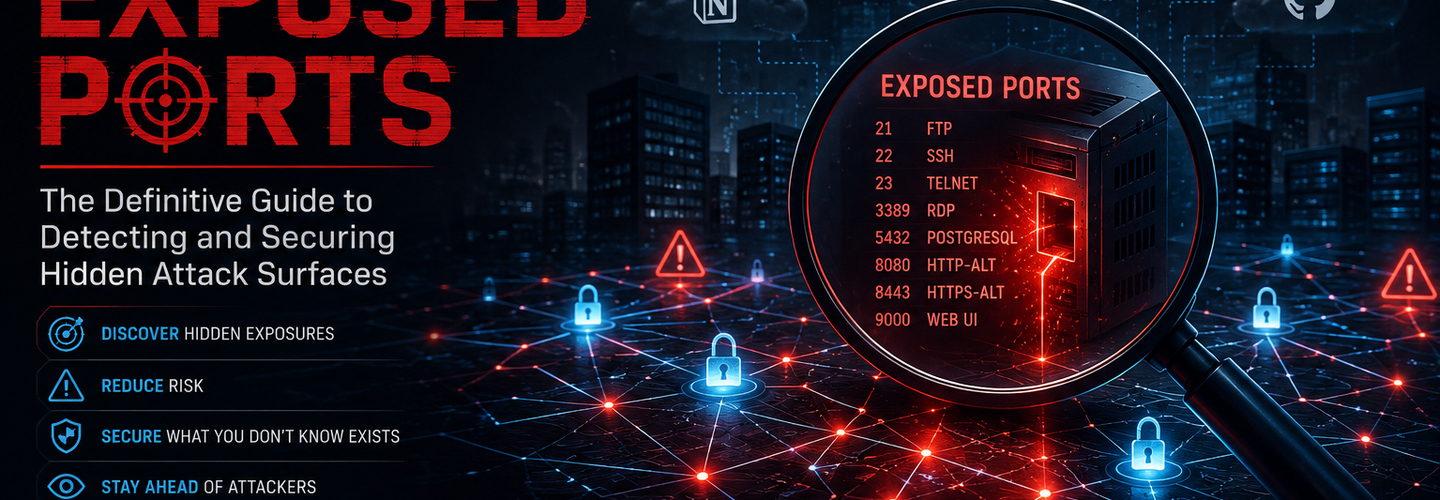
Shadow IT Exposed Ports: The Definitive Guide to Detecting and Securing Hidden Attack Surfaces (2026)
Summarize this blog post with: ChatGPT | Perplexity | Claude | Grok
Most organizations focus on protecting known infrastructure — approved firewalls, sanctioned cloud services, and managed endpoints. What many security teams underestimate is how quickly shadow IT systems can expose vulnerable ports to the internet without centralized visibility or oversight. In this guide, you'll learn exactly how shadow IT exposed ports create hidden attack surfaces, how attackers discover and exploit them, and the strategies security teams use to detect and close these risks before they become breaches.
## Key Takeaways
- ▸Shadow IT exposed ports are internet-accessible services running on unauthorized or unmanaged systems and applications outside official IT oversight.
- ▸Unmonitored exposed ports significantly increase organizational attack surface and breach risk — often invisible to the security teams responsible for defending them.
- ▸Remote access services including RDP, SSH, SMB, and database ports are the most frequently targeted by attackers scanning the internet for exploitable entry points.
- ▸Continuous asset discovery and external attack surface monitoring help organizations identify hidden exposures before attackers do.
- ▸Tools like Shodan, Censys, and Nmap improve visibility into exposed infrastructure and are used by both defenders and adversaries to locate open services.
- ▸Zero trust access controls and firewall hardening reduce the likelihood of exploitation from unmanaged services by enforcing strict authentication at every access boundary.
- ▸Effective shadow IT management requires ongoing monitoring, clear governance policies, and automated exposure remediation workflows.
## What Are Shadow IT Exposed Ports and Why Are They Dangerous?
Shadow IT exposed ports are internet-accessible services running on unmanaged or unauthorized systems outside official IT oversight — creating network entry points that security teams have no visibility into, no control over, and no ability to patch or monitor. Shadow IT refers to any hardware, software, application, or cloud service deployed by employees or business units without formal IT approval. When these unauthorized systems run network services — web servers, databases, remote desktop agents, file sharing services — they expose ports to the internet that bypass all centralized security controls.
Exposed ports are TCP or UDP ports that accept inbound connections from external networks. Every service that listens on an open port is an potential entry point. Authorized exposed ports — a company's web server on port 443, for example — are known, managed, and protected. Shadow IT exposed ports are none of those things. They may run outdated software, use default credentials, and remain unpatched for months or years because nobody in the security organization knows they exist.
The difference between authorized and unauthorized exposed services is visibility. An authorized service is inventoried, monitored, and subject to change management processes. An unauthorized service — a developer's cloud VM running a public-facing SSH server, a remote employee's self-installed VPN client, or a forgotten staging environment left running in an abandoned AWS account — sits entirely outside that governance framework. Exposed ports increase organizational attack surface by allowing external access to services that may lack proper security controls. For a practical view of how your own internet-facing assets appear from the outside, the ReconShield Exposure Assessment Tool performs passive OWASP-level analysis against your web infrastructure without sending disruptive traffic.
## How Does Shadow IT Increase an Organization's Attack Surface?
Shadow IT increases organizational attack surface by introducing unmanaged, unmonitored, and unpatched internet-facing services that attackers can discover using the same scanning tools defenders use — often before the organization itself knows those services exist. Attack surface management involves continuously discovering, monitoring, and securing internet-facing assets and exposed services. Shadow IT systematically undermines all three of those activities.
The scale of this problem is larger than most organizations realize. Gartner estimates that by 2027, over 75% of employees will acquire, modify, or create technology outside IT visibility — Source: Gartner IT Forecast, 2024. At the same time, over 60% of data breaches involve assets that were unknown, unmanaged, or poorly inventoried at the time of compromise — Source: IBM Cost of a Data Breach Report, 2024. These two statistics converge on a single uncomfortable reality: shadow IT is growing faster than most organizations' ability to discover and control it.
Compliance and governance challenges compound the security risk. Exposed services running on unmanaged systems may store regulated data — customer records, payment information, protected health data — in environments that fail PCI DSS, HIPAA, SOC 2, or GDPR compliance requirements. When a breach occurs through a shadow IT asset, the organization is still liable for the data exposed, regardless of whether the system was officially sanctioned.
Remote access exploitation risks are among the most immediately dangerous consequences of shadow IT. Employees who install remote desktop tools, self-managed VPN endpoints, or unauthorized RDP servers on corporate networks to support their own work create direct pathways into the internal network. These pathways bypass network access controls, VPN authentication requirements, and endpoint detection systems that would otherwise protect the organization. The ReconShield TCP Port Analyzer helps map open ports across your internet-facing infrastructure to identify exactly these kinds of unauthorized remote access exposures.
## Which Exposed Ports Are Most Frequently Exploited by Attackers?
The most frequently exploited exposed ports in shadow IT environments are RDP (3389), SSH (22), SMB (445), FTP (21), Telnet (23), common database ports, and container management interfaces — all of which are regularly targeted by automated scanning and credential attack campaigns. Each of these ports represents a service category that attackers have built specialized tools and exploit chains to target at scale.
RDP Port 3389 — The Ransomware Entry Point
RDP (Remote Desktop Protocol) on port 3389 is the single most exploited exposed port in ransomware attacks, providing attackers with a direct graphical interface to compromised Windows systems. Shodan consistently indexes millions of publicly accessible RDP servers. When a shadow IT system — a developer workstation, a temporary cloud VM, or a branch office system — exposes RDP without VPN protection or network-level authentication, it becomes an immediate ransomware target. The Conti, REvil, and LockBit ransomware groups have all used exposed RDP as a primary initial access vector — Source: CISA Alert AA21-131A, 2021. Credential stuffing, brute force, and exploitation of unpatched RDP vulnerabilities like BlueKeep (CVE-2019-0708) remain active attack methods against exposed RDP instances.
SSH Port 22 — Credential Attacks and Cryptomining
Exposed SSH servers on port 22 are targeted continuously by automated credential attack campaigns that attempt to log in using default usernames, common passwords, and credential lists sourced from public breach databases. SSH exposure is particularly common in shadow IT because developers frequently spin up Linux cloud instances — on AWS, GCP, or Azure — with SSH exposed to the internet for their own access convenience. Without key-based authentication, strong password policies, or fail2ban-style rate limiting, these instances are compromised within hours of deployment. Successful SSH compromises are frequently used to install cryptomining malware, establish persistent backdoors, or pivot to internal network resources. You can validate your domain's DNS security configuration — often correlated with cloud infrastructure management — using the ReconShield DNS Lookup and Security Analysis tool.
SMB, FTP, Telnet, and Database Ports
SMB on port 445, FTP on port 21, and Telnet on port 23 represent legacy protocols that remain in shadow IT environments due to old applications, BYOD devices, and unmanaged network-attached storage systems — all of which are trivially exploitable by modern attack tools. The EternalBlue exploit, which powered WannaCry and NotPetya, targets exposed SMB. Telnet transmits all data including credentials in plaintext. FTP has no encryption and frequently uses anonymous access or default credentials. Database ports — MySQL on 3306, MSSQL on 1433, PostgreSQL on 5432, MongoDB on 27017 — are exposed in shadow IT environments when developers deploy cloud databases without configuring proper security groups or firewall rules, leaving them accessible to the entire internet with no authentication.
Kubernetes and Docker management interfaces represent an emerging and rapidly growing shadow IT exposure category. Kubernetes dashboards, Docker APIs on port 2375, and etcd on port 2379 are frequently left exposed in development environments that were never meant to reach production. Attackers who find an unauthenticated Kubernetes API can deploy containers, extract secrets, and compromise entire cluster workloads in minutes.
## How Do Cybercriminals Discover Internet-Exposed Services?
Cybercriminals discover internet-exposed services using the same automated internet-wide scanning tools available to defenders — including Shodan, Censys, Masscan, and ZMap — which can scan the entire IPv4 address space for specific open ports in under an hour. Attackers use automated internet-wide scanning to identify vulnerable ports such as RDP, SSH, SMB, and database services, then apply prioritization logic to identify the highest-value targets within the results.
The speed of this discovery is frequently underestimated by defenders. Shodan continuously indexes open ports across the entire internet, meaning that a shadow IT system exposed to the internet can appear in attacker scanning results within minutes of deployment. Security researchers at Palo Alto's Unit 42 have documented that new internet-facing hosts are scanned by automated tools within 15 minutes of their first public exposure — Source: Palo Alto Unit 42 Cloud Threat Report, 2023.
OSINT and passive reconnaissance complement active scanning. Attackers use certificate transparency logs to enumerate subdomains and cloud services, analyze WHOIS records to identify hosting infrastructure, and use job postings to identify technology stacks that may have specific known vulnerabilities. For a detailed walkthrough of exactly how passive reconnaissance data sources expose infrastructure details, our Anatomy of Passive OSINT guide covers the complete investigator methodology that attackers replicate.
Lateral movement opportunities make initial exposed port discoveries exponentially more damaging. Once an attacker gains access through a single exposed port on a shadow IT system, they can use that foothold to pivot into internal network segments, compromise credentials, and reach systems that were never directly exposed to the internet. A developer's unsecured cloud VM running SSH is not just at risk itself — it is a potential entry point to the entire corporate network if it has any VPN, VPC peering, or site-to-site tunnel connectivity back to the organization's internal infrastructure.
## How Can Organizations Detect Shadow IT Infrastructure?
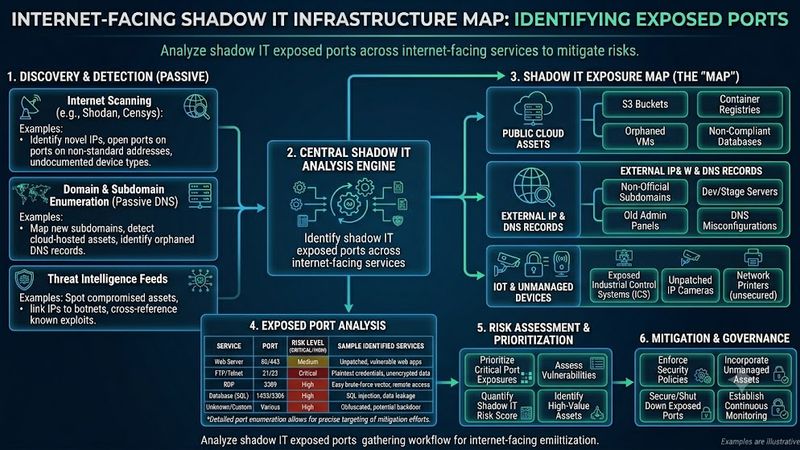
Organizations detect shadow IT infrastructure through continuous asset discovery, external attack surface monitoring, passive DNS analysis, cloud inventory auditing, and network traffic analysis — combining internal visibility tools with external scanning perspectives that reveal what internet-facing assets actually look like to an attacker. Relying solely on internal inventories is insufficient because shadow IT, by definition, bypasses the processes that generate those inventories.
External Attack Surface Monitoring
External attack surface monitoring is the practice of continuously scanning and analyzing an organization's internet-facing footprint from an outside perspective — discovering assets that internal IT processes may have missed. The most effective approach mirrors what an attacker would do: query Shodan and Censys for the organization's IP ranges and ASNs, enumerate subdomains through certificate transparency logs, and analyze DNS records for unexpected resolutions. This outside-in view reveals shadow IT exposures that would never appear in internal asset management databases.
For teams wanting to implement this visibility immediately, the ReconShield IP Reputation Intelligence tool cross-references IP addresses and ASNs against global threat feeds and surfaces risk scores for internet-facing infrastructure. Pairing this with the ReconShield WHOIS Domain Intelligence tool — which queries RDAP endpoints for domain and infrastructure attribution — gives security teams an on-demand external reconnaissance capability.
DNS and Cloud Inventory Analysis
DNS analysis reveals shadow IT by surfacing subdomains, cloud provider hostnames, and historical resolution records that point to infrastructure the organization may not have formally inventoried. A DNS query for all subdomains of a company's domain — using certificate transparency logs via crt.sh, passive DNS services, or brute-force subdomain enumeration — frequently reveals development environments, abandoned staging servers, employee-created cloud applications, and forgotten vendor integrations. Validating your DNS security posture alongside this discovery process is equally important. The ReconShield DNS Lookup tool audits SPF, DMARC, MX, and NS records — common misconfiguration areas in shadow IT cloud deployments.
SIEM Correlation and Network Traffic Analysis
SIEM platforms can detect shadow IT through correlation rules that flag unusual outbound connections, unexpected inbound traffic on non-standard ports, or authentication events from unrecognized hosts. Network traffic analysis tools identify services communicating on ports that are not listed in the authorized service catalog. For teams building structured threat intelligence to feed these detection workflows, our Beginner's Guide to Threat Intelligence and IOC Analysis explains how IOC feeds, traffic correlation, and external threat data combine to detect unauthorized infrastructure activity.
## What Tools Are Best for Monitoring Exposed Ports and Shadow IT?
The best tools for monitoring exposed ports and shadow IT combine internet-wide scanning intelligence, cloud security posture management, and continuous external attack surface monitoring to give security teams complete visibility into both known and unknown internet-facing infrastructure. No single tool provides full coverage — effective exposure management requires combining external reconnaissance tools with cloud-native security platforms.
Shodan is the most widely used search engine for internet-connected devices, indexing banner data, open ports, TLS certificates, and service metadata across the entire IPv4 internet. Security teams use Shodan to search for their organization's IP ranges and identify exposed services they were previously unaware of. Shodan's alerting feature notifies teams when new hosts in their IP space appear in scan results — a direct detection mechanism for newly deployed shadow IT.
Censys provides similar internet-wide scanning intelligence with stronger certificate and TLS analysis capabilities. Its Attack Surface Management platform allows organizations to continuously monitor their external-facing assets and receive alerts when new exposures are discovered. Censys is particularly effective at discovering shadow IT through certificate transparency log correlation.
Nmap remains the industry-standard tool for targeted port scanning and service identification. While primarily used in authorized internal scanning contexts, Nmap is the reference tool for understanding which services are running on discovered hosts and what version information is exposed. For teams validating their own SSL/TLS configuration as part of port exposure auditing, the ReconShield SSL/TLS Crypto Checker audits cipher suites and certificate chains across your internet-facing services.
SecurityTrails provides passive DNS history, subdomain enumeration, and WHOIS intelligence that are essential for discovering shadow IT infrastructure through DNS analysis. Its API allows security teams to automate continuous monitoring of their domain's DNS footprint.
Microsoft Defender for Cloud and Wiz represent the cloud-native security posture management (CSPM) category — platforms that continuously audit cloud environment configurations, identify publicly exposed resources, and flag misconfigured security groups that inadvertently expose ports to the internet. These platforms are essential for organizations with multi-cloud environments where shadow IT cloud deployments are most likely to occur.
Palo Alto Cortex Xpanse and CrowdStrike Falcon Exposure Management represent the enterprise attack surface management (ASM) category, providing continuous discovery of internet-facing assets including shadow IT, automated risk scoring, and integration with broader SIEM and SOAR platforms for remediation workflows.
[Insert image: Shodan search results showing exposed RDP servers filtered by organization ASN | Alt text: "Detect shadow IT exposed ports with Shodan internet-wide scanning"]
[Insert image: ReconShield TCP Port Analyzer showing open port discovery results for a target domain | Alt text: "Map exposed ports across internet-facing assets with ReconShield Port Scanner"]
## What Are the Best Practices for Securing Shadow IT Exposed Ports?
Securing shadow IT exposed ports requires a layered approach combining zero trust access controls, continuous asset discovery, firewall hardening, network segmentation, and governance policies that make unauthorized infrastructure deployment difficult to sustain invisibly. No single control eliminates shadow IT risk — the goal is to reduce both the likelihood of unauthorized exposure and the dwell time before it is discovered and remediated.
Zero trust security reduces shadow IT risk by enforcing strict authentication and least-privilege access across all systems — meaning that even if a shadow IT service is deployed, it cannot be accessed without passing authentication and authorization checks that are centrally managed. Implementing MFA on all remote access services, requiring certificate-based authentication for SSH, and deploying network access control (NAC) solutions that enforce device compliance before granting network access all reduce the exploitability of shadow IT services even when they exist.
Firewall hardening and port exposure minimization require a default-deny inbound policy on all network perimeters. Every exposed port must have a documented business justification, an assigned owner, and a defined review schedule. Cloud security groups and network ACLs should be audited automatically using CSPM tools to detect any deviation from the approved exposure baseline. The ReconShield Security Headers Auditor complements network-layer firewall auditing by validating application-layer security controls — CSP, HSTS, and X-Frame-Options — that are frequently misconfigured in shadow IT web applications.
Continuous asset inventory is the operational foundation of shadow IT exposure management. Organizations should implement automated asset discovery that runs continuously — not quarterly or annually — using a combination of internal network scanning, cloud provider API queries, and external attack surface monitoring. Continuous asset inventory helps organizations identify unauthorized infrastructure before exposed services become exploitable. Each discovered asset should be automatically classified, assigned an owner, and compared against the approved service catalog to flag any unauthorized exposures for immediate remediation.
Network segmentation limits the blast radius when shadow IT systems are compromised. By isolating unmanaged or BYOD devices in dedicated network segments with restricted routing to internal systems, organizations ensure that a compromised shadow IT asset cannot be used as a direct pivot point into the core network. Micro-segmentation technologies — particularly in cloud environments — allow granular control over east-west traffic flows that traditional network perimeters cannot enforce.
Vulnerability management automation ensures that when shadow IT assets are discovered, they are immediately assessed for known vulnerabilities and patched or isolated before attackers can exploit them. Integrating asset discovery output with vulnerability management platforms like Qualys, Rapid7, or Tenable allows organizations to automatically initiate vulnerability assessments against newly discovered assets within hours of discovery rather than waiting for the next scheduled scan cycle.
## What Real-World Breaches Were Caused by Shadow IT Exposed Services?
Real-world breaches caused by shadow IT exposed services consistently share a common pattern: an unmanaged or forgotten internet-facing asset — a cloud storage bucket, a remote access server, a development database — is discovered and exploited by attackers before the defending organization even knew it existed. These incidents demonstrate that shadow IT exposure is not a theoretical risk; it is one of the leading root causes of enterprise data breaches.
Open RDP attack cases have driven some of the most damaging ransomware incidents in recent years. The Colonial Pipeline ransomware attack in 2021 was attributed to a compromised VPN account, but subsequent investigations revealed that exposed remote access services — including legacy RDP instances — were present in the environment — Source: US Senate Homeland Security Committee Report, 2021. Ransomware groups including REvil, DarkSide, and Cl0p explicitly prioritize internet-exposed RDP servers as initial access vectors.
Misconfigured Kubernetes dashboards have exposed organizations including Tesla, which in 2018 discovered that its AWS Kubernetes environment had an unauthenticated dashboard exposed to the internet. Attackers installed cryptomining software using the unsecured Kubernetes access — Source: RedLock Cloud Security Report, 2018. The Kubernetes API server and dashboard remain among the most dangerous shadow IT exposures in cloud-native environments.
Public database leaks caused by misconfigured cloud databases — MongoDB, Elasticsearch, and Redis instances deployed without authentication and exposed to the internet — have exposed billions of records. Security researcher Bob Diachenko identified hundreds of publicly accessible MongoDB instances containing production data every year between 2017 and 2023. These instances are almost always shadow IT: databases deployed by developers or data teams without formal security review. For context on how threat actors operationalize compromised data from these exposures, our analysis of real-world threat intelligence incidents covers how leaked infrastructure data fuels subsequent attack campaigns.
## What's Next for Shadow IT Security and Exposure Management?
The future of shadow IT security is defined by AI-driven attack surface management, continuous exposure validation, cloud-native security posture management, and automated remediation workflows that eliminate the time gap between discovery and closure of unauthorized exposures. The era of periodic manual security audits is ending — the velocity of cloud deployment and shadow IT growth requires continuous automated visibility.
AI-driven attack surface management is transforming how organizations discover and prioritize shadow IT risks. Machine learning models can analyze patterns in DNS changes, certificate issuances, cloud API logs, and network traffic to identify shadow IT deployments faster and with fewer false positives than threshold-based alerting. Platforms like Palo Alto Cortex Xpanse and CrowdStrike Falcon Exposure Management are already applying AI-based anomaly detection to distinguish authorized infrastructure changes from unauthorized shadow IT deployments.
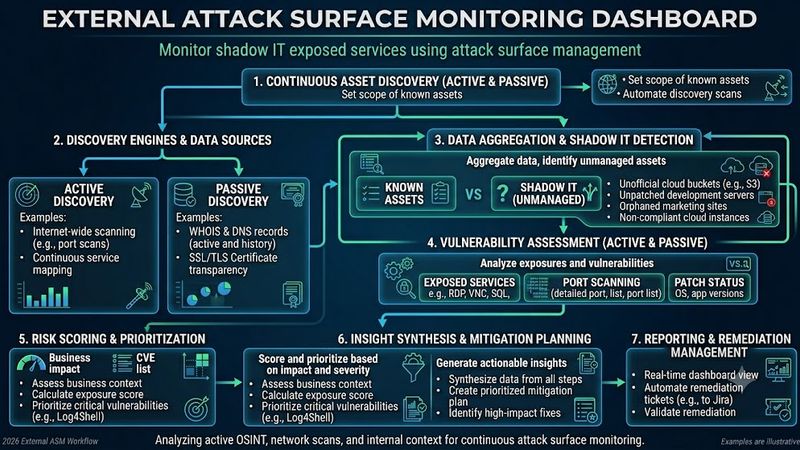
Continuous exposure validation — automated and recurring tests of whether known-vulnerable configurations are present across all internet-facing assets — is replacing point-in-time penetration testing for attack surface monitoring purposes. By running exposure validation continuously, organizations maintain current knowledge of their exposure status rather than operating on data that may be weeks or months out of date.
Unified asset visibility platforms are converging CSPM, external attack surface management, and internal asset inventory into single platforms that provide a complete picture of an organization's digital footprint — authorized and unauthorized — in real time. This convergence directly addresses the core problem of shadow IT: the gap between what IT manages and what actually exists on the internet. Start building your exposure visibility baseline today with the ReconShield infrastructure exposure diagnostics suite, which provides passive assessment of your internet-facing assets with zero traffic sent directly to target systems.
## Conclusion
Shadow IT exposed ports are not a niche security concern — they are one of the most common and consequential contributors to enterprise data breaches, ransomware incidents, and compliance failures today. Every unauthorized system, forgotten cloud VM, or employee-deployed application that exposes a port to the internet is a potential entry point that your security team may know nothing about.
The organizations that solve this problem are the ones that treat asset discovery as a continuous operation rather than a periodic project. They combine external attack surface monitoring with internal cloud security controls, enforce zero trust access policies on all remote services, and automate the detection-to-remediation cycle so that shadow IT exposures are closed in hours rather than months. Audit your external exposure baseline now — because attackers are already scanning for it. Begin with the ReconShield passive diagnostics suite and the TCP Port Analyzer to see your internet-facing infrastructure the way an attacker sees it.
Written by Surendra Reddy Cybersecurity Researcher & Founder, ReconShield. Surendra is a cybersecurity engineer specializing in Open Source Intelligence (OSINT), exposure intelligence, and AI-driven threat analysis. He built ReconShield to democratize access to enterprise-grade infrastructure visibility tools and secure the digital internet-facing assets.
Reviewed by ReconShield Editorial Team — Peer-reviewed for technical accuracy, attack surface management correctness, and operational applicability against current enterprise security frameworks.
## Analyst Commentary & Implementation Blueprint
Security advisory
Continuous security exposure assessment is critical to identifying public vulnerabilities before they are exploited. Organizations should maintain a passive inventory of all web servers, TLS configs, and open ports, ensuring that default configurations are eliminated and security advisories are actively implemented.
Hardened Security Configuration Blueprint
# General Security Hardening Directive
ServerTokens ProductOnly
ServerSignature Off
FileETag None
Actionable Mitigation Checklist
- ✔Perform passive asset inventories weekly.
- ✔Restrict administrative ports using local firewall controls.
- ✔Monitor active CVE alerts for exposed software.
Common Inquiries & FAQs
Why is passive scanning preferred for continuous auditing?
Passive audits do not cause operational impact or trigger firewall blocks, making them ideal for constant surveillance of internet-facing assets.
What should I do if a vulnerability is flagged?
Apply the latest vendor patches, restrict access to the resource via firewalls, or verify configuration flags to mitigate risks.
Surendra Reddy
Surendra Reddy is a cybersecurity researcher and founder of ReconShield, specializing in OSINT and defensive infrastructure analysis.
Connect on LinkedIn ↗// AUDIT BRIEFING DISCUSSION (2 COMMENTS)
Great breakdown of the passive infrastructure vectors. We recently audited our external DNS zones and found multiple dangling staging environments. Implementing wildcard certificates reduced our CT log leaks significantly.
Is there any automated tooling you recommend for daily crt.sh scraping? Manually checking CT logs is becoming unsustainable for our domain portfolio.
// MORE ARTICLES
Security Researchers Warn Critical n8n Flaws May Expose Automation Platforms to RCE
Researchers have disclosed critical vulnerabilities in n8n that could expose automation workflows and connected enterprise systems to remote code execution risks, prompting urgent patch recommendations for users and administrators.

How Agentic AI Is Changing Software Engineering and Expanding Mobile Attack Surfaces
Agentic AI is rapidly transforming software engineering workflows through automation and intelligent coding assistance, while cybersecurity experts warn of expanding mobile attack surfaces and emerging application security risks.

Critical Tenda Router Backdoor (CVE-2026-11405): Check If Your Device Is Vulnerable Now
CVE-2026-11405 is an unpatched Tenda router backdoor granting full admin access without a password. Check if your model is affected now.