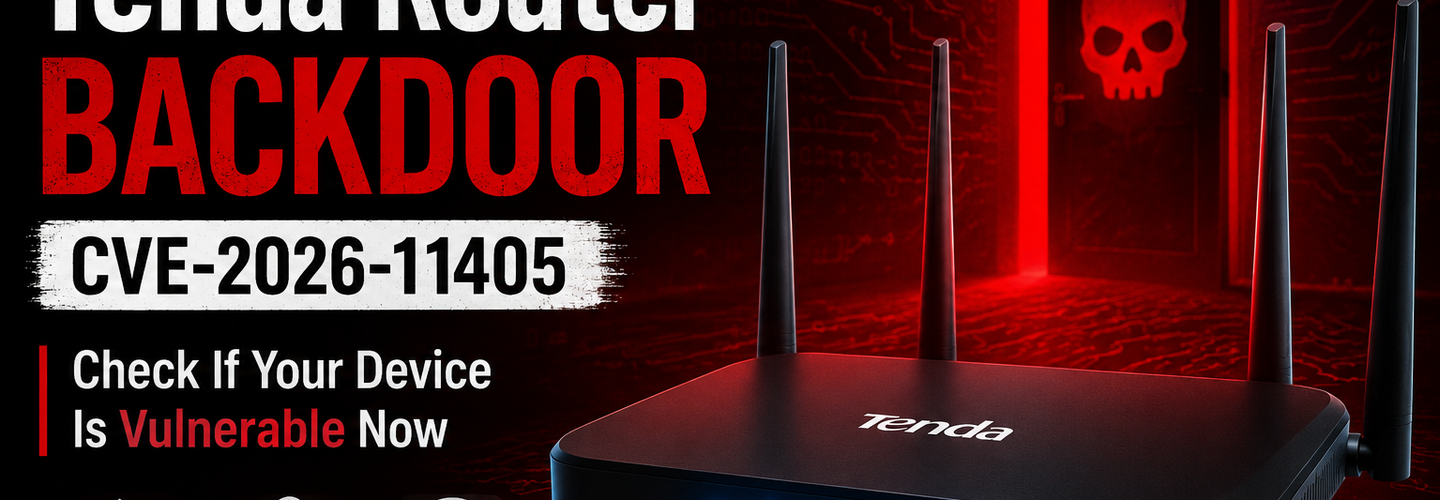
Critical Tenda Router Backdoor (CVE-2026-11405): Check If Your Device Is Vulnerable Now
Summarize this blog post with:
ChatGPT | Perplexity | Claude | Grok
You've probably set a strong administrator password on your router and considered the job done. What most owners don't realize is that some routers ship with a second, hidden login path that makes the password you set completely irrelevant. In this guide, you'll learn how the newly disclosed Tenda router backdoor works, which models are affected, and exactly what to do since no patch currently exists.
Key Takeaways
- ▸CVE-2026-11405 is an undocumented authentication backdoor built directly into the firmware of several Tenda router models, disclosed by CERT/CC on July 6, 2026.
- ▸The backdoor lets an attacker log in with any username paired with a hidden internal password, bypassing the router owner's actual configured credentials entirely.
- ▸Five specific firmware builds are confirmed affected, covering the Tenda FH1201, W15E, AC10, AC5, and AC6 V2 router models.
- ▸No patch is currently available. CERT/CC notified Tenda on May 19, 2026, and received no response by the time of public disclosure seven weeks later.
- ▸Successful exploitation grants full administrative control, including the ability to change DNS servers, disable firewall rules, and reconfigure the entire device.
- ▸Reports on active exploitation conflict: CERT/CC and most researchers report no confirmed in-the-wild exploitation or public proof-of-concept as of publication, while at least one security firm has reported scanning activity targeting a related port — treat this as unconfirmed until corroborated further.
- ▸With no fix available, disabling remote web management is currently the single most effective mitigation.
What Is the Tenda Router Backdoor CVE-2026-11405?
The Tenda router backdoor is an undocumented, secondary authentication path built directly into the firmware of several Tenda router models, letting an attacker gain full administrative access without knowing the actual configured password. CERT/CC, operated by Carnegie Mellon University's Software Engineering Institute, disclosed the flaw as CVE-2026-11405 on July 6, 2026, after being unable to get any response from Tenda following initial notification on May 19. Unlike a typical software bug caused by a coding mistake, this backdoor is a fully functional, alternate login path that exists alongside the router's normal authentication process.
For example, the flaw sits inside the login() function of the /bin/httpd web server binary, the component that handles every authentication attempt to a Tenda router's management interface. Whether this alternate path was placed there deliberately or left behind as a forgotten development feature remains unclear, and CERT/CC's advisory draws no conclusion on intent.
Why Does This Backdoor Matter?
This backdoor matters because it fundamentally breaks the assumption that a strong router password protects the device. A router sits at the boundary between a home or office network and the internet, meaning whoever controls it controls every device connected behind it. An attacker who successfully authenticates through this hidden path can redirect DNS queries to attacker-controlled servers, disable firewall protections, modify port forwarding rules, and intercept or reroute traffic for every device on the network.
At the same time, Tenda's continued silence compounds the risk. Tenda has a documented history of not responding to security researchers who disclosed critical vulnerabilities in its products across 2013, 2020, 2021, and 2022 — Source: TechTimes, 2026. Because there is currently no patch and no communicated remediation timeline, affected owners are left depending entirely on configuration-based hardening rather than a clean fix, for an unknown period of time.
Technical Breakdown: How the Backdoor Works
The vulnerability activates only after a router's normal authentication check fails, which is what makes it a genuine backdoor rather than a simple implementation flaw. According to CERT/CC's advisory, the firmware first performs standard MD5-based password verification exactly as expected. If that check fails, the login function doesn't reject the attempt — instead, it quietly follows a second, undocumented code path.
The Hidden Comparison
For example, the login routine calls an internal function to retrieve an alternate password value stored under the configuration key sys.rzadmin.password, then performs a direct plaintext comparison between that stored value and whatever password the user supplied. If the two values match, the device grants role=2 administrator-level access and creates a fully valid session, regardless of what the router owner actually set as their administrator password. Critically, the username submitted during this process isn't validated at all — any username paired with the correct hidden password succeeds.
Why This Differs From a Typical Vulnerability
Most router vulnerabilities stem from implementation mistakes: a buffer overflow, a misconfigured endpoint, or a default password users forgot to change. This flaw is categorically different because it's a separate, fully functional login path rather than a flaw in the existing one, meaning there is nothing an owner could have configured differently to avoid exposure. That distinction is also why disabling or changing settings within the router's own interface can't fully resolve the issue on its own.
Which Tenda Router Models Are Affected?
CERT/CC's advisory confirms five specific firmware builds as affected, spanning five popular consumer and small-business router models.
- ▸Tenda FH1201 — firmware US_FH1201V1.0BR_V1.2.0.14(408)_EN_TD
- ▸Tenda W15E — firmware US_W15EV1.0br_V15.11.0.5(1068_1567_841)_EN_TDE
- ▸Tenda AC10 — firmware US_AC10V1.0re_V15.03.06.46_multi_TDE01
- ▸Tenda AC5 — firmware US_AC5V1.0RTL_V15.03.06.48_multi_TDE01
- ▸Tenda AC6 V2 — firmware US_AC6V2.0RTL_V15.03.06.51_multi_T
Because backdoor logic like this often shares common code lineage across a vendor's broader product line, other Tenda models and firmware builds not explicitly listed should be treated with appropriate caution as well, pending further research.
Is This Vulnerability Being Actively Exploited?
This is genuinely unclear, and the available reporting conflicts. CERT/CC's own advisory, along with reporting from BleepingComputer, TechTimes, and Dark Web Informer, states that no active exploitation or public proof-of-concept code has been confirmed, and the CVE is not currently listed in CISA's Known Exploited Vulnerabilities catalog. Separately, one security research firm has reported observing automated scanning activity targeting a specific port associated with a published detection script, along with anecdotal reports of routers contacting suspicious external infrastructure — but this claim hasn't been corroborated by CERT/CC or the other outlets tracking the disclosure. Given that conflict, treat any claim of confirmed active exploitation with caution until it's independently verified, while still treating the underlying risk as serious given the nature of the flaw itself.
How Do You Check If Your Router Is Vulnerable?
Checking your device takes just a few minutes and doesn't require any technical expertise beyond locating your router's firmware version.
Log into your router's administrative web interface (typically via a browser at your router's LAN IP address).
Navigate to the System Status or Firmware Information page.
Locate the full firmware version string.
Compare it against the five affected builds listed above.
If you're uncertain how to read your version string, Tenda's own firmware download center lists version references by model for comparison.
[Insert image: Screenshot of a router firmware version page for comparison | Alt text: "Check Tenda router firmware version for CVE-2026-11405"]
What Should You Do Since No Patch Exists?
With no vendor patch available, CERT/CC's guidance and standard router-hardening practice both point to configuration-based defenses rather than a technical fix.
- ▸Disable remote (WAN-side) web management immediately if it's enabled, since this is the single setting that allows the interface to be reached from the public internet at all.
- ▸Restrict the admin interface to a trusted, segmented local network, keeping it off the public internet entirely wherever your setup allows.
- ▸Change the router's default LAN IP address, which reduces opportunistic discovery by automated scanners targeting known default ranges, though CERT/CC is clear this won't stop a deliberate, targeted attacker.
- ▸Monitor Tenda's firmware download page for any future update addressing this CVE, and check back periodically given the company's history of delayed responses.
- ▸Consider retiring the device if it has aged out of vendor support, replacing it with hardware from a manufacturer with a stronger track record of timely security patching.
Before assuming your network is unaffected, running a website vulnerability scanner against your exposed network devices can help confirm whether any admin interfaces are reachable from the internet in the first place.
Enterprise and Small-Office Mitigation
Organizations running any of the affected models — including in satellite offices, retail locations, or remote employee setups — should treat this as an emergency network audit trigger rather than a routine advisory.
- ▸Inventory all deployed router hardware across every office and remote work location to identify any of the five confirmed affected models.
- ▸Implement VLAN segmentation to isolate any vulnerable devices from critical business systems if immediate replacement isn't feasible.
- ▸Monitor authentication logs for successful logins following a failed password attempt, since a successful login despite an incorrect administrator password is a key indicator of exploitation.
- ▸Disable remote management fleet-wide as a baseline policy for all edge networking devices, not just the ones confirmed affected by this specific CVE.
Use a DNS lookup tool to confirm your DNS servers haven't been silently redirected, and a subdomain enumeration tool to check whether any unexpected infrastructure is tied to your network's public-facing footprint.
Practical Security Best Practices
- ▸Never expose device administration interfaces directly to the internet, regardless of vendor or device type.
- ▸Segment IoT and networking devices onto separate VLANs from computers holding sensitive data.
- ▸Prefer vendors with a demonstrated track record of timely firmware patching when purchasing new networking equipment.
- ▸Retire hardware that has aged out of support, since unsupported devices won't receive fixes for newly discovered flaws like this one.
- ▸Monitor CERT/CC and CISA advisories directly for updates, since this disclosure may evolve as more research emerges.
An IP reputation lookup is worth running against any external addresses your router logs show unexpected outbound connections to.
What's Next? Tracking This Disclosure
This story is still developing, particularly around whether Tenda responds and whether exploitation claims get independently corroborated.
- ▸Watch for a vendor statement or patch from Tenda, though the company's history suggests this may take considerable time, if it comes at all.
- ▸Follow whether this CVE gets added to CISA's KEV catalog, which would indicate confirmed active exploitation has been independently verified.
- ▸Review our related coverage of the Microsoft Defender RoguePlanet zero-day for another recent example of a vendor security tool itself becoming the point of failure.
- ▸Bookmark our cybersecurity news hub for updates as this disclosure develops.
Conclusion
CVE-2026-11405 is a reminder that the trust placed in a device is only as good as the code that can't be seen from the outside. With no patch available and no meaningful response from Tenda, the only real defense right now is configuration hardening — disable remote management, segment the network, and check your firmware version against the five confirmed builds today. If your device is affected and aging out of support, this is a reasonable prompt to consider replacing it with hardware from a vendor with a stronger patching track record. Stay subscribed to trusted vulnerability intelligence sources so any update to this disclosure reaches you as soon as it's confirmed.
Written by ReconShield Editorial Team — a cybersecurity publication covering cyber threats, data breaches, vulnerabilities, malware, threat intelligence, and online privacy, providing practical insights to help readers stay informed and secure.
Reviewed by Surendra Reddy, Founder & Principal Security Engineer, ReconShield — a cybersecurity researcher specializing in OSINT, infrastructure exposure intelligence, and passive diagnostic tooling.
Disclaimer: This article was initially drafted using AI assistance. However, the content has undergone thorough revisions, editing, and fact-checking by human editors and subject matter experts to ensure accuracy.
Read More:
AI Bug Hunting: How Security Researchers Use AI to Find Vulnerabilities in
CVE-2026-46331: New Linux pedit COW Exploit Enables Root Access by Poisoning Cached Binaries
Update Chrome Now: 382 Security Vulnerabilities Patched, Including 15 Critical Bugs
Security Alert: Multiple FatFs Vulnerabilities Impact Embedded Devices Worldwide
Top 15 Critical CVE-2026 Vulnerabilities Every IT Team Should Know
Breaking: Hackers Claim Massive Accenture Data Breach, 35GB of Source Code Allegedly Stolen
## Analyst Commentary & Implementation Blueprint
Security advisory
Continuous security exposure assessment is critical to identifying public vulnerabilities before they are exploited. Organizations should maintain a passive inventory of all web servers, TLS configs, and open ports, ensuring that default configurations are eliminated and security advisories are actively implemented.
Hardened Security Configuration Blueprint
# General Security Hardening Directive
ServerTokens ProductOnly
ServerSignature Off
FileETag None
Actionable Mitigation Checklist
- ✔Perform passive asset inventories weekly.
- ✔Restrict administrative ports using local firewall controls.
- ✔Monitor active CVE alerts for exposed software.
Common Inquiries & FAQs
Why is passive scanning preferred for continuous auditing?
Passive audits do not cause operational impact or trigger firewall blocks, making them ideal for constant surveillance of internet-facing assets.
What should I do if a vulnerability is flagged?
Apply the latest vendor patches, restrict access to the resource via firewalls, or verify configuration flags to mitigate risks.
Surendra Reddy
Surendra Reddy is a cybersecurity researcher and founder of ReconShield, specializing in OSINT and defensive infrastructure analysis.
Connect on LinkedIn ↗// AUDIT BRIEFING DISCUSSION (2 COMMENTS)
Great breakdown of the passive infrastructure vectors. We recently audited our external DNS zones and found multiple dangling staging environments. Implementing wildcard certificates reduced our CT log leaks significantly.
Is there any automated tooling you recommend for daily crt.sh scraping? Manually checking CT logs is becoming unsustainable for our domain portfolio.
// MORE ARTICLES
Security Researchers Warn Critical n8n Flaws May Expose Automation Platforms to RCE
Researchers have disclosed critical vulnerabilities in n8n that could expose automation workflows and connected enterprise systems to remote code execution risks, prompting urgent patch recommendations for users and administrators.

How Agentic AI Is Changing Software Engineering and Expanding Mobile Attack Surfaces
Agentic AI is rapidly transforming software engineering workflows through automation and intelligent coding assistance, while cybersecurity experts warn of expanding mobile attack surfaces and emerging application security risks.

SplitVPN Hacked: Data Breach Exposes 865,000 User Records and 58 Million Hidden Connection Logs (July 2026)
SplitVPN hacked: 865,336 user records and 58 million connection logs exposed, directly contradicting the VPN's "no-logs" promise. What was leaked and what to do now.