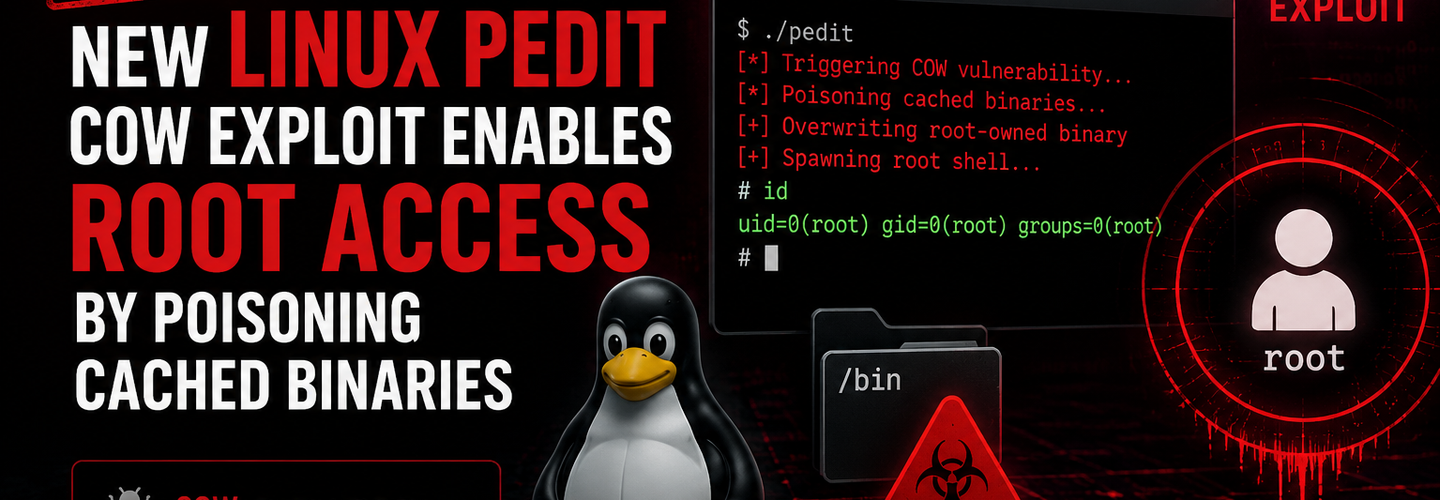
CVE-2026-46331: New Linux pedit COW Exploit Enables Root Access by Poisoning Cached Binaries
Summarize this blog post with: ChatGPT | Perplexity | Claude | Grok
A working exploit for CVE-2026-46331 appeared on GitHub within 24 hours of the CVE being assigned on June 16, 2026. The vulnerability — nicknamed "pedit COW" — is an out-of-bounds write in the Linux kernel's traffic-control packet-editing subsystem that corrupts shared page-cache memory, allowing an unprivileged local user to inject shellcode into the in-memory copy of a setuid-root binary and execute a root shell. What makes this particularly dangerous is what it does not do: it never touches a single byte on disk, which means file-integrity monitoring comes back clean while the attacker already has root. The fix was merged on June 16 as part of what was framed for weeks on the public netdev mailing list as a routine data-corruption fix — no CVE, no security label, no urgency signal — until the CVE arrived, the PoC dropped the next day, and administrators had essentially no warning window. In this guide, you'll get the full technical root cause, the exploit chain step by step, every confirmed-affected distribution and kernel version, vendor advisory status, and the exact mitigations to apply right now.
## Key Takeaways
- ▸CVE-2026-46331 ("pedit COW") is an out-of-bounds write in the Linux kernel's act_pedit traffic-control subsystem — introduced in kernel commit 899ee91156e5 and present across kernel versions v5.18 through v7.1-rc6, patched in v7.1-rc7.
- ▸The exploit, dubbed packet_edit_meme, achieves local privilege escalation to root by corrupting the page-cached in-memory ELF image of the setuid binary /bin/su, injecting a shellcode payload (setgid(0) + setuid(0) + execve("/bin/sh")) that executes as root.
- ▸The attack bypasses file-integrity monitoring entirely — the exploit overwrites only the kernel's in-memory cached copy of the binary; the on-disk file is never modified and passes all integrity checks while a root shell is already open.
- ▸Two prerequisites must be present: the act_pedit kernel module must be loadable, and unprivileged user namespaces must be enabled — both conditions are default on RHEL, Debian, and most Ubuntu configurations.
- ▸A weaponized public PoC dropped June 17, 2026 — one day after CVE assignment — compressing the window between "patch available" and "active exploitation risk" to under 48 hours.
- ▸The upstream fix was publicly visible on the netdev mailing list for weeks before CVE assignment as a routine data-corruption fix with no security framing — making pedit COW an N-day in the way that matters most to defenders: the exploitable detail was on a public list long before any security tooling could flag it.
- ▸Concurrently, a companion page-cache corruption vulnerability — CVE-2026-43503 ("DirtyClone") — was published by JFrog Security Research on June 25, exploiting a different code path (netfilter TEE + IPsec decryption) to achieve the same outcome: a root shell from an in-memory page-cache write.
## What Is CVE-2026-46331 (pedit COW)?
CVE-2026-46331, nicknamed "pedit COW," is an out-of-bounds write in the packet-editing action (act_pedit) that corrupts shared page-cache memory. A public, working exploit appeared within a day of the CVE assignment on June 16.
The pedit COW vulnerability sits in one of the least scrutinized corners of the Linux kernel: the traffic-control (tc) subsystem's packet-editing action. Most security research focuses on networking attack surfaces — exposed ports, protocol parsers, remote code paths. The traffic-control subsystem is an internal kernel mechanism used to modify packet headers in flight, primarily by network administrators managing QoS and traffic shaping on servers with complex routing requirements. It is rarely thought of as a privilege escalation attack surface.
The vulnerability originates in a kernel function called tcf_pedit_act(). Under normal circumstances, the function should create a private copy of data before making any modifications. This process follows the standard copy-on-write (COW) mechanism, which prevents changes from affecting shared memory. However, researchers found that the function validates writable memory ranges before the final packet offsets are fully determined. Some packet-editing keys calculate their offsets only during runtime. As a result, writes can occur outside the intended memory region. Instead of modifying a private copy, the kernel ends up altering a shared page-cache page. If that page belongs to a cached executable file, the file's in-memory image becomes corrupted.
The bug name "pedit COW" comes from the fact that copy-on-write semantics failed. The kernel function responsible, tcf_pedit_act(), is supposed to take a private copy of packet data before editing it.
This class of vulnerability has a well-established lineage in Linux security research. The original Dirty COW (CVE-2016-5195) shocked the security community in 2016 by demonstrating that copy-on-write race conditions in the kernel could be exploited for privilege escalation from any local user account. The DirtyFrag family that followed applied similar page-cache corruption techniques through different kernel code paths. pedit COW is the latest and, in some respects, most concerning instance: it operates through a subsystem that is not typically thought of as an attack surface, it bypasses all disk-based detection, and it had a working exploit in public circulation before most security tooling had a rule or a vendor advisory to alert on.
## The Technical Root Cause: Why tcf_pedit_act() Fails
The vulnerability is a partial-COW failure in the tcf_pedit_act() function — the kernel validates memory range boundaries at the wrong point in the code path, allowing runtime-determined packet offsets to push writes beyond the bounds of the intended private copy and into shared page-cache memory.
The root cause is a partial-COW page-cache corruption bug introduced in kernel commit 899ee91156e5, present across Linux kernel versions v5.18 through v7.1-rc6 and patched in v7.1-rc7. The flaw resides in the net/sched act_pedit subsystem, a traffic editing component of the Linux traffic control (tc) framework.
To understand why this matters, consider what page-cache memory is and why it is shared. The Linux kernel maintains a page cache — a region of physical memory where the contents of disk files are stored after being read. When multiple processes open the same file (for example, the /bin/su binary, which every user can execute), they all read from the same set of cached pages rather than each loading a separate copy from disk. This sharing is efficient — it means one copy in memory serves thousands of processes. The safety guarantee is that these shared pages are read-only for user-space processes; the COW mechanism ensures that any write creates a private copy first, leaving the shared pages intact.
When tcf_pedit_act() fails to enforce this guarantee — writing into the shared page-cache copy instead of creating a private one first — it violates this safety invariant. The write goes directly into the kernel's in-memory representation of a cached file. If that file happens to be a setuid-root binary, the attacker has just modified, in kernel memory, the code that the kernel will execute the next time any user runs that binary.
The specific timing failure is that the bounds check on writable memory ranges occurs before all packet-editing key offsets are resolved. Some keys compute their actual write offset during runtime, after the bounds validation has already run. Those late-resolved offsets can push the write out of the expected region and into adjacent cached page data.
## The Exploit Chain: From Unprivileged User to Root Shell
The attack chain works by spawning a user namespace child process with CAP_NET_ADMIN capabilities — a permission reachable by unprivileged users on systems where unprivileged user namespaces are enabled by default. The exploit then leverages the COW corruption primitive to overwrite the page-cached ELF entry point of the setuid-root binary /bin/su, injecting shellcode that executes setgid(0) + setuid(0) + execve("/bin/sh") — delivering a root shell to the attacker.
The attack chain requires exactly five steps and no additional tools beyond the kernel itself:
Step 1 — Obtain namespace-local CAP_NET_ADMIN: The attacker spawns an unprivileged user namespace. On systems where unprivileged_userns_clone is enabled (the default on most distributions), this requires no elevated permissions whatsoever — any shell user can create a user namespace. Inside that namespace, the process holds CAP_NET_ADMIN for the namespace-local network context. This is the capability required to configure tc traffic-control rules, including act_pedit packet-editing actions.
Step 2 — Configure act_pedit rules targeting /bin/su's cached pages: Using the namespace-local CAP_NET_ADMIN, the attacker configures tc packet-editing rules that will write to memory regions overlapping with the page-cache pages backing /bin/su. The specific write targets the ELF entry point — the first bytes the kernel executes when a process runs the binary.
Step 3 — Trigger the out-of-bounds write: The attacker sends packets that trigger the configured act_pedit action. Due to the late-resolved offset bug, tcf_pedit_act() writes outside the intended private copy and directly into the shared page-cache page backing /bin/su.
Step 4 — Inject shellcode at the ELF entry point: The out-of-bounds write overwrites the ELF entry bytes of /bin/su in the kernel's page cache with a minimal shellcode payload: setgid(0); setuid(0); execve("/bin/sh", NULL, NULL). The on-disk binary is completely unchanged.
Step 5 — Execute /bin/su to trigger the shellcode: Any subsequent execution of /bin/su — by the attacker or any other user — now runs the injected shellcode rather than the legitimate binary code. Since /bin/su is a setuid-root binary, the shellcode executes with root privileges. The attacker receives a root shell.
The exploit never touches the file on disk. It poisons the cached copy of a setuid root binary (/bin/su) in memory, injects a small payload, and runs that altered image as root. File-integrity checks come back clean while a root shell is already open.
This last point deserves emphasis because of its operational implications. File-integrity monitoring tools — Tripwire, AIDE, OSSEC, auditd file-watch rules — compare on-disk file hashes against known-good baselines. The disk is never touched. Every file-integrity check passes. The exploit operates entirely in kernel RAM. The only artifact is the root shell itself.
## Why File-Integrity Monitoring Cannot Catch This
Both exploits avoid the disk entirely. Both bypass file-integrity monitoring because those tools check on-disk state. Both leave no kernel audit log. Both require only a local unprivileged user account to start.
The pedit COW exploit specifically targets the architectural gap between what file-integrity tools monitor (on-disk state) and what the kernel actually executes (in-memory page-cache state). In normal operation these are identical — the kernel loads a file into the page cache from disk and executes from that cache. File-integrity monitoring is effective precisely because an attacker who wants to persist malicious code typically modifies a file on disk, and that modification shows up in the hash comparison.
pedit COW subverts this assumption by modifying the cache without modifying the disk. From the moment the shellcode is injected until the system reboots (flushing the page cache) or the page-cache entry is evicted and reloaded from disk, every execution of /bin/su runs the shellcode. Every file-integrity check says /bin/su is clean. The divergence between disk and cache is invisible to every tool that checks disk state.
There is a mitigating observation worth noting: dropping the page cache (echo 3 > /proc/sys/vm/drop_caches) clears the poisoned in-memory copy — but this has no remediation value after exploitation because the attacker already has a root shell. Post-exploitation cleanup of the cache does not revoke the shell or undo any privilege escalation that has already occurred. Dropping the page cache (echo 3 > /proc/sys/vm/drop_caches) clears the poisoned in-memory copy, but does nothing about the root shell the attacker already opened. Treat the host as compromised.
## The N-Day Disclosure Timeline: What Defenders Missed
The fix was developed in the open on the netdev mailing list as a routine data-corruption patch (subject "net/sched: fix pedit partial COW leading to page cache corruption"), with no CVE and no security framing. The kernel.org CNA assigned CVE-2026-46331 at merge time on June 16, 2026 — weeks after the exploitable detail was already public — and a weaponized PoC dropped June 17.
This disclosure timeline is one of the most operationally significant aspects of pedit COW — not because the patch arrived late, but because the exploitable technical detail was publicly accessible on the netdev mailing list for weeks before any security tooling could possibly flag it.
The patch subject line was "net/sched: fix pedit partial COW leading to page cache corruption." A reader with deep kernel networking expertise could recognize the security implications — page cache corruption via a tc action that bypasses COW semantics is precisely the primitive needed for this class of privilege escalation. But there was no CVE. There was no entry in NVD, CISA KEV, Red Hat's security advisories, Debian's DSA feed, or Ubuntu's USN feed. Automated vulnerability scanners had nothing to key on. SIEM rules had nothing to trigger against.
We did not catch this one through our own monitoring. It came in through a customer escalation — it was never on oss-security, and the kernel CNA stream is not currently on our watchlist.
This admission from TuxCare — a company whose business is Linux kernel security — illustrates how effectively the "routine data-corruption patch with no security framing" pattern can evade normal vulnerability monitoring. The kernel.org CNA is a relatively new authority (the Linux kernel project became its own CVE Numbering Authority in February 2024), and its notifications are not yet integrated into every security team's patch-management workflow.
The operational lesson is direct: following only CVE-based feeds will miss vulnerabilities during the window between public patch availability and CVE assignment — a window that, as pedit COW demonstrates, can stretch to weeks for kernel vulnerabilities that are not obviously security-relevant to patch authors.
## CVE-2026-43503 ("DirtyClone"): The Concurrent Companion Vulnerability
One week after the pedit COW exploit published, JFrog Security Research published DirtyClone — a second, independent Linux privilege escalation vulnerability achieving root through page-cache corruption via a completely different kernel code path.
DirtyClone is the fourth member of the DirtyFrag family of Linux kernel privilege escalation vulnerabilities. It exploits a missing SKBFL_SHARED_FRAG flag propagation in __pskb_copy_fclone(), triggered through a netfilter TEE rule. The resulting unflagged skb clone passes through IPsec in-place decryption, which overwrites the file-backed page-cache page backing /usr/bin/su.
Both CVE-2026-46331 and CVE-2026-43503 exploit the same architectural tension: the Linux kernel shares physical memory between multiple subsystems for performance, and the safety mechanisms preventing one subsystem from corrupting another are enforced through metadata flags, COW invariants, and range checks. When any of those checks fail, runs early, or fail to propagate across a code path, shared read-only memory becomes a write target. Both exploits avoid the disk entirely. Both bypass file-integrity monitoring because those tools check on-disk state. Both leave no kernel audit log. Both require only a local unprivileged user account to start.
The simultaneous publication of two page-cache corruption privilege escalation exploits within the same week is not coincidence — it reflects intensifying research attention on the architectural pattern. The Linux kernel's shared page-cache design, which provides significant performance benefits, requires precise enforcement of COW invariants across dozens of different kernel subsystems. Each subsystem that handles memory in proximity to page-cache pages is a potential failure point if its COW enforcement has any gap.
For administrators dealing with both vulnerabilities simultaneously, the compensating controls overlap substantially: disabling unprivileged user namespaces blocks both the pedit COW attack path and the DirtyClone attack path. However, the mitigation for DirtyClone's specific kernel modules (blocking esp4, esp6, and rxrpc) differs from pedit COW's module mitigation (blocking act_pedit), so both must be addressed.
## Affected Distributions and Kernel Versions
CVE-2026-46331 affects Linux kernel versions v5.18 through v7.1-rc6 and has been confirmed exploitable by the public PoC on the following distributions and kernel versions:
RHEL 10.0 on kernel 6.12.0-228.el10 — no bypass flag needed; user namespaces open by default. Debian 13 (Trixie) on kernel 6.12.90+deb13.1 — no bypass flag needed. Ubuntu 24.04.4 on kernel 6.17.0-22 — requires the --ubuntu aa-exec userns bypass flag to circumvent AppArmor restrictions. Ubuntu 26.04 on kernel 7.0.0-14 returns "FAIL," but that is the AppArmor user namespace hardening doing its job, not a fixed kernel — the underlying vulnerable code still exists.
Additionally, Red Hat has identified RHEL 8 and RHEL 9 as affected versions. Debian 11 and Debian 12 remain listed as vulnerable. Ubuntu systems are also affected by the underlying kernel flaw.
The broader affected range from CybersecurityNews confirms: organizations running kernels between v5.18 and v7.1-rc6 should treat this as a critical priority patch.
## Vendor Advisories and Patch Status
Vendor-fixed kernels are available for the major enterprise distributions. The patch target for every system is to deploy the distribution-specific fixed kernel and reboot — rebooting is essential both to load the patched kernel and to flush any potentially poisoned page-cache entries from memory.
Red Hat Enterprise Linux: Red Hat has published official security bulletin RHSB-2026-008. Fixed kernels are available via: RHSA-2026:27353 for RHEL 8, RHSA-2026:27355 for RHEL 8.8 EUS/TUS, and corresponding RHEL 9 and RHEL 10 errata. Red Hat rates the vulnerability as Important. Apply via dnf update kernel and reboot.
AlmaLinux: ALSA-2026:27353 is the AlmaLinux 8 rebuild of Red Hat's errata, released June 22. Apply via dnf update kernel and reboot.
Debian: Debian 13 (Trixie) has been patched through its security update channel. Debian 11 and Debian 12 fix availability should be confirmed against the current Debian Security Advisories feed. Apply via apt update && apt upgrade and reboot.
Ubuntu: Patches are in progress. Ubuntu 24.04's AppArmor user namespace hardening restricts the exploit's attack path but does not fix the underlying kernel vulnerability. Ubuntu 26.04's default AppArmor policies block the primary attack path, but systems remain vulnerable if AppArmor is modified or bypassed. Monitor Ubuntu Security Notices (USN) for the kernel update and apply when available.
Upstream kernel: v7.1-rc7 contains the fix. All mainline and stable backport trees are patched.
## Immediate Mitigation Steps for Systems That Cannot Be Patched Immediately
For systems where deploying a patched kernel and rebooting is not immediately feasible — production database servers, systems with no current maintenance window, hosts requiring extended testing before kernel updates — two compensating controls block the exploit chain:
Compensating Control 1 — Disable the act_pedit kernel module
echo 'install act_pedit /bin/true' | sudo tee /etc/modprobe.d/disable-act_pedit.conf
This prevents the act_pedit module from loading, eliminating the specific code path the exploit requires. If your environment does not use tc traffic-control rules with pedit actions, this control has zero operational impact. If your environment does use pedit rules for legitimate network traffic management, this control will break those rules — assess operational impact before deploying.
Compensating Control 2 — Disable unprivileged user namespaces
On RHEL and compatible distributions:
bash
sysctl -w user.max_user_namespaces=0 echo "user.max_user_namespaces=0" >> /etc/sysctl.conf
On Debian and Ubuntu:
bash
sysctl -w kernel.unprivileged_userns_clone=0 echo "kernel.unprivileged_userns_clone=0" >> /etc/sysctl.conf
That removes the namespace-local capability the exploit needs, but it breaks rootless containers, some CI sandboxes, and sandboxed browsers. Test first.
Specifically: Podman, Buildah, and other rootless container tools will fail. Some Kubernetes configurations will fail. Browser sandboxes that depend on user namespaces may fail. Assess this impact in your environment before deploying on production systems.
Both controls are temporary workarounds, not fixes. Test for side effects (rootless containers, browser sandboxes) before deploying. The complete series is required — a kernel that applied the original DirtyFrag fix but not Fragnesia is still vulnerable to Fragnesia's bypass.
## Detection: Hunting for Exploitation Attempts
Because pedit COW leaves no on-disk artifacts and no kernel audit log entries from the write itself, detection must focus on the behavioral prerequisites and post-exploitation signals rather than the corruption event directly.
Detect the exploit preconditions: Monitor for unprivileged user namespace creation immediately followed by tc filter or action configuration attempts. The combination of clone(CLONE_NEWUSER | CLONE_NEWNET) system call followed by tc invocations from the same process tree is a specific behavioral signature of this exploit's attack chain. Configure auditd rules to capture clone system calls with CLONE_NEWUSER flags from non-root processes.
Monitor act_pedit module loading: If you have disabled act_pedit via modprobe blacklisting, any attempt to load it will fail — but the attempt itself can be logged via auditd module-loading events or kernel module audit rules.
Monitor for unexpected namespace creation patterns: Unexpected spikes in user namespace creation from non-container-orchestration processes on servers that do not run rootless containers are a broad detection signal for this exploit class and other user-namespace-dependent privilege escalation attacks.
Post-exploitation indicators: After a successful pedit COW exploitation, the attacker has a root shell. Normal post-exploitation indicators apply: unexpected root-privileged processes without a corresponding setuid binary execution in the audit log, unusual privilege changes in process trees that did not go through sudo, su, or legitimate setuid execution chains, and unexpected child processes spawned from unexpected parent processes.
Audit local access exposure: Review who has shell on shared hosts, CI/CD runners, build servers, and multi-tenant systems. Revoke what is not needed for the duration. Privilege escalation vulnerabilities require local access as a prerequisite — reducing the pool of local accounts on exposed systems directly reduces the practical exploitability risk during the window between disclosure and full patch deployment.
## Why This Pattern Keeps Recurring: The Page-Cache Architectural Tension
Both CVE-2026-46331 and CVE-2026-43503 exploit the same architectural tension: the Linux kernel shares physical memory between multiple subsystems for performance, and the safety mechanisms preventing one subsystem from corrupting another are enforced through metadata flags, COW invariants, and range checks. When any of those checks fail, runs early, or fail to propagate across a code path, shared read-only memory becomes a write target.
This is the third year in which a page-cache corruption privilege escalation exploit with a working public proof-of-concept has emerged from the Linux kernel. Dirty COW in 2016 established the vulnerability class. DirtyFrag and its descendants (Fragnesia, and now DirtyClone) have progressively mapped the same pattern through different kernel subsystems. pedit COW extends it to the traffic-control subsystem.
The pattern will continue appearing because the performance requirement — shared physical memory across kernel subsystems — creates a structural constraint. Every subsystem that can write to kernel memory in proximity to page-cache pages must enforce COW semantics correctly. The Linux kernel is large, complex, and written primarily in C — a language that provides no automatic memory-safety guarantees. Every new code path that handles memory near the page cache is a potential site for this class of bug.
The security research and defensive posture implications are clear: page-cache corruption privilege escalation vulnerabilities will continue to be discovered, working public exploits will continue to appear within days of CVE assignment, and the unprivileged user namespace prerequisite will continue to be the most reliable mitigating control until vendor-fixed kernels are deployed. For the full context on the broader Linux kernel privilege escalation landscape and how the ReconShield team approaches these vulnerabilities, see the ReconShield Linux Kernel Vulnerability guide, which covers CVE-2024-1086, CVE-2026-23111, and CVE-2022-0492 in depth.
## How External Attack Surface Management Reduces Privilege Escalation Exposure
CVE-2026-46331 requires local access — an attacker cannot exploit it remotely without first gaining a foothold on the target system. Reducing the initial access attack surface directly reduces the practical risk from this and every other local privilege escalation vulnerability.
The two most common initial access vectors that provide the local shell access needed for pedit COW exploitation are: exposed services with weak or default credentials (SSH with password authentication on port 22, exposed web application admin panels, exposed database management interfaces), and compromised web applications that provide command execution (SQL injection, server-side template injection, RCE vulnerabilities in web frameworks).
Audit your internet-facing servers for exposed services that provide local access. Use the ReconShield Port Scanner to identify open TCP ports on your public-facing IP addresses — particularly SSH (22), RDP (3389), database ports (3306, 5432), and non-standard web ports that may host admin panels or management interfaces with no business reason to be publicly accessible. Cross-reference discovered services against your authorized exposure inventory and close everything that exceeds intended exposure.
For servers hosting web applications, assess the application's security posture using the ReconShield Exposure Assessment Tool for passive OWASP misconfiguration detection, the Security Headers Auditor for browser-level security controls, and the SSL/TLS Checker for TLS configuration that protects credentials in transit. A web application with poor security posture is a potential initial-access path to the local shell that makes CVE-2026-46331 exploitable. Hardening the application reduces that path.
Verify your IP reputation with the ReconShield IP Reputation Intelligence tool — a server IP appearing on abuse blacklists may indicate that the host has already been compromised and used for malicious activity, making a local privilege escalation from an existing foothold the next step in an active attack chain.
## Administrator Action Checklist
Complete the following actions in priority order, starting now:
Priority 1 — Identify affected systems (immediate): Run uname -r on every Linux system in your environment. Any kernel from v5.18 through v7.1-rc6 is affected. Flag all affected systems for immediate action.
Priority 2 — Deploy vendor-fixed kernels (within 24–48 hours): Apply the appropriate vendor errata: RHSA-2026:27353 (RHEL 8), RHSA-2026:27355 (RHEL 8 EUS), ALSA-2026:27353 (AlmaLinux 8), and equivalent RHEL 9/10 errata. On Debian, apt update && apt upgrade. On Ubuntu, monitor USN for the kernel update. Reboot after applying — the reboot loads the patched kernel and flushes any poisoned page-cache entries simultaneously.
Priority 3 — Apply compensating controls to systems that cannot be immediately rebooted: Block act_pedit module loading via modprobe blacklist. Assess whether disabling unprivileged user namespaces is operationally feasible given rootless container dependencies.
Priority 4 — Audit local access: Review every account with local shell access on multi-tenant systems, CI/CD runners, build servers, and shared research environments. Disable accounts that are not required for active operational purposes. Rotate credentials for all active accounts.
Priority 5 — Configure detection: Add auditd rules monitoring CLONE_NEWUSER combined with tc invocations from non-container-orchestration processes. Monitor for unexpected root-privileged processes without legitimate setuid binary execution ancestry.
Priority 6 — Reduce initial access attack surface: Use the ReconShield Port Scanner to audit exposed services on internet-facing servers. Close services that provide local shell access with no business justification for public exposure. Run the passive scanner suite for the complete external security posture picture that contextualizes your exposure to the initial-access attacks that precede privilege escalation.
## Conclusion
pedit COW is the kind of vulnerability that administrators rightly find alarming — not because of novel exploitation technique (the page-cache corruption pattern is well-established) but because of what it neutralizes. File-integrity monitoring, a foundational security control trusted for decades to detect unauthorized binary modification, is completely blind to this exploit class. The disk is pristine. The audit log is empty. The root shell is open.
The mitigations are clear and available: vendor-fixed kernels are shipping now, the act_pedit module block eliminates the specific exploit path, and disabling unprivileged user namespaces removes the entry point. The challenge is operational — deploying kernel patches at scale, across distributions, with mandatory reboots, at the speed that a working public PoC demands.
Patch your kernels. Reboot to clear poisoned page-cache entries. Block act_pedit on systems that do not use it. Review who has local shell access on every shared host in your environment. Then reduce the initial access attack surface that makes any local privilege escalation vulnerability practically exploitable, using the ReconShield passive scanner suite to audit your external exposure continuously.
The window between "patch merged" and "public exploit" is collapsing. The only reliable defense is a patch deployment operation that matches that speed.
Written by Surendra Reddy Cybersecurity Researcher & Founder, ReconShield. Surendra specializes in OSINT, exposure intelligence, and AI-driven threat analysis. Author Profile →
Reviewed by ReconShield Editorial Team — Peer-reviewed for technical accuracy against The Hacker News, CybersecurityNews, TuxCare, CyaSha, CyberSecGuru, MalwareTips, and GuardianMSSP reporting on CVE-2026-46331; Red Hat Security Bulletin RHSB-2026-008; and NVD CVE-2026-46331.
Disclaimer: This article was initially drafted using AI assistance. However, the content has undergone thorough revisions, editing, and fact-checking by human editors and subject matter experts to ensure accuracy. All CVE technical details, affected version ranges, and vendor advisory status reflect information publicly available as of June 28, 2026.
Read More:
Chrome 149 Released With Critical Security Fixes for Windows, macOS, and Linux
BugHunter AI: The Ultimate AI-Powered Bug Bounty Toolkit for Ethical Hackers in 2026
GPT-5.5-Cyber: OpenAI's AI Security Model That Finds and Fixes Vulnerabilities Automatically
AI Bug Hunting: How Security Researchers Use AI to Find Vulnerabilities in 2026
## Analyst Commentary & Implementation Blueprint
Security advisory
Continuous security exposure assessment is critical to identifying public vulnerabilities before they are exploited. Organizations should maintain a passive inventory of all web servers, TLS configs, and open ports, ensuring that default configurations are eliminated and security advisories are actively implemented.
Hardened Security Configuration Blueprint
# General Security Hardening Directive
ServerTokens ProductOnly
ServerSignature Off
FileETag None
Actionable Mitigation Checklist
- ✔Perform passive asset inventories weekly.
- ✔Restrict administrative ports using local firewall controls.
- ✔Monitor active CVE alerts for exposed software.
Common Inquiries & FAQs
Why is passive scanning preferred for continuous auditing?
Passive audits do not cause operational impact or trigger firewall blocks, making them ideal for constant surveillance of internet-facing assets.
What should I do if a vulnerability is flagged?
Apply the latest vendor patches, restrict access to the resource via firewalls, or verify configuration flags to mitigate risks.
Surendra Reddy
Surendra Reddy is a cybersecurity researcher and founder of ReconShield, specializing in OSINT and defensive infrastructure analysis.
Connect on LinkedIn ↗// AUDIT BRIEFING DISCUSSION (2 COMMENTS)
Great breakdown of the passive infrastructure vectors. We recently audited our external DNS zones and found multiple dangling staging environments. Implementing wildcard certificates reduced our CT log leaks significantly.
Is there any automated tooling you recommend for daily crt.sh scraping? Manually checking CT logs is becoming unsustainable for our domain portfolio.
// MORE ARTICLES

SplitVPN Hacked: Data Breach Exposes 865,000 User Records and 58 Million Hidden Connection Logs (July 2026)
SplitVPN hacked: 865,336 user records and 58 million connection logs exposed, directly contradicting the VPN's "no-logs" promise. What was leaked and what to do now.

Critical WordPress wp2shell RCE Vulnerability Puts Millions of Sites at Risk—Patch Now
wp2shell is a pre-auth RCE in WordPress Core affecting 500M+ sites. Public exploits exist—patch to 7.0.2 or 6.9.5 immediately.

New Windows RDP Flaws Could Lead to Data Theft — Everything You Need to Know
Microsoft patched a dozen Windows RDP flaws in July 2026 that could leak memory data. See affected versions, KB numbers, and how to patch.