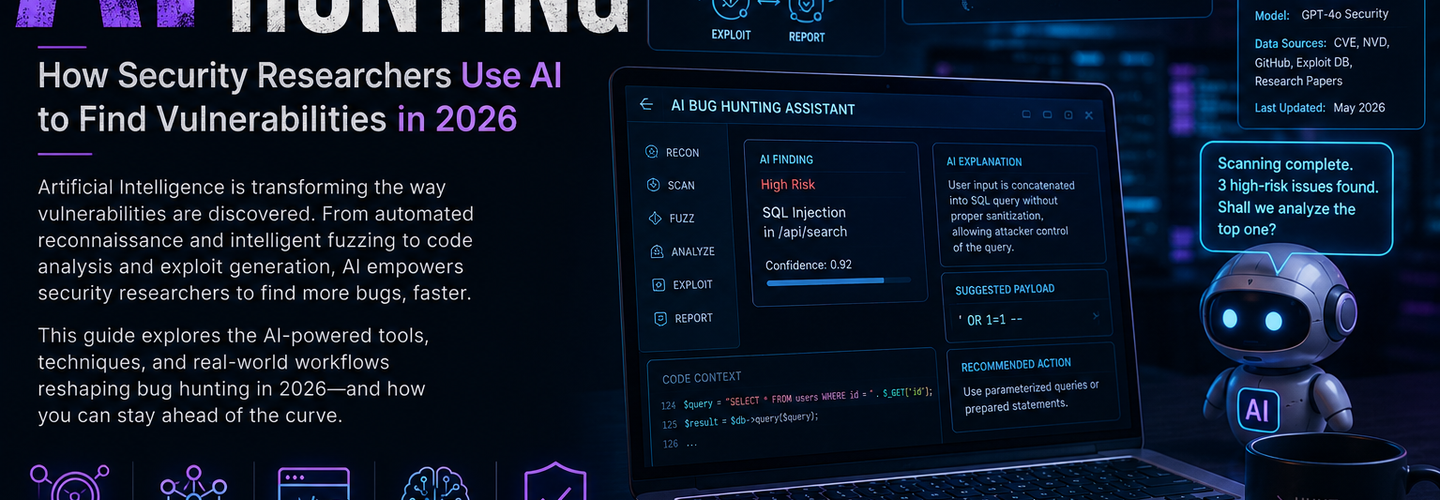
AI Bug Hunting: How Security Researchers Use AI to Find Vulnerabilities in 2026
Summarize this blog post with: ChatGPT | Perplexity | Claude | Grok
AI is transforming every field it touches — and security vulnerability research is no exception. Yet most bug hunters treat AI as a search assistant rather than an active testing partner, leaving enormous discovery efficiency on the table. This guide explains exactly how security researchers are integrating AI into their bug hunting workflows in 2026, which tools produce real results, and how you can adopt the same techniques starting today.
Key Takeaways
- ▸AI bug hunting is the use of artificial intelligence tools to automate, augment, and accelerate the discovery of security vulnerabilities in applications, systems, and networks.
- ▸AI excels at reconnaissance automation, code pattern analysis, intelligent fuzzing, and vulnerability triage — compressing tasks that once took hours into minutes.
- ▸Google's Project Big Sleep discovered a confirmed exploitable vulnerability in SQLite in November 2024, marking the first publicly documented AI-discovered zero-day in production open-source software.
- ▸AI does not replace manual testing for business logic flaws, complex chained vulnerabilities, or contextual attack scenarios requiring human reasoning and creativity.
- ▸The most effective bug hunters in 2026 combine AI-assisted automation for coverage breadth with human expertise for depth, context, and validation.
- ▸Responsible disclosure obligations remain identical whether a vulnerability was discovered by a human researcher or an AI system — authorization and ethics apply equally.
- ▸Beginners can start immediately using AI-augmented recon workflows, LLM-assisted code review, and AI-powered report writing without advanced machine learning knowledge.
What Is AI Bug Hunting?
AI bug hunting is the use of artificial intelligence models and tools to automate, augment, and accelerate the discovery of security vulnerabilities in web applications, APIs, networks, and compiled software. Rather than replacing human researchers, AI functions as a force multiplier — handling high-volume, pattern-recognition tasks that previously consumed hours of manual effort, freeing researchers to focus on deeper creative exploitation and logic-level analysis.
The discipline builds directly on traditional bug hunting methodology. If you are new to the fundamentals of reconnaissance, attack surface mapping, and vulnerability validation, start with the complete bug hunting methodology guide before layering AI techniques on top. AI makes a skilled researcher faster — it does not substitute for foundational knowledge.
In 2026, AI is being applied across every phase of the bug hunting lifecycle: generating recon queries, analyzing source code for vulnerability patterns, fuzzing input parameters intelligently, correlating findings across large attack surfaces, and even drafting initial vulnerability disclosure reports. The researchers winning the most bug bounties are those who have woven AI into their workflow as a systematic accelerator, not a one-off shortcut.
Why AI Is Changing Vulnerability Research in 2026
AI is changing vulnerability research because the volume and complexity of software has outpaced what human researchers can manually review. Nearly 29,000 CVEs were published in 2023 alone, a record high — Source: National Vulnerability Database (NVD), 2023. That number continues rising. No team of human analysts can track every relevant vulnerability class, test every endpoint, or triage every finding without AI assistance.
The landmark proof of concept arrived in November 2024, when Google's Project Big Sleep — an AI agent built on Gemini — discovered a confirmed, exploitable stack buffer underflow vulnerability in SQLite, one of the most widely deployed databases in the world — Source: Google DeepMind, November 2024. The vulnerability existed in code that human auditors had missed. This was the first publicly documented case of an AI system discovering a real zero-day vulnerability in production open-source software, and it sent a clear signal to the security research community.
For organizations, the stakes are equally significant. Research shows that 84% of commercial codebases contain at least one known open-source vulnerability — Source: Synopsys Open Source Security and Risk Analysis Report, 2024. AI-powered scanning gives defenders and researchers the speed needed to meaningfully reduce that exposure. Browse the ReconShield AI Cybersecurity research category for ongoing analysis of how AI is reshaping both offensive and defensive security.
How AI Tools Help Bug Hunters Find Vulnerabilities
AI tools assist bug hunters across four primary phases: reconnaissance, code analysis, fuzzing, and vulnerability triage. Each phase benefits differently from AI assistance, and understanding which phase to prioritize depends on your current workflow bottleneck.
AI-Powered Reconnaissance
Reconnaissance is where AI delivers some of its earliest and most accessible wins. AI models can process and correlate large volumes of passive intelligence data faster than any manual workflow. Instead of manually sifting through DNS records, certificate transparency logs, WHOIS history, and subdomain lists, researchers now prompt AI models to identify patterns, summarize ownership chains, and flag anomalies across hundreds of assets simultaneously.
In practice, this means feeding an AI model the output from passive recon tools and asking it to cluster related infrastructure, identify unusual registrar patterns, or flag recently registered domains that match a target's naming convention. Pair this with the ReconShield Subdomains Hub for automated subdomain enumeration and the IP Intelligence Hub for cross-referencing IP ranges against threat feeds. Then use DNS Lookup analysis to audit SPF, DMARC, and nameserver configurations that AI pattern recognition can quickly flag as misconfigured. For broader OSINT methodology, the OSINT Fundamentals Guide explains the passive intelligence collection framework that underpins AI-assisted recon.
Automated Code Analysis and Pattern Recognition
AI-powered static analysis tools can scan thousands of lines of code in seconds, identifying vulnerability patterns that match known weakness classes. Tools like GitHub Copilot Autofix, Semgrep, and Snyk Code use machine learning models trained on millions of code samples and historical CVE data to flag dangerous functions, unsafe input handling, hardcoded credentials, and insecure dependency usage.
For bug hunters working on programs that offer source code access — such as open-source targets or private program code drops — AI code review dramatically expands what a single researcher can cover. Feed a file into an LLM with a targeted prompt asking it to identify SQL query construction, unsanitized user input, or missing authorization checks. The model surfaces candidate locations for manual verification in seconds. Confirm any AI-flagged finding using the Exposure Assessment Tool, which provides OWASP-aligned baseline scanning against the live web application to validate whether code-level weaknesses translate to exploitable runtime conditions.
Intelligent Fuzzing and Input Generation
AI-assisted fuzzing generates smarter, context-aware payloads rather than purely random or dictionary-based inputs. Traditional fuzzers like FFUF send large volumes of predefined wordlists against endpoints. AI-enhanced fuzzers analyze the application's response patterns, parameter structures, and data types to generate mutation inputs that are far more likely to trigger edge-case behaviour and unhandled exceptions.
LLMs can also generate tailored payload lists for specific vulnerability classes. For example, prompting a model with the full HTTP request context of an API endpoint produces XSS and SQLi payload variants tuned to the observed parameter encoding and content type. Run the Security Headers Auditor alongside fuzzing sessions — missing Content-Security-Policy or X-Frame-Options headers identified during automated header checks confirm that any successful XSS payload will execute without browser mitigation interference. Check SSL/TLS posture with the SSL/TLS Checker to identify weak cipher suites and protocol downgrades that AI-assisted network fuzzing can target directly.
Vulnerability Triage and Impact Assessment
AI models accelerate vulnerability triage by classifying, prioritizing, and contextualizing raw findings before human review. When a scanner or fuzzer produces hundreds of potential findings, AI can instantly sort them by CVSS score criteria, assign probable vulnerability classes, filter duplicates, and flag which findings have the highest likelihood of real-world exploitability. This prevents the alert fatigue that causes critical vulnerabilities to get buried under false positives.
Use the ReconShield Vulnerability DB to cross-reference AI-flagged findings against known CVE patterns and check whether similar weaknesses have been documented and assigned identifiers in public databases. This step adds credibility to your triage output and strengthens the impact section of your eventual disclosure report.
Best AI Tools for Bug Hunting in 2026
The AI bug hunting toolchain in 2026 combines general-purpose large language models with specialized security-focused AI products — and knowing when to use each is half the skill.
Large Language Models (ChatGPT, Claude, Gemini) serve as research assistants, payload generators, code reviewers, and report drafters. Security researchers use them to analyze JavaScript bundles, reverse-engineer API response structures, generate targeted fuzzing wordlists, explain unfamiliar code patterns, and draft initial vulnerability reports that require only minor human editing.
GitHub Copilot Autofix integrates directly into development environments and flags vulnerable code patterns with suggested remediation in real time. Semgrep is a free, open-source static analysis framework with a large community-contributed rule library covering dozens of vulnerability classes. Snyk Code offers AI-powered code scanning with deep contextual analysis that goes beyond simple pattern matching. Burp Suite AI extensions — including AI-assisted scanning modules in the professional edition — automatically prioritize and explain detected vulnerabilities in plain language for rapid triage. For open port discovery supporting the AI recon workflow, the TCP Port Analyzer maps exposed services that become AI-assisted lateral movement candidates, while WHOIS Intelligence provides registrar and ownership data for AI-driven infrastructure correlation.
Nuclei with AI-generated templates represents one of the most powerful combinations currently available. Researchers prompt an LLM to generate Nuclei detection templates for newly disclosed CVEs — sometimes within hours of public disclosure — enabling near-real-time scanning for emerging vulnerabilities before mass exploitation begins. The ReconShield Vulnerability Research briefings track these emerging CVEs as they surface.
What Are the Limitations of AI in Bug Hunting?
AI in bug hunting has real, structural limitations that every researcher must understand before over-relying on automated output. Recognizing these limits is what separates researchers who use AI effectively from those who submit low-quality findings based on unvalidated AI output.
First, AI cannot discover novel business logic vulnerabilities without deep contextual understanding of what the application is supposed to do. Chained multi-step vulnerabilities — where five individually benign steps combine into a critical exploit — require the creative, contextual reasoning that human researchers still uniquely provide. Second, AI-generated payloads produce false positives that must be manually validated before submission. Submitting an unvalidated AI finding to a bug bounty program is a fast path to reputation damage and program bans.
Third, AI models can hallucinate vulnerability details, particularly when asked about obscure CVEs, niche frameworks, or rapidly evolving attack classes. Always verify AI-generated claims against primary sources such as the NVD, vendor advisories, and the ReconShield Security Blog. AI is a powerful assistant — it is not an authority.
How to Start Using AI for Bug Hunting Today
Integrating AI into your bug hunting workflow requires no machine learning expertise — only a methodical approach to prompting and validation. Start with the phases where AI provides the clearest, most immediate return.
Begin with AI-assisted recon summarization. After running passive recon using subdomain enumeration, DNS analysis, and IP lookups, paste your raw output into an LLM and ask it to identify unusual patterns, missing security configurations, or asset groupings that suggest infrastructure relationships. This step alone can cut your recon analysis time by more than half. Use the ReconShield Security Scanner to generate a comprehensive passive baseline of the target, then feed that output into your LLM workflow for rapid prioritization.
Next, add AI-powered code review to any program that provides source access. Upload individual files and prompt the model to identify insecure function calls, unvalidated user input paths, and missing authorization checks specific to the application's framework. Validate every flagged location manually in the live application before recording a finding.
Finally, use AI for disclosure report drafting. Feed the model your proof-of-concept steps, the affected endpoint, and the observed behaviour, and ask it to produce a structured vulnerability report draft. Review and revise the output carefully before submission. Follow the ReconShield Security Disclosure process as a reference model for how professional, responsible disclosure is structured. Explore the full suite of ReconShield security tools to build the passive intelligence layer that feeds your AI workflow with clean, reliable input data.
Conclusion
AI bug hunting is not the future of vulnerability research — it is the present. Researchers who integrate AI into reconnaissance, code analysis, fuzzing, and triage are finding more vulnerabilities, finding them faster, and submitting higher-quality reports than those relying on manual-only techniques. The skill ceiling has not lowered — it has risen, because human expertise is now required to direct, validate, and ethically apply AI output rather than simply run it.
Start by layering AI into one phase of your existing workflow this week. Master the prompting, validate the output rigorously, and expand from there. The researchers earning the most in bug bounty programs in 2026 are not the ones with the most tools — they are the ones who understand how to make every tool, human and artificial, work together.
Written by ReconShield Editorial Team — A cybersecurity publication covering cyber threats, data breaches, vulnerabilities, malware, threat intelligence, and online privacy. The team analyzes security incidents and provides practical insights to help readers stay informed and secure.
Reviewed by Surendra Reddy — Founder & Principal Security Engineer, ReconShield. Cybersecurity researcher specializing in OSINT, exposure intelligence, and AI-driven threat analysis.
## Analyst Commentary & Implementation Blueprint
Security advisory
Continuous security exposure assessment is critical to identifying public vulnerabilities before they are exploited. Organizations should maintain a passive inventory of all web servers, TLS configs, and open ports, ensuring that default configurations are eliminated and security advisories are actively implemented.
Hardened Security Configuration Blueprint
# General Security Hardening Directive
ServerTokens ProductOnly
ServerSignature Off
FileETag None
Actionable Mitigation Checklist
- ✔Perform passive asset inventories weekly.
- ✔Restrict administrative ports using local firewall controls.
- ✔Monitor active CVE alerts for exposed software.
Common Inquiries & FAQs
Why is passive scanning preferred for continuous auditing?
Passive audits do not cause operational impact or trigger firewall blocks, making them ideal for constant surveillance of internet-facing assets.
What should I do if a vulnerability is flagged?
Apply the latest vendor patches, restrict access to the resource via firewalls, or verify configuration flags to mitigate risks.
Surendra Reddy
Surendra Reddy is a cybersecurity researcher and founder of ReconShield, specializing in OSINT and defensive infrastructure analysis.
Connect on LinkedIn ↗// AUDIT BRIEFING DISCUSSION (2 COMMENTS)
Great breakdown of the passive infrastructure vectors. We recently audited our external DNS zones and found multiple dangling staging environments. Implementing wildcard certificates reduced our CT log leaks significantly.
Is there any automated tooling you recommend for daily crt.sh scraping? Manually checking CT logs is becoming unsustainable for our domain portfolio.
// MORE ARTICLES

AI Meets Penetration Testing: PentestCode Launches with 18 Specialized Security Agents
PentestCode launches with 18 integrated security tools and a 13-agent AI architecture that automates full penetration testing workflows.

AI Goes to War: Chinese Hackers Exploit Claude Code and DeepSeek in Government Attacks
Suspected Chinese hackers used Claude Code and DeepSeek in a split-model workflow to breach government systems. Here's what happened.

Best AI Cybersecurity Stocks to Buy as Cybercrime Surges in 2026
AI cybersecurity stocks are surging as cybercrime accelerates in 2026. Explore the sector's key players, growth drivers, and risks to weigh.