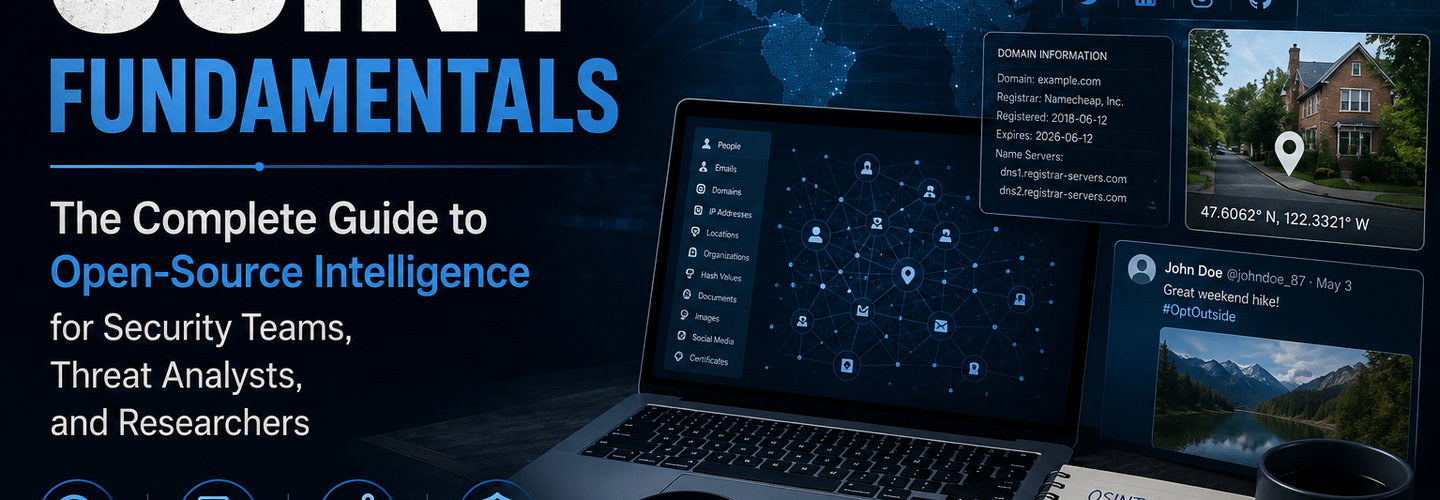
OSINT Fundamentals: The Complete Guide to Open-Source Intelligence for Security Teams, Threat Analysts, and Researchers
Summarize this blog post with: ChatGPT | Perplexity | Claude | Grok
You've probably searched for a person, company, or domain online during a security investigation and found useful information — but if you've never structured that search into a repeatable methodology with defined data sources, correlation techniques, and documented collection procedures, you're conducting informal research rather than intelligence. OSINT — Open-Source Intelligence — is the formal discipline of collecting, processing, and analysing information from publicly available sources to produce actionable intelligence. In this guide, you'll learn the foundational principles, core data source categories, collection methodology, and operational security considerations that define professional OSINT practice in 2026.
## Key Takeaways
- ▸OSINT (Open-Source Intelligence) is the collection and analysis of information obtained exclusively from publicly available, legally accessible sources — including websites, DNS records, social media, public databases, and academic publications.
- ▸OSINT is passive by definition — data is collected from third-party sources rather than from the target directly, meaning the target generates no logs or alerts as a result of the collection activity.
- ▸The OSINT intelligence cycle follows a structured five-phase process: Planning, Collection, Processing, Analysis, and Dissemination — transforming raw public data into actionable, attributed intelligence.
- ▸Infrastructure OSINT — DNS records, WHOIS registration data, SSL certificates, IP routing data, and exposed service banners — is the highest-yield OSINT category for cybersecurity applications.
- ▸Human OSINT (HUMINT-derived) — social media profiles, professional networks, public filings, and conference presentations — reveals organizational structure, technology choices, and personnel data that attackers use for social engineering targeting.
- ▸Operational security during OSINT collection requires using isolated investigation environments, avoiding direct target-facing queries that generate server logs, and understanding jurisdictional legal frameworks governing intelligence collection.
- ▸Defensive OSINT — running intelligence collection against your own organization — consistently surfaces more security-relevant findings than most internal vulnerability assessments, because it captures the attacker's perspective rather than the defender's.
## What Is OSINT and How Is It Different From Other Intelligence Disciplines?
OSINT (Open-Source Intelligence) is the systematic collection, processing, and analysis of information obtained from publicly available, legally accessible sources to produce intelligence products that support decision-making. The "open-source" terminology refers to the open accessibility of the information — not to open-source software — distinguishing this intelligence discipline from classified collection methods that require special access, intercepts, or covert operations.
OSINT is one of five recognized intelligence disciplines alongside SIGINT (signals intelligence), HUMINT (human intelligence), IMINT (imagery intelligence), and MASINT (measurement and signature intelligence). Its defining characteristic — that all collection uses only legally accessible public data — makes it simultaneously the most accessible discipline and the most underestimated. Security professionals frequently assume that publicly available data provides only superficial intelligence. In practice, professional OSINT collection against an organization's internet-facing infrastructure, public filings, social media footprint, and registration records routinely surfaces information the target organization believes is private or internal.
OSINT accounts for over 80% of all intelligence collected by major national intelligence agencies — Source: NATO Open Source Intelligence Handbook, 2023 — a reflection of how much actionable intelligence is embedded in publicly available sources before any covert collection is necessary. In cybersecurity specifically, OSINT is the foundational phase of every professional penetration test, threat intelligence program, and incident response investigation — providing attribution, infrastructure mapping, and organizational context before any direct engagement with the target.
The distinction between OSINT and active reconnaissance matters legally and operationally. OSINT queries third-party databases, registries, and archives — generating logs only on those third-party systems, not on the target. Active reconnaissance sends queries directly to the target's infrastructure — generating server logs, IDS alerts, and potentially constituting unauthorized computer access under applicable law. The ReconShield platform is built entirely on passive OSINT principles — the passive scanner suite audits your internet-facing infrastructure by querying authoritative registries and public databases, never sending active probes to target systems.
## What Are the Core OSINT Data Source Categories?
Professional OSINT practice organizes data sources into six categories — each providing distinct intelligence value and requiring specific collection techniques and analysis frameworks.
Infrastructure and Network Intelligence
Infrastructure OSINT is the highest-yield category for cybersecurity applications, providing direct, technical intelligence about an organization's internet-facing systems through data sources that are entirely passive and universally accessible. The primary infrastructure OSINT sources are DNS zone data, WHOIS and RDAP registration records, Certificate Transparency logs, IP routing and ASN databases, and passive port scan archives.
DNS records expose an organization's hosting architecture — which cloud providers and CDNs serve their infrastructure, which mail servers handle their email, which subdomains exist across their service portfolio. WHOIS records reveal registrar choices, registration age, EPP protection status, and name server configuration for every domain the organization owns. Certificate Transparency logs archive every SSL/TLS certificate ever issued for every domain — including subdomains the organization has never publicly promoted. IP routing databases reveal which IP blocks an organization owns directly versus leases from hosting providers. Passive port scan archives provide historical service profiles for any IP address.
Use the ReconShield DNS Security Analysis tool for DNS enumeration, the WHOIS Intelligence tool for registration data, the SSL/TLS Checker for certificate intelligence, and the IP Reputation tool for ASN and routing data. The structured methodology for integrating these sources into a complete infrastructure investigation is covered in the ReconShield passive reconnaissance guide.
Search Engine and Web Intelligence
Search engine OSINT uses structured query operators — commonly called "dorks" — to surface specific content types, file formats, and infrastructure exposures indexed by major search engines that would not be discoverable through standard browsing. Google, Bing, and DuckDuckGo each support advanced operators including site:, filetype:, inurl:, intitle:, and ext: that enable precision targeting of indexed content.
Common OSINT-productive dork patterns include: site:target.com filetype:pdf to surface all indexed PDF documents (which frequently contain organizational metadata, author names, and internal path disclosures), site:target.com inurl:admin to identify administrative interfaces indexed by search engines, "target.com" ext:env OR ext:log OR ext:bak to find accidentally exposed configuration files and backup data, and "@target.com" filetype:xls to surface spreadsheets referencing organizational email addresses. Each search should be documented with the exact query string, the search engine used, the date of collection, and the results obtained — maintaining collection provenance for intelligence products.
Social Media and Professional Network Intelligence
Social media OSINT extracts organizational intelligence from professional networks, public social platforms, developer communities, and academic publication databases — surfacing employee identities, organizational hierarchy, technology stack disclosures, and operational data that organizations publish publicly without recognizing the intelligence value to adversaries.
LinkedIn professional profiles are the richest single OSINT source for organizational intelligence. Job postings for security engineers routinely disclose the organization's SIEM platform, endpoint security vendor, cloud provider, and network segmentation approach — the exact operational security stack that a threat actor uses to tailor evasion and post-exploitation techniques. Employee profiles reveal team structures, reporting relationships, tenure, and technology specializations. Former employees frequently discuss internal systems and processes in public posts after departure, particularly in developer communities and conference presentation materials.
GitHub repositories represent another high-yield OSINT source. Developers frequently commit code containing API keys, internal hostnames, database connection strings, and private IP addressing schemes in version control history — data that remains accessible in repository history even after the committing developer removes it from the current codebase. Over 100,000 unique API keys and credentials are accidentally committed to public GitHub repositories every day — Source: GitGuardian State of Secrets Sprawl, 2024.
Public Records and Filing Intelligence
Public records OSINT extracts intelligence from government filing databases, regulatory submissions, court records, patent applications, and corporate registration databases — sources that organizations are legally required to populate with accurate information and that are publicly accessible through official government portals.
SEC EDGAR filings (for US public companies) contain detailed descriptions of technology infrastructure, cybersecurity risk factors, material cyber incidents, and vendor relationships in annual reports and 10-K filings. Patent applications disclose proprietary technical implementations and product architectures in detail. Corporate registry filings reveal subsidiary structures, registered addresses, and officer identities. Court filings in litigation involving technology companies sometimes expose internal architecture and security program details in submitted evidence.
Dark Web and Underground Forum Monitoring
Dark web OSINT monitors underground forums, paste sites, and encrypted communication channels for threat intelligence relevant to a specific organization — including leaked credentials, disclosed vulnerabilities affecting the organization's vendors, advertised initial access listings, and threat actor discussions of planned campaigns.
This category requires careful operational security — accessing dark web sources directly exposes the investigator's infrastructure and creates potential legal complexity in some jurisdictions. Professional threat intelligence teams use dedicated, isolated virtual machines with appropriate anonymization for dark web collection. For most enterprise security teams, consuming threat intelligence feeds from vendors who professionally monitor dark web sources is operationally preferable to conducting direct dark web OSINT. The ReconShield Beginner's Guide to Threat Intelligence and IOC Analysis covers how threat intelligence feeds are collected, processed, and operationalized for defensive security programs.
Domain and Registration Intelligence
Domain and registration OSINT extracts intelligence from the public infrastructure layer of the internet — combining WHOIS records, DNS configurations, Certificate Transparency logs, and WHOIS privacy protection patterns to reveal organizational infrastructure relationships, campaign infrastructure attribution, and domain portfolio scope.
For attackers, domain OSINT maps the complete target domain portfolio — including legacy domains, subsidiary domains, and regional variants that may have weaker security posture than the primary corporate domain. For defenders, the same collection maps their own external exposure and surfaces unprotected domains ripe for spoofing. For threat intelligence investigators, domain OSINT clusters malicious infrastructure by shared registration patterns, name server providers, and certificate issuance timing — attributing campaign domains to common operators even when registrant data is privacy-redacted. The ReconShield WHOIS domain intelligence guide covers domain registration intelligence in complete operational depth.
## What Is the OSINT Intelligence Cycle?
The OSINT intelligence cycle is the structured five-phase workflow that transforms a collection requirement into a finished, actionable intelligence product — distinguishing professional intelligence practice from informal internet searching by imposing process discipline on collection, analysis, and dissemination.
Phase 1 — Planning and Direction
Planning establishes what intelligence is needed, why it is needed, what decisions it will support, and what sources and collection methods are appropriate — preventing the undisciplined, unfocused collection that characterizes amateur OSINT and wastes analyst time on data with no intelligence value.
A planning document for an OSINT engagement specifies: the subject (target organization, individual, or infrastructure), the intelligence requirement (specific questions the collection must answer), the collection methodology (which source categories to use and in what sequence), the legal framework (jurisdictional constraints on collection methods), the timebox (collection duration), and the output format (report, raw data export, threat assessment). Without planning, OSINT collection suffers from confirmation bias — analysts find data that confirms existing assumptions rather than data that answers the stated intelligence requirement.
Phase 2 — Collection
Collection executes the planned methodology against the identified data sources — querying DNS records, retrieving WHOIS data, examining certificate transparency logs, reviewing social media profiles, and systematically extracting data from each approved source category in a documented sequence.
Effective collection documents every query — the exact search term or tool query, the source queried, the date and time of collection, and the raw results. This documentation serves two purposes: maintaining provenance for intelligence products that cite the data, and enabling reproducibility — allowing another analyst to verify findings by repeating the exact collection procedure. The ReconShield infrastructure intelligence tools provide consistent, reproducible query outputs that satisfy both requirements — the DNS Security Analysis tool, WHOIS tool, IP Reputation tool, Port Scanner, and SSL/TLS Checker each return normalized, timestamped data suitable for intelligence documentation.
Phase 3 — Processing
Processing transforms raw collected data into structured, searchable, cross-referenced form — de-duplicating overlapping results from multiple sources, normalizing data formats for comparison, extracting key fields, and organizing collected data into the analytical categories defined during planning.
For infrastructure OSINT, processing involves building a structured asset inventory from collected DNS, WHOIS, certificate, and IP data — mapping each discovered hostname to its IP address, ASN operator, certificate issuance history, and WHOIS registration metadata. This structured inventory makes the correlation and analysis phase significantly more efficient by providing a single reference structure rather than requiring analysts to cross-reference multiple raw data exports.
Phase 4 — Analysis and Production
Analysis identifies patterns, relationships, anomalies, and conclusions from processed data — producing the assessments, attributions, and intelligence judgments that answer the original planning requirement.
Infrastructure OSINT analysis identifies: hosting provider patterns (do multiple target assets share the same cloud or CDN provider, creating third-party dependency risks?), registration timing correlations (do clusters of domains share creation dates suggesting coordinated campaign deployment?), certificate relationship patterns (do multiple domains share certificates revealing common infrastructure?), and security posture gaps (which discovered assets lack authentication records, current certificates, or appropriate security headers?). The ReconShield Anatomy of Passive OSINT guide provides the structured analytical framework for infrastructure correlation.
Phase 5 — Dissemination
Dissemination delivers the finished intelligence product to the decision-makers who need it in a format and at a classification level appropriate for their role and purpose — converting analytical conclusions into actionable recommendations that drive security decisions.
Effective OSINT dissemination reports present findings in three layers: executive summary (what was found and why it matters — 1–2 paragraphs), key findings (specific, prioritised intelligence items with supporting evidence), and detailed appendix (raw data, collection methodology, and source documentation for technical verification). Different audiences require different layers — CISOs need the executive summary and key findings; security engineers need the detailed appendix to reproduce and act on the findings.
## What Are the Legal and Ethical Boundaries of OSINT?
OSINT collection operates within legal and ethical boundaries that vary by jurisdiction, target type, and collection method — and understanding these boundaries is not optional for professional OSINT practitioners. Conducting collection that appears passive but crosses into unauthorized access has resulted in criminal prosecutions under computer crime statutes in multiple jurisdictions.
The core legal boundary in most jurisdictions is whether data collection involves unauthorized access to computer systems. Querying a DNS registry, reading a public WHOIS record, reviewing a publicly accessible website, or examining indexed search engine results are universally recognized as lawful OSINT collection. Accessing a server through a vulnerability, bypassing authentication on a nominally public-facing system, scraping data at volumes that constitute denial of service, or accessing data the website owner has restricted through robots.txt or technical controls is active intrusion — not OSINT.
Privacy law considerations apply when collecting personal data about individuals rather than organizations. GDPR in the EU, CCPA in California, and equivalent regulations in other jurisdictions impose purpose limitations and data minimization requirements on personal data collected even from public sources. Professional OSINT practitioners document the legal basis for personal data collection and apply appropriate retention limits to collected personal data.
Corporate and competitive intelligence OSINT is legal when using publicly available sources — examining a competitor's job postings, reviewing their patent applications, or analysing their public financial filings. It becomes legally problematic when it involves deceiving target employees to extract information, accessing internal systems under false pretenses, or inducing target employees to breach confidentiality obligations.
The ReconShield platform is built with these boundaries built in — every tool operates entirely on passive OSINT principles, querying public registries and databases without any active interaction with target systems.
## How Do Security Teams Apply OSINT Operationally?
Security teams apply OSINT across four primary operational contexts — each using the same data sources and collection techniques but directed at different intelligence requirements and producing different operational outputs.
Attack surface management uses continuous OSINT collection against an organization's own infrastructure to maintain a current, complete inventory of every internet-facing asset — closing the gap between what the organization believes it exposes and what is actually visible from the public internet. Organizations consistently discover 30–50% more internet-facing assets through systematic OSINT collection than appear in their internal asset inventories — Source: CyCognito Attack Surface Report, 2024. The ReconShield passive scanner suite provides the tool foundation for external attack surface discovery.
Threat hunting applies OSINT to proactively search for evidence of threat actor reconnaissance or infrastructure preparation targeting a specific organization — monitoring CT logs for unusual certificate issuance against organizational domains, watching WHOIS feeds for new lookalike domain registrations, and reviewing dark web intelligence for organizational credential exposure before active exploitation begins.
Incident response uses OSINT during active security incidents to attribute attacker infrastructure — identifying the hosting providers, registrars, and ASN operators responsible for observed malicious IP addresses and domains, enabling abuse reporting and providing attribution context for law enforcement engagement. The six-step IP investigation workflow in the ReconShield IP reputation check guide is directly applicable to incident response attribution.
Third-party risk assessment uses OSINT to passively evaluate vendor security posture — examining DNS authentication configuration, IP reputation of vendor mail servers, certificate management practices, and WHOIS registration security of vendor domains — without requiring vendor cooperation or self-assessment questionnaire responses that may not reflect actual security posture. The DNS record types guide covers how to interpret vendor DNS configuration as a security signal.
## OSINT Operational Security: Protecting Your Investigation
OSINT practitioners must protect their own operational security during collection — because even passive collection using public data sources can reveal the investigator's identity, organizational affiliation, and investigation targets to the subject being investigated if collection is not conducted with appropriate isolation.
The primary exposure vectors are direct website visits (server logs record visitor IP addresses), search engine queries (major search providers log queries and may surface them through autocomplete or API usage analytics), and tool fingerprinting (distinctive user agent strings, request timing patterns, or query combinations that identify specific analyst tools). For sensitive investigations — particularly those involving threat actors who actively monitor for investigative interest in their infrastructure — investigation without appropriate isolation provides the target advance warning of scrutiny.
Professional operational security for OSINT collection uses: dedicated investigation virtual machines isolated from personal browsing, VPN or Tor routing for any direct website visits, search engine queries through privacy-respecting search tools that do not log queries, and passive tool suites like ReconShield that query third-party registries rather than target systems directly. For infrastructure OSINT specifically, the fully passive nature of DNS queries to authoritative servers, WHOIS lookups to registrar databases, and certificate transparency log searches means the target system generates no logs regardless of investigation intensity.
## Tools for OSINT Collection and Infrastructure Intelligence
Professional OSINT collection requires a toolset organized by data source category — with specific tools for infrastructure intelligence, domain and IP investigation, certificate analysis, and web security assessment:
DNS Security Analysis Tool — Infrastructure OSINT primary tool. Returns complete DNS record sets, validates email authentication configuration, checks DNSSEC status. Essential for both target infrastructure mapping and defensive self-assessment.
WHOIS Intelligence Tool — Domain and IP registration intelligence. Retrieves registration data, EPP status, name server configuration, and network block ownership for any domain or IP address.
IP Reputation Intelligence Tool — Network OSINT. Returns ASN ownership, hosting provider classification, geolocation, proxy and VPN detection, and multi-feed threat reputation for any IP address.
SSL/TLS Checker — Certificate intelligence. Audits TLS certificates, Subject Alternative Names, cipher suite support, and certificate chain integrity — the primary tool for certificate transparency correlation.
Port Scanner — Service intelligence. Maps open TCP ports on target IP addresses within authorized scope, revealing service profiles that complement DNS and WHOIS intelligence.
Exposure Assessment Tool — Web application OSINT. Performs passive OWASP misconfiguration detection revealing application-layer security posture without active exploitation.
Security Headers Auditor — Web security posture. Evaluates browser-level security controls as a passive security posture signal. The ReconShield OWASP HTTP Headers Hardening guide covers the security significance of each header in investigation context.
Passive Scanner Suite — Integrated infrastructure audit. Combines email authentication, SSL/TLS, and HTTP security header analysis in a single passive workflow.
## What's Next: AI-Augmented OSINT in 2026
AI-augmented OSINT is rapidly changing the speed and scale at which intelligence can be collected and analysed — with large language models enabling natural language querying of structured OSINT datasets, automated pattern recognition across massive data volumes, and real-time correlation of signals from dozens of simultaneous data sources that would require teams of analysts to process manually.
For defensive security teams, AI augmentation means that attack surface monitoring, brand protection monitoring, and third-party risk assessment can operate at a scale and frequency previously feasible only for the largest enterprise security programs. Automated OSINT pipelines that continuously collect, process, and analyse DNS changes, WHOIS modifications, and certificate issuance events across an organization's full domain portfolio — alerting on anomalies in near-real-time — are becoming operationally accessible to mid-market security teams.
For threat actors, the same AI augmentation enables reconnaissance at a scale and targeting precision previously impossible — automated collection and analysis of organizational structure, technology stack, and employee data across thousands of potential targets simultaneously, feeding highly personalized spear-phishing campaigns with OSINT-derived context that makes them convincingly authentic. The average AI-assisted spear-phishing email achieves a click rate 40% higher than manually crafted phishing — Source: Hoxhunt Phishing Trends Report, 2024 — directly attributable to the quality of OSINT-derived personalization.
Understanding the AI-specific threat landscape for OSINT-enabled attacks is covered in the ReconShield AI Cybersecurity research category.
## Conclusion
OSINT is not internet searching — it is a structured intelligence discipline with defined methodology, documented data sources, reproducible collection procedures, and analytical frameworks for transforming raw public data into actionable intelligence. The difference between informal searching and professional OSINT is process: planning before collection, documentation during collection, structured analysis after collection, and dissemination to decision-makers who act on the findings.
For cybersecurity teams, the most immediately valuable OSINT application is self-directed: run the same collection against your own infrastructure that a professional attacker would run before targeting you. Start with infrastructure OSINT using the ReconShield DNS Security Analysis tool and WHOIS Intelligence tool. Audit certificates with the SSL/TLS Checker. Check IP reputation with the IP Reputation tool. Then run the passive scanner suite for the complete integrated external security posture picture.
The organizations that see themselves through their adversaries' eyes — systematically and continuously — maintain consistently better security postures than those that rely exclusively on internal assessments.
Written by Surendra Reddy Cybersecurity Researcher & Founder, ReconShield. Surendra specializes in OSINT, exposure intelligence, and AI-driven threat analysis. Author Profile →
Reviewed by ReconShield Editorial Team — Peer-reviewed for accuracy against current OSINT methodology standards, legal frameworks, and cybersecurity research practice.
## Analyst Commentary & Implementation Blueprint
Security advisory
Continuous security exposure assessment is critical to identifying public vulnerabilities before they are exploited. Organizations should maintain a passive inventory of all web servers, TLS configs, and open ports, ensuring that default configurations are eliminated and security advisories are actively implemented.
Hardened Security Configuration Blueprint
# General Security Hardening Directive
ServerTokens ProductOnly
ServerSignature Off
FileETag None
Actionable Mitigation Checklist
- ✔Perform passive asset inventories weekly.
- ✔Restrict administrative ports using local firewall controls.
- ✔Monitor active CVE alerts for exposed software.
Common Inquiries & FAQs
Why is passive scanning preferred for continuous auditing?
Passive audits do not cause operational impact or trigger firewall blocks, making them ideal for constant surveillance of internet-facing assets.
What should I do if a vulnerability is flagged?
Apply the latest vendor patches, restrict access to the resource via firewalls, or verify configuration flags to mitigate risks.
Surendra Reddy
Surendra Reddy is a cybersecurity researcher and founder of ReconShield, specializing in OSINT and defensive infrastructure analysis.
Connect on LinkedIn ↗// AUDIT BRIEFING DISCUSSION (2 COMMENTS)
Great breakdown of the passive infrastructure vectors. We recently audited our external DNS zones and found multiple dangling staging environments. Implementing wildcard certificates reduced our CT log leaks significantly.
Is there any automated tooling you recommend for daily crt.sh scraping? Manually checking CT logs is becoming unsustainable for our domain portfolio.
// MORE ARTICLES
The Gentlemen Ransomware Targets Windows Networks with 21 Lateral Movement Techniques
The Gentlemen ransomware uses 21 lateral movement techniques to spread across Windows networks. See its attack chain, IOCs, and defenses.
Critical Chrome Extension Flaws Put Millions of Browsers at Risk of Account Takeover: The Definitive 2026 Security Guide
Critical Chrome extension flaws expose millions to account takeover. Learn how the attacks work, which extensions are at risk, and how to protect your accounts.
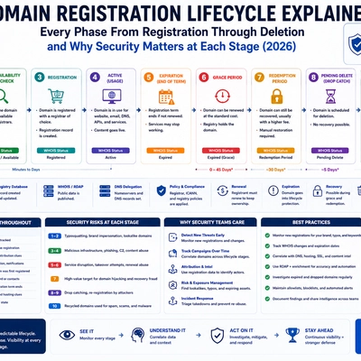
Domain Registration Lifecycle Explained: Every Phase From Registration Through Deletion and Why Security Matters at Each Stage (2026)
Domain registration lifecycle explained: registration, renewal, expiry, grace period, redemption, deletion, and security implications for every phase in 2026.