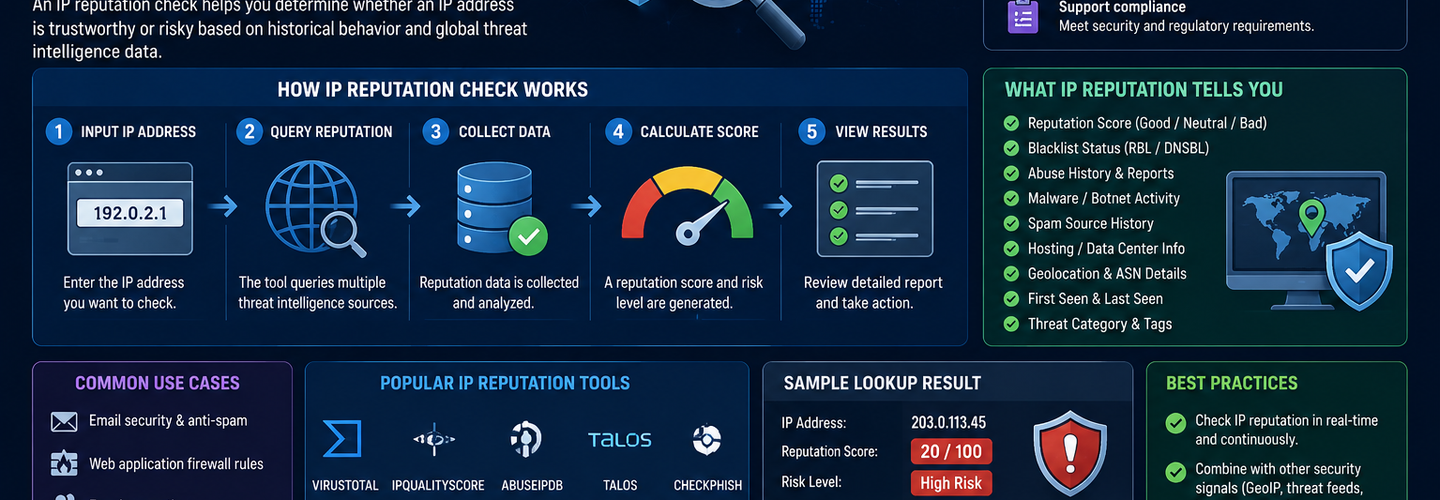
IP Reputation Check: The Complete Guide to IP Threat Intelligence, Blacklist Analysis, and Infrastructure Investigation (2026)
Summarize this blog post with: ChatGPT | Perplexity | Claude | Grok
You've probably already blocked a suspicious IP address during an incident or checked a sender IP when a phishing email landed in your inbox — but if you're treating IP reputation as a binary blacklist check rather than a multi-layered intelligence signal, you're leaving significant investigative and defensive capability on the table. IP reputation is one of the richest, fastest-available passive intelligence sources in security operations, correlating geolocation, ASN ownership, hosting provider behavior, historical abuse records, botnet participation, and real-time threat feed scoring into a single lookup. In this guide, you'll learn exactly what IP reputation means, how threat feeds score addresses, how to investigate any IP as part of a structured incident response workflow, and how to operationalize IP intelligence across your security stack.
## Key Takeaways
- ▸IP reputation is a composite risk score assigned to an IP address based on its historical and current association with malicious activity — including spam, malware command-and-control, scanning campaigns, phishing, botnets, and credential stuffing.
- ▸IP reputation checks are passive — querying threat intelligence databases never sends traffic to the target IP, making them safe and legally defensible for any investigative purpose.
- ▸ASN ownership and hosting provider identity are the two most analytically powerful fields in an IP reputation lookup, revealing whether an address belongs to bulletproof hosting infrastructure, a residential ISP, a major cloud provider, or a known malicious network block.
- ▸Proxy, VPN, and Tor exit node detection are essential fraud prevention signals — IP addresses identified as anonymization infrastructure require additional authentication challenges regardless of reputation score.
- ▸IP blacklists and threat feeds use different data sources and scoring methodologies, meaning a single-source blacklist check frequently misses addresses flagged by other feeds — multi-feed cross-referencing is the minimum standard for security operations.
- ▸Real-time threat intelligence enrichment of IP addresses from firewall logs, SIEM alerts, and email headers transforms raw network data into actionable attribution within seconds of an alert firing.
- ▸Organizations that operationalize IP reputation checks in automated incident response workflows reduce mean time to triage by up to 60% compared to teams relying on manual lookups during active incidents — Source: Ponemon Institute, 2024.
## What Is IP Reputation and How Is It Measured?
IP reputation is a composite security risk assessment of an IP address based on its historical association with malicious activity, the nature of the network infrastructure it belongs to, and its real-time presence across global threat intelligence feeds. It is not a simple on/off flag — it is a scored, multi-dimensional signal that reflects the cumulative behavioral history of traffic originating from or routed through a specific address.
IP reputation scores are calculated by aggregating evidence from multiple independent data sources: spam trap networks that capture emails from unsolicited senders, honeypot systems that record unauthorized connection attempts, botnet tracking infrastructure that logs command-and-control communication patterns, DNS blacklists (DNSBLs) that catalogue known abusive senders, and passive DNS correlation systems that track which domains resolve to which IP addresses over time. Each source contributes evidence, and the resulting score reflects both the volume and severity of observed malicious behavior.
The concept of IP reputation matters because the internet's addressing system creates persistent, attributable infrastructure. An IP address used to send spam campaigns, host a phishing page, or relay botnet commands leaves a documented trail across dozens of independent threat intelligence systems. Over 1.5 billion IP addresses have been flagged across major threat intelligence feeds — Source: Spamhaus Project, 2024 — representing a substantial fraction of the global IPv4 address space and highlighting how pervasive IP-based abuse has become. Run a passive, multi-feed IP reputation check on any address using the ReconShield IP Reputation Intelligence tool, which cross-references live threat feeds, ASN ownership data, and proxy detection simultaneously without sending any traffic to the target.
## What Does an IP Reputation Check Actually Return?
A comprehensive IP reputation check returns seven categories of intelligence: geolocation data, ASN and network ownership, hosting provider identification, proxy and anonymization detection, blacklist presence, threat category classification, and a composite risk score. Each category serves distinct use cases across fraud prevention, incident response, and threat hunting.
Geolocation data maps an IP address to a country, region, city, and approximate coordinates. City-level accuracy typically falls within 25–50 miles for most addresses — precise enough for fraud detection and regulatory compliance but not for physical attribution. ASN (Autonomous System Number) ownership identifies the network operator routing the IP block — whether it is a major cloud provider like AWS or Google Cloud, a residential broadband ISP, a colocation data center, or a bulletproof hosting provider known to ignore abuse reports. ASN is the single most discriminating field for rapid infrastructure classification.
Hosting provider identification extracts the commercial entity operating the data center or cloud environment, which is distinct from the ASN operator in many cloud architectures. Proxy and anonymization detection flags whether the address is a known Tor exit node, commercial VPN endpoint, open proxy, or datacenter IP commonly used for traffic masking. Blacklist presence reports which of the major DNS-based blacklists (Spamhaus, Barracuda, SURBL, UCEPROTECT, and others) currently list the address and for what category of abuse. Threat category classification labels the specific types of malicious activity associated with the address — spam source, scanner, botnet C2, phishing host, credential stuffer, or malware distributor. The composite risk score aggregates all signals into a single 0–100 scale for rapid triage prioritization.
## Why Is ASN the Most Important Field in an IP Reputation Lookup?
The Autonomous System Number (ASN) is the single most actionable intelligence field returned by an IP reputation check because it reveals the network-level operator responsible for the IP block — directly determining whether an IP address is likely to be a trustworthy enterprise user, a cloud service worker, a residential consumer, or infrastructure operated by a provider known to tolerate or facilitate malicious activity.
An ASN is a unique number assigned by a Regional Internet Registry (ARIN, RIPE, APNIC, LACNIC, or AFRINIC) to a network operator that independently routes traffic on the internet. Large cloud providers operate hundreds of ASNs — AWS alone operates over 200 ASNs globally. Residential ISPs each have one or a few ASNs covering their entire subscriber base. And certain hosting providers — commonly called bulletproof hosters — operate ASNs with documented histories of ignoring abuse reports and actively hosting criminal infrastructure.
How Bulletproof Hosting ASNs Differ From Legitimate Cloud Infrastructure
Bulletproof hosting ASNs are operated by providers that deliberately market their services to criminal actors by promising non-responsiveness to abuse complaints — allowing customers to host phishing pages, malware distribution infrastructure, command-and-control servers, and spam relays without takedown risk. These providers typically operate from jurisdictions with limited cybercrime enforcement cooperation, accept cryptocurrency payments exclusively, and maintain minimal identity verification for customers.
The security implication is direct: an IP address belonging to a bulletproof hosting ASN should be treated with the highest level of suspicion regardless of whether it currently appears on blacklists. Blacklists are inherently reactive — they flag addresses after abuse is observed. ASN-level analysis is predictive — it flags addresses based on the infrastructure context they belong to, before specific abuse activity is documented. Cross-reference ASN ownership against your threat intelligence baseline using the ReconShield IP Reputation Intelligence tool, which returns both the ASN operator and a contextual risk classification for the network block.
Cloud Provider ASNs and the Shared Infrastructure Problem
IP addresses belonging to major cloud providers — AWS, Google Cloud, Microsoft Azure, DigitalOcean, Vultr, Linode — present a more nuanced reputation challenge because the same ASN contains both legitimate enterprise workloads and malicious infrastructure rented by attackers. A blanket block of AWS IP ranges would take down a significant fraction of the legitimate internet alongside attacker infrastructure.
The analytical solution is to correlate ASN ownership with specific IP-level reputation signals rather than making block decisions at the ASN level for legitimate cloud providers. A Google Cloud IP with a clean reputation score, no blacklist presence, and no proxy detection is almost certainly a legitimate Google service. The same ASN hosting an IP with a high threat score, multiple blacklist entries, and known scanner behavior is a different risk profile entirely — likely a compromised or malicious cloud workload. This nuanced approach requires multi-feed reputation data rather than single-source blacklist lookups.
## How Do IP Blacklists and Threat Feeds Work?
IP blacklists (also called block lists or deny lists) are continuously updated databases of IP addresses observed sending spam, hosting malware, operating botnets, or conducting other network abuse — maintained by independent organizations, security vendors, and cooperative threat sharing networks, and consumed by mail servers, firewalls, and security tools to make automated blocking and filtering decisions.
The major IP blacklist operators use different methodologies to populate their lists. Spamhaus operates the world's largest anti-spam blacklist network, using spam trap networks (email addresses that have never been legitimately subscribed to anything), passive observation of spam campaigns, and formal abuse reporting to identify and list abusive senders. Their SBL (Spamhaus Block List) lists spam sources, their XBL (Exploits Block List) lists compromised devices and open proxies, and their DBL (Domain Block List) lists spam domains. Barracuda Reputation Block List (BRBL) focuses specifically on email sender reputation. SURBL focuses on domains embedded in spam messages. Emerging Threats and AlienVault OTX aggregate broader threat intelligence including malware C2 addresses, scanning sources, and exploit kit hosts.
Why Single-Feed Blacklist Checks Are Insufficient
Relying on a single blacklist for IP reputation decisions consistently misses malicious addresses because no single feed has complete visibility across all categories of abuse — each feed captures a different slice of the threat landscape based on its data collection methodology and coverage focus. An address actively used for credential stuffing against web applications may not appear on email-focused spam blacklists at all, even if it is simultaneously flagged by web application threat feeds and honeypot networks.
The detection rate of any single blacklist for known malicious IPs averages 40–60% — Source: Spamhaus Research, 2023 — meaning that using only one source leaves the majority of malicious infrastructure undetected. Multi-feed cross-referencing raises this coverage to over 85% for addresses with documented malicious histories. Security operations teams should therefore query multiple independent reputation sources for every IP under investigation, correlating their findings rather than accepting any single source as definitive. The ReconShield IP Reputation Intelligence tool aggregates signals from multiple threat intelligence sources simultaneously, returning a normalized composite score rather than a single-feed yes/no blacklist result.
The Lag Problem: Why Reputation Scores Are Always Behind Reality
IP reputation scores are inherently retrospective — they reflect observed past behavior rather than real-time current activity — creating a detection lag between when an IP address begins malicious activity and when it appears in threat feeds with a meaningful reputation score. This lag typically ranges from hours for the fastest-updating feeds to days or weeks for feeds relying on manual analysis or aggregated reporting.
Attackers exploit this lag through IP rotation — frequently cycling through IP addresses, using each one briefly before it accumulates enough abuse reports to be listed, then discarding it and moving to a clean address. This technique, common in spam operations and credential stuffing campaigns, reduces the effectiveness of blacklist-only defenses. Defending against it requires correlating reputation data with behavioral signals — connection rate analysis, user agent patterns, geographic velocity — rather than relying on reputation scores alone. Understanding how attackers cycle through compromised infrastructure at scale is covered in depth in the ReconShield Dutch botnet takedown analysis, which documents how 17 million compromised devices were used as rotating IP infrastructure for malicious campaigns.
## How to Investigate Any IP Address: A Step-by-Step Workflow
A structured IP address investigation follows a six-step passive intelligence workflow that transforms a raw IP address into a complete infrastructure profile — attributing the address to a network operator, assessing its reputation across multiple threat feeds, correlating it with domain and certificate intelligence, and producing a triage decision in under three minutes without sending any traffic to the target.
Step 1 — Run the Initial IP Reputation and Geolocation Lookup
Begin every IP investigation with a multi-feed reputation check that returns ASN ownership, geolocation, hosting provider, proxy detection, and blacklist presence simultaneously. The goal of this first step is rapid triage — determining within 60 seconds whether the IP belongs to legitimate infrastructure, a known malicious operator, or an ambiguous address requiring deeper investigation.
Run the target IP through the ReconShield IP Reputation Intelligence tool. Record the ASN operator, country of registration, hosting provider, composite risk score, and any blacklist categories returned. An IP with a risk score above 75, multiple blacklist entries, and an ASN belonging to a bulletproof hosting provider can typically be triaged as malicious immediately. An IP belonging to a major cloud provider with a clean score requires deeper step-by-step correlation before a triage decision.
Step 2 — Correlate With WHOIS and Network Block Ownership
Cross-reference the IP address against WHOIS registration data to identify the legal entity responsible for the network block — which may differ from the ASN operator, particularly for sub-allocated IP blocks leased to smaller hosting providers or corporate customers. WHOIS IP block data reveals the organization name, abuse contact email, network description, and the date the block was allocated — all contextually useful for attribution.
Use the ReconShield WHOIS Intelligence tool to query the IP address directly, returning the RIR-registered network block ownership alongside the abuse reporting contact. For incident response workflows, the abuse contact is the reporting destination if you need to notify a hosting provider of malicious activity originating from their infrastructure. For a complete understanding of how WHOIS data relates to domain and IP attribution across the full investigation workflow, the ReconShield WHOIS domain intelligence guide covers the methodology in depth.
Step 3 — Perform Passive Port Intelligence on the IP Address
Query the open TCP ports on the IP address to understand what services it is running — revealing whether it is operating as a web server, mail server, remote access endpoint, database server, or undisclosed service that provides additional context about its likely use case and associated risk.
A high port count with services like remote desktop protocol (RDP on port 3389), SMB (port 445), or database ports (MySQL 3306, PostgreSQL 5432) exposed publicly is a significant indicator of compromised or poorly secured infrastructure, regardless of current reputation score. An IP running only HTTPS (443) and HTTP (80) is more consistent with a legitimate web service. Use the ReconShield Port Scanner to passively map open TCP ports on the target IP — identifying inadvertently exposed services that compound the risk profile of any address under investigation. For the full security methodology behind what exposed ports reveal about attacker infrastructure and shadow IT, the ReconShield Shadow IT Exposed Ports guide is the definitive reference.
Step 4 — Reverse-DNS and Domain Correlation
Perform a reverse DNS lookup (PTR record query) on the IP address to identify the hostname it resolves to, then forward-resolve that hostname to confirm the mapping is consistent — a technique that reveals whether the IP is part of legitimate named infrastructure or an unnamed, unattributed address more consistent with temporary malicious hosting.
Legitimate enterprise infrastructure typically has meaningful PTR records — mail servers resolve to descriptive hostnames matching their sending domain, CDN endpoints resolve to provider infrastructure names, web servers resolve to their service domain. IP addresses used for malicious hosting frequently lack PTR records entirely, or have PTR records pointing to generic provider-assigned names with no organizational attribution. Correlate PTR record findings with DNS record analysis using the ReconShield DNS Security Analysis tool, which also surfaces all domains currently resolving to the target IP through passive DNS correlation — often the most operationally significant finding in a phishing infrastructure investigation.
Step 5 — SSL Certificate Intelligence
Query the SSL/TLS certificate currently served by the IP address to identify the domain names it covers — because TLS certificates frequently reveal the full scope of malicious infrastructure hosted on a single IP through Subject Alternative Names (SANs) that list every domain covered by the certificate.
A phishing IP serving a certificate for secure-login-bankname.com with SANs including account-verify-bankname.net and banking-support-bankname.org immediately reveals a broader campaign infrastructure than the single domain that triggered the alert. Certificate transparency logs provide an additional retrospective signal — every certificate ever issued for domains resolving to the target IP is publicly logged, creating a historical record of infrastructure use that persists even after malicious domains are taken down. Audit TLS certificates and cipher suite security for any IP running HTTPS using the ReconShield SSL/TLS Checker.
Step 6 — Correlate Findings and Produce a Triage Decision
Produce a structured triage decision by correlating all five intelligence signals into a risk verdict with a recommended response action. A complete IP investigation triage output documents: the ASN operator and infrastructure type, the composite reputation score and specific blacklist categories, open port profile, PTR record and domain correlation findings, certificate SAN scope, and a recommended action from the set: {allow, monitor, challenge, block, escalate for further investigation}.
Most IP addresses investigated during security operations fall clearly into one of three categories within this six-step workflow: definitively malicious infrastructure (block immediately), clearly legitimate infrastructure (allow with monitoring), or ambiguous cloud-hosted addresses requiring behavioral correlation before a final decision. Addresses in the third category should be elevated to a monitoring queue with enhanced logging rather than being either blindly trusted or blocked without evidence.
## How IP Reputation Applies Across Security Use Cases
IP reputation intelligence applies across at least six distinct security use cases — from email security and fraud prevention to incident response and threat hunting — with each use case applying the same underlying data to different operational decisions.
Email Security and Spam Filtering
IP reputation is the primary signal used by mail servers to filter inbound email — checking the sending IP against DNS-based blacklists and reputation feeds before evaluating message content, SPF alignment, DKIM signatures, or DMARC policy. An email arriving from an IP with a high spam reputation score is typically rejected or quarantined before any content inspection occurs.
Mail server administrators configure reject thresholds based on blacklist membership: addresses on Spamhaus SBL or XBL are typically hard-rejected by most enterprise mail servers; addresses on secondary lists may be soft-rejected or quarantined pending user review. Email from IP addresses on Spamhaus blacklists accounts for fewer than 0.1% of delivery attempts to participating mail servers — Source: Spamhaus Project, 2024 — demonstrating the effectiveness of IP reputation as a first-pass email filter. For the complete email authentication configuration that works alongside IP reputation filtering, the ReconShield SPF-DKIM-DMARC Blueprint covers every DNS record required to protect your own domain from spoofing.
Web Application Fraud Prevention
IP reputation scoring is a core signal in web application fraud prevention systems, used to risk-score login attempts, account registrations, payment transactions, and API calls based on the reputation and infrastructure characteristics of the connecting IP address. High-risk IP signals — blacklist membership, proxy or VPN detection, datacenter ASN classification, and geographic inconsistency with the account's established baseline — trigger step-up authentication challenges or transaction holds.
E-commerce platforms that integrate IP reputation into their fraud scoring models reduce fraudulent transaction approval rates by 25–40% compared to identity-signal-only fraud models — Source: LexisNexis Risk Solutions Cybercrime Report, 2024. Proxy and VPN detection is particularly valuable in this context: legitimate customers overwhelming use residential ISP connections, while fraud actors and account takeover bots disproportionately connect through VPNs, proxies, and datacenter addresses to mask their true location and bypass geographic restrictions. The ReconShield IP Reputation Intelligence tool returns proxy and VPN classification alongside the full reputation profile in a single lookup.
Incident Response and Alert Triage
During an active security incident, IP reputation checks on every external address in the alert context transform raw network logs into prioritized, attributed intelligence within seconds — allowing analysts to immediately separate known-malicious infrastructure from ambiguous addresses that require deeper investigation, dramatically reducing mean time to triage.
A SIEM alert on an endpoint making outbound HTTPS connections to 15 external IP addresses produces an unmanageable investigation queue if each address must be manually researched. IP reputation lookups on all 15 addresses simultaneously return reputation scores, ASN classifications, and threat categories that typically reduce the investigation queue to 2–3 high-priority addresses within a minute. The remaining addresses are quickly classified as CDN infrastructure, known SaaS services, or unrated addresses requiring behavioral correlation — all actionable categorizations that structure the investigation rather than leaving analysts to prioritize by intuition.
Threat Hunting and Infrastructure Profiling
Threat hunters use IP reputation data as a starting point for proactive investigation — querying known-malicious IP ranges to surface connections from internal endpoints that security alerts have not yet flagged. This technique, called adversary infrastructure correlation, identifies compromised endpoints by working backward from attacker infrastructure to internal victims rather than forward from internal anomalies to external attribution.
For example, a threat hunter who identifies a cluster of IP addresses associated with a specific threat actor group (obtained from a threat intelligence platform or public IOC feed) can query internal DNS and firewall logs for any connections to that cluster — surfacing compromised endpoints that evaded detection because the connection pattern did not trigger behavioral alert rules. For the foundational methodology on how threat intelligence IOCs are collected, validated, and operationalized in exactly this way, the ReconShield Beginner's Guide to Threat Intelligence and IOC Analysis is the essential reference.
Network Access Control and Firewall Policy
IP reputation data feeds directly into network access control (NAC) and firewall policy enforcement, enabling organizations to implement dynamic block lists that automatically update based on current threat intelligence rather than relying exclusively on manually maintained static deny lists.
Threat intelligence platform integrations with next-generation firewalls (NGFWs) and SIEM platforms allow reputation-based blocking to operate at wire speed: as new malicious IP addresses are added to threat feeds, the firewall policy updates automatically without requiring human intervention. Organizations using dynamic, reputation-based firewall policies block an average of 4.7x more malicious connections than those using static deny lists — Source: Palo Alto Networks Threat Intelligence Report, 2024. The ReconShield passive scanner suite provides the continuous external visibility layer that complements internal firewall telemetry — surfacing how your internet-facing infrastructure appears from the outside to both legitimate users and threat actors scanning for exposure.
Third-Party and Vendor Risk Assessment
IP reputation checks on vendor-operated infrastructure provide an objective, evidence-based component of third-party risk assessments — supplementing questionnaire-based assessments with passive intelligence about the actual security posture of vendor network infrastructure. Vendors whose mail servers, web servers, or API endpoints operate from IP ranges with high reputation scores or blacklist membership have demonstrated infrastructure hygiene problems that questionnaire responses may not disclose.
Include IP reputation analysis of vendor MX record IP addresses, primary web server IPs, and API endpoint addresses as a standard component of vendor onboarding and annual review workflows. A vendor whose mail server IP is listed on Spamhaus SBL is either sending spam or operating compromised infrastructure — neither is acceptable for a vendor with access to your data or systems. Correlate vendor IP reputation findings with WHOIS registration data using the WHOIS Intelligence tool and DNS security posture using the DNS Security Analysis tool for a complete passive vendor infrastructure assessment without requiring any active scanning or vendor cooperation.
## What Is Proxy and VPN Detection and Why Does It Matter?
Proxy and VPN detection identifies whether an IP address is a known anonymization endpoint — including commercial VPN services, Tor exit nodes, open proxies, residential proxy networks, and datacenter IPs commonly used for traffic routing and identity masking — enabling security systems to apply appropriate risk scoring and authentication requirements to connections from these addresses.
The security relevance of anonymization detection differs significantly by context. For email security, VPN and proxy IP addresses are high-risk signals because legitimate email senders almost never route mail through commercial VPNs. For web application security, the signal requires context — a security researcher legitimately using a corporate VPN to access a web application is a normal use case, while an automated credential stuffing bot using a residential proxy network to simulate legitimate user connections is a threat. For fraud prevention in consumer-facing applications, any anonymization layer raises the risk score because it suggests the user is deliberately obscuring their true location and identity.
Residential proxy networks represent the most sophisticated anonymization infrastructure from a detection perspective — routing traffic through the IP addresses of real residential consumers who have (often unknowingly) installed software that converts their connection into a proxy relay. This makes the traffic appear to originate from a legitimate residential ISP rather than a datacenter, bypassing datacenter-based blocking. Over 100 million residential IP addresses are estimated to be enrolled in residential proxy networks globally — Source: HUMAN Security Fraud Intelligence Report, 2024 — the majority of device owners having consented through buried terms in free applications rather than through explicit disclosure. Understanding how compromised residential devices are enrolled into these networks at scale is directly covered in the ReconShield analysis of the Dutch botnet takedown involving 17 million infected devices.
## How Do You Check If Your Own IP Address Is Blacklisted?
Checking whether your own IP address or mail server IP is listed on major blacklists is a critical operational hygiene task — because blacklist listing prevents your legitimate email from being delivered, causes your web server to be blocked by security-conscious visitors, and may indicate that your infrastructure has been compromised and is being used for malicious activity without your knowledge.
IP blacklisting of legitimate infrastructure typically occurs through one of three scenarios. First, a server is compromised and used to send spam or relay malicious traffic — accumulating blacklist entries before the compromise is detected. Second, a shared hosting environment results in your IP being listed due to malicious activity from another customer on the same server. Third, a misconfigured mail server or email marketing campaign generates high complaint rates that trigger spam trap hits.
Discovering a blacklist listing through proactive monitoring is vastly preferable to discovering it through mail delivery failures or customer complaints. Check your current mail server and web server IP reputation using the ReconShield IP Reputation Intelligence tool, which returns blacklist status across major feeds simultaneously. If your IP is listed, the next step is investigating the root cause — correlating the listing date with internal log data to identify what traffic generated the abuse reports. Verify that your mail server IP has a valid PTR record and that your DNS records are correctly configured using the DNS Security Analysis tool, since missing PTR records and DNS misconfigurations are common secondary factors in spam listing events. For the complete email authentication hardening workflow that prevents your domain from being spoofed — which can cause your legitimate IPs to be associated with fraudulent campaigns — the ReconShield SPF-DKIM-DMARC Blueprint is the definitive implementation reference.
## What Makes IP Reputation Data Go Stale — and How Do You Account for It?
IP reputation data becomes stale through two primary mechanisms: IP address reassignment and reputation washing — creating a category of addresses that carry high risk profiles in threat intelligence systems but are currently operated by legitimate users, and conversely, recently activated malicious addresses that have not yet accumulated documented abuse history.
IP address reassignment occurs when a hosting provider or ISP reassigns an IP block from one customer to another. An IP address used by a bulletproof hosting customer to operate malware C2 infrastructure may subsequently be reassigned to a legitimate business after the malicious customer's contract terminates. The address retains its historical reputation signals for months or years after reassignment, potentially causing false positive blocks against legitimate traffic. This is why IP reputation decisions should always be correlated with behavioral signals rather than being made exclusively on historical reputation data.
Reputation washing is the deliberate strategy of cycling through fresh IP addresses before they accumulate reputation signals — acquiring clean addresses, using them for malicious activity until they begin appearing on blacklists, then replacing them with new clean addresses. Professional spam and fraud operators maintain rotating pools of thousands of addresses specifically to stay ahead of blacklist coverage. Counter-detection requires velocity analysis, behavioral correlation, and ASN-level risk assessment rather than address-level reputation checks alone.
Accounting for data staleness in operational workflows means setting appropriate TTLs for cached reputation data (typically 1–4 hours for high-activity monitoring, 24 hours for lower-priority checks), cross-referencing multiple independent feeds to reduce false positives from single-source errors, and treating reputation scores as probabilistic risk signals rather than definitive verdicts. The passive OSINT investigation methodology developed by professional threat intelligence analysts explicitly addresses how to weight and correlate multiple data sources of varying freshness and confidence to produce reliable attribution conclusions.
## Tools for IP Reputation Intelligence
Comprehensive IP reputation investigation requires a toolset covering reputation scoring, ASN attribution, passive port intelligence, DNS correlation, certificate analysis, and domain registration data — because no single data source provides complete visibility into an IP address's infrastructure context, current risk profile, and historical abuse activity.
The ReconShield passive intelligence suite covers every layer of IP reputation analysis:
IP Reputation Intelligence Tool — The primary IP investigation tool. Returns geolocation, ASN ownership, hosting provider identity, proxy and VPN detection, composite risk score, and multi-feed blacklist presence for any IPv4 or IPv6 address. Queries live threat intelligence databases without sending any traffic to the target — fully passive and legally defensible.
WHOIS Intelligence Tool — Retrieves RIR-registered network block ownership for IP addresses, identifying the organization, abuse contact, and network allocation date. Essential for attribution and abuse reporting workflows. Also returns domain registration data for correlated domain investigations.
DNS Security Analysis Tool — Performs PTR record (reverse DNS) lookups for IP addresses, identifies all domains currently resolving to the target IP through passive DNS correlation, and validates DNS security configuration including DNSSEC, SPF, DKIM, and DMARC for any associated domain.
Port Scanner — Passively maps open TCP ports on IP addresses, revealing service profiles — web servers, mail servers, remote access endpoints, database servers — that provide essential infrastructure context for IP reputation assessment and triage decisions.
SSL/TLS Checker — Queries TLS certificates served by IP addresses running HTTPS, returning Subject Alternative Names that reveal all domains hosted on the address, certificate issuance history, cipher suite security, and certificate chain integrity. SAN analysis frequently reveals campaign scope beyond the initially investigated domain.
Security Headers Auditor — Evaluates browser-level security controls on web servers associated with investigated IP addresses. Missing or misconfigured security headers on a web server are secondary indicators of infrastructure operational hygiene that complement reputation data. The ReconShield HTTP Security Headers guide provides the implementation reference for correctly deploying every major security header.
Exposure Assessment Tool — Performs passive OWASP misconfiguration detection on web applications associated with investigated IP addresses, providing application-layer risk context that complements network-layer reputation data.
Passive Scanner Suite — Runs the complete non-intrusive infrastructure audit workflow across any domain — combining email security validation, SSL/TLS configuration analysis, and HTTP security header assessment in a single interface for comprehensive passive surface coverage.
## What's Next: Automating IP Reputation in Security Operations
The operational future of IP reputation is automated enrichment integrated directly into every alert, log record, and connection event processed by your security stack — moving from analyst-initiated lookup workflows to real-time, machine-speed enrichment that annotates every IP address in your environment with reputation context before a human analyst sees it.
Modern SIEM platforms and SOAR orchestration tools support threat intelligence integration that automatically enriches every external IP address appearing in firewall logs, endpoint telemetry, DNS query logs, and email header analysis with reputation scores, ASN classification, and blacklist status — transforming the raw network data stored in log management systems into pre-contextualized intelligence that accelerates triage from minutes to seconds. Organizations that implement automated IP reputation enrichment in their SIEM detect and triage malicious connection events an average of 3.2x faster than those relying on analyst-initiated manual lookups — Source: Gartner Security Operations Survey, 2024.
The next evolution beyond enrichment is automated response: SOAR playbooks that automatically block connections from IPs scoring above a defined reputation threshold, challenge connections from proxy or VPN addresses with step-up authentication, and escalate connections from ASNs on a watchlist for analyst review — all without waiting for human triage. Building this capability requires clean, consistent reputation data from the start. The ReconShield IP Reputation Intelligence tool provides the foundational passive lookup capability for both manual investigation workflows and as the reference data source for validating automated enrichment pipeline accuracy.
## Conclusion
IP reputation is not a simple blacklist check — it is a layered intelligence capability that, when properly operationalized, transforms every IP address in your network telemetry from an opaque string of numbers into an attributed, risk-scored, infrastructure-contextualized data point. The difference between a security team that performs single-feed blacklist lookups and one that conducts full multi-signal IP reputation investigations is the difference between a binary block decision and a structured, evidenced triage workflow.
Start with your own infrastructure. Run every mail server IP, web server IP, and API endpoint through the ReconShield IP Reputation Intelligence tool to confirm you are not operating from blacklisted or compromised IP ranges. Cross-reference with WHOIS data using the WHOIS Checker. Audit open ports with the Port Scanner. Validate TLS certificates with the SSL/TLS Checker. Then build outward — integrate IP reputation enrichment into your SIEM alert workflow, add reputation-based scoring to your web application's fraud prevention logic, and include IP intelligence in every vendor risk assessment.
IP reputation data is passive, immediate, and available right now. The security teams that use it systematically — not just reactively during incidents — maintain materially better threat detection and faster investigation workflows than those who reach for it only when something has already gone wrong.
Written by Surendra Reddy Cybersecurity Researcher & Founder, ReconShield. Surendra is a cybersecurity engineer specializing in Open Source Intelligence (OSINT), exposure intelligence, and AI-driven threat analysis. He built ReconShield to democratize access to enterprise-grade infrastructure visibility tools and secure the digital internet-facing assets of organizations worldwide. Author Profile →
Reviewed by ReconShield Editorial Team — Peer-reviewed for technical accuracy against current threat intelligence feed methodologies, RIR allocation data, and active IP abuse research.
## Analyst Commentary & Implementation Blueprint
Security advisory
Continuous security exposure assessment is critical to identifying public vulnerabilities before they are exploited. Organizations should maintain a passive inventory of all web servers, TLS configs, and open ports, ensuring that default configurations are eliminated and security advisories are actively implemented.
Hardened Security Configuration Blueprint
# General Security Hardening Directive
ServerTokens ProductOnly
ServerSignature Off
FileETag None
Actionable Mitigation Checklist
- ✔Perform passive asset inventories weekly.
- ✔Restrict administrative ports using local firewall controls.
- ✔Monitor active CVE alerts for exposed software.
Common Inquiries & FAQs
Why is passive scanning preferred for continuous auditing?
Passive audits do not cause operational impact or trigger firewall blocks, making them ideal for constant surveillance of internet-facing assets.
What should I do if a vulnerability is flagged?
Apply the latest vendor patches, restrict access to the resource via firewalls, or verify configuration flags to mitigate risks.
Surendra Reddy
Surendra Reddy is a cybersecurity researcher and founder of ReconShield, specializing in OSINT and defensive infrastructure analysis.
Connect on LinkedIn ↗// AUDIT BRIEFING DISCUSSION (2 COMMENTS)
Great breakdown of the passive infrastructure vectors. We recently audited our external DNS zones and found multiple dangling staging environments. Implementing wildcard certificates reduced our CT log leaks significantly.
Is there any automated tooling you recommend for daily crt.sh scraping? Manually checking CT logs is becoming unsustainable for our domain portfolio.
// MORE ARTICLES

Security Researchers Warn Critical n8n Flaws May Expose Automation Platforms to RCE
Researchers have disclosed critical vulnerabilities in n8n that could expose automation workflows and connected enterprise systems to remote code execution risks, prompting urgent patch recommendations for users and administrators.

How Agentic AI Is Changing Software Engineering and Expanding Mobile Attack Surfaces
Agentic AI is rapidly transforming software engineering workflows through automation and intelligent coding assistance, while cybersecurity experts warn of expanding mobile attack surfaces and emerging application security risks.

SplitVPN Hacked: Data Breach Exposes 865,000 User Records and 58 Million Hidden Connection Logs (July 2026)
SplitVPN hacked: 865,336 user records and 58 million connection logs exposed, directly contradicting the VPN's "no-logs" promise. What was leaked and what to do now.