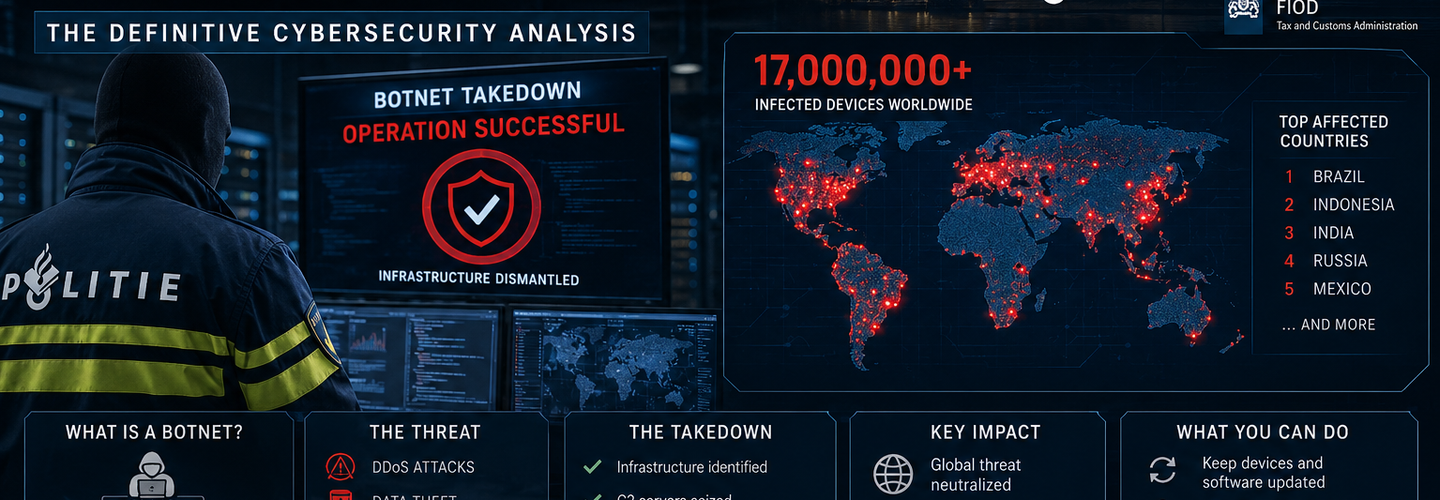
Dutch Authorities Dismantle Massive Botnet Linked to 17 Million Infected Devices: The Definitive Cybersecurity Analysis
Summarize this blog post with: ChatGPT | Perplexity | Claude | Grok
Cyberattacks, ransomware campaigns, and botnets have become regular headlines in today's digital world. What many people do not realize is how millions of everyday devices — routers, smartphones, smart TVs — can quietly become part of a criminal infrastructure without their owners ever knowing. In this definitive guide, you'll learn exactly how Dutch authorities dismantled a botnet linked to 17 million infected devices, how the criminal operation worked, why it matters for global cybersecurity, and the concrete steps you can take to protect your systems right now.
## Key Takeaways
- ▸Botnets are networks of compromised devices controlled remotely by cybercriminals to conduct malicious activities including DDoS attacks, phishing campaigns, and malware distribution.
- ▸Dutch authorities dismantled a botnet linked to at least 17 million infected devices and seized more than 200 servers supporting the operation across multiple countries.
- ▸Infected devices reportedly included computers, smartphones, routers, tablets, and internet-connected smart devices used as distributed attack infrastructure.
- ▸Command-and-control (C2) servers allow attackers to coordinate malicious activity across millions of compromised systems from a centralized or distributed network.
- ▸Unpatched software, weak passwords, and insecure IoT devices remain the most common pathways through which devices are recruited into botnets.
- ▸Organizations can reduce botnet risk through continuous monitoring, endpoint security, vulnerability management, and proactive network segmentation.
- ▸The Dutch operation demonstrates the growing importance of international cooperation between law enforcement, cybersecurity agencies, and independent researchers in combating cybercrime.
## What Is a Botnet and How Does It Work?
A botnet is a network of internet-connected devices infected with malware and controlled remotely by cybercriminals through command-and-control (C2) infrastructure. The term is a portmanteau of "robot" and "network" — and that description is apt. Infected devices become automated soldiers in a criminal army, carrying out instructions without their owners' knowledge or consent.
For context on how malware spreads and enables these infections in the first place, the ReconShield team has published a detailed breakdown of malware propagation techniques and phishing attack vectors that every security professional should review.
How Command-and-Control Infrastructure Works
Command-and-control (C2) infrastructure is the backbone of every botnet, enabling attackers to send instructions to thousands or millions of infected devices simultaneously. Traditionally, C2 servers operated on a centralized model — one server issuing commands to all bots. Modern botnets increasingly use peer-to-peer (P2P) architectures, making them far more resilient because there is no single point of failure.
First, a device gets infected with a bot agent — a lightweight malware process that runs silently in the background. Second, the bot agent phones home to the C2 server to await instructions. Third, the operator issues commands, which spread to all bots in the network simultaneously. This architecture is what allowed the Dutch botnet to coordinate 17 million devices at once, making it one of the largest criminal infrastructure takedowns in cybersecurity history.
Common Botnet Use Cases
Cybercriminals deploy botnets for a range of illegal activities, from denial-of-service attacks to credential theft and anonymous traffic routing. The most common use cases include:
- ▸Distributed Denial-of-Service (DDoS) attacks that overwhelm websites and online services
- ▸Mass phishing email campaigns delivered through thousands of compromised machines
- ▸Credential stuffing attacks that try stolen usernames and passwords across multiple platforms
- ▸Proxy services that allow criminals to route malicious traffic anonymously through victim devices
- ▸Cryptomining operations that use victim devices' processing power to generate cryptocurrency
- ▸Malware distribution as a paid-for "loader" service sold to other criminal groups
## Why Is the Dutch Botnet Takedown Considered Significant?
The Dutch botnet operation is considered one of the most significant cybercrime infrastructure disruptions in recent years because of its extraordinary scale — 17 million infected devices and more than 200 servers dismantled in a single coordinated operation. To put that into perspective, 17 million compromised devices is larger than the entire population of the Netherlands itself.
Scale alone doesn't tell the whole story, though. What makes this takedown particularly meaningful is what the infrastructure was actually enabling. Botnet operators use compromised devices such as routers, smartphones, computers, and IoT devices to conduct cyberattacks while hiding their identities. By routing traffic through millions of victim machines, the criminals behind this network could conduct attacks with near-total anonymity.
Impact on Global Cybersecurity
Large-scale botnet disruptions have measurable effects on global DDoS attack volumes, spam levels, and malware distribution rates. When major botnets are taken down, security researchers routinely observe sudden drops in spam and attack traffic across the internet. Estimates suggest that a botnet of this size could generate attack traffic volumes exceeding hundreds of gigabits per second — enough to overwhelm even enterprise-grade defenses.
Moreover, this takedown demonstrates what is possible when national cybersecurity agencies, law enforcement, and private researchers work together. The operation highlights that international cooperation between law enforcement, cybersecurity agencies, and researchers can significantly reduce cybercrime infrastructure — a model that will define the future of cybercrime fighting. According to ENISA's Threat Landscape report, botnets remain among the top three cyber threats to organizations globally — Source: ENISA Threat Landscape, 2024.
## How Did Dutch Authorities Discover and Dismantle the 17 Million-Device Botnet?
The Dutch National Police and the National Cyber Security Centre (NCSC) led a coordinated investigation that combined threat intelligence analysis, international law enforcement cooperation, and direct server seizure to dismantle the botnet. Operations like this rarely happen overnight — they are the result of months or years of surveillance, evidence collection, and legal coordination across multiple jurisdictions.
The Role of Security Researchers
Independent cybersecurity researchers often play a pivotal role in major botnet takedowns by identifying C2 infrastructure and providing technical evidence to law enforcement. In many documented cases, it is a single researcher who first spots anomalous traffic patterns or discovers exposed command-and-control panels before ever contacting authorities.
Researchers monitoring live IP threat intelligence feeds — like the real-time threat pulse on ReconShield — can identify indicators of compromise associated with botnet infrastructure long before formal law enforcement investigations begin. Spotting active botnet-linked IPs in real time is exactly the kind of passive OSINT work that contributed to intelligence gathering in operations like this one.
Infrastructure Seizure Details
Seizing more than 200 servers is an unusually high number, reflecting the distributed, redundant architecture that modern botnets use to survive partial takedowns. Operators deliberately spread infrastructure across multiple countries and hosting providers to complicate jurisdiction issues and make a single-country seizure ineffective. The Dutch-led operation required coordination with foreign law enforcement to simultaneously take down servers across multiple jurisdictions — a logistical achievement as impressive as the technical one.
## How Did the 17 Million-Device Botnet Actually Operate?
The botnet operated as a distributed proxy and attack network, routing criminal traffic through millions of compromised devices to anonymize cybercriminal operations and enable attacks at massive scale. Understanding the architecture reveals why networks like this are so dangerous and so difficult to take down.
Types of Devices Recruited Into the Botnet
The infected device pool reportedly included home routers, desktop computers, smartphones, tablets, and a range of IoT devices — reflecting how broadly attackers target internet-connected hardware. Home routers were especially valuable because they operate continuously, have high-bandwidth connections, and are almost never monitored by their owners for suspicious outbound traffic.
IoT devices — smart cameras, smart home hubs, digital video recorders — were also heavily targeted. These devices typically run lightweight operating systems with minimal security controls. You can use ReconShield's Port Scanner to check your own network for exposed services on devices that shouldn't be internet-facing — it's a critical first step in identifying whether your hardware could be vulnerable to botnet recruitment.
Botnet Architecture and Proxy Services
Proxy botnets are among the most commercially valuable types of botnet infrastructure because they allow cybercriminals to sell anonymous internet access to other criminals as a service. The compromised devices effectively act as exit nodes — making malicious traffic appear to originate from millions of legitimate residential IP addresses around the world. This makes it extraordinarily difficult for defenders to block attacks based on IP reputation alone, because the attacking IPs are constantly rotating across real consumer devices.
For security teams defending against this type of threat, running regular IP Lookup checks on suspicious traffic — cross-referencing against 50+ threat databases — can reveal whether traffic hitting your infrastructure originates from known botnet-linked addresses, even when those addresses are residential IPs.
## What Cybercrimes Were Enabled by This Botnet Network?
The botnet enabled a full spectrum of cybercrime operations, serving as a criminal-for-hire infrastructure that other threat actors could rent to conduct DDoS attacks, phishing campaigns, credential stuffing, and anonymous malware distribution. This "crime-as-a-service" model is increasingly common among sophisticated criminal organizations.
DDoS Attacks and Service Disruption
A botnet of 17 million devices represents an extraordinary DDoS capability, capable of generating terabit-scale attack traffic that can bring down almost any target. The 2016 Mirai botnet — which infected approximately 600,000 devices — took down major DNS provider Dyn and disrupted Twitter, Netflix, and Reddit simultaneously. A network 28 times larger represents a categorically different threat level. According to Cloudflare's DDoS Threat Report, the frequency of hyper-volumetric DDoS attacks exceeding 1 Tbps increased by 55% in 2024 — Source: Cloudflare DDoS Threat Report Q4, 2024.
Phishing Campaigns and Credential Theft
Botnet-distributed phishing campaigns are particularly dangerous because they originate from millions of legitimate residential IP addresses, bypassing traditional email security filters. Standard spam filters and blocklists are built around blocking known malicious IP ranges — but when phishing emails arrive from real home internet connections spread across 50 countries, those filters become far less effective.
Understanding how phishing attacks steal credentials is essential context here. The Microsoft Teams impersonation attacks covered in ReconShield's threat intelligence analysis show exactly how sophisticated social engineering layers on top of distributed delivery infrastructure.
Malware Distribution as a Service
Criminal organizations operating large botnets increasingly monetize them by renting loader access to other malware operators, turning the botnet into a distribution platform for ransomware, spyware, and banking trojans. This "pay-per-install" model generates substantial revenue while insulating the botnet operators from direct involvement in downstream attacks. Supply chain malware threats like GlassWorm — which targets developers through infected packages — are exactly the type of payload that gets distributed at scale through botnet loader services.
## How Can Routers and IoT Devices Become Part of a Botnet?
Routers and IoT devices become botnet targets primarily because they run outdated firmware, use factory-default credentials, expose unnecessary services to the internet, and receive little to no security monitoring from their owners. These devices are not inherently insecure — they become insecure through neglect and misconfiguration.
Common Attack Vectors for Device Infection
Attackers exploit five primary weaknesses to recruit devices into botnets: default credentials, unpatched vulnerabilities, exposed management interfaces, malicious downloads, and social engineering. Each of these represents a different failure mode with a different remediation strategy.
First, default credentials are catastrophically common — a significant percentage of consumer routers are never reconfigured from factory defaults. Second, firmware vulnerabilities go unpatched for months or years because router manufacturers have historically poor patch distribution mechanisms. Third, administrative interfaces like Telnet (port 23) and SSH (port 22) are often left exposed to the internet when they should only be accessible from within a local network. You can check your own exposed ports right now with ReconShield's Port Scanner — it uses passive detection to identify internet-facing services without sending intrusive traffic to your targets.
According to a Symantec IoT Threat Report, over 55% of IoT device attacks target routers, making them the most common entry point for botnet malware campaigns — Source: Symantec Internet Security Threat Report, 2023.
Vulnerable DNS and Email Security as Entry Points
Misconfigured DNS records and weak email security controls also contribute to botnet infection rates by enabling phishing emails and malicious redirect campaigns to reach end users. When an organization's SPF, DKIM, and DMARC records are incorrectly configured, it becomes trivially easy for attackers to send convincing phishing emails that appear to come from legitimate internal addresses.
ReconShield's DNS Lookup Tool and Email Security Validator let you audit these records directly — checking for SPF soft-fail configurations, missing DMARC policies, and DKIM misalignment that attackers exploit as phishing footholds. The DNS Intelligence guide on the ReconShield blog provides a comprehensive walkthrough of how DNS records reveal attack surface exposure.
## What Security Weaknesses Do Attackers Exploit to Build Botnets?
Botnet operators systematically exploit four categories of weakness: weak authentication, unpatched software vulnerabilities, exposed services, and misconfigured security headers. Understanding each category is the first step toward closing these gaps in your own infrastructure.
Weak Credentials and Authentication Failures
Weak or default passwords remain the single most common entry point for botnet malware infections across routers, IoT devices, and corporate servers. A 2023 Verizon Data Breach Investigations Report found that stolen or weak credentials were involved in over 80% of hacking-related breaches — Source: Verizon DBIR, 2023. Enabling multi-factor authentication (MFA), enforcing strong password policies, and eliminating default credentials are non-negotiable baseline controls.
Unpatched Software and Firmware Vulnerabilities
Unpatched software creates the exploitable conditions that botnet malware specifically hunts for — automated scanners probe millions of IPs looking for systems running known-vulnerable software versions. The Log4Shell vulnerability (CVE-2021-44228) is a perfect example: within 72 hours of disclosure, security researchers observed millions of automated exploitation attempts from botnet-driven scanners. You can explore the Log4Shell CVE analysis in ReconShield's CVE intelligence database to understand the scale of vulnerability-driven botnet recruitment.
Similarly, authentication bypass vulnerabilities in enterprise network devices — like the Palo Alto PAN-OS authentication bypass analyzed in ReconShield's vulnerability research — become immediate recruitment targets the moment proof-of-concept exploits are published.
Exposed Services and Misconfigured Security Headers
Unnecessary exposed services — open database ports, unprotected administrative interfaces, and insecure HTTP headers — dramatically expand the attack surface that botnet operators can exploit. ReconShield's Security Headers Checker audits CSP, HSTS, X-Frame-Options, and related controls that prevent script injection and clickjacking — two techniques commonly used to deliver bot malware through compromised web pages. The full HTTP Security Headers guide is essential reading for any web security professional.
Expired or weak SSL/TLS certificates create additional exposure — they enable man-in-the-middle attacks that can intercept device communications and inject malicious payloads. ReconShield's SSL/TLS Checker analyzes certificate validity, cipher strength, and protocol version to surface these risks before attackers do. For a deeper technical foundation, the SSL vs TLS explained guide covers exactly what security teams need to know.
## How Can Businesses Detect Botnet Activity in Their Networks?
Businesses can detect botnet activity by monitoring for anomalous outbound traffic patterns, unexpected DNS queries, unusual port activity, and connections to known malicious command-and-control IP addresses. Botnet-infected devices leave behavioral traces — the challenge is having the monitoring infrastructure in place to catch them.
Network-Level Detection Indicators
The clearest network-level botnet indicators are unexpected outbound connections to unfamiliar IPs, especially on non-standard ports, combined with unusually high outbound traffic volumes at odd hours. A compromised device that's part of a DDoS botnet will generate traffic spikes that stand out clearly in network flow analysis. Similarly, devices that are serving as proxy nodes will show sustained, high-volume outbound connections to rotating IP addresses.
Using ReconShield's IP Lookup Tool to cross-reference suspicious outbound IPs against 50+ threat databases and blocklists is an effective triage step for network security teams. If an internal device is routinely connecting to IPs flagged across multiple threat feeds, that device is a high-priority investigation candidate.
DNS Anomaly Detection
Botnet C2 communication frequently relies on DNS — either through hard-coded C2 domain lookups or Domain Generation Algorithms (DGAs) that produce random-looking domain names that are difficult to block. Monitoring DNS query logs for unusual domain patterns — high-entropy domain names, queries to newly registered domains, or high-volume queries to the same domain from multiple internal hosts — can surface C2 communication before it causes damage.
Auditing your own DNS infrastructure for security weaknesses is equally important, since misconfigured DNS can make your domain a phishing pivot point. ReconShield's DNS Lookup Tool provides a fast way to audit SPF, DMARC, and CNAME configurations that attackers exploit.
WHOIS and Infrastructure Attribution
WHOIS intelligence is a powerful tool for attributing suspicious infrastructure to known threat actors and identifying botnet-linked domains before they're used in attacks. When a new domain appears in your network traffic, a quick WHOIS Lookup can reveal whether it was registered recently (a red flag), uses privacy protection to hide registrant details, or shares registration patterns with previously identified malicious infrastructure.
## What Lessons Can Organizations Learn from the Dutch Cybercrime Operation?
The Dutch botnet takedown delivers four critical lessons for organizations: asset visibility matters, passive monitoring works, patch velocity is a competitive advantage, and international cooperation is the future of cybercrime response. Each of these lessons translates directly into actionable security program improvements.
Lesson 1: You Cannot Defend What You Cannot See
The most fundamental security lesson from any large botnet is that unknown, unmonitored devices become attack infrastructure. Organizations that don't maintain an accurate inventory of their internet-facing assets are, by definition, operating blind. Devices on forgotten network segments, decommissioned servers still accessible from the internet, and shadow IT — all of these are prime botnet recruitment targets.
ReconShield's Exposure Assessment Tool provides a passive, zero-impact way to discover what your infrastructure looks like from the outside — the same perspective an attacker has. Running regular exposure assessments is the organizational equivalent of the intelligence gathering that enabled the Dutch authorities to map the botnet before moving to seize servers.
Lesson 2: Vulnerability Patching Speed Determines Attack Surface Size
Every day an unpatched vulnerability remains in your environment is a day botnet operators can exploit it to add your devices to their network. The window between vulnerability disclosure and mass exploitation has collapsed in recent years — in some cases, automated exploitation begins within hours of a CVE being published.
The Palo Alto PAN-OS authentication bypass analysis on ReconShield is a direct illustration of this principle: enterprise-grade network devices with known vulnerabilities become immediate botnet targets the moment exploit code goes public.
Lesson 3: Security Researchers Are Your Force Multipliers
Engaging with the security research community — sharing threat intelligence, participating in responsible disclosure programs, and monitoring researcher-published indicators of compromise — dramatically amplifies your organization's defensive capabilities. The Dutch operation worked in part because researchers had already mapped significant portions of the botnet infrastructure before law enforcement moved in.
The ReconShield blog's threat intelligence category publishes analyst-authored research and CVE analyses that translate exactly this kind of intelligence into actionable guidance for security teams.
## How Can Individuals Protect Their Devices from Botnet Malware?
Individuals can protect their devices from botnet infection by changing default credentials, enabling automatic firmware updates, disabling unnecessary remote access features, and maintaining up-to-date antivirus and endpoint protection software. These steps are not technically complex — but they require deliberate, consistent action.
Practical Device Hardening Steps
The single highest-impact action any individual can take is changing their router's default admin username and password immediately after setup. Factory-default credentials are publicly documented and are the first thing automated botnet recruitment tools try. Beyond credentials, these additional steps significantly reduce risk:
- ▸Enable automatic firmware updates on all routers, smart devices, and network-connected hardware
- ▸Disable remote management interfaces (Telnet, WAN-side HTTP admin) unless explicitly required
- ▸Segment IoT devices onto a separate guest network isolated from primary computers and phones
- ▸Check whether your home IP address appears on any threat intelligence blocklists using ReconShield's IP Lookup Tool
- ▸Verify your email domain's SPF and DKIM configuration with the Email Security Validator to prevent your domain from being spoofed in phishing campaigns
Recognizing Signs of Infection
Common botnet infection signs include unexplained slowdowns, unusually high outbound network traffic, overheating hardware running at maximum CPU, and internet service provider warnings about unusual traffic patterns from your connection. If you notice any of these indicators, immediately disconnect the suspect device, run a malware scan, and consider a factory reset followed by a firmware update before reconnecting.
## What Does This Takedown Mean for the Future of Cybersecurity?
The Dutch botnet takedown signals a maturation in international law enforcement's ability to coordinate complex, multi-jurisdictional cybercrime operations — a capability that will be increasingly essential as criminal infrastructure becomes more distributed and resilient. The days when a single country's authorities could independently dismantle major cybercrime infrastructure are largely over.
The Evolving Botnet Threat Landscape
Modern botnets are evolving toward peer-to-peer architectures, encrypted C2 communications, and AI-assisted target selection — making future takedowns progressively more difficult. Criminal organizations are also increasingly using legitimate cloud hosting providers to blend malicious traffic with normal internet activity. The growing use of AI in cyberattack automation — explored in ReconShield's ChatGPT vulnerability and AI security risks analysis — suggests that offensive capabilities will continue to accelerate.
What Security Teams Should Prepare For
Security teams should anticipate larger, more resilient botnets, faster exploitation of newly disclosed vulnerabilities, and increasing use of residential proxy networks that complicate IP-based blocking. The response framework is clear: invest in behavioral detection (not just signature-based tools), maintain real-time threat intelligence feeds, and implement zero-trust network architectures that assume devices are compromised until proven otherwise.
The emergence of autonomous AI-powered penetration testing tools — analyzed in ReconShield's Pentest Swarm AI guide — also signals that defenders need to test their own defenses with the same level of automation that attackers now deploy.
## What's Next: Immediate Security Actions for Organizations and Individuals
Every organization and individual can take concrete, high-impact actions this week to reduce botnet exposure — starting with a full audit of internet-facing infrastructure. Here is a prioritized action roadmap:
For Organizations:
- ▸Run a passive exposure assessment using ReconShield's Exposure Assessment Tool to identify internet-facing misconfigurations immediately
- ▸Audit all domain DNS records — SPF, DMARC, and DKIM — using the DNS Lookup Tool to close phishing entry points
- ▸Check SSL/TLS certificate health across all public-facing services with the SSL/TLS Checker
- ▸Review HTTP security headers on all web properties using ReconShield's Security Headers Checker
- ▸Investigate any suspicious IPs in network logs using the IP Lookup Tool with cross-referencing against 50+ threat feeds
- ▸Conduct WHOIS investigations on unfamiliar domains appearing in DNS or network logs via the WHOIS Lookup Tool
- ▸Subscribe to the ReconShield threat intelligence briefing to receive zero-day alerts and botnet indicator updates
For Individuals:
- ▸Change all default router and device credentials today
- ▸Enable automatic firmware updates on every network-connected device
- ▸Run your home IP through ReconShield's IP Lookup Tool to check for blocklist flagging
- ▸Segment smart home devices onto a separate network from your computers and phones
## Conclusion
The Dutch authorities' dismantling of a botnet linked to 17 million infected devices is one of the most significant cybercrime infrastructure takedowns in cybersecurity history — and it carries lessons that directly apply to every organization and individual connected to the internet. Botnets are not abstract threats. They are built from real devices that belong to real people and real organizations who simply weren't paying close enough attention to their security posture.
The three overarching takeaways are clear. First, asset visibility is foundational — you cannot defend what you don't know exists. Second, proactive security hygiene (patching, credential management, exposure auditing) is dramatically cheaper than incident response. Third, the future of cybercrime fighting is collaborative — between law enforcement, researchers, and security-conscious organizations sharing intelligence.
Botnet operators count on their victims staying passive. The most effective thing you can do right now is take one concrete step: run a passive scan of your infrastructure with ReconShield's Exposure Assessment Tool and see your attack surface the way an attacker would. Stay informed through the ReconShield threat intelligence blog — because the next major botnet is already being built, and the defenders who detect it earliest will shape how quickly it gets dismantled.
Written by Surendra Reddy Cybersecurity Researcher & Founder, ReconShield. Surendra is a cybersecurity engineer specializing in Open Source Intelligence (OSINT), exposure intelligence, and AI-driven threat analysis. He built ReconShield to democratize access to enterprise-grade infrastructure visibility tools and secure the digital internet-facing assets.
Reviewed by ReconShield Editorial Team — Fact-checked and peer-reviewed in alignment with ReconShield's Editorial Policy.
## Analyst Commentary & Implementation Blueprint
Security advisory
Continuous security exposure assessment is critical to identifying public vulnerabilities before they are exploited. Organizations should maintain a passive inventory of all web servers, TLS configs, and open ports, ensuring that default configurations are eliminated and security advisories are actively implemented.
Hardened Security Configuration Blueprint
# General Security Hardening Directive
ServerTokens ProductOnly
ServerSignature Off
FileETag None
Actionable Mitigation Checklist
- ✔Perform passive asset inventories weekly.
- ✔Restrict administrative ports using local firewall controls.
- ✔Monitor active CVE alerts for exposed software.
Common Inquiries & FAQs
Why is passive scanning preferred for continuous auditing?
Passive audits do not cause operational impact or trigger firewall blocks, making them ideal for constant surveillance of internet-facing assets.
What should I do if a vulnerability is flagged?
Apply the latest vendor patches, restrict access to the resource via firewalls, or verify configuration flags to mitigate risks.
Surendra Reddy
Surendra Reddy is a cybersecurity researcher and founder of ReconShield, specializing in OSINT and defensive infrastructure analysis.
Connect on LinkedIn ↗// AUDIT BRIEFING DISCUSSION (2 COMMENTS)
Great breakdown of the passive infrastructure vectors. We recently audited our external DNS zones and found multiple dangling staging environments. Implementing wildcard certificates reduced our CT log leaks significantly.
Is there any automated tooling you recommend for daily crt.sh scraping? Manually checking CT logs is becoming unsustainable for our domain portfolio.
// MORE ARTICLES
Security Researchers Warn Critical n8n Flaws May Expose Automation Platforms to RCE
Researchers have disclosed critical vulnerabilities in n8n that could expose automation workflows and connected enterprise systems to remote code execution risks, prompting urgent patch recommendations for users and administrators.

How Agentic AI Is Changing Software Engineering and Expanding Mobile Attack Surfaces
Agentic AI is rapidly transforming software engineering workflows through automation and intelligent coding assistance, while cybersecurity experts warn of expanding mobile attack surfaces and emerging application security risks.
SplitVPN Hacked: Data Breach Exposes 865,000 User Records and 58 Million Hidden Connection Logs (July 2026)
SplitVPN hacked: 865,336 user records and 58 million connection logs exposed, directly contradicting the VPN's "no-logs" promise. What was leaked and what to do now.