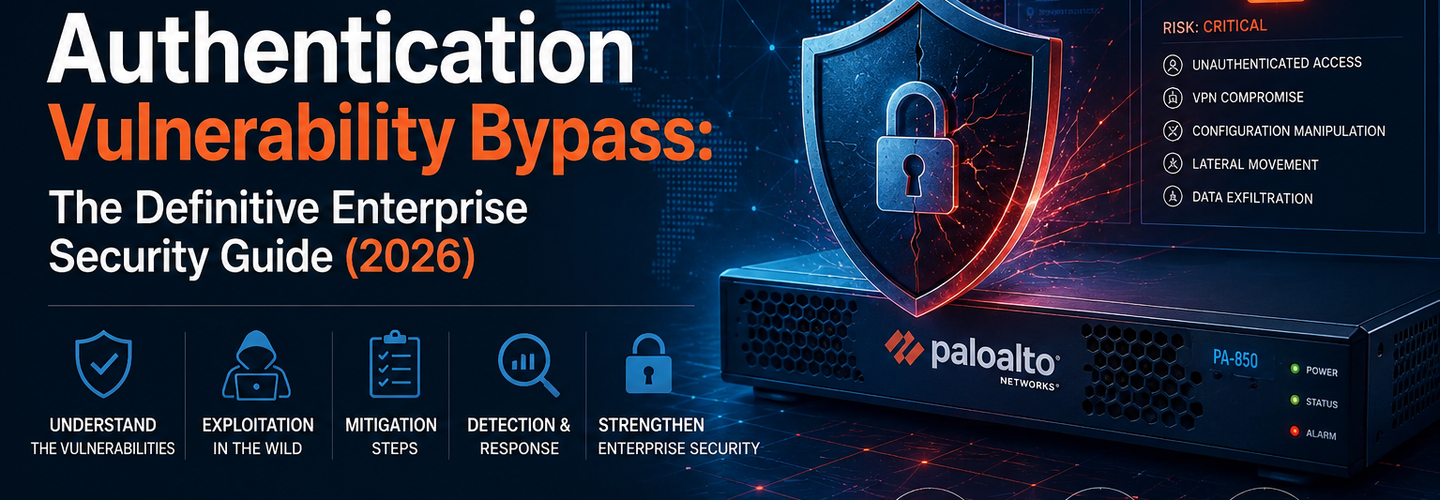
Palo Alto Networks PAN-OS Authentication Vulnerability Bypass: The Definitive Enterprise Security Guide (2026)
Summarize this blog post with: ChatGPT | Perplexity | Claude | Grok
Enterprise firewalls are designed to stop attackers before they reach critical systems — yet modern threat actors increasingly target the security infrastructure itself. Many organizations understand that PAN-OS vulnerabilities are serious, but few fully grasp how authentication bypass flaws can provide direct, silent access to protected networks without triggering a single credential alert. In this guide, you'll learn exactly how the Palo Alto Networks PAN-OS authentication vulnerability bypass works, which environments are affected, how attackers are exploiting it in the wild right now, and the precise mitigation steps your security team must take immediately.
## Key Takeaways
- ▸The PAN-OS authentication vulnerability bypass allows attackers to circumvent authentication controls on affected Palo Alto Networks firewall deployments — gaining access without valid credentials.
- ▸CVE-2026-0257 and CVE-2026-0265 affect specific PAN-OS authentication workflows and may enable unauthorized access under certain portal and gateway configurations.
- ▸Active exploitation of PAN-OS vulnerabilities increases the risk of unauthorized VPN access, credential abuse, and lateral movement deep within enterprise networks.
- ▸Immediate patching and restricting exposed authentication portals to trusted IP ranges significantly reduce exploitation risk even before a full patch cycle completes.
- ▸Indicators of compromise include suspicious administrator logins, unauthorized VPN sessions, unexpected configuration changes, and anomalous outbound traffic from firewall management interfaces.
- ▸Multi-factor authentication, network segmentation, and continuous monitoring improve organizational resilience against authentication bypass attacks.
- ▸Incident response planning should include forensic review, credential rotation, firewall isolation, and structured threat-hunting procedures before resuming normal operations.
## What Is the Palo Alto Networks PAN-OS Authentication Vulnerability Bypass?
The Palo Alto Networks PAN-OS authentication vulnerability bypass is a class of security flaw that allows unauthenticated remote attackers to circumvent the authentication controls protecting PAN-OS management interfaces, GlobalProtect portals, or VPN gateways — enabling unauthorized access to network infrastructure without supplying valid credentials.
In concrete terms, a successful bypass allows a threat actor to reach administrative interfaces or VPN endpoints that should require a username and password, MFA token, or certificate-based authentication. Instead, the attacker sends a specially crafted HTTP request that the authentication engine misprocesses — either skipping the verification step entirely or accepting a forged authentication state.
How Authentication Bypass Vulnerabilities Work in PAN-OS
Authentication bypass vulnerabilities in PAN-OS exploit weaknesses in how the firewall validates session state, request origin, or credential tokens — rather than weaknesses in a user's password strength. This is a critical distinction: no amount of password complexity protects against a flaw that lets the attacker skip the password check altogether.
For example, a common bypass pattern involves manipulating HTTP headers or URL parameters that the authentication layer uses to determine whether a session is already authenticated. If the parser can be tricked into interpreting a malformed request as a pre-authenticated session, the attacker bypasses the login gate entirely. Palo Alto Networks firewalls serve as perimeter gatekeepers for millions of enterprise networks, making any authentication flaw in PAN-OS a high-priority target for ransomware operators and nation-state actors alike.
Understand how your perimeter looks to an attacker before they exploit it — run a passive infrastructure scan with ReconShield's free Exposure Assessment Tool.
## Why Is the PAN-OS Authentication Bypass Considered a High-Risk Security Threat?
The PAN-OS authentication bypass is considered a critical-severity threat because Palo Alto Networks firewalls sit at the network perimeter of hundreds of thousands of enterprise, government, and critical infrastructure deployments worldwide — meaning a single exploited flaw can provide attackers with direct entry into otherwise hardened environments.
Palo Alto Networks products are deployed in over 85,000 organizations globally, including financial institutions, healthcare systems, and government agencies — Source: Palo Alto Networks Annual Report, 2024. When a perimeter device's authentication mechanism fails, every asset behind that perimeter is immediately at greater risk. Attackers who compromise a firewall do not need to exploit individual servers or endpoints; they inherit access to the traffic, routing, and VPN sessions the firewall controls.
Enterprise and Compliance Implications
Firewall authentication bypass flaws carry direct compliance implications under PCI-DSS Requirement 6 (secure systems and software), HIPAA Security Rule technical safeguards, and NIST SP 800-41 firewall security guidelines. Organizations that cannot demonstrate timely patching and access control enforcement face regulatory exposure alongside technical risk.
Moreover, the 2024 Verizon Data Breach Investigations Report found that exploitation of public-facing applications — including network security appliances — accounted for 14% of all confirmed breach vectors — Source: Verizon DBIR, 2024. PAN-OS vulnerabilities fall squarely in this category and are consistently targeted within days of public disclosure. Assess your organization's DNS security posture and identify spoofable domains with ReconShield's DNS Lookup and Security Analysis Tool.
## What Is CVE-2026-0257 and How Does It Affect GlobalProtect?
CVE-2026-0257 is an authentication bypass vulnerability affecting the GlobalProtect portal and gateway components of Palo Alto Networks PAN-OS that allows an unauthenticated remote attacker to bypass pre-login authentication checks under specific configuration conditions.
GlobalProtect is Palo Alto Networks' remote access VPN solution, deployed by enterprises to provide secure connectivity for remote workers and branch offices. CVE-2026-0257 targets the authentication handshake that GlobalProtect uses to validate client identity before establishing a VPN session. By sending a malformed or unexpected authentication request, an attacker can force the portal to proceed as if authentication has already been completed.
Technical Exploitation Conditions for CVE-2026-0257
CVE-2026-0257 is exploitable when the GlobalProtect portal is exposed to untrusted network interfaces — a configuration that is common in organizations that allow remote employee VPN access from the open internet. The flaw does not require any credentials, valid certificates, or prior knowledge of user accounts.
First, the attacker identifies a PAN-OS deployment with GlobalProtect portal access exposed on a public IP address. Second, they send a crafted HTTP request that bypasses the authentication state machine. Third, they gain access to the VPN gateway or begin enumerating users and network resources accessible through the portal session. This three-step exploit chain requires no specialized tooling beyond standard HTTP manipulation capabilities.
Identify exposed ports and services on your public-facing infrastructure before attackers do — use ReconShield's TCP Port Analyzer to map open interfaces.
## What Is CVE-2026-0265 and How Does It Impact PAN-OS Authentication Controls?
CVE-2026-0265 is a secondary authentication control bypass affecting PAN-OS management web interface components, distinct from GlobalProtect, that allows unauthenticated attackers to reach certain administrative functions when management access is inadvertently exposed to untrusted networks.
While CVE-2026-0257 targets VPN portal authentication, CVE-2026-0265 targets the PAN-OS management plane — the administrative interface administrators use to configure firewall policies, routing, and security profiles. Unauthorized access to the management plane is especially dangerous because it allows an attacker to modify firewall rules, create backdoor administrator accounts, or disable logging and monitoring entirely.
How CVE-2026-0265 Differs From Standard Privilege Escalation
CVE-2026-0265 is not a privilege escalation vulnerability but a pre-authentication bypass — meaning the attacker does not need an existing low-privilege account to exploit it. The vulnerability skips the authentication checkpoint entirely, placing the attacker directly in an administrative context.
This distinction matters for incident response teams. Standard privilege escalation attacks leave authentication logs — a low-privilege login followed by escalation activity. A pre-authentication bypass may leave no valid login event at all, making forensic reconstruction of the attack timeline significantly harder. Security teams should treat any unexplained configuration change on a PAN-OS device as a potential CVE-2026-0265 exploitation indicator, even without corresponding log entries. Verify your SSL and TLS certificate configurations on all perimeter devices with ReconShield's SSL/TLS Crypto Checker.
## Which PAN-OS Versions Are Vulnerable to Authentication Bypass Attacks?
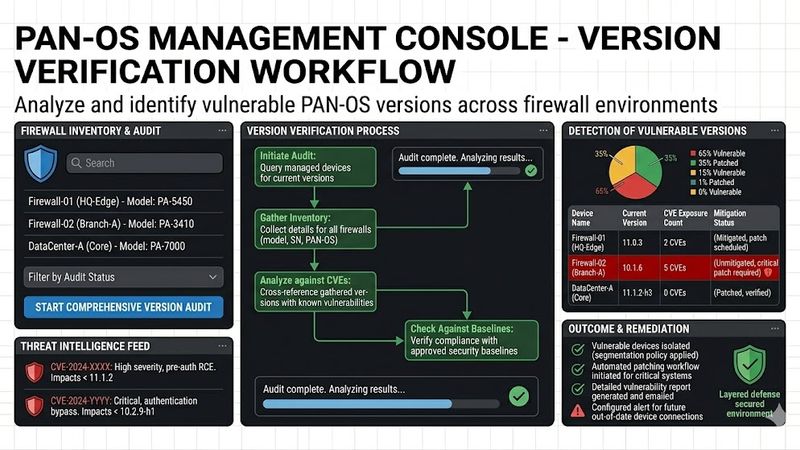
PAN-OS authentication bypass vulnerabilities CVE-2026-0257 and CVE-2026-0265 affect PAN-OS versions prior to the patched releases published by Palo Alto Networks in their official security advisory — organizations should consult the Palo Alto Networks Security Advisories portal directly for the current affected version matrix, as patch availability varies by release branch.
As a general principle, any PAN-OS deployment running an unpatched version with GlobalProtect portal, gateway, or management web interface exposed to untrusted networks is at elevated risk. Historically, Palo Alto Networks patches are released across the PAN-OS 10.x, 11.x, and Cloud NGFW branches, with hotfix releases made available for critical severity vulnerabilities within days of disclosure.
Configuration Factors That Increase Exposure
The most critical exposure factor is whether authentication portals or management interfaces are accessible from untrusted networks — particularly the public internet. Organizations that limit management access to RFC 1918 private IP ranges and require VPN or jump-host access to reach the management plane are substantially less exposed, even on unpatched versions.
Additional configuration risk factors include environments where management interface lockdown is incomplete, where Telemetry is enabled and reachable externally, where GlobalProtect pre-logon configurations are in use, and where certificate-based authentication has not been enforced. Review your domain ownership intelligence and infrastructure attribution with ReconShield's WHOIS Domain Intelligence Tool.
## How Do Attackers Exploit PAN-OS Authentication Bypass Vulnerabilities in the Wild?
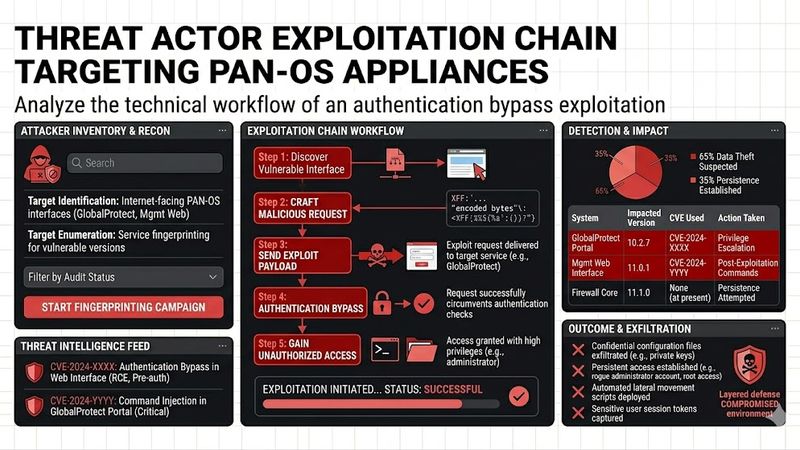
Attackers exploit PAN-OS authentication bypass vulnerabilities through a rapid scanning-to-exploitation pipeline — identifying vulnerable internet-exposed firewalls using mass-scanning infrastructure, confirming vulnerability status, and deploying exploit payloads within hours of proof-of-concept code becoming publicly available.
The exploitation timeline for network appliance vulnerabilities has compressed dramatically. The average time-to-exploitation for critical network device CVEs dropped to under 5 days in 2024, compared to over 30 days in 2021 — Source: Rapid7 Vulnerability Intelligence Report, 2024. PAN-OS vulnerabilities, given the high value of the assets they protect, are often exploited within 24–48 hours of public disclosure.
Mass Scanning and Firewall Fingerprinting
Attackers use mass-scanning tools such as Shodan, Censys, and custom TCP scanners to identify internet-exposed PAN-OS GlobalProtect portals and management interfaces at scale. These platforms index billions of internet-connected devices and can return a list of potentially vulnerable targets within minutes. Attackers filter results by PAN-OS banner, portal title, or characteristic HTTP response headers to identify deployment versions and confirm exposure before committing to exploitation.
For example, an attacker searching Censys for the GlobalProtect portal login page title can enumerate tens of thousands of exposed deployments globally. Once a candidate target is identified, they probe it with CVE-specific exploit payloads to confirm the authentication bypass succeeds before moving to the next stage.
Post-Exploitation: What Attackers Do After Bypassing Authentication
After successfully bypassing PAN-OS authentication, threat actors consistently pursue credential harvesting, persistent backdoor creation, and lateral movement into the protected network. This mirrors the attack pattern observed in the Microsoft Teams IT helpdesk impersonation campaign, where initial access is quickly leveraged to pivot deeper into the target organization.
Specifically, attackers who compromise the GlobalProtect gateway create new VPN credentials or capture existing session tokens, providing persistent network access that survives firewall reboots. Attackers who reach the management plane typically create hidden administrator accounts, modify firewall policies to open additional access paths, and disable or tamper with logging to hinder forensic response. Check your IP reputation and cross-reference infrastructure addresses against global threat feeds with ReconShield's IP Reputation Intelligence Tool.
## What Real-World Exploitation Activity Has Been Observed?
Real-world exploitation of PAN-OS authentication bypass vulnerabilities has been attributed to ransomware affiliates, financially motivated threat actors, and suspected nation-state intrusion operators — reflecting the high strategic value of network perimeter access.
Unit 42 and Palo Alto Networks threat intelligence teams have documented exploitation attempts against GlobalProtect infrastructure within days of prior CVE disclosures, including CVE-2024-3400, where exploitation began within 48 hours of public disclosure and affected thousands of unpatched firewalls globally — Source: Palo Alto Networks Unit 42 Threat Intelligence, 2024. Vendors including Volexity and Shadowserver have independently corroborated mass scanning and exploitation activity following PAN-OS security advisories. Similar supply-chain and perimeter exploitation patterns are analyzed in depth in ReconShield's GlassWorm malware and npm supply chain attack research.
## What Indicators of Compromise Should Security Teams Monitor?
Indicators of compromise for PAN-OS authentication bypass exploitation include anomalous authentication events, unexpected configuration changes, unauthorized VPN sessions, and suspicious outbound traffic from firewall management interfaces — though pre-authentication bypass flaws may produce fewer log entries than credential-based attacks.
Security teams should actively hunt for the following IOC categories across their SIEM and firewall log infrastructure.
Authentication anomalies include administrator login events from unexpected geographic locations or IP addresses, successful authentication events without corresponding MFA logs, repeated failed authentication attempts immediately followed by success, and VPN sessions established at unusual hours by accounts not typically used for remote access.
Configuration changes include new administrator accounts created outside of change management windows, modifications to firewall policy rules — especially rules that permit inbound access from external IPs — changes to logging and monitoring configurations, and newly registered or modified SSL certificates on the management interface.
Network indicators include outbound connections from the firewall management interface to external IP addresses not associated with Palo Alto Networks update servers, DNS queries from firewall management interfaces to newly registered or suspicious domains, and unexpected network traffic traversing firewall routes that were previously blocked. Identify suspicious IP addresses and cross-reference against 50+ global threat blocklists with ReconShield's IP Reputation Intelligence Tool.
[Insert image: ReconShield IP Reputation Intelligence Tool showing threat feed cross-reference results | Alt text: "Check IP reputation against threat feeds with ReconShield IP Lookup Tool"]
## How to Patch and Mitigate the PAN-OS Authentication Vulnerability
The primary mitigation for CVE-2026-0257 and CVE-2026-0265 is immediate application of the patches published in Palo Alto Networks' official security advisory — and where patching cannot be completed immediately, restricting access to GlobalProtect portals and management interfaces to trusted IP ranges provides a critical compensating control.
Follow this prioritized remediation sequence.
Step 1: Identify all exposed PAN-OS deployments. Inventory every firewall and Panorama instance in your environment. Identify which deployments have GlobalProtect portal or management web interface access reachable from untrusted networks. Use ReconShield's TCP Port Analyzer to passively identify what ports and services your firewalls are currently exposing to the internet.
Step 2: Apply Palo Alto Networks security patches immediately. Consult the official Palo Alto Networks Security Advisory for CVE-2026-0257 and CVE-2026-0265 to identify the patched release for your specific PAN-OS version branch. Prioritize deployments with internet-exposed portals. Validate patch application by reviewing the installed content version and PAN-OS software version on each device post-update.
Step 3: Restrict management interface access. If patching cannot begin immediately, restrict management plane access to internal RFC 1918 IP ranges only. Palo Alto Networks explicitly recommends that management interfaces never be exposed to the internet — a control that eliminates the majority of CVE-2026-0265 exploitation risk regardless of patch status.
Step 4: Enforce certificate-based authentication on GlobalProtect. Where possible, require client certificates for GlobalProtect pre-logon and user-logon configurations. Certificate-based authentication significantly raises the bar for exploitation even on vulnerable versions.
Step 5: Rotate credentials and review VPN sessions. After patching, rotate all administrator credentials, API keys, and service account passwords. Terminate and audit all active VPN sessions. Review VPN user session history for unauthorized access. Audit your email authentication configurations — SPF, DKIM, and DMARC — with ReconShield's Email Security Tool to block phishing campaigns targeting recently compromised users.
## What Tools and Platforms Help Detect PAN-OS Exploitation?
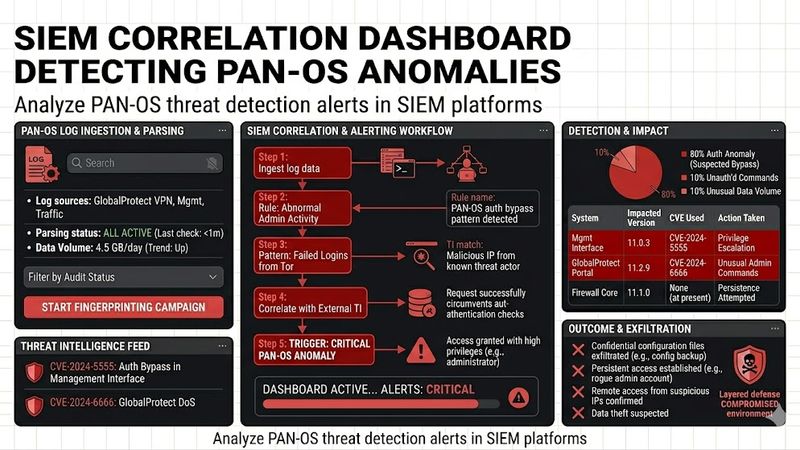
Effective detection of PAN-OS authentication bypass exploitation requires a combination of firewall-native logging, SIEM integration, threat intelligence feeds, and external infrastructure monitoring — no single tool provides complete visibility across all exploitation stages.
Palo Alto Networks Cortex XDR provides native behavioral analytics for PAN-OS environments, including anomaly detection for authentication events, configuration changes, and management plane access. It is the first tool security teams with existing Palo Alto deployments should activate for post-exploitation detection.
Microsoft Sentinel and Splunk both offer PAN-OS log connectors and community detection rule packs covering authentication anomalies, management interface access from unexpected IPs, and firewall rule modification events. Building custom detection rules aligned to the CVE-2026-0257 and CVE-2026-0265 exploitation patterns significantly improves early detection.
Shodan Monitor and Censys Attack Surface Management allow organizations to see their internet-exposed infrastructure from an attacker's perspective — identifying GlobalProtect portals and management interfaces that should be restricted. ReconShield's passive toolset complements these platforms with free, real-time infrastructure intelligence:
- ▸Exposure Assessment Tool — Passively scan for misconfigured and exposed web services fronting your firewall infrastructure
- ▸Security Headers Auditor — Audit CSP and HSTS configurations on authentication portals
- ▸SSL/TLS Crypto Checker — Verify certificate integrity and cipher strength on GlobalProtect and management endpoints
- ▸DNS Lookup and Security Analysis Tool — Identify DNS misconfigurations that could be exploited alongside PAN-OS attacks
- ▸IP Reputation Intelligence Tool — Cross-reference attacker IP addresses from firewall logs against 50+ global threat feeds
- ▸WHOIS Domain Intelligence Tool — Attribute suspicious domains encountered during PAN-OS incident investigation
## What Are the Incident Response Steps After Potential PAN-OS Compromise?
Incident response after a suspected PAN-OS authentication bypass compromise requires immediate containment, forensic preservation, credential invalidation, and threat-hunting procedures before the affected firewall is returned to normal operation.
Containment: Isolate the suspected firewall from production traffic where operationally feasible. If isolation is not possible, immediately restrict management interface access and block all inbound connections to the GlobalProtect portal from untrusted sources. Preserve firewall logs before any reboot or remediation action that could overwrite volatile memory.
Forensic review: Export and preserve all system logs, traffic logs, configuration audit logs, and threat logs from the affected device. Identify the earliest anomalous event in the authentication log. Reconstruct the attacker's session timeline, including what configurations were accessed, modified, or exported. Engage Palo Alto Networks support and, if applicable, your incident response retainer immediately for forensic assistance on the PAN-OS platform.
Credential rotation: Rotate all local administrator accounts on the affected firewall. Rotate all API keys and service account tokens. Force re-authentication for all active VPN sessions. If the management plane was accessed, treat all credentials that may have been visible to an administrator-level session as compromised and rotate accordingly across connected systems.
Threat hunting: Search your SIEM for lateral movement events that correlate with the firewall compromise timeline. Look for new account creations in Active Directory or cloud identity providers, unusual privilege escalation events, and unexpected access to file shares, email systems, or databases by accounts that would have been accessible via the VPN. Review the ReconShield attack surface management methodology to understand how attackers map and pivot through enterprise environments post-compromise.
Recovery and hardening: Rebuild the firewall configuration from a known-good backup if management plane compromise is confirmed, rather than attempting to identify and remove all attacker modifications manually. Apply all available patches before returning the device to production. Implement the access restriction and authentication hardening controls described in the mitigation section above.
## What Should Organizations Do Next to Strengthen Firewall Security?
Organizations should treat the PAN-OS authentication vulnerability disclosure as a trigger for a broader firewall security review — not just an isolated patch event — because authentication bypass flaws will continue to emerge as long as network perimeter devices are exposed to untrusted networks without strict access controls.
Adopt a management plane isolation policy. No firewall or network security appliance management interface should be directly accessible from the internet. All management access should route through dedicated management VLANs, out-of-band management networks, or privileged access workstations that require separate strong authentication. This single architectural control eliminates the majority of management-plane exploitation risk across all current and future CVEs.
Implement continuous external attack surface monitoring. Your perimeter exposure changes every time a new service is deployed, a DNS record is modified, or a cloud resource is provisioned. Static quarterly assessments are insufficient. Continuous passive monitoring with tools like ReconShield's Exposure Assessment Tool provides ongoing visibility into what your firewalls and associated infrastructure are exposing to the internet without the disruptive traffic generated by active scanning.
Build a vulnerability patching SLA for network appliances. Treat critical-severity network appliance CVEs — CVSS 9.0 and above — with a 24-to-48-hour patch SLA where operationally feasible. Pair this with compensating controls — IP restriction, authentication hardening — that can be deployed within hours when patching requires a maintenance window. Learn how DNS intelligence supports rapid threat investigation and attribution in ReconShield's DNS Intelligence guide for cybersecurity researchers.
Conduct regular firewall security reviews. Schedule quarterly reviews of firewall policy, administrator account lists, API key inventories, and exposed service configurations. Compare current configurations against a known-good baseline. Engage an external penetration tester or red team annually to validate that authentication controls and access restrictions are functioning as intended.
## Conclusion
The Palo Alto Networks PAN-OS authentication vulnerability bypass represents exactly the type of threat that keeps enterprise security teams awake — a high-severity flaw in the infrastructure layer designed to stop attackers, actively exploited in the wild, with a compressed time-to-exploitation window measured in hours rather than weeks.
The organizations that weather this class of threat are not the ones with the most complex security stacks — they are the ones with the strongest operational discipline. Patch immediately. Restrict management interfaces. Monitor authentication anomalies. Rotate credentials after any suspected compromise. And treat your perimeter devices as attack targets, not just defensive tools.
Start by understanding your current exposure. Run a passive scan with ReconShield's free Exposure Assessment Tool to see exactly what your firewalls and network infrastructure are exposing to the internet right now — with zero packet transmission and zero operational disruption.
Written by Surendra Reddy — Cybersecurity Researcher & Founder, ReconShield. Surendra is a cybersecurity engineer specializing in Open Source Intelligence (OSINT), exposure intelligence, and AI-driven threat analysis. He built ReconShield to democratize access to enterprise-grade infrastructure visibility tools and secure the digital internet-facing assets of organizations worldwide.
Reviewed by ReconShield Editorial & Research Team — Fact-checked against Palo Alto Networks Security Advisories, NIST NVD CVE database, and published threat intelligence reports as of May 2026.
## Analyst Commentary & Implementation Blueprint
Security advisory
Continuous security exposure assessment is critical to identifying public vulnerabilities before they are exploited. Organizations should maintain a passive inventory of all web servers, TLS configs, and open ports, ensuring that default configurations are eliminated and security advisories are actively implemented.
Hardened Security Configuration Blueprint
# General Security Hardening Directive
ServerTokens ProductOnly
ServerSignature Off
FileETag None
Actionable Mitigation Checklist
- ✔Perform passive asset inventories weekly.
- ✔Restrict administrative ports using local firewall controls.
- ✔Monitor active CVE alerts for exposed software.
Common Inquiries & FAQs
Why is passive scanning preferred for continuous auditing?
Passive audits do not cause operational impact or trigger firewall blocks, making them ideal for constant surveillance of internet-facing assets.
What should I do if a vulnerability is flagged?
Apply the latest vendor patches, restrict access to the resource via firewalls, or verify configuration flags to mitigate risks.
Surendra Reddy
Surendra Reddy is a cybersecurity researcher and founder of ReconShield, specializing in OSINT and defensive infrastructure analysis.
Connect on LinkedIn ↗// AUDIT BRIEFING DISCUSSION (2 COMMENTS)
Great breakdown of the passive infrastructure vectors. We recently audited our external DNS zones and found multiple dangling staging environments. Implementing wildcard certificates reduced our CT log leaks significantly.
Is there any automated tooling you recommend for daily crt.sh scraping? Manually checking CT logs is becoming unsustainable for our domain portfolio.
// MORE ARTICLES
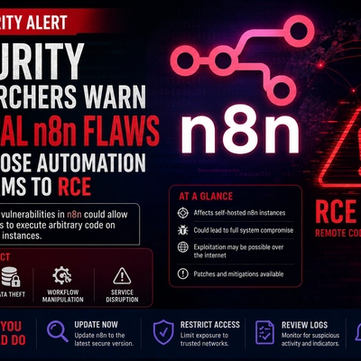
Security Researchers Warn Critical n8n Flaws May Expose Automation Platforms to RCE
Researchers have disclosed critical vulnerabilities in n8n that could expose automation workflows and connected enterprise systems to remote code execution risks, prompting urgent patch recommendations for users and administrators.

How Agentic AI Is Changing Software Engineering and Expanding Mobile Attack Surfaces
Agentic AI is rapidly transforming software engineering workflows through automation and intelligent coding assistance, while cybersecurity experts warn of expanding mobile attack surfaces and emerging application security risks.

SplitVPN Hacked: Data Breach Exposes 865,000 User Records and 58 Million Hidden Connection Logs (July 2026)
SplitVPN hacked: 865,336 user records and 58 million connection logs exposed, directly contradicting the VPN's "no-logs" promise. What was leaked and what to do now.