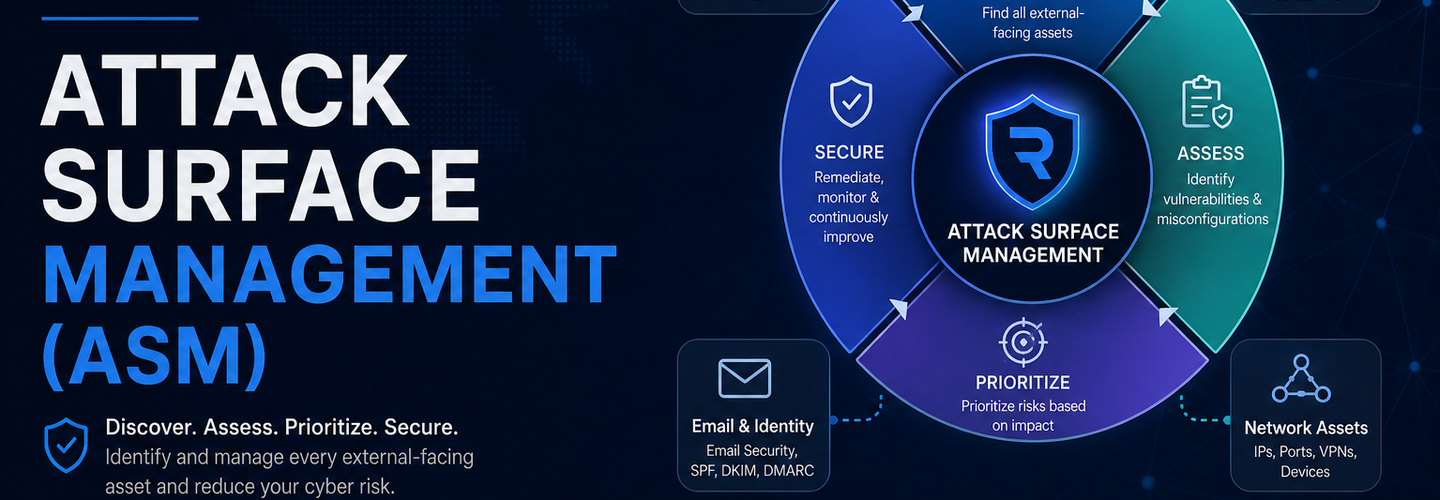
Complete Guide to Attack Surface Management (ASM) | ReconShield
Attack surface management (ASM) is the continuous process of discovering, inventorying, classifying, and securing every digital asset an organization exposes to potential attackers. It answers one foundational question: what can an adversary see and reach from the outside?
Every IP address, domain, subdomain, open port, cloud bucket, API endpoint, and third-party integration is a potential doorway into your environment. Attack surface management maps all of those doorways — and then helps you lock the ones that shouldn't be open.
Unlike point-in-time security assessments, ASM is an ongoing practice. Your attack surface changes every day as developers deploy new services, employees connect personal devices, vendors gain access, and cloud infrastructure scales up or down. A snapshot taken six months ago tells you almost nothing about your current exposure.
## Why Attack Surface Management Matters in 2024
The average enterprise has thousands of internet-facing assets — many of which the security team has never audited, and some of which the IT department doesn't even know exist. These are called shadow IT assets, and they are consistently among the first things attackers find.
Consider some of the realities security teams face today:
- ▸Cloud sprawl has exploded the number of assets organizations expose to the internet. A single misconfigured S3 bucket or an open Elasticsearch instance can expose millions of records.
- ▸Mergers and acquisitions bring inherited infrastructure that hasn't been assessed in years, with unknown risk profiles.
- ▸Remote work has pushed assets like VPN gateways, RDP endpoints, and collaboration tools to the perimeter — each becoming a high-value target.
- ▸Third-party supply chain risk means your attack surface doesn't end at your own assets. Vendors with privileged access extend your exposure considerably.
Attackers perform attack surface analysis constantly. They use automated scanners to discover exposed services, enumerate subdomains, identify software versions, and probe for known vulnerabilities — often within hours of a new CVE being published. If you're not doing attack surface management, your adversaries are doing it for you.
## Types of Attack Surfaces
Understanding attack surface management starts with understanding what comprises an attack surface. Security professionals typically break it into three categories:
1. Digital Attack Surface
Everything internet-facing: websites, APIs, cloud services, email servers, DNS records, login portals, and exposed databases. This is the primary focus of external attack surface monitoring.
2. Physical Attack Surface
On-premises hardware, physical access points, USB ports, and network devices. While less visible to remote attackers, physical vectors remain relevant in targeted attacks.
3. Social Engineering Attack Surface
Employees, contractors, and partners who can be manipulated through phishing, pretexting, or other human-centered attacks. This attack surface grows with headcount and third-party relationships.
Most ASM programs prioritize the digital attack surface because it's the most accessible to external threat actors and the most measurable with automated tooling.
## External vs. Internal Attack Surface
The external attack surface is everything visible from the internet — the view an unauthenticated attacker gets before they ever gain a foothold. It includes:
- ▸Internet-facing servers and applications
- ▸Subdomains and DNS records
- ▸Open ports and exposed services (see our Port Scanner)
- ▸SSL/TLS certificates and their metadata
- ▸Code repositories with leaked credentials
- ▸Email security configurations (SPF, DKIM, DMARC)
The internal attack surface is what becomes reachable once an attacker is already inside the network. It includes internal services, lateral movement paths, privilege escalation opportunities, and sensitive data stores.
External attack surface management (EASM) takes an outside-in perspective, using the same vantage point as an attacker. This is why it's often described as "attacker-centric" — it shows you what adversaries actually see, not just what's in your CMDB.
## How External Attack Surface Monitoring Works
External attack surface monitoring is the continuous, automated process of tracking your internet-facing assets for new exposures, configuration changes, and emerging vulnerabilities. Here's what it looks like in practice:
Asset Discovery
The foundation of any ASM program is knowing what you own. Discovery uses techniques like:
- ▸DNS enumeration to find subdomains and related domains
- ▸Certificate transparency logs to surface newly issued certificates for your domains
- ▸ASN and IP range lookups to map your IP space (use our IP Scanner to explore this)
- ▸Reverse WHOIS lookups to find domains registered under your organization
- ▸Internet scanning to find exposed services by organization name or ASN
Continuous Monitoring
Assets aren't static. External attack surface monitoring watches for changes: new subdomains that appear overnight, a port that opens on a server that previously had none, an SSL certificate that's about to expire, or a service that suddenly exposes an admin panel.
Alerts are triggered when something unexpected changes — giving security teams the chance to investigate before attackers exploit it.
Vulnerability Correlation
Once assets are discovered, they're analyzed for known vulnerabilities. This means correlating software versions with CVE databases, checking for common misconfigurations, and running automated checks against discovered services. Our Vulnerability Scanner integrates directly into this workflow to identify exploitable weaknesses across your exposed assets.
Risk Prioritization
Not all findings are equal. A critical vulnerability on a public-facing login portal is more urgent than a low-severity issue on an internal dev server. ASM tools rank findings by exploitability, asset criticality, and business context to help teams focus remediation effort where it matters most.
## The Attack Surface Analysis Process
Attack surface analysis is the structured evaluation of your attack surface to understand its composition, risk level, and reduction opportunities. It's typically performed during security assessments, post-incident reviews, and as part of periodic security program audits.
A thorough attack surface analysis follows these steps:
Step 1: Define the Scope
What organizations, subsidiaries, domains, IP ranges, and cloud accounts are in scope? For large enterprises, this alone can be a significant exercise.
Step 2: Enumerate Assets
Use automated discovery tools to build a comprehensive asset inventory. The goal is to find everything — especially assets the security team doesn't already know about.
Step 3: Classify and Prioritize Assets
Not every asset deserves equal attention. Classify assets by type (web app, database, API, network device), environment (production, staging, dev), and business criticality.
Step 4: Identify Exposures
For each asset, ask: what's exposed? Open ports, software versions, authentication mechanisms, and data types all contribute to the exposure profile.
Step 5: Map Attack Paths
How could an attacker chain exposures together to reach a high-value target? Attack path analysis connects individual findings into realistic attack scenarios.
Step 6: Remediate and Retest
Fix the findings, then verify the fixes. Continuous attack surface analysis means this cycle never fully ends — it repeats as the environment changes.
## Key Components of an ASM Program
A mature attack surface management program includes the following capabilities:
ComponentDescriptionAsset InventoryComprehensive, continuously updated record of all internet-facing assetsDiscovery AutomationOngoing scanning and enumeration to catch new and shadow assetsExposure MonitoringAlerting on new ports, services, certificates, and misconfigurationsVulnerability ManagementIntegration with CVE feeds and scanning to prioritize patchingRisk ScoringContextual ranking of findings by exploitability and business impactReporting & MetricsDashboards to track attack surface size, risk trends, and remediation progressThird-Party CoverageVisibility into vendor and supply chain exposure
## Common Attack Surface Vulnerabilities
When conducting attack surface analysis, certain vulnerability classes appear repeatedly across organizations of all sizes:
Exposed Administrative Interfaces — RDP, SSH, and web-based admin panels open to the internet are consistently among the highest-risk findings. Attackers actively scan for these using tools like our Port Scanner.
Outdated Software and Unpatched Services — Internet-facing servers running end-of-life software or unpatched versions are prime targets. Run a Vulnerability Scanner against your external assets to catch these before attackers do.
Misconfigured Cloud Storage — Public S3 buckets, Azure Blob containers, and GCP Storage buckets with open access permissions expose sensitive data without any exploitation required.
Subdomain Takeover — When a subdomain's DNS record points to a cloud service that has since been deprovisioned, an attacker can claim that service and hijack the subdomain — including any session cookies or trust associated with it.
Expired or Weak TLS Certificates — Expired certs cause browser warnings and break trust. Weak cipher suites and outdated TLS versions create interception risk.
Leaked Credentials in Code Repositories — Developers accidentally commit API keys, passwords, and tokens to public GitHub repositories far more often than most organizations realize.
Open Database Ports — A MongoDB or Elasticsearch instance exposed on its default port with no authentication is a critical finding. These are routinely scanned and exploited within hours of being exposed.
## Attack Surface Management Tools and Techniques
The ASM tooling landscape has matured significantly. Organizations can choose from:
Dedicated EASM Platforms — Commercial platforms offer continuous external monitoring at enterprise scale, combining asset discovery with risk scoring and workflow integration.
Open-Source Recon Tools — Tools like Amass, Subfinder, Shodan, and Censys are staples of the security researcher's toolkit and are widely used for attack surface analysis.
ReconShield's Integrated Suite — ReconShield combines IP scanning, port scanning, and vulnerability scanning into a unified platform, giving security teams the outside-in visibility they need without managing multiple disconnected tools.
Bug Bounty Programs — Crowdsourcing attack surface discovery through bug bounty programs adds a layer of adversarial testing that complements automated tooling.
The most effective ASM programs combine automated discovery and monitoring with periodic manual review. Automation catches the obvious issues at scale; human analysis identifies the subtle ones.
## How to Reduce Your Attack Surface
Discovering your attack surface is only half the work. Reducing it is where security value is created. Key reduction strategies include:
Shut Down What You Don't Need — The most secure service is the one that doesn't exist. Decommission unused servers, close unnecessary ports, and retire legacy applications that no longer serve a business purpose.
Enforce a Minimal Exposure Policy — Every service exposed to the internet should require a business justification. New externally facing assets should go through a security review before deployment.
Segment Your Network — Proper network segmentation limits an attacker's ability to move laterally after an initial compromise. Not everything needs to be internet-reachable.
Apply Zero Trust Principles — Move away from perimeter-based security. Authenticate every user and device, enforce least-privilege access, and assume breach.
Automate Patch Management — The window between a CVE being published and active exploitation is shrinking. Automated patching for internet-facing systems is no longer optional.
Monitor Continuously — Attack surface management is not a quarterly exercise. Set up continuous external attack surface monitoring so your team is notified the moment something changes.
## ASM vs. Traditional Vulnerability Management
Traditional Vulnerability ManagementAttack Surface ManagementPerspectiveInside-out (from within the network)Outside-in (attacker's view)Asset DiscoveryRelies on known asset inventoryDiscovers unknown assetsFrequencyPeriodic (weekly, monthly, quarterly)ContinuousScopeInternal and externalPrimarily externalFocusKnown vulnerabilities on known assetsExposure across all assets, including unknowns
The two practices are complementary, not competing. ASM fills the visibility gap that traditional vulnerability management leaves open — unknown assets with unknown vulnerabilities.
## Building a Continuous ASM Program
Implementing attack surface management is a journey, not a one-time project. Here's a practical roadmap:
Phase 1 — Baseline (Weeks 1–4) Perform an initial attack surface analysis to establish a baseline inventory. Identify critical unknowns, shadow IT, and high-risk exposures. Prioritize and remediate the most critical findings.
Phase 2 — Automate (Weeks 5–8) Deploy continuous external attack surface monitoring. Set up alerting for new assets, open ports, certificate changes, and new vulnerabilities against known assets.
Phase 3 — Integrate (Weeks 9–12) Connect ASM data to your SIEM, ticketing system, and vulnerability management workflow. Make ASM findings actionable — tied to owners, SLAs, and remediation tracking.
Phase 4 — Mature (Ongoing) Expand coverage to subsidiaries and third parties. Add threat intelligence context to prioritization. Conduct regular attack surface analysis reviews and measure attack surface reduction over time.
## FAQs
What is the difference between attack surface management and penetration testing? Penetration testing is a time-limited, in-depth simulation of an attack. ASM is continuous and focused on discovery and monitoring. Both are valuable — ASM identifies what to test; pen testing validates whether discovered exposures are actually exploitable.
How often should I perform an attack surface analysis? Ideally, attack surface monitoring is continuous. A full attack surface analysis review should occur at least quarterly, and immediately after major infrastructure changes, acquisitions, or incidents.
Does attack surface management cover cloud environments? Yes. Cloud infrastructure — AWS, Azure, GCP — is a major source of unmanaged external exposure. A complete ASM program must include cloud asset discovery and misconfiguration monitoring.
Where do I start with attack surface management? Start with discovery. Use ReconShield's IP Scanner to map your IP space, the Port Scanner to identify exposed services, and the Vulnerability Scanner to find known weaknesses — then build from there.
## Conclusion
Attack surface management is how modern security teams stop playing catch-up and start getting ahead of attackers. By continuously discovering, monitoring, and reducing your external exposure, you shrink the window of opportunity available to adversaries.
The organizations that do this well share a common approach: they treat their attack surface as a living entity that demands constant attention, not a static checklist to be audited once a year. They invest in automation, maintain accurate asset inventories, and respond quickly when something changes.
ReconShield is built to support exactly this approach — giving your team the port scanning, vulnerability scanning, and IP scanning capabilities needed to maintain continuous visibility over your external attack surface.
Start your attack surface analysis today — before someone else does it for you.
Related Resources:
## Analyst Commentary & Implementation Blueprint
Security advisory
Continuous security exposure assessment is critical to identifying public vulnerabilities before they are exploited. Organizations should maintain a passive inventory of all web servers, TLS configs, and open ports, ensuring that default configurations are eliminated and security advisories are actively implemented.
Hardened Security Configuration Blueprint
# General Security Hardening Directive
ServerTokens ProductOnly
ServerSignature Off
FileETag None
Actionable Mitigation Checklist
- ✔Perform passive asset inventories weekly.
- ✔Restrict administrative ports using local firewall controls.
- ✔Monitor active CVE alerts for exposed software.
Common Inquiries & FAQs
Why is passive scanning preferred for continuous auditing?
Passive audits do not cause operational impact or trigger firewall blocks, making them ideal for constant surveillance of internet-facing assets.
What should I do if a vulnerability is flagged?
Apply the latest vendor patches, restrict access to the resource via firewalls, or verify configuration flags to mitigate risks.
Surendra Reddy
Surendra Reddy is a cybersecurity researcher and founder of ReconShield, specializing in OSINT and defensive infrastructure analysis.
Connect on LinkedIn ↗// AUDIT BRIEFING DISCUSSION (2 COMMENTS)
Great breakdown of the passive infrastructure vectors. We recently audited our external DNS zones and found multiple dangling staging environments. Implementing wildcard certificates reduced our CT log leaks significantly.
Is there any automated tooling you recommend for daily crt.sh scraping? Manually checking CT logs is becoming unsustainable for our domain portfolio.
// MORE ARTICLES
Security Researchers Warn Critical n8n Flaws May Expose Automation Platforms to RCE
Researchers have disclosed critical vulnerabilities in n8n that could expose automation workflows and connected enterprise systems to remote code execution risks, prompting urgent patch recommendations for users and administrators.

How Agentic AI Is Changing Software Engineering and Expanding Mobile Attack Surfaces
Agentic AI is rapidly transforming software engineering workflows through automation and intelligent coding assistance, while cybersecurity experts warn of expanding mobile attack surfaces and emerging application security risks.

SplitVPN Hacked: Data Breach Exposes 865,000 User Records and 58 Million Hidden Connection Logs (July 2026)
SplitVPN hacked: 865,336 user records and 58 million connection logs exposed, directly contradicting the VPN's "no-logs" promise. What was leaked and what to do now.