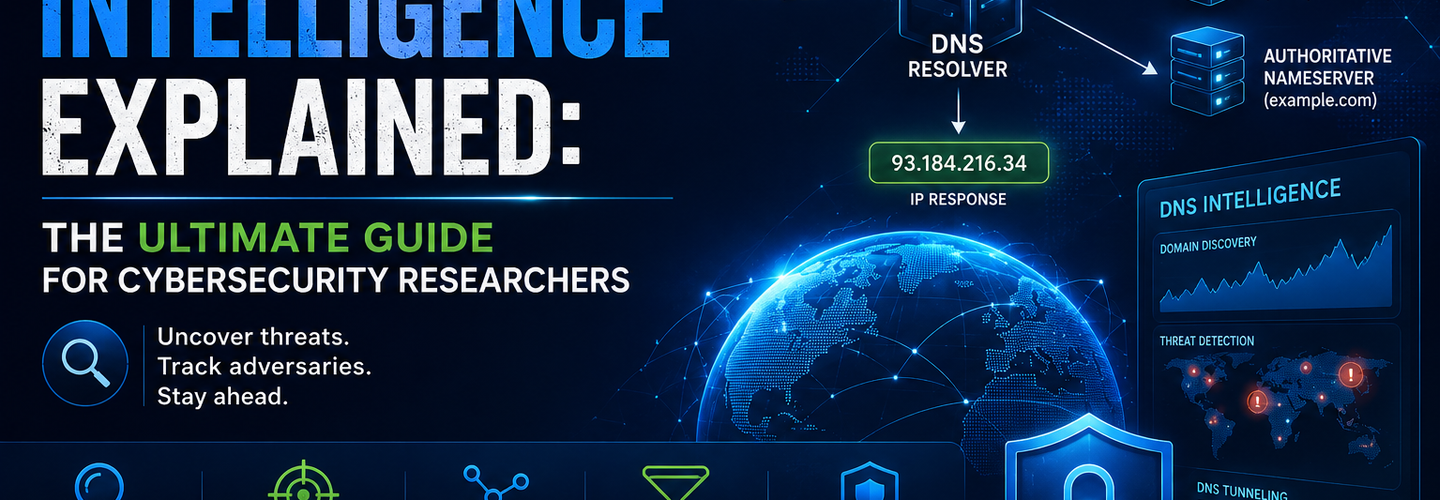
DNS Intelligence Explained: The Ultimate Guide for Cybersecurity Researchers
Every domain on the internet leaves a trail. Buried inside the Domain Name System — the internet's distributed phonebook — lies a rich layer of intelligence that cybersecurity researchers, threat hunters, and penetration testers rely on daily. Whether you're mapping an attack surface, investigating a phishing campaign, or tracking malicious infrastructure, DNS intelligence is one of the most powerful and underutilized assets in your toolkit.
This guide breaks down exactly what DNS intelligence is, why it matters, how to perform effective DNS reconnaissance, and how to apply DNS security analysis in real-world investigations.
## What Is DNS Intelligence?
DNS intelligence refers to the collection, analysis, and interpretation of data derived from the Domain Name System. While DNS was originally designed simply to resolve human-readable domain names to IP addresses, the metadata and historical records it generates reveal far more than most people realize.
At its core, DNS intelligence includes:
- ▸DNS records (A, AAAA, MX, TXT, CNAME, NS, SOA, PTR)
- ▸Historical DNS data — past resolutions and record changes over time
- ▸Passive DNS — aggregated, anonymized resolution data gathered from DNS resolvers
- ▸DNS zone transfer data — when misconfigured servers expose their entire DNS map
- ▸Subdomain enumeration results — the full scope of a domain's infrastructure
- ▸TTL (Time-to-Live) patterns — which can hint at infrastructure behavior
For cybersecurity researchers, each of these data points can expose relationships between domains, IPs, threat actors, and hosting infrastructure that would otherwise remain invisible.
## Why DNS Intelligence Matters in Cybersecurity
Modern threat actors are sophisticated, but they all share one dependency: they need infrastructure. Command-and-control servers, phishing pages, malware distribution endpoints — all of them rely on DNS. This makes DNS one of the few consistent observational layers available to defenders and researchers alike.
Here's why DNS intelligence is a cornerstone of modern security research:
1. Infrastructure Mapping
When investigating a threat, knowing which IP addresses a domain has historically resolved to — and which other domains have shared those IPs — can expose an entire threat actor's infrastructure network.
2. Phishing and Brand Abuse Detection
DNS data allows researchers to identify lookalike domains (e.g., paypa1.com vs paypal.com) registered to impersonate brands. Monitoring new domain registrations and their DNS patterns is a proactive defense strategy.
3. Malware Campaign Tracking
Many malware families use algorithmically generated domains (Domain Generation Algorithms, or DGAs) for resilient C2 communication. Analyzing DNS query patterns and comparing them against known DGA signatures is a key detection technique.
4. Attack Surface Reduction
Organizations that regularly perform DNS reconnaissance on their own domains often discover forgotten subdomains, misconfigured records, and dangling DNS entries that attackers could exploit.
5. Threat Intelligence Enrichment
IP addresses and domains found in threat feeds gain context when correlated with DNS data. A single IP may link back to dozens of malicious domains through passive DNS records, transforming a single IOC into a network of related threats.
## Key DNS Record Types Every Researcher Should Know
Before diving into reconnaissance techniques, it's essential to understand what each DNS record type reveals:
## Key DNS Record Types Every Researcher Should Know
Understanding DNS record types is essential for effective DNS reconnaissance and infrastructure analysis. Each record reveals different intelligence about a target's hosting environment, network infrastructure, and security posture.
A Record
Purpose: Maps a domain to an IPv4 address
Intelligence Value: Reveals current hosting infrastructure and IP history
AAAA Record
Purpose: Maps a domain to an IPv6 address
Intelligence Value: Provides visibility into IPv6 infrastructure
MX Record
Purpose: Specifies mail exchange servers
Intelligence Value: Identifies email providers and mail infrastructure
TXT Record
Purpose: Stores arbitrary text such as SPF, DKIM, and verification tokens
Intelligence Value: Reveals email security posture and technology stack
NS Record
Purpose: Defines authoritative nameservers
Intelligence Value: Shows DNS providers and hosting relationships
CNAME Record
Purpose: Creates canonical aliases for domains
Intelligence Value: Helps identify CDN usage and third-party services
SOA Record
Purpose: Contains zone authority information
Intelligence Value: Exposes administrative metadata and serial numbers
PTR Record
Purpose: Performs reverse DNS lookups
Intelligence Value: Validates forward and reverse DNS consistency
Reviewing all available record types — not just the A record — gives a far more complete picture of a target's infrastructure.
## DNS Reconnaissance: Techniques and Methodology
DNS reconnaissance is the structured process of extracting as much DNS-derived intelligence as possible about a target domain or IP range. It is a foundational phase in both offensive security (penetration testing, red team ops) and defensive research (threat hunting, incident response).
Step 1: Basic DNS Lookup
The starting point of any DNS recon is a standard DNS Lookup. This reveals the current A, AAAA, MX, NS, TXT, and CNAME records for a target domain.
From a single DNS lookup, a researcher can identify:
- ▸The hosting provider (via IP geolocation and ASN lookup)
- ▸Whether the site uses a CDN like Cloudflare or Akamai (often masking the real origin IP)
- ▸The mail provider (Gmail, Microsoft 365, custom mail server)
- ▸SPF/DKIM configuration, which hints at email security maturity
- ▸Verification tokens left by third-party services (Google Analytics, HubSpot, etc.)
Pro tip: TXT records are often overlooked but can be goldmines. Organizations frequently leave old verification tokens or cloud service keys in their TXT records.
Step 2: WHOIS Lookups and Registrant Intelligence
DNS records tell you about infrastructure. WHOIS records tell you about ownership. Even in the era of GDPR-redacted WHOIS data, these lookups remain valuable.
Key intelligence from WHOIS includes:
- ▸Registrar — where the domain was registered
- ▸Registration and expiration dates — newly registered domains are higher risk; old domains may have been recently acquired
- ▸Registrant organization — often redacted, but sometimes reveals the registering entity
- ▸Name servers — cross-referenced with DNS data to confirm consistency
- ▸Registrant email (when visible) — pivoting on email addresses can reveal other domains registered by the same actor
Pivoting on shared WHOIS attributes — particularly historical registrant emails or organization names — is a classic technique for uncovering related threat actor infrastructure.
Step 3: Subdomain Enumeration
Subdomains represent an organization's extended infrastructure and are frequently the weakest link. Development servers, staging environments, legacy applications, and internal tools are routinely exposed via subdomains and then forgotten.
Subdomain enumeration techniques include:
- ▸Brute-force enumeration — testing wordlists of common subdomain names against a target
- ▸Certificate Transparency (CT) log mining — SSL/TLS certificates are publicly logged; CT logs expose subdomains at scale
- ▸DNS zone transfers (AXFR) — if a nameserver is misconfigured, it will respond to zone transfer requests with its entire DNS zone, handing you every subdomain at once
- ▸Web crawling and scraping — mining page source, JavaScript files, and sitemaps for subdomain references
- ▸Reverse DNS — querying IP ranges for PTR records to discover associated hostnames
Combining these methods gives researchers the most complete view of an organization's DNS footprint.
Step 4: Passive DNS Analysis
Passive DNS is arguably the most powerful concept in DNS intelligence. Unlike active DNS queries that return only current data, passive DNS databases record historical DNS resolutions observed by sensors distributed across the internet.
With passive DNS, you can answer questions like:
- ▸Which IP addresses did this domain resolve to over the past 2 years?
- ▸Which domains have historically resolved to this malicious IP?
- ▸When did this domain first appear in DNS?
- ▸Has this domain's nameserver changed recently?
A sudden change in nameserver or hosting IP can be an indicator of domain takeover or infrastructure migration — both highly relevant signals in an investigation.
Step 5: IP and ASN Intelligence Correlation
After identifying IP addresses associated with a domain, an IP Scanner and ASN lookup provide context on the broader network block. This allows researchers to:
- ▸Identify whether an IP belongs to a cloud provider, hosting company, or residential ISP
- ▸Discover other domains hosted on the same IP (shared hosting pivot)
- ▸Map Autonomous System Numbers (ASNs) used by a threat actor
- ▸Detect fast-flux DNS behavior (rapidly rotating IPs used by botnets)
## DNS Security Analysis: Applying Intelligence to Real Investigations
Raw DNS data becomes DNS security analysis when applied to specific investigative questions. Here are several common use cases:
Investigating a Phishing Domain
Run a DNS Lookup on the phishing domain — note the IP, hosting provider, and mail records
Check WHOIS for registration date (very new = high suspicion), registrar, and any visible registrant data
Query passive DNS for other domains on the same IP
Look for SSL certificate data via CT logs
Check MX records — phishing pages often use legitimate mail services to avoid spam filters
Compare TXT/SPF records with the legitimate domain they're impersonating
Mapping Threat Actor Infrastructure
Start with a known malicious domain or IP (an IOC from a threat feed)
Use passive DNS to find all domains that have resolved to that IP
For each discovered domain, pull WHOIS data and look for shared registrant emails, phone numbers, or organization names
Cross-reference nameservers — threat actors often reuse infrastructure
Use an IP Scanner to identify neighboring IPs in the same ASN and check for additional malicious infrastructure
Identifying Dangling DNS Records
Dangling DNS records occur when a DNS entry points to a resource that no longer exists — for example, a CNAME pointing to a deprovisioned cloud service. Attackers can register the defunct resource and take over the subdomain.
Enumerate all subdomains of the target
For each CNAME record, verify the canonical name resolves correctly
Flag any CNAMEs pointing to third-party services (AWS S3, GitHub Pages, Heroku) that may have been deprovisioned
Report or remediate before an attacker exploits the gap
## DNS Intelligence Tools in Your Recon Workflow
ReconShield provides integrated tools that streamline DNS intelligence gathering at every stage:
- ▸DNS Lookup — Query all record types for any domain instantly. Essential starting point for any DNS recon task.
- ▸WHOIS — Retrieve domain registration data, registrant details, nameserver records, and registration history.
- ▸IP Scanner — Resolve IP geolocation, ASN, and reverse DNS. Pivot from domains to IP infrastructure and back.
Used together, these three tools cover the foundational layer of any DNS-based investigation — from initial discovery through infrastructure correlation.
## Best Practices for DNS Intelligence Gathering
To get the most from your DNS recon efforts, follow these principles:
Document everything. DNS data changes. Record timestamps, TTL values, and exact record values at the time of your query. Historical context is essential in investigations.
Always pivot. DNS intelligence compounds. An IP leads to more domains; a nameserver leads to a registrar; a registrant email leads to additional registrations. Follow every thread.
Combine active and passive data. Active DNS queries show the current state. Passive DNS shows history. Both are necessary for a complete picture.
Respect legal and ethical boundaries. DNS reconnaissance on targets you are not authorized to assess may be illegal. Always operate within the scope of authorized engagements or your own infrastructure.
Correlate with other intel layers. DNS intelligence is most powerful when combined with certificate transparency data, BGP/ASN data, threat intelligence feeds, and OSINT. No single data source tells the whole story.
## Conclusion
DNS intelligence is not a niche skill — it is a foundational competency for anyone serious about cybersecurity research. From mapping attack surfaces and tracking threat actor infrastructure to identifying phishing campaigns and discovering subdomain vulnerabilities, DNS data sits at the intersection of nearly every investigative workflow.
The combination of DNS reconnaissance, WHOIS analysis, and IP intelligence gives researchers a powerful trifecta for understanding how internet infrastructure is organized, who owns it, and how it's being used. With tools like ReconShield's DNS Lookup, WHOIS, and IP Scanner, that intelligence is accessible instantly — no command line required.
Whether you're a threat hunter, penetration tester, incident responder, or security researcher, making DNS intelligence a core part of your methodology will sharpen every investigation you run.
Read More:
F5 BIG-IP Appliances Targeted by Hackers for SSH Intrusions Into Enterprise Linux Systems
Vellore Man Arrested in Cambodia Cyber Slavery Racket Linked to Online Scam Networks
Cyber Fraud in Bengaluru: Elderly Woman Loses Rs 7.69 Lakh After Clicking Fake WhatsApp Link
10,000+ Zero-Day Vulnerabilities Identified by Anthropic Claude Mythos in Glasswing Project
PyrsistenceSniper Detects 117 Malware Persistence Techniques Across Windows, Linux, and macOS
Greenwood Cyber + AI Lab Opens in Tulsa Through Microsoft and Black Tech Street Collaboration
Open-Source Ecosystem Under Threat as Hackers Breach 34 Software Packages
## Analyst Commentary & Implementation Blueprint
Security advisory
Continuous security exposure assessment is critical to identifying public vulnerabilities before they are exploited. Organizations should maintain a passive inventory of all web servers, TLS configs, and open ports, ensuring that default configurations are eliminated and security advisories are actively implemented.
Hardened Security Configuration Blueprint
# General Security Hardening Directive
ServerTokens ProductOnly
ServerSignature Off
FileETag None
Actionable Mitigation Checklist
- ✔Perform passive asset inventories weekly.
- ✔Restrict administrative ports using local firewall controls.
- ✔Monitor active CVE alerts for exposed software.
Common Inquiries & FAQs
Why is passive scanning preferred for continuous auditing?
Passive audits do not cause operational impact or trigger firewall blocks, making them ideal for constant surveillance of internet-facing assets.
What should I do if a vulnerability is flagged?
Apply the latest vendor patches, restrict access to the resource via firewalls, or verify configuration flags to mitigate risks.
Surendra Reddy
Surendra Reddy is a cybersecurity researcher and founder of ReconShield, specializing in OSINT and defensive infrastructure analysis.
Connect on LinkedIn ↗// AUDIT BRIEFING DISCUSSION (2 COMMENTS)
Great breakdown of the passive infrastructure vectors. We recently audited our external DNS zones and found multiple dangling staging environments. Implementing wildcard certificates reduced our CT log leaks significantly.
Is there any automated tooling you recommend for daily crt.sh scraping? Manually checking CT logs is becoming unsustainable for our domain portfolio.
// MORE ARTICLES

SplitVPN Hacked: Data Breach Exposes 865,000 User Records and 58 Million Hidden Connection Logs (July 2026)
SplitVPN hacked: 865,336 user records and 58 million connection logs exposed, directly contradicting the VPN's "no-logs" promise. What was leaked and what to do now.

Critical WordPress wp2shell RCE Vulnerability Puts Millions of Sites at Risk—Patch Now
wp2shell is a pre-auth RCE in WordPress Core affecting 500M+ sites. Public exploits exist—patch to 7.0.2 or 6.9.5 immediately.
New Windows RDP Flaws Could Lead to Data Theft — Everything You Need to Know
Microsoft patched a dozen Windows RDP flaws in July 2026 that could leak memory data. See affected versions, KB numbers, and how to patch.