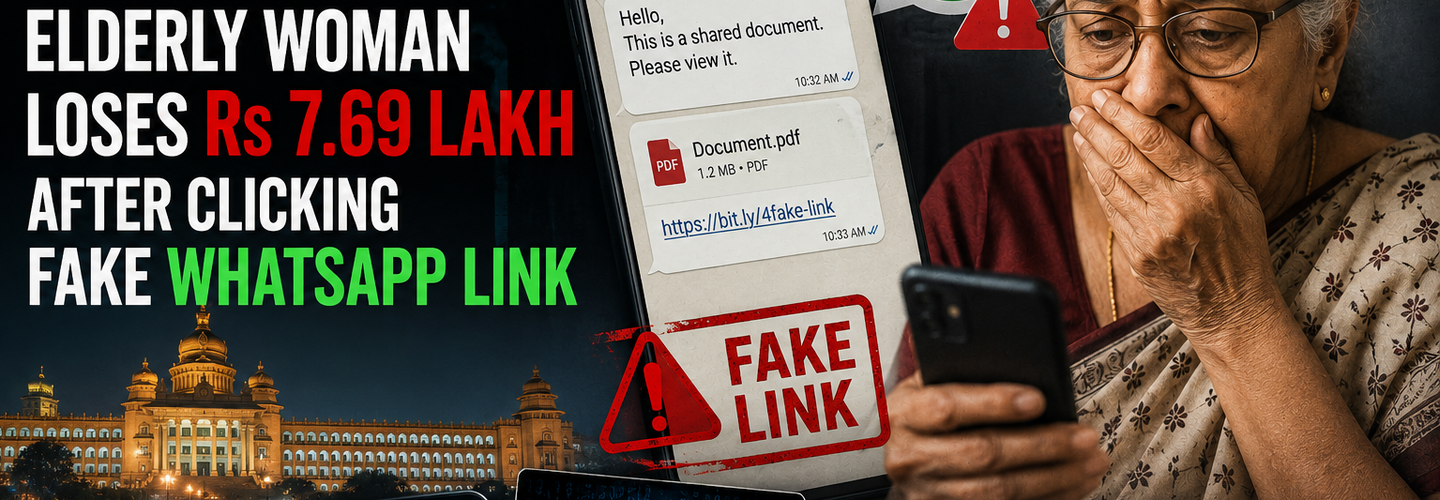
Cyber Fraud in Bengaluru: Elderly Woman Loses Rs 7.69 Lakh After Clicking Fake WhatsApp Link
She was 86 years old. She received what looked like a routine message from her bank on WhatsApp. She clicked the link. Within hours, Rs 7.69 lakh — nearly eight years of a modest pension — had vanished from her account.
The case, reported by Deccan Herald from Bengaluru on May 23, 2026, is not exceptional by the grim standards of India's cybercrime landscape. What makes it worth examining closely is precisely that: its ordinariness. A malicious link. A trusting recipient. A bank account drained. No elaborate deception, no weeks-long psychological siege — just a single tap on a smartphone screen, and a life's savings gone.
Bengaluru police have registered a case and begun investigating the incident. The victim's family member, who attempted to report the fraud by calling the national cybercrime helpline 1930, remained in the queue for nearly 45 minutes — a detail that speaks as loudly as the fraud itself about the infrastructure strain India's cybercrime response is under.
## Threat Overview
What happened in this case fits a well-documented and increasingly prevalent attack pattern: the malicious WhatsApp link disguised as legitimate bank communication.
Fraudsters craft messages designed to mimic the visual and verbal language of Indian banks — complete with official-sounding sender names, urgent warnings about account suspension, KYC deadline alerts, or credit card notifications. The link embedded in the message routes the recipient to one of two outcomes: a convincing phishing page that harvests login credentials, card numbers, and OTPs, or a drive-by download that installs remote-access malware directly on the device.
In either case, the attacker gains sufficient access to initiate unauthorized transactions — often multiple, in rapid succession, before the victim realizes anything is wrong. In cases involving remote access tools, the victim's phone effectively becomes an instrument in the attacker's hands, with transactions authenticated silently in the background.
WhatsApp is the delivery channel of choice for this attack class for several reasons. With over 500 million users in India, it carries an implicit social trust that email lacks. Messages from unknown numbers can still look legitimate if styled correctly. Most critically, WhatsApp's end-to-end encryption — a genuine privacy protection — also means telecom-level filtering that catches SMS phishing links cannot be applied to WhatsApp content the same way.
A Business Standard survey found that 42% of WhatsApp users in India had received scam messages asking for payments or personal details — a number that almost certainly understates actual exposure, given how many users don't recognize fraudulent messages as such in the moment.
## Technical Impact Analysis
The attack targeting the Bengaluru woman illustrates why the "just don't click unknown links" advisory, while correct, is insufficient as a standalone defense.
Modern phishing pages built to impersonate Indian banks are increasingly difficult to distinguish from their legitimate counterparts. They replicate visual branding, use HTTPS (which many users incorrectly interpret as a guarantee of legitimacy), and pre-populate details scraped from data breaches or social engineering to add personalization. A message that addresses the recipient by name and references their specific bank — details that a scammer may have obtained for a few rupees from underground data markets — carries far more credibility than generic warnings suggest.
For elderly users in particular, the risk calculus is compounded by several factors. Digital banking interfaces were not designed with an 86-year-old's cognitive context in mind. The visual similarity between legitimate and fraudulent pages is more likely to mislead someone who didn't grow up with the mental model of "HTTPS vs. HTTP" or "domain spoofing." And the social pressure embedded in urgency-framing — "your account will be blocked in 24 hours" — is a psychological trigger that affects all age groups but hits harder when the recipient has less contextual experience to push back against it.
Indian police have also documented a related attack variant that adds a self-propagation layer: once a victim clicks a malicious WhatsApp link and their device is compromised, the malware automatically sends the same link to all contacts in the victim's WhatsApp list — turning each victim into an unwitting vector for further infections. This makes the attack not merely a financial crime but a cascading network-level threat.
## Industry Implications
Bengaluru has reported a steady drumbeat of such cases over the past 24 months. A retired 70-year-old north Bengaluru resident lost over Rs 69 lakh after a call chain escalating from a fake ICICI Bank representative to impersonators posing as Delhi CID officials. A 60-year-old senior citizen was defrauded of Rs 2.8 crore after receiving what appeared to be a legitimate gift from a "Citibank official" — a bugged mobile phone. A woman lost Rs 31.83 crore over six months to a "digital arrest" operation that kept her on Skype under surveillance while extracting 187 separate bank transfers.
These cases exist on a spectrum, but they share a structural feature: financial institutions remain the most impersonated entities in Indian cybercrime, and messaging platforms — particularly WhatsApp — have become the primary distribution channel.
MHA data indicates that over 50% of cyber frauds targeting Indians in 2025 originated from high-security scam compounds in Cambodia, Myanmar, and Laos — meaning the person on the other end of these WhatsApp messages is frequently a trafficked worker in a locked compound, operating under coercion, following a script. The crime has victims on both sides of the screen.
India recorded 28.15 lakh cybercrime cases in 2025, up from 22.68 lakh the previous year. Investment scams led total losses, accounting for 76% of money lost and 35% of all reported cases. But the WhatsApp banking fraud category — phishing links, fake KYC alerts, malicious APK downloads — quietly accounts for an enormous volume of individual incidents, particularly in Karnataka, where Bengaluru's dense concentration of digital banking adopters across all age groups provides fertile ground.
One in five UPI users in India has reported experiencing a fraud attempt, according to a LocalCircles survey, and 51% of victims don't report the incident at all. The cases that make the news represent a fraction of the actual incidence.
## Why This Matters
The Bengaluru case is a reminder that cybercrime, at its core, is not primarily a technical problem. It is a trust problem.
The 86-year-old woman who clicked that link wasn't being careless. She was doing exactly what a banking customer is supposed to do when their bank reaches out: responding to a communication about her account. The fraud worked not because she failed to follow best practices, but because the fraudsters successfully counterfeited the trust signals she had learned to rely on.
This framing has direct implications for how cybersecurity awareness campaigns should be designed. Telling elderly users to "be suspicious of all messages" is both cognitively demanding and, practically speaking, incompatible with normal digital participation. The more actionable intervention is structural: banks need to reduce the volume of legitimate communications they send over WhatsApp and unverified channels, so that any such message becomes inherently suspect. When genuine bank communications arrive via WhatsApp, they erode the very skepticism that protects customers.
The 45-minute wait at the 1930 helpline is equally significant. The critical window for freezing fraudulent transactions is minutes to hours — not the days or weeks that follow a lengthy queue. At scale, helpline congestion is not a minor administrative issue; it is a structural barrier to the most effective available intervention. The Indian Cybercrime Coordination Centre's (I4C) Citizen Financial Cyber Fraud Reporting and Management System is designed to enable real-time transaction freezes, but it can only function if victims can get through.
Observers note that while I4C has successfully blocked fraudulent transactions worth over Rs 8,031 crore since inception, the gap between reported cases and formal FIRs — only 55,484 FIRs from 28 lakh reported cases in 2025 — reflects a systemic under-prosecution problem that lets most perpetrators operate without consequence.
## How Users Can Stay Safe
Protecting yourself and your family members — especially elderly relatives — from WhatsApp banking fraud requires a mix of behavioral habits and structural decisions. These are practical, immediately actionable steps.
Do not act on banking communications received via WhatsApp. Legitimate banks do not ask you to click links to update KYC, avoid account suspension, or verify card details via WhatsApp. If you receive such a message — even if it looks authentic — close it and call your bank directly using the number printed on the back of your card or on your bank's official website.
Verify the URL before entering any information. If you have clicked a link, look at the address bar before doing anything else. Bank phishing pages routinely use domains that resemble legitimate ones — "hdfc-bank-update.com" or "sbi.kyc-verify.in" — but are not the bank's actual domain. When in doubt, close the tab.
Do not download APK files sent via WhatsApp. Any message asking you to download an application through WhatsApp, rather than through the official Google Play Store or Apple App Store, should be treated as malicious. These files frequently contain remote-access malware.
Enable two-step verification on WhatsApp itself. This protects your WhatsApp account from being hijacked and used to send malicious links to your contacts. Go to WhatsApp Settings → Account → Two-step verification.
Brief your elderly family members regularly and specifically. General warnings about "being careful online" are less effective than specific, scenario-based guidance: "If you get a WhatsApp message that says your bank account will be blocked, don't click anything — just call us first." Repeat this regularly, because these messages are designed to create urgency that overrides prior caution.
Act within minutes if something goes wrong. If you suspect you've clicked a malicious link or shared your credentials, immediately call your bank's fraud helpline to freeze transactions, then call 1930 (national cybercrime helpline) or file a complaint at cybercrime.gov.in. Every minute matters. Keep your bank's fraud number saved in your contacts before you ever need it.
If the helpline queue is too long, go directly to the nearest police station and file a complaint, or use the online portal at cybercrime.gov.in. An FIR on record activates formal mechanisms to trace and potentially freeze the destination accounts.
## Official Responses
Bengaluru Cybercrime Police have registered a case and are investigating the transaction trail in the current incident. Karnataka police have, over the past year, repeatedly issued public advisories warning against clicking unverified links on WhatsApp and SMS, and have urged citizens to call 1930 at the first sign of suspicious activity.
The Reserve Bank of India maintains public guidance reminding customers that banks will never ask for OTPs, PINs, or login credentials through any channel — including messaging apps. CERT-In, India's national cybersecurity agency, has issued multiple advisories specifically addressing WhatsApp phishing campaigns targeting banking customers.
The Ministry of Electronics and Information Technology has pushed telecom operators to strengthen SMS filtering systems, though these protections apply less comprehensively to OTT messaging platforms like WhatsApp, which operates over data rather than the cellular SMS channel.
WhatsApp's parent company Meta has stated it uses automated systems to detect and remove accounts engaged in scam behavior, and maintains reporting mechanisms within the app. Critics, including consumer advocacy groups, argue these reactive measures are insufficient given the velocity at which fraudulent accounts are created and retired.
## Sources & References
Deccan Herald — "Bengaluru: 86-yr-old loses Rs 7.69L to cyber fraudsters due to malicious WhatsApp link" (May 23, 2026)
Business Standard — "WhatsApp job scams: 42% of WhatsApp users got job scam messages" (May 2025)
South China Morning Post — "In India, cyber scams targeting elderly fuel digital safety concerns" (April 2025)
Outlook Money — "India's Digital Fraud Surge: What Consumers Need To Know About Rights And Remedies" (February 2026)
Kaval / Misinformation and Online Scam Statistics — "Cybercrime in India 2026 Report" (March 2026)
Insights on India — "Cybercrime in India 2025: 24% Spike, ₹22,495 Crore Lost" (February 2026)
Deccan Herald — "Fake I-T inquiry: How retired Bengaluru man lost Rs 69 lakh in cyber fraud" (2024)
Deccan Herald — "Cyber frauds gift 'free phone', cheat 60-year-old of Rs 2.8 crore in Bengaluru" (2024)
News Karnataka / CyberCrimeIndia.today — "Bengaluru woman loses ₹31.83 crore in Karnataka's biggest digital arrest scam" (November 2025)
MHA / I4C — Indian Cybercrime Coordination Centre transaction freeze data (2025)
LocalCircles Survey — UPI fraud attempt experience and under-reporting rate among Indian users
CERT-In — Public advisories on WhatsApp phishing campaigns targeting banking customers
Reserve Bank of India (RBI) — Customer guidance on banking credential security
## Conclusion
Rs 7.69 lakh. For a family managing the finances of an 86-year-old, that number is not an abstraction — it is medication, rent, savings that took decades to accumulate. The click that erased it took less than a second.
India's cybercrime surge is often discussed in aggregate — lakhs of cases, crores of rupees, statistics that can feel remote. What keeps getting lost in the numbers is the texture of individual incidents: the trust extended, the urgency manufactured, the devastation that follows. The Bengaluru case is a prompt to look at the person behind the statistic, and to take the practical steps — both personal and systemic — that might protect the next one.
If you suspect a fraud or encounter suspicious activity online, report it immediately at cybercrime.gov.in or call 1930.
ReconShield publishes cybersecurity awareness, threat intelligence, and digital safety content for educational purposes. This article does not constitute legal or financial advice. For cybercrime reporting in India, contact the National Cyber Crime Reporting Portal at cybercrime.gov.in or call 1930.
Read More:
Hackers Exploit Vulnerable Lenovo Driver to Disable EDR Security Protections
QR Code Phishing Explodes in 2026 as Microsoft Detects 8.3 Billion Email Threats
Public Exploit Code Emerges for Chromium Flaw Potentially Affecting Millions Worldwide
F5 BIG-IP Appliances Targeted by Hackers for SSH Intrusions Into Enterprise Linux Systems
Vellore Man Arrested in Cambodia Cyber Slavery Racket Linked to Online Scam Networks
## Analyst Commentary & Implementation Blueprint
Security advisory
Continuous security exposure assessment is critical to identifying public vulnerabilities before they are exploited. Organizations should maintain a passive inventory of all web servers, TLS configs, and open ports, ensuring that default configurations are eliminated and security advisories are actively implemented.
Hardened Security Configuration Blueprint
# General Security Hardening Directive
ServerTokens ProductOnly
ServerSignature Off
FileETag None
Actionable Mitigation Checklist
- ✔Perform passive asset inventories weekly.
- ✔Restrict administrative ports using local firewall controls.
- ✔Monitor active CVE alerts for exposed software.
Common Inquiries & FAQs
Why is passive scanning preferred for continuous auditing?
Passive audits do not cause operational impact or trigger firewall blocks, making them ideal for constant surveillance of internet-facing assets.
What should I do if a vulnerability is flagged?
Apply the latest vendor patches, restrict access to the resource via firewalls, or verify configuration flags to mitigate risks.
Surendra Reddy
Surendra Reddy is a cybersecurity researcher and founder of ReconShield, specializing in OSINT and defensive infrastructure analysis.
Connect on LinkedIn ↗// AUDIT BRIEFING DISCUSSION (2 COMMENTS)
Great breakdown of the passive infrastructure vectors. We recently audited our external DNS zones and found multiple dangling staging environments. Implementing wildcard certificates reduced our CT log leaks significantly.
Is there any automated tooling you recommend for daily crt.sh scraping? Manually checking CT logs is becoming unsustainable for our domain portfolio.
// MORE ARTICLES
Security Researchers Warn Critical n8n Flaws May Expose Automation Platforms to RCE
Researchers have disclosed critical vulnerabilities in n8n that could expose automation workflows and connected enterprise systems to remote code execution risks, prompting urgent patch recommendations for users and administrators.

How Agentic AI Is Changing Software Engineering and Expanding Mobile Attack Surfaces
Agentic AI is rapidly transforming software engineering workflows through automation and intelligent coding assistance, while cybersecurity experts warn of expanding mobile attack surfaces and emerging application security risks.
₹250 Crore Cyber Scam Busted: Gujarat Police Arrest 19, Including MBA Student
Gujarat Police bust a ₹250 crore cyber fraud network, arresting 19 including an MBA student. Here's how the mule account scam worked.