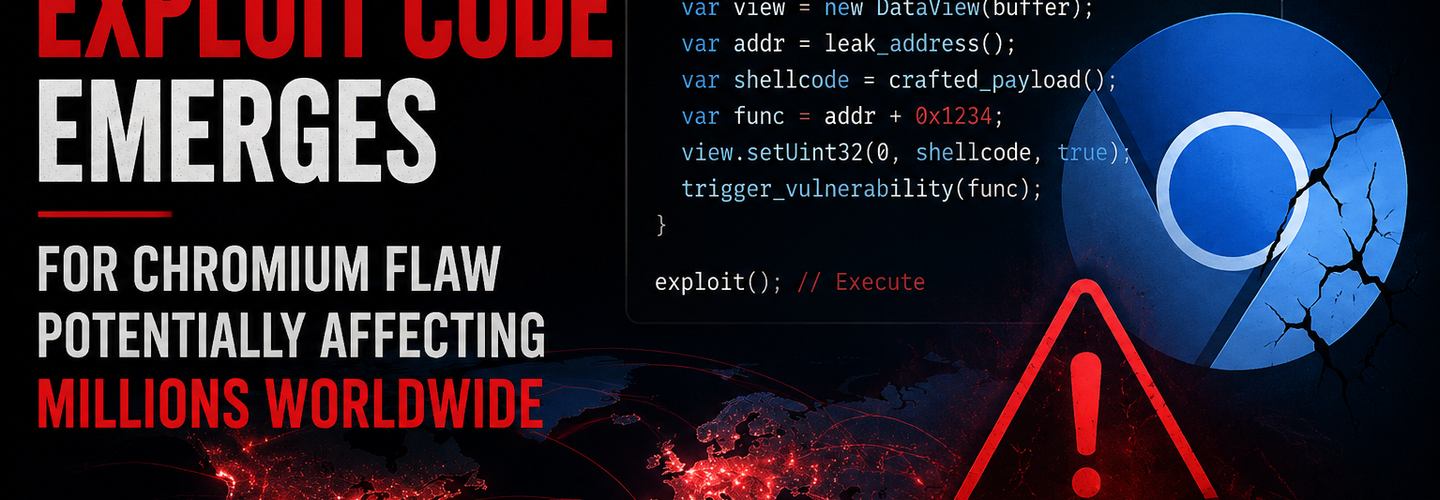
Public Exploit Code Emerges for Chromium Flaw Potentially Affecting Millions Worldwide
Billions of people open a browser tab every day without a second thought. It's background noise — so familiar it barely registers as an action anymore. That invisibility is precisely what makes browser-level vulnerabilities so dangerous. A flaw that lives inside Chrome's rendering pipeline doesn't announce itself with a pop-up or a strange file on your desktop. By the time you know something went wrong, the damage is already done.
That's the uncomfortable reality now facing users of Google Chrome and virtually every major Chromium-based browser on the planet, following the public emergence of exploit code targeting CVE-2026-5281 — a high-severity memory vulnerability in Chrome's WebGPU implementation that has already been confirmed in active, real-world attacks.
## Threat Overview: What CVE-2026-5281 Actually Is
CVE-2026-5281 is a use-after-free flaw affecting Chrome's WebGPU implementation through its Dawn GPU abstraction layer. To understand why this matters, a brief technical primer is useful without getting into territory that benefits threat actors.
Use-after-free (UAF) vulnerabilities are a class of memory safety error that occur when software references a block of memory after it has already been released. In Chrome's case, the flaw resides in Dawn — a cross-platform component that enables WebGPU functionality and interacts closely with underlying system hardware, increasing the potential impact of exploitation.
The vulnerability affects Chrome versions before v146.0.7680.177/178 for Windows and macOS, and before v146.0.7680.177 for Linux. CVE-2026-5281 was flagged by a pseudonymous bug hunter who previously reported two other vulnerabilities fixed in the Chrome update released on March 23, 2026: a heap buffer overflow in WebGL (CVE-2026-4675) and another use-after-free bug in Dawn (CVE-2026-4676).
That's not a coincidence. That cluster points to a sustained research effort focused on Chrome's graphics stack. Someone has been systematically probing the seams where Chrome's GPU-accelerated components meet the underlying hardware — and finding gaps.
The attack path requires a victim to visit a malicious webpage. No user interaction beyond navigation is required. That's as low-friction as browser threats get.
## Technical Impact Analysis
The official NVD description is terse by design. What is clearly stated is the attacker model: a remote attacker who had already compromised the renderer process could execute arbitrary code via a crafted HTML page.
That qualifier — "who had already compromised the renderer process" — is significant. It tells us this vulnerability is most likely one link in a chain, not a standalone weapon. The typical attack chain observed in 2025 and 2026 follows a predictable pattern: a renderer compromise (often via a V8 or media parser bug) gains initial code execution inside Chrome's sandboxed renderer process, then a secondary vulnerability like CVE-2026-5281 escalates privileges to escape the sandbox.
Sandbox escapes are the crown jewel of browser exploitation. Chrome's sandbox is specifically engineered to contain damage — to ensure that even if malicious code runs inside the browser, it can't reach the broader operating system. A vulnerability that assists in breaking out of that containment doesn't just threaten the browser session. It threatens the entire machine.
Successful exploitation could allow attackers to execute code on affected systems, steal authentication tokens, access CI secrets, pivot into internal infrastructure, or deploy secondary malware. For enterprise environments and development pipelines especially, the implications go well beyond a single compromised workstation.
As of early May 2026, CVE-2026-5281 has eight public proof-of-concept (PoC) exploits available on GitHub. The emergence of public exploit code dramatically lowers the bar for less sophisticated threat actors. What was once the domain of nation-state-level operators can now be picked up and tested by a far broader range of adversaries.
## Industry Implications: More Than Just a Browser Bug
Chrome holds somewhere between 65–70% of the global desktop browser market. But raw browser market share understates the actual exposure footprint of Chromium itself.
Even non-interactive or headless deployments must be updated, as rendering malicious content is sufficient to trigger exploitation. Given Chromium's prevalence in cloud workloads and automation frameworks, the risk extends beyond traditional user browsing scenarios.
Think about the modern enterprise technology stack: PDF generation services, web preview engines, CI/CD pipeline automation, container-based rendering workloads — a significant portion of these use headless Chrome under the hood. None of these systems has a human clicking "Update Chrome." They run quietly, often with elevated access, and frequently without the same patch cadence as end-user machines.
In automation-heavy environments, a compromised rendering service or CI runner could provide a direct path to sensitive credentials or production systems.
The blast radius also extends to every major browser built on the Chromium engine. Microsoft Edge, Brave, Opera, and Vivaldi are all advised to apply fixes as they become available. That is the real operational blast radius: not just Chrome, but browser estates that inherit Chromium security debt on their own cadence. Each browser vendor ships on a slightly different timeline, meaning the window of exposure varies across organizations depending on which browsers they've standardized.
There's a broader pattern worth naming here. Google spent much of last year playing Whac-A-Mole with actively exploited Chrome bugs, ultimately patching eight zero-days across 2025. The cadence hasn't slowed in 2026. CVE-2026-5281 is Chrome's fourth confirmed zero-day of the year, following vulnerabilities in CSS rendering, the Skia graphics library, and the V8 JavaScript engine. The graphics and rendering stack has emerged as a sustained focus of sophisticated threat actors.
## Why This Matters
Patch fatigue is real. Security teams face a constant drumbeat of critical advisories, and the temptation to triage browser updates as low-priority is understandable when there are firewalls to tune and endpoints to manage. CVE-2026-5281 is a direct argument against that instinct.
Three factors separate this from routine vulnerability disclosures:
Confirmed in-the-wild exploitation. This isn't theoretical. CISA's decision to add CVE-2026-5281 to the Known Exploited Vulnerabilities catalog on April 1, 2026, reinforces this. KEV inclusion is a strong signal to prioritize remediation over routine patch timelines. Federal agencies were given until April 15 to apply the fix — an aggressive deadline that signals genuine urgency.
Public exploit code exists. The moment PoC code hits GitHub, the threat model changes. The vulnerability is no longer controlled by the researchers or threat actors who initially weaponized it. It becomes available to a far wider pool of opportunistic attackers who can adapt and deploy it without deep technical expertise.
The component is everywhere. WebGPU and Dawn aren't niche features. As GPU-accelerated graphics become standard in modern web applications, the Dawn component is increasingly load-bearing. Flaws in it affect virtually every Chromium-based browser across every major operating system.
## How Users Can Stay Safe
The good news: a patch exists, it's been available since early April, and applying it is the single most effective thing any user or organization can do right now.
For individual users:
- ▸Update Chrome immediately. Open Chrome, navigate to chrome://settings/help, and verify you're running version 146.0.7680.178 (Windows/macOS) or 146.0.7680.177 (Linux) or later. Chrome typically updates automatically, but confirming the version takes ten seconds and eliminates ambiguity.
- ▸Restart the browser after updating. Updates download silently, but they don't fully apply until Chrome restarts. A pending update is not a patched browser.
- ▸Update all Chromium-based browsers. If you use Microsoft Edge, Brave, Opera, or Vivaldi, check for updates in each application separately. These browsers ship security updates on their own schedules.
- ▸Be cautious with unfamiliar links. While this sounds basic, drive-by exploitation through malicious webpages is the delivery mechanism here. A link that routes through several redirects, arrives in an unexpected email, or leads to an unfamiliar domain warrants extra scrutiny — especially while unpatched.
For security and IT teams:
- ▸Audit your environment for headless Chromium deployments. CI/CD runners, rendering services, and automation tools that embed Chromium are easily overlooked in browser patch cycles and may require manual updates.
- ▸Verify patch status across all browser types in your environment, not just Chrome. Standardized browser inventories make this dramatically easier.
- ▸Treat KEV catalog additions as immediate escalation triggers. CISA's Known Exploited Vulnerabilities list exists precisely to surface the subset of CVEs that have moved from theoretical to active threat — use it accordingly.
- ▸Enable automatic browser updates where policy permits, and verify the enforcement is working. Silent update mechanisms are only effective if they're actually running.
## Official Responses
Google released emergency security updates to address CVE-2026-5281 on April 1, 2026. On February 17, 2026, CISA added CVE-2026-2441 — a related Chromium flaw — to their Known Exploited Vulnerabilities database. Google released Chrome versions 145.0.7632.75/76 for Windows/Mac and 144.0.7559.75 for Linux on February 13 to address that earlier vulnerability. The response timeline for CVE-2026-5281 followed a similar rapid-patch model.
Google stated that access to further details about the bug will remain under wraps until most users are patched, and potentially longer if third-party dependencies are involved — a standard move aimed at stopping others from quickly weaponizing the bug.
CISA added CVE-2026-5281 to its Known Exploited Vulnerabilities catalog on April 1, 2026, requiring Federal Civilian Executive Branch agencies to apply the necessary fixes by April 15, 2026.
Microsoft confirmed that Edge Stable 146.0.3856.62 contains the fix for related Chromium graphics stack vulnerabilities. Opera, Vivaldi, and Brave have each published security advisories with corresponding patched version numbers.
## Sources & References
- ▸CISA KEV Catalog — Known Exploited Vulnerabilities: cisa.gov/known-exploited-vulnerabilities-catalog
- ▸Google Chrome Releases Blog — Official stable channel update advisories: chromereleases.googleblog.com
- ▸NVD (National Vulnerability Database) — CVE-2026-5281 entry: nvd.nist.gov
- ▸Help Net Security — "Google fixes Chrome zero-day with in-the-wild exploit (CVE-2026-5281)" — April 1, 2026
- ▸Field Effect — "Chrome and Chromium-based browsers receive fixes for exploited flaw" — February 19, 2026
- ▸The Hacker News — "New Chrome Zero-Day CVE-2026-5281 Under Active Exploitation — Patch Released" — April 2, 2026
- ▸The Register — "Google fixes exploited Chrome CSS zero-day" — February 16, 2026
- ▸SOCRadar — CVE-2026-5281 Vulnerability Intelligence Report — April 3, 2026
- ▸Orca Security — CVE-2026-2441 Cloud Workload Impact Analysis — March 23, 2026
## Conclusion
There's a reliable pattern in how serious browser vulnerabilities unfold: a quiet disclosure, a rapid patch, a brief window where the security community hopes most users update before the adversaries catch up. CVE-2026-5281 has already moved past that window. Public exploit code is out. Active exploitation has been confirmed. CISA called it urgent enough to mandate federal remediation on a two-week deadline.
What makes this moment distinct isn't just the severity of the flaw — it's the consistency with which Chrome's graphics stack has been targeted throughout 2025 and 2026. The same anonymous researcher who reported CVE-2026-5281 had already flagged three other graphics-related vulnerabilities in the preceding weeks. That's not random bug hunting; it's systematic probing of a specific attack surface by someone who understands it deeply.
The patch is available. The update takes minutes. The window where this remains a manageable risk instead of a realized incident is still open — but it won't stay that way indefinitely.
ReconShield covers threat intelligence, vulnerability research, and defensive cybersecurity. This article is intended for awareness and defensive purposes only.
Read More:
Gremlin Stealer Conceals C2 URLs and Exfiltration Paths in Encrypted Resource Sections
Copy Fail (CVE-2026-31431): The Linux Kernel Flaw That Handed Root to Anyone Who Asked
Malicious VS Code Extension Linked to Unauthorized Access of GitHub Internal Repositories
AI-Powered Cyber Threats Are Escalating Faster Than Enterprise Defenses Can Adapt
Urgent Chrome Update Released After Critical Remote Code Execution Vulnerabilities Discovered
Hackers Exploit Vulnerable Lenovo Driver to Disable EDR Security Protections
QR Code Phishing Explodes in 2026 as Microsoft Detects 8.3 Billion Email Threats
## Analyst Commentary & Implementation Blueprint
Security advisory
Continuous security exposure assessment is critical to identifying public vulnerabilities before they are exploited. Organizations should maintain a passive inventory of all web servers, TLS configs, and open ports, ensuring that default configurations are eliminated and security advisories are actively implemented.
Hardened Security Configuration Blueprint
# General Security Hardening Directive
ServerTokens ProductOnly
ServerSignature Off
FileETag None
Actionable Mitigation Checklist
- ✔Perform passive asset inventories weekly.
- ✔Restrict administrative ports using local firewall controls.
- ✔Monitor active CVE alerts for exposed software.
Common Inquiries & FAQs
Why is passive scanning preferred for continuous auditing?
Passive audits do not cause operational impact or trigger firewall blocks, making them ideal for constant surveillance of internet-facing assets.
What should I do if a vulnerability is flagged?
Apply the latest vendor patches, restrict access to the resource via firewalls, or verify configuration flags to mitigate risks.
Surendra Reddy
Surendra Reddy is a cybersecurity researcher and founder of ReconShield, specializing in OSINT and defensive infrastructure analysis.
Connect on LinkedIn ↗// AUDIT BRIEFING DISCUSSION (2 COMMENTS)
Great breakdown of the passive infrastructure vectors. We recently audited our external DNS zones and found multiple dangling staging environments. Implementing wildcard certificates reduced our CT log leaks significantly.
Is there any automated tooling you recommend for daily crt.sh scraping? Manually checking CT logs is becoming unsustainable for our domain portfolio.
// MORE ARTICLES

Security Researchers Warn Critical n8n Flaws May Expose Automation Platforms to RCE
Researchers have disclosed critical vulnerabilities in n8n that could expose automation workflows and connected enterprise systems to remote code execution risks, prompting urgent patch recommendations for users and administrators.

How Agentic AI Is Changing Software Engineering and Expanding Mobile Attack Surfaces
Agentic AI is rapidly transforming software engineering workflows through automation and intelligent coding assistance, while cybersecurity experts warn of expanding mobile attack surfaces and emerging application security risks.

SplitVPN Hacked: Data Breach Exposes 865,000 User Records and 58 Million Hidden Connection Logs (July 2026)
SplitVPN hacked: 865,336 user records and 58 million connection logs exposed, directly contradicting the VPN's "no-logs" promise. What was leaked and what to do now.