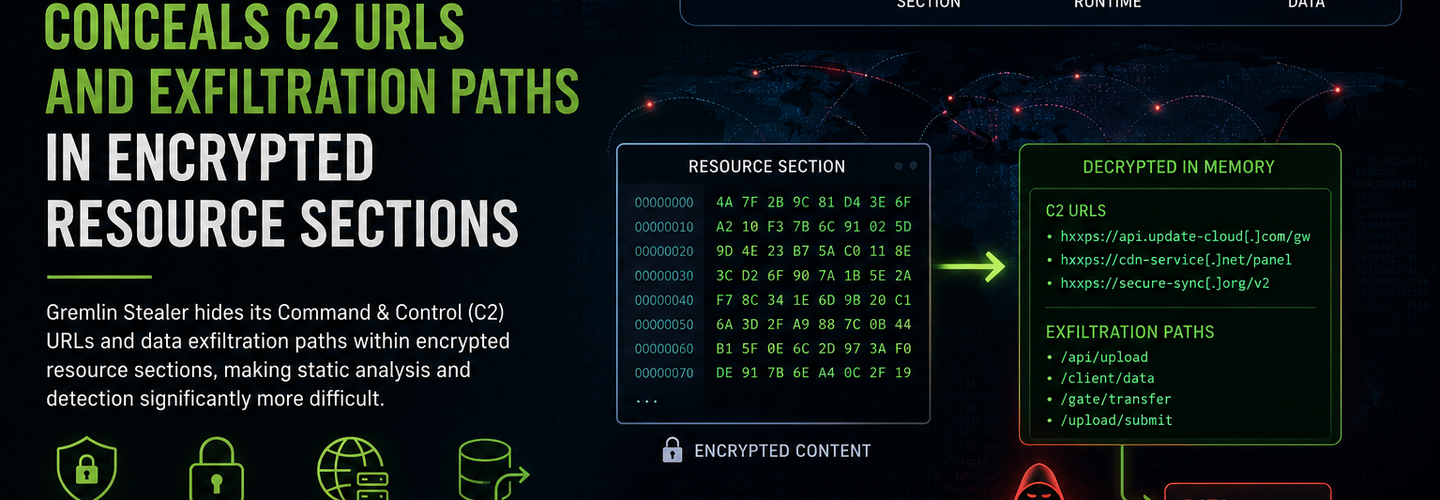
Gremlin Stealer Conceals C2 URLs and Exfiltration Paths in Encrypted Resource Sections
Threat researchers are warning about evolving capabilities in the increasingly monitored “Gremlin Stealer” malware family after analysts identified new techniques designed to conceal command-and-control (C2) infrastructure and data exfiltration paths within encrypted resource sections embedded inside malware binaries.
The discovery reflects a broader trend in cybercrime operations where malware developers are prioritizing stealth, modularity, and anti-analysis features to bypass modern endpoint security tools and frustrate incident responders.
Security teams tracking information-stealing malware say the latest Gremlin Stealer variants demonstrate how cybercriminal groups are refining payload delivery and communication concealment rather than relying solely on large-scale malware changes. By hiding operational infrastructure inside encrypted internal resources, attackers can reduce visible indicators that traditional static analysis tools often depend on during detection workflows.
The findings have drawn attention from defenders because information stealers continue to play a major role in credential theft, session hijacking, cryptocurrency fraud, and broader enterprise compromise campaigns.
Threat Overview
Information-stealing malware has become one of the most persistent cybercrime threats facing organizations and consumers alike. These malware families are commonly used to harvest:
- ▸Browser credentials
- ▸Authentication cookies
- ▸Cryptocurrency wallet information
- ▸Stored payment data
- ▸VPN credentials
- ▸Email account access tokens
- ▸Messaging application sessions
Unlike ransomware operations that immediately disrupt business operations, infostealers often operate quietly in the background, collecting valuable data that can later be sold, reused, or leveraged for further intrusion activity.
Researchers analyzing Gremlin Stealer observed that the malware stores critical operational components — including C2 endpoints and exfiltration configuration data — within encrypted sections embedded in executable resources.
This technique complicates detection because many conventional security scans prioritize behavioral analysis or easily extractable configuration strings during rapid triage processes.
By encrypting these internal resources, malware operators reduce the exposure of identifiable infrastructure that defenders commonly use to generate detection signatures and block malicious communications.
How the Concealment Technique Works
Security analysts describe the observed method as part of a broader “configuration hiding” strategy increasingly adopted by modern malware developers.
In many malware families, operational infrastructure such as remote server URLs, API endpoints, and exfiltration routes are stored in plaintext within binaries or configuration files. This makes them relatively easy for researchers to identify during reverse engineering.
Gremlin Stealer’s newer variants appear designed to obscure those operational details by embedding encrypted configuration data within internal resource sections that are only decrypted during runtime.
From a defensive perspective, this creates several challenges:
## Reduced Static Visibility
Traditional signature-based tools often rely on identifiable indicators embedded inside executable files. Encrypted resources significantly reduce immediately visible indicators.
## Faster Infrastructure Rotation
Concealed configuration data enables operators to update infrastructure more efficiently while limiting exposure during malware analysis.
## Increased Reverse Engineering Complexity
Encrypted resource storage forces analysts to spend additional time reconstructing malware behavior and identifying communications infrastructure.
## Improved Evasion Against Automated Sandboxes
Some automated malware analysis systems prioritize rapid scanning and may miss concealed operational details if decryption routines are not fully triggered during execution.
Researchers note that the technique itself is not entirely new, but its increasing adoption across infostealer ecosystems demonstrates the growing maturity of financially motivated cybercrime groups.
Technical Impact Analysis
The use of encrypted resource sections significantly affects both enterprise defenders and incident response teams.
## Detection Challenges
Modern endpoint detection and response (EDR) platforms increasingly depend on layered visibility that combines static analysis, behavioral telemetry, and threat intelligence.
When malware obscures infrastructure details internally, defenders may face delays identifying:
- ▸Active communication endpoints
- ▸Data exfiltration destinations
- ▸Campaign attribution indicators
- ▸Related malware clusters
This delay can extend containment timelines during active incidents.
## Threat Hunting Limitations
Threat hunting teams frequently search for known malicious domains, infrastructure overlaps, or suspicious configuration artifacts across enterprise environments.
Concealed configuration storage weakens the effectiveness of traditional indicator-based hunting approaches and increases reliance on behavioral analytics.
## Operational Security Improvements for Threat Actors
By encrypting operational data internally, malware operators reduce the risk of rapid infrastructure blacklisting following public disclosure.
This enables campaigns to remain active longer before defensive controls adapt.
## Increased Risk of Credential Abuse
Infostealers remain particularly dangerous because stolen credentials often fuel secondary attacks, including:
- ▸Business email compromise (BEC)
- ▸Cloud account takeover
- ▸Unauthorized remote access
- ▸Financial fraud
- ▸Enterprise lateral movement
Security researchers warn that even relatively small-scale credential theft incidents can create cascading organizational risks.
Industry Implications
The evolution of Gremlin Stealer highlights broader shifts occurring within the cybercrime ecosystem.
## Malware-as-a-Service Maturity
Many information stealers now operate through subscription-based criminal ecosystems where developers continuously add stealth improvements to remain competitive.
Enhanced concealment capabilities may become standard features among commercially distributed malware kits.
## Growing Pressure on Defenders
Security teams are increasingly required to rely on behavioral analysis, anomaly detection, and threat intelligence correlation instead of simple indicator matching.
This transition places additional operational pressure on under-resourced organizations.
## Expanding Infostealer Economy
Credential theft remains highly profitable because stolen access can be resold across underground marketplaces.
Researchers continue to observe overlaps between infostealer infections and later-stage ransomware incidents, highlighting the broader ecosystem impact.
## Cloud and SaaS Exposure
As organizations expand cloud adoption, browser-stored sessions and SaaS authentication tokens have become especially valuable targets for infostealer operators.
Compromised sessions can sometimes bypass traditional password protections entirely.
Why This Matters
Infostealers are no longer “low-level” malware threats.
Over the past several years, credential theft malware has become deeply interconnected with larger cybercrime operations, including ransomware, fraud, espionage, and supply-chain intrusion campaigns.
The latest Gremlin Stealer developments underscore how threat actors continue investing in stealth-focused engineering designed to slow defenders and extend campaign lifespans.
For organizations, this means traditional security visibility alone may no longer provide sufficient protection against modern credential theft operations.
The broader concern is not just the malware itself, but what stolen access enables afterward.
Compromised credentials frequently become the entry point for:
- ▸Enterprise breaches
- ▸Cloud compromise
- ▸Financial theft
- ▸Data exposure incidents
- ▸Operational disruption
The increasing sophistication of infostealers also reinforces the need for continuous monitoring and layered defensive controls rather than reliance on single-point detection technologies.
How Users Can Stay Safe
Cybersecurity experts recommend several defensive practices to reduce exposure to information-stealing malware.
## Enable Multi-Factor Authentication
MFA significantly reduces the impact of stolen passwords by requiring additional verification factors during authentication.
## Avoid Downloading Untrusted Software
Many infostealer infections originate from malicious downloads, fake installers, pirated software, or phishing attachments.
Users should download software only from verified sources.
## Keep Security Software Updated
Modern endpoint protection platforms continuously improve behavioral detection capabilities against evolving malware families.
Frequent updates remain essential.
## Monitor Browser Extensions
Malicious or compromised browser extensions can increase credential theft risks.
Organizations should review extension policies and limit unnecessary installations.
## Implement Least-Privilege Access
Restricting account permissions reduces the operational impact if credentials become compromised.
## Regularly Review Account Activity
Unexpected login alerts, unauthorized sessions, or unusual cloud activity may indicate credential theft attempts.
Early detection remains critical.
## Segment Sensitive Systems
Network segmentation can help limit broader exposure if endpoint compromise occurs.
Official Responses and Security Community Analysis
Threat intelligence researchers and enterprise defenders continue monitoring infostealer activity closely due to its growing role in broader cybercrime ecosystems.
Industry experts note that modern malware operators increasingly prioritize:
- ▸Infrastructure concealment
- ▸Anti-analysis protections
- ▸Encrypted configurations
- ▸Sandbox evasion
- ▸Modular deployment architectures
These capabilities are designed to extend operational lifespan and complicate forensic analysis.
Several cybersecurity agencies and industry groups continue urging organizations to strengthen:
- ▸Endpoint visibility
- ▸Identity security
- ▸Backup protections
- ▸Threat hunting programs
- ▸Incident response readiness
Security vendors are also adapting detection engines to focus more heavily on suspicious runtime behavior rather than static malware signatures alone.
Sources & References
- ▸CISA Malware Guidance
- ▸MITRE ATT&CK Framework
- ▸Microsoft Threat Intelligence
- ▸IBM X-Force Threat Intelligence
- ▸Palo Alto Networks Unit 42
- ▸CrowdStrike Threat Research
Conclusion
The latest Gremlin Stealer developments demonstrate how information-stealing malware continues evolving into a more sophisticated and operationally resilient threat category.
By hiding C2 infrastructure and exfiltration paths inside encrypted resource sections, malware operators are making analysis, detection, and attribution increasingly difficult for defenders.
As cybercriminal ecosystems mature, organizations may need to place greater emphasis on behavioral monitoring, identity protection, and recovery readiness rather than relying solely on traditional signature-based detection approaches.
The growing sophistication of infostealer campaigns serves as another reminder that modern cyber resilience depends not only on preventing compromise, but also on detecting abuse quickly and minimizing the downstream impact of stolen access.
Read More:
IRDAI Orders Insurance Firms to Strengthen Defences Against AI-Powered Cyberattacks by May 22
Cybersecurity Analysts Examine Potential Risks Following Claude Mythos AI Developments
New WordPress Plugin Vulnerability Raises Risk of Unauthorized Website Access
How Agentic AI Is Changing Software Engineering and Expanding Mobile Attack Surfaces
UK Says AI-Fueled Cyber Risks Are Tied to Security Weaknesses Rather Than Repository Transparency
Everpure strengthens cyber resilience by positioning data management as the final layer of defence
## Analyst Commentary & Implementation Blueprint
Security advisory
Continuous security exposure assessment is critical to identifying public vulnerabilities before they are exploited. Organizations should maintain a passive inventory of all web servers, TLS configs, and open ports, ensuring that default configurations are eliminated and security advisories are actively implemented.
Hardened Security Configuration Blueprint
# General Security Hardening Directive
ServerTokens ProductOnly
ServerSignature Off
FileETag None
Actionable Mitigation Checklist
- ✔Perform passive asset inventories weekly.
- ✔Restrict administrative ports using local firewall controls.
- ✔Monitor active CVE alerts for exposed software.
Common Inquiries & FAQs
Why is passive scanning preferred for continuous auditing?
Passive audits do not cause operational impact or trigger firewall blocks, making them ideal for constant surveillance of internet-facing assets.
What should I do if a vulnerability is flagged?
Apply the latest vendor patches, restrict access to the resource via firewalls, or verify configuration flags to mitigate risks.
Surendra Reddy
Surendra Reddy is a cybersecurity researcher and founder of ReconShield, specializing in OSINT and defensive infrastructure analysis.
Connect on LinkedIn ↗// AUDIT BRIEFING DISCUSSION (2 COMMENTS)
Great breakdown of the passive infrastructure vectors. We recently audited our external DNS zones and found multiple dangling staging environments. Implementing wildcard certificates reduced our CT log leaks significantly.
Is there any automated tooling you recommend for daily crt.sh scraping? Manually checking CT logs is becoming unsustainable for our domain portfolio.
// MORE ARTICLES
Security Researchers Warn Critical n8n Flaws May Expose Automation Platforms to RCE
Researchers have disclosed critical vulnerabilities in n8n that could expose automation workflows and connected enterprise systems to remote code execution risks, prompting urgent patch recommendations for users and administrators.

How Agentic AI Is Changing Software Engineering and Expanding Mobile Attack Surfaces
Agentic AI is rapidly transforming software engineering workflows through automation and intelligent coding assistance, while cybersecurity experts warn of expanding mobile attack surfaces and emerging application security risks.

Critical Tenda Router Backdoor (CVE-2026-11405): Check If Your Device Is Vulnerable Now
CVE-2026-11405 is an unpatched Tenda router backdoor granting full admin access without a password. Check if your model is affected now.