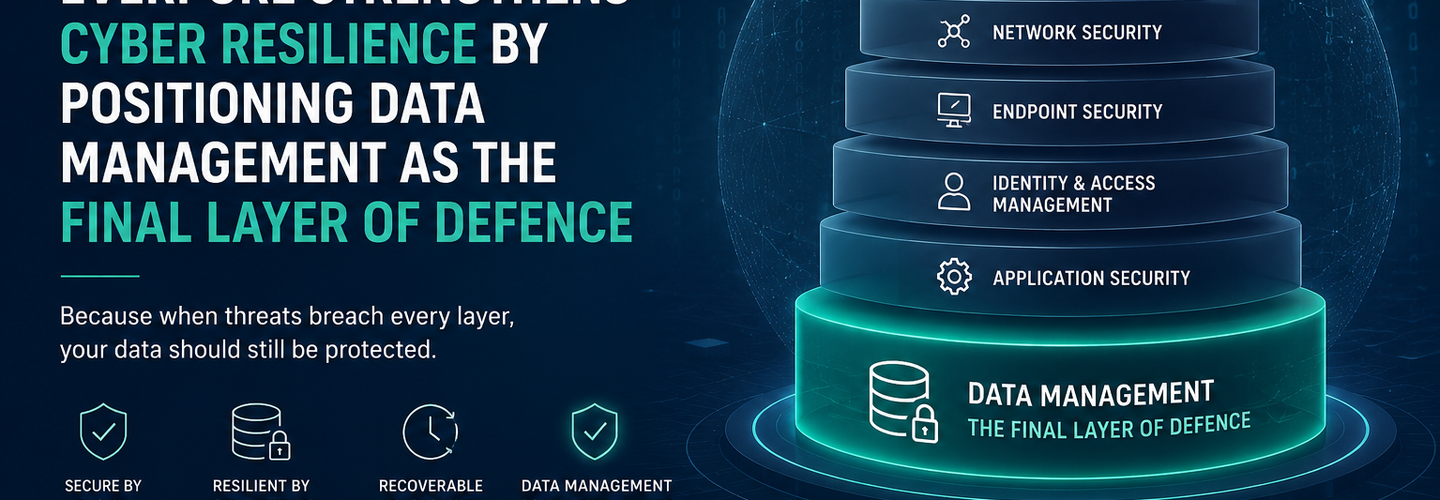
Everpure strengthens cyber resilience by positioning data management as the final layer of defence.
Cybersecurity strategies are undergoing a significant transformation as enterprises confront a growing reality: prevention alone is no longer enough. While organizations continue investing heavily in firewalls, endpoint protection, identity controls, and AI-powered threat detection, recent cyber incidents have demonstrated that determined attackers still find ways into corporate environments.
Against this backdrop, Everpure is positioning data management as a critical resilience pillar — one designed not merely to stop attacks, but to ensure businesses can recover quickly when security controls fail.
The company’s latest cyber resilience approach reflects a broader shift taking place across the security industry. Rather than focusing exclusively on perimeter defence, organizations are increasingly prioritizing recovery readiness, immutable backups, rapid restoration, and operational continuity.
Security leaders now recognize a difficult truth: the final measure of cyber resilience is not whether an intrusion occurs, but whether an organization can survive and recover from it.
The Growing Pressure on Enterprise Resilience
Ransomware groups continue targeting critical infrastructure, healthcare networks, financial institutions, and manufacturing environments at a relentless pace. At the same time, cloud misconfigurations, insider risks, and supply-chain attacks are expanding the attack surface for businesses of all sizes.
Industry analysts have repeatedly warned that recovery capabilities are becoming just as important as traditional prevention mechanisms. According to multiple cybersecurity reports published over the past year, organizations increasingly face double-extortion incidents where attackers attempt to encrypt, exfiltrate, or corrupt backup systems alongside production data.
This trend has elevated enterprise data management from a back-office IT function into a frontline cybersecurity requirement.
Everpure’s strategy aligns with this shift by emphasizing resilient data architecture, continuous backup integrity validation, secure recovery workflows, and stronger visibility across hybrid environments.
Rather than treating backup infrastructure as passive storage, the company is advocating for a model where data management systems actively contribute to cyber defence operations.
Why Data Has Become the Ultimate Target
Modern cyberattacks are no longer focused solely on disrupting devices or networks. Increasingly, attackers are targeting the data itself.
Corrupted databases, manipulated cloud repositories, encrypted file systems, and inaccessible recovery environments can cripple organizations long after the initial breach occurs. Even businesses with advanced security monitoring can face severe operational paralysis if recovery mechanisms fail during a crisis.
This reality has pushed enterprises toward adopting layered resilience frameworks that combine:
- ▸Immutable backups
- ▸Segmented recovery environments
- ▸Zero Trust access controls
- ▸Automated anomaly detection
- ▸Multi-cloud redundancy
- ▸Continuous recovery testing
Everpure’s messaging reflects the growing consensus that data recovery speed is now a core cybersecurity metric.
Industry observers note that recovery time objectives (RTOs) and recovery point objectives (RPOs) are becoming board-level concerns, especially for organizations operating in regulated sectors.
For healthcare providers, delayed data restoration can impact patient services. For financial institutions, prolonged downtime may trigger compliance consequences. For manufacturers, operational outages can disrupt global supply chains within hours.
In many cases, the economic damage caused by downtime significantly exceeds the immediate technical impact of the intrusion itself.
Technical Impact Analysis
Cyber resilience strategies centered on data management are increasingly designed to reduce what security professionals call “blast radius” — the operational scope of disruption following a cyber incident.
Everpure’s approach appears focused on several key technical principles:
## Immutable Recovery Architecture
Immutable storage ensures backup data cannot be modified or deleted within a defined retention period. This capability has become essential as ransomware operators increasingly attempt to compromise recovery systems before launching broader attacks.
Security analysts widely consider immutable backups one of the strongest defensive safeguards against destructive cyber incidents.
## Hybrid Environment Visibility
Modern enterprises often operate across on-premises infrastructure, private clouds, SaaS platforms, and public cloud environments simultaneously. This complexity creates fragmented visibility, making it difficult for security teams to maintain consistent recovery readiness.
Unified data management platforms help organizations monitor backup integrity, detect unusual activity, and streamline restoration across distributed environments.
## AI-Driven Threat Detection in Data Systems
Artificial intelligence is increasingly being integrated into cyber resilience workflows to identify suspicious encryption patterns, abnormal access behavior, or unusual backup modifications.
Rather than acting as standalone security tools, these analytics capabilities serve as early-warning mechanisms designed to reduce recovery delays.
## Recovery Automation
Manual recovery processes often create operational bottlenecks during crises. Automated restoration orchestration can significantly reduce downtime by accelerating workload recovery and minimizing human error under pressure.
Cybersecurity experts have repeatedly emphasized that response speed directly influences the financial and reputational consequences of cyber incidents.
Industry Implications
Everpure’s positioning highlights a larger evolution occurring across enterprise cybersecurity priorities.
For years, organizations largely measured cyber maturity through prevention-focused metrics such as intrusion detection rates, malware blocking efficiency, or endpoint coverage percentages. Today, resilience is becoming the dominant benchmark.
This transition is influencing several areas of the broader cybersecurity ecosystem:
## Cyber Insurance Requirements
Insurers are increasingly evaluating backup integrity, recovery testing frequency, and ransomware recovery readiness when assessing organizational risk profiles.
Businesses unable to demonstrate mature recovery capabilities may face higher premiums or reduced coverage eligibility.
## Regulatory Expectations
Governments and regulators worldwide are strengthening operational resilience requirements, particularly for critical infrastructure operators and financial services providers.
Several regulatory frameworks now emphasize recovery planning, incident continuity, and resilience testing alongside conventional cybersecurity controls.
## Board-Level Accountability
Cyber resilience has moved beyond IT departments into executive leadership discussions. Boards increasingly expect measurable recovery preparedness metrics rather than generalized security assurances.
This shift is accelerating enterprise investment in resilient data management platforms.
## Cloud Security Strategy Changes
As organizations migrate workloads to multi-cloud environments, resilience planning is becoming deeply integrated into cloud architecture decisions.
Enterprises are seeking platforms capable of protecting workloads consistently across hybrid ecosystems without introducing excessive operational complexity.
Why This Matters
The cybersecurity conversation is evolving from “Can we stop attacks?” to “Can we continue operating after attacks occur?”
That distinction is critical.
Even highly mature organizations with advanced security programs can experience breaches. The defining factor is often how effectively they recover, restore trust, and resume operations.
Everpure’s focus on data management as the final layer of defence reflects an industry wide acknowledgment that resilience now represents the true measure of security effectiveness.
For many enterprises, downtime is no longer just an IT issue it is a business continuity crisis.
Operational interruptions can affect:
- ▸Customer trust
- ▸Financial performance
- ▸Regulatory compliance
- ▸Supply chain operations
- ▸Healthcare delivery
- ▸Public services
- ▸Brand reputation
The increasing sophistication of ransomware groups and destructive cyber campaigns has reinforced the need for recovery-first security thinking.
Organizations that fail to modernize resilience strategies may find themselves vulnerable even if their preventive controls appear strong on paper.
How Users Can Stay Safe
While large-scale cyber resilience strategies are often discussed at the enterprise level, many defensive principles also apply to smaller organizations and everyday users.
Cybersecurity professionals recommend the following practices:
## Maintain Secure Backups
Store backups in separate, protected environments and regularly verify restoration capabilities. Backup systems should not rely solely on the same credentials or network segments as production infrastructure.
## Enable Multi-Factor Authentication
MFA remains one of the most effective safeguards against unauthorized access, particularly for cloud storage, administrative systems, and backup consoles.
## Regularly Update Systems
Unpatched vulnerabilities continue to contribute to many cyber incidents. Organizations should prioritize timely patch management for operating systems, applications, and cloud services.
## Monitor for Unusual Activity
Unexpected encryption activity, login anomalies, or abnormal data transfers may indicate early-stage compromise attempts.
Continuous monitoring helps organizations respond before disruptions escalate.
## Develop Incident Recovery Plans
Recovery strategies should include clear communication procedures, restoration priorities, and business continuity workflows.
Testing recovery processes regularly is equally important.
## Limit Access Privileges
Applying least-privilege principles reduces the likelihood of widespread compromise if credentials are stolen or accounts become compromised.
Official Responses and Industry Perspective
Cybersecurity vendors across the industry are increasingly emphasizing resilience-oriented messaging as ransomware and destructive attacks continue evolving.
Security researchers and enterprise risk analysts broadly agree that organizations must balance prevention, detection, and recovery rather than relying exclusively on perimeter-focused security strategies.
Industry groups have also highlighted the growing importance of operational continuity planning.
Several recent government advisories and cybersecurity frameworks stress:
- ▸Immutable backup adoption
- ▸Recovery environment isolation
- ▸Incident response rehearsals
- ▸Critical asset prioritization
- ▸Continuous resilience testing
Everpure’s positioning reflects these broader industry priorities by placing recoverability at the center of cybersecurity planning.
Analysts note that the companies likely to adapt most successfully to the modern threat landscape will be those capable of recovering quickly and maintaining operational continuity during disruptive events.
Sources & References
- ▸CISA Cybersecurity Guidance
- ▸NIST Cybersecurity Framework
- ▸IBM Cost of a Data Breach Report
- ▸World Economic Forum Cybersecurity Insights
- ▸ENISA Threat Landscape Reports
- ▸Everpure Official Website
Conclusion
Cyber resilience is no longer defined solely by an organization’s ability to block threats at the perimeter. As cyberattacks grow more disruptive and recovery systems become direct targets, enterprises are reevaluating how they protect the integrity and availability of their data.
Everpure’s emphasis on data management as the final layer of defence reflects a broader industry realization that resilience must extend beyond detection and prevention.
In an environment where operational continuity has become inseparable from cybersecurity, the ability to recover quickly may ultimately determine which organizations withstand the next generation of cyber threats and which do not.
Read More:
IRDAI Orders Insurance Firms to Strengthen Defences Against AI-Powered Cyberattacks by May 22
Cybersecurity Analysts Examine Potential Risks Following Claude Mythos AI Developments
New WordPress Plugin Vulnerability Raises Risk of Unauthorized Website Access
How Agentic AI Is Changing Software Engineering and Expanding Mobile Attack Surfaces
UK Says AI-Fueled Cyber Risks Are Tied to Security Weaknesses Rather Than Repository Transparency
## Analyst Commentary & Implementation Blueprint
Security advisory
Continuous security exposure assessment is critical to identifying public vulnerabilities before they are exploited. Organizations should maintain a passive inventory of all web servers, TLS configs, and open ports, ensuring that default configurations are eliminated and security advisories are actively implemented.
Hardened Security Configuration Blueprint
# General Security Hardening Directive
ServerTokens ProductOnly
ServerSignature Off
FileETag None
Actionable Mitigation Checklist
- ✔Perform passive asset inventories weekly.
- ✔Restrict administrative ports using local firewall controls.
- ✔Monitor active CVE alerts for exposed software.
Common Inquiries & FAQs
Why is passive scanning preferred for continuous auditing?
Passive audits do not cause operational impact or trigger firewall blocks, making them ideal for constant surveillance of internet-facing assets.
What should I do if a vulnerability is flagged?
Apply the latest vendor patches, restrict access to the resource via firewalls, or verify configuration flags to mitigate risks.
Surendra Reddy
Surendra Reddy is a cybersecurity researcher and founder of ReconShield, specializing in OSINT and defensive infrastructure analysis.
Connect on LinkedIn ↗// AUDIT BRIEFING DISCUSSION (2 COMMENTS)
Great breakdown of the passive infrastructure vectors. We recently audited our external DNS zones and found multiple dangling staging environments. Implementing wildcard certificates reduced our CT log leaks significantly.
Is there any automated tooling you recommend for daily crt.sh scraping? Manually checking CT logs is becoming unsustainable for our domain portfolio.
// MORE ARTICLES
Security Researchers Warn Critical n8n Flaws May Expose Automation Platforms to RCE
Researchers have disclosed critical vulnerabilities in n8n that could expose automation workflows and connected enterprise systems to remote code execution risks, prompting urgent patch recommendations for users and administrators.

How Agentic AI Is Changing Software Engineering and Expanding Mobile Attack Surfaces
Agentic AI is rapidly transforming software engineering workflows through automation and intelligent coding assistance, while cybersecurity experts warn of expanding mobile attack surfaces and emerging application security risks.

Critical Tenda Router Backdoor (CVE-2026-11405): Check If Your Device Is Vulnerable Now
CVE-2026-11405 is an unpatched Tenda router backdoor granting full admin access without a password. Check if your model is affected now.