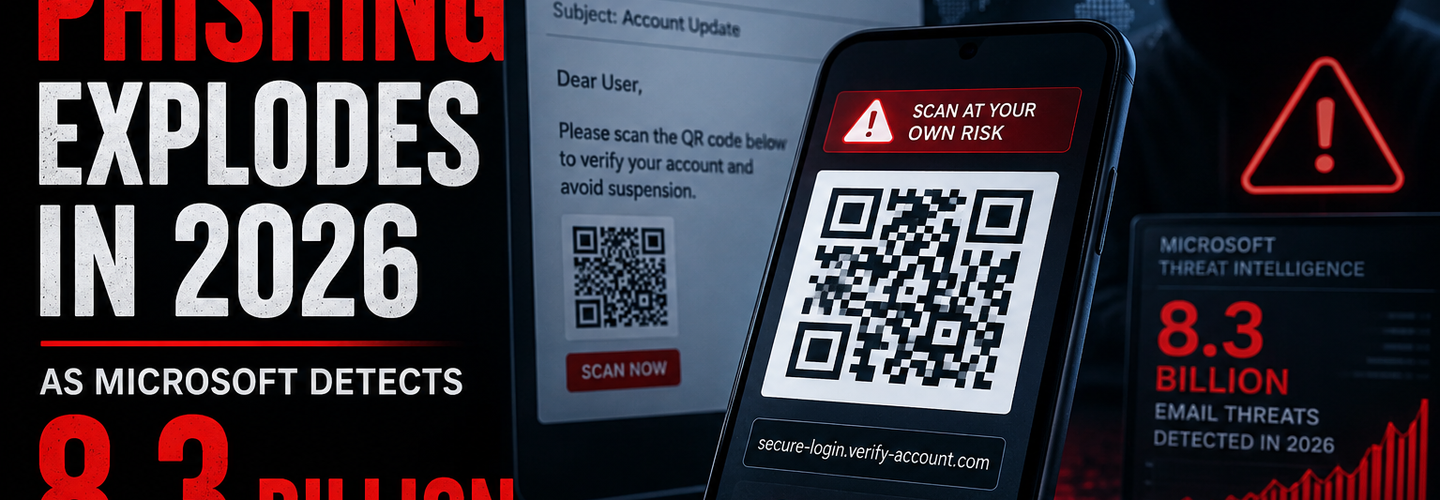
QR Code Phishing Explodes in 2026 as Microsoft Detects 8.3 Billion Email Threats
A dramatic surge in QR code phishing campaigns is reshaping the enterprise threat landscape, according to new findings from Microsoft, which says attackers are increasingly using image-based lures to bypass traditional email defenses and target corporate credentials.
The company’s latest threat intelligence report reveals that Microsoft detected approximately 8.3 billion phishing emails during the first quarter of 2026, with QR code phishing — commonly called “quishing” — emerging as the fastest-growing attack vector observed during the period.
Researchers observed QR-based phishing activity jump from 7.6 million attacks in January to 18.7 million in March, representing a staggering 146% increase in just three months.
Security analysts say the spike highlights a larger shift in cybercriminal strategy: rather than relying on malware-heavy campaigns, threat actors are increasingly exploiting trusted workplace habits, mobile workflows, and identity systems.
## Threat Overview: Why QR Code Phishing Is Surging
QR codes have become deeply embedded in modern business operations. Employees use them for everything from authentication requests and conference check-ins to cloud document access and mobile payments.
Attackers are capitalizing on that familiarity.
Unlike conventional phishing emails containing suspicious hyperlinks, QR-based attacks hide malicious destinations inside images. When users scan the code with their smartphones, they are redirected outside the visibility of many enterprise email security tools.
Microsoft researchers noted that attackers are increasingly embedding QR codes directly inside email bodies rather than attaching them as separate PDF files or documents.
That subtle shift matters because many legacy email filtering systems are optimized for analyzing text-based URLs, not encoded image content.
Cybersecurity researchers say the tactic is especially effective in hybrid work environments where employees routinely move between managed corporate devices and unmanaged personal smartphones.
“Threat actors attempt to exploit the limitations of text-based scanning engines,” Microsoft said in its Q1 threat report.
## The Enterprise Identity Problem
The rise in QR phishing reflects a broader industry trend toward identity-focused attacks.
Rather than attempting to breach hardened infrastructure directly, cybercriminals increasingly target login credentials, authentication tokens, and cloud identities — assets that can provide immediate access to enterprise environments.
According to Microsoft’s findings, approximately 78% of email threats observed in Q1 2026 were link-based, while credential theft remained the dominant attack objective.
Security teams warn that compromised enterprise credentials can lead to:
- ▸Cloud account takeover
- ▸Business email compromise (BEC)
- ▸Financial fraud
- ▸Internal espionage
- ▸Data theft
- ▸Lateral movement across networks
Because QR phishing often shifts victims onto personal mobile devices, many organizations face reduced visibility into the malicious interaction itself.
That visibility gap has become a major concern for defenders.
## Mobile Devices Become the Weakest Link
One of the biggest cybersecurity challenges highlighted by the latest wave of campaigns is the growing dependence on mobile authentication workflows.
Employees increasingly use smartphones to:
- ▸Approve multi-factor authentication requests
- ▸Access SaaS platforms
- ▸Open collaboration tools
- ▸Authenticate remote sessions
- ▸Review corporate documents
Threat actors understand that behavior and are designing campaigns specifically around it.
Researchers from multiple security firms say attackers are intentionally exploiting the trust users place in QR codes because they appear routine and business-friendly.
Industry analysts note that QR adoption accelerated significantly during the pandemic era, conditioning users to scan codes quickly without extensive scrutiny.
That behavioral shift has unintentionally created a highly effective social engineering opportunity.
## Technical Impact Analysis
Although QR phishing lacks the technical sophistication associated with advanced malware campaigns, its operational impact can be severe.
Compromised identities remain one of the most valuable assets in cybercrime.
Security researchers warn that stolen credentials are frequently leveraged in secondary attacks involving ransomware affiliates, cloud abuse, or long-term persistence operations.
Recent investigations have shown phishing campaigns impersonating:
- ▸Payroll systems
- ▸HR departments
- ▸Cloud storage providers
- ▸MFA notifications
- ▸Voicemail alerts
- ▸Internal collaboration platforms
Researchers have also observed campaigns using fake CAPTCHA verification pages alongside QR-based lures to increase credibility.
Microsoft additionally warned that CAPTCHA-gated phishing activity surged sharply during March 2026, reflecting how attackers continue experimenting with layered social engineering techniques.
## Industry Implications
The rapid growth of QR phishing is forcing organizations to rethink long-standing assumptions about phishing defense.
Traditional awareness training has historically focused on suspicious hyperlinks, spelling errors, and malicious attachments. But modern phishing campaigns increasingly rely on:
- ▸Trusted SaaS branding
- ▸Mobile workflows
- ▸Cloud identity systems
- ▸AI-generated content
- ▸Visual deception
- ▸Multi-stage authentication lures
Security professionals say this evolution is exposing weaknesses in many enterprise security programs.
Organizations that invested heavily in desktop-focused email protection may still lack sufficient mobile security visibility or identity-centric controls.
The trend is also increasing pressure on security vendors.
Email security providers, identity protection firms, and mobile threat defense companies are all racing to improve QR scanning analysis, image inspection, and behavioral detection capabilities.
Analysts expect identity security spending to rise further throughout 2026 as enterprises prioritize zero-trust strategies and phishing-resistant authentication.
## Why This Matters
QR code phishing represents more than just another phishing trend — it signals a broader transformation in how cybercriminals approach enterprise intrusion.
The modern attack surface is no longer limited to laptops and email inboxes.
Today’s workforce operates across cloud platforms, mobile devices, collaboration tools, and personal endpoints simultaneously. Attackers are adapting accordingly.
The implications are significant:
- ▸Mobile devices are increasingly targeted as authentication hubs.
- ▸Identity systems have become primary attack targets.
- ▸Social engineering continues outperforming many technical exploits.
- ▸Traditional phishing detection methods face growing limitations.
Security researchers also warn that generative AI could further accelerate phishing effectiveness by enabling more convincing and personalized lures at scale.
## Official Responses and Security Guidance
Microsoft has urged organizations to strengthen identity protections and expand security awareness programs to include QR-related attack scenarios.
Industry guidance released by vendors and cybersecurity agencies recommends organizations:
- ▸Deploy phishing-resistant MFA
- ▸Use conditional access policies
- ▸Strengthen mobile security controls
- ▸Monitor anomalous login activity
- ▸Improve email filtering technologies
- ▸Expand employee awareness training
- ▸Limit unmanaged device exposure
Security experts also emphasize the importance of rapid patch management and software updates as attackers continue combining phishing with broader credential abuse campaigns.
## How Users Can Stay Safe
Treat unexpected QR codes with suspicion
Employees should avoid scanning QR codes received unexpectedly through email or messaging platforms.
Verify requests independently
If a QR code claims to relate to payroll, MFA updates, invoices, or internal documents, confirm the request through official channels before interacting.
Inspect login pages carefully
Users should verify website legitimacy before entering passwords or authentication codes after scanning a QR code.
Use phishing-resistant authentication
Organizations should consider adopting hardware security keys or passkey-based authentication systems where possible.
Keep devices updated
Applying operating system and browser security updates remains critical for reducing exposure to evolving threats.
Report suspicious messages quickly
Rapid reporting allows security teams to investigate campaigns before they spread across the organization.
## Expert Commentary
Threat intelligence analysts say QR phishing will likely remain one of the fastest-growing enterprise threats throughout 2026 due to its simplicity, scalability, and effectiveness.
Unlike sophisticated malware operations requiring advanced infrastructure, QR phishing primarily exploits trust and routine behavior.
That makes it inexpensive for cybercriminals to deploy — and difficult for defenders to eliminate entirely.
Security researchers also caution against viewing phishing solely as an email problem.
The newest generation of campaigns increasingly spans mobile devices, cloud authentication systems, collaboration platforms, and identity infrastructure simultaneously.
For defenders, that means cybersecurity awareness, identity protection, and mobile security can no longer operate as separate disciplines.
## Conclusion
The explosion of QR code phishing campaigns marks another turning point in the evolution of social engineering threats.
As organizations embrace mobile-first workflows and cloud-based collaboration environments, attackers are increasingly exploiting the trust users place in familiar business tools and authentication processes.
Microsoft’s latest findings show that phishing is not fading — it is adapting.
And in many cases, the weakest link is no longer the email itself, but the moment a user reaches for their smartphone and scans a seemingly harmless code.
## Sources & References
- ▸Microsoft Security Blog – Q1 2026 Email Threat Report
- ▸Cybersecurity Dive Coverage
- ▸SC Media Report
- ▸The Hacker News Coverage
- ▸Acronis Threat Research
Read More:
Gremlin Stealer Conceals C2 URLs and Exfiltration Paths in Encrypted Resource Sections
Copy Fail (CVE-2026-31431): The Linux Kernel Flaw That Handed Root to Anyone Who Asked
Malicious VS Code Extension Linked to Unauthorized Access of GitHub Internal Repositories
AI-Powered Cyber Threats Are Escalating Faster Than Enterprise Defenses Can Adapt
Urgent Chrome Update Released After Critical Remote Code Execution Vulnerabilities Discovered
Hackers Exploit Vulnerable Lenovo Driver to Disable EDR Security Protections
## Analyst Commentary & Implementation Blueprint
Security advisory
Continuous security exposure assessment is critical to identifying public vulnerabilities before they are exploited. Organizations should maintain a passive inventory of all web servers, TLS configs, and open ports, ensuring that default configurations are eliminated and security advisories are actively implemented.
Hardened Security Configuration Blueprint
# General Security Hardening Directive
ServerTokens ProductOnly
ServerSignature Off
FileETag None
Actionable Mitigation Checklist
- ✔Perform passive asset inventories weekly.
- ✔Restrict administrative ports using local firewall controls.
- ✔Monitor active CVE alerts for exposed software.
Common Inquiries & FAQs
Why is passive scanning preferred for continuous auditing?
Passive audits do not cause operational impact or trigger firewall blocks, making them ideal for constant surveillance of internet-facing assets.
What should I do if a vulnerability is flagged?
Apply the latest vendor patches, restrict access to the resource via firewalls, or verify configuration flags to mitigate risks.
Surendra Reddy
Surendra Reddy is a cybersecurity researcher and founder of ReconShield, specializing in OSINT and defensive infrastructure analysis.
Connect on LinkedIn ↗// AUDIT BRIEFING DISCUSSION (2 COMMENTS)
Great breakdown of the passive infrastructure vectors. We recently audited our external DNS zones and found multiple dangling staging environments. Implementing wildcard certificates reduced our CT log leaks significantly.
Is there any automated tooling you recommend for daily crt.sh scraping? Manually checking CT logs is becoming unsustainable for our domain portfolio.
// MORE ARTICLES
Security Researchers Warn Critical n8n Flaws May Expose Automation Platforms to RCE
Researchers have disclosed critical vulnerabilities in n8n that could expose automation workflows and connected enterprise systems to remote code execution risks, prompting urgent patch recommendations for users and administrators.
How Agentic AI Is Changing Software Engineering and Expanding Mobile Attack Surfaces
Agentic AI is rapidly transforming software engineering workflows through automation and intelligent coding assistance, while cybersecurity experts warn of expanding mobile attack surfaces and emerging application security risks.
SplitVPN Hacked: Data Breach Exposes 865,000 User Records and 58 Million Hidden Connection Logs (July 2026)
SplitVPN hacked: 865,336 user records and 58 million connection logs exposed, directly contradicting the VPN's "no-logs" promise. What was leaked and what to do now.