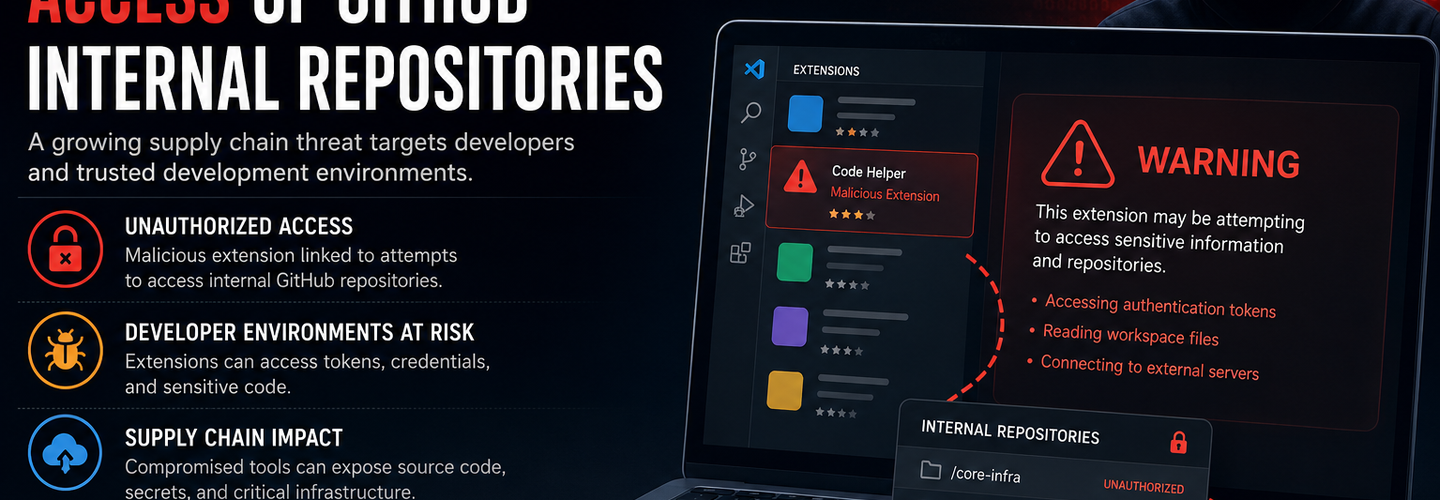
Malicious VS Code Extension Linked to Unauthorized Access of GitHub Internal Repositories
A newly uncovered software supply chain incident involving a malicious Visual Studio Code extension has reignited concerns about the growing security risks within developer ecosystems. Researchers investigating suspicious activity tied to GitHub environments say the extension appears to have been used in attempts to gain unauthorized access to internal repositories, exposing the broader dangers posed by compromised developer tooling.
The discovery comes amid increasing attacks targeting software development platforms, CI/CD pipelines, and open-source ecosystems. While browser extensions and package repositories have historically served as attractive delivery vectors for cybercriminals, integrated development environment (IDE) extensions are now becoming a more prominent target due to their deep access to source code, authentication tokens, and developer workflows.
Security analysts warn that the incident highlights a larger trend: threat actors are increasingly focusing on developers themselves rather than directly attacking hardened enterprise infrastructure.
## Threat Overview
According to threat intelligence researchers monitoring developer-focused attacks, the malicious VS Code extension was designed to imitate legitimate productivity or development functionality while quietly interacting with GitHub-related authentication contexts.
Investigators believe the extension leveraged permissions commonly granted inside development environments to interact with repositories and developer sessions. Although details surrounding the full scope of exposure remain limited, the activity reportedly involved unauthorized attempts to access internal GitHub repositories associated with organizations and development teams.
The campaign reflects a broader evolution in software supply chain threats. Rather than exploiting vulnerabilities in production servers, attackers increasingly attempt to compromise trusted tools already embedded within engineering environments.
VS Code extensions present a particularly attractive target because they often receive elevated trust from developers. Once installed, extensions may gain access to workspace files, terminal sessions, configuration settings, API tokens, and cloud-connected developer services.
Cybersecurity teams have repeatedly warned that developers frequently prioritize convenience and productivity over strict security review when installing plugins and extensions. In large organizations where thousands of extensions may be in active use, maintaining visibility becomes especially difficult.
Industry telemetry from multiple security vendors has shown a sharp rise in malicious packages and extensions targeting developer ecosystems over the past two years. Threat actors have increasingly abused platforms tied to:
- ▸VS Code marketplaces
- ▸npm repositories
- ▸PyPI packages
- ▸GitHub Actions workflows
- ▸Docker images
- ▸CI/CD integrations
The latest incident underscores how a seemingly harmless extension can become a gateway into highly sensitive development infrastructure.
## Technical Impact Analysis
While public reporting has not disclosed operational specifics of the malicious extension, security experts say IDE-based threats can create serious downstream risks for organizations.
Modern development environments frequently store:
- ▸GitHub authentication tokens
- ▸SSH keys
- ▸API credentials
- ▸Cloud secrets
- ▸Repository access permissions
- ▸Session information
- ▸Internal documentation
When a malicious extension gains access to these assets, the potential impact extends well beyond a single workstation.
Unauthorized repository access can expose:
- ▸Proprietary source code
- ▸Security architecture details
- ▸Internal tooling
- ▸API schemas
- ▸Customer integrations
- ▸Unreleased software components
In some cases, attackers may also attempt to leverage stolen development credentials to move laterally across engineering infrastructure.
Researchers note that attacks against software development environments are especially dangerous because compromised code repositories can introduce cascading supply chain risks affecting customers, partners, and downstream software consumers.
Security professionals compare these incidents to previous large-scale software supply chain attacks that demonstrated how trusted developer ecosystems can become high-value targets for cybercriminals and nation-state operators alike.
Another concern involves persistence. Malicious extensions can sometimes remain active for extended periods before detection, particularly when they masquerade as legitimate utilities or productivity enhancements.
The trust model surrounding extensions also complicates detection efforts. Developers may unknowingly approve extensive permissions during installation without reviewing the extension’s origin, publisher history, or behavior patterns.
Experts say organizations should treat IDE extensions with the same scrutiny traditionally applied to production software dependencies.
## Industry Implications
The incident is likely to intensify discussions around developer environment security, particularly as enterprises accelerate software delivery pipelines and adopt AI-assisted coding platforms.
Developer workstations increasingly serve as gateways into enterprise infrastructure. In many organizations, engineering environments now maintain direct connectivity to:
- ▸Cloud infrastructure
- ▸Kubernetes clusters
- ▸Production environments
- ▸Container registries
- ▸Secrets managers
- ▸Internal repositories
This level of interconnected access makes developers a high-value target for threat actors seeking privileged entry points.
Security leaders say traditional endpoint protection alone is often insufficient for defending modern development ecosystems. Organizations must now address risks across the entire software development lifecycle (SDLC).
The rise of malicious IDE extensions also presents challenges for platform operators and extension marketplaces. Vetting developer tools at scale remains difficult, especially when malicious code may remain dormant or employ evasive techniques to avoid automated detection systems.
The broader cybersecurity industry has already seen increasing pressure on software vendors to improve supply chain transparency following multiple high-profile attacks in recent years.
Regulators and government agencies have also pushed for stronger software security practices. In the United States, agencies including the Cybersecurity and Infrastructure Security Agency (CISA) have repeatedly emphasized the importance of secure-by-design development principles and software supply chain integrity.
Analysts believe incidents involving developer tooling will continue to rise as attackers recognize the strategic value of compromising trusted engineering environments instead of attempting direct attacks against heavily defended enterprise networks.
## Why This Matters
This incident represents more than an isolated malicious extension discovery.
It highlights a fundamental shift in cyber threat activity targeting the software supply chain itself.
For years, organizations focused heavily on perimeter defenses, email security, and endpoint detection. But as enterprise security controls matured, threat actors adapted by targeting trusted relationships inside development ecosystems.
A compromised extension can potentially affect:
- ▸Individual developers
- ▸Software vendors
- ▸Enterprise customers
- ▸Open-source communities
- ▸Critical infrastructure operators
The interconnected nature of modern software development means even small compromises can produce widespread downstream effects.
The issue also raises concerns about visibility. Many organizations lack comprehensive inventories of IDE extensions installed across engineering teams. Security monitoring frequently prioritizes servers and cloud infrastructure while overlooking developer workstations and local tooling.
As AI coding assistants, cloud-based development environments, and automated pipelines continue to expand, the attack surface surrounding developers is expected to grow significantly.
The incident serves as another reminder that software supply chain security is no longer optional — it has become a foundational cybersecurity requirement.
## How Users Can Stay Safe
Security experts recommend several defensive measures for developers and organizations seeking to reduce exposure to malicious extensions and software supply chain threats.
Review Extension Permissions Carefully
Developers should avoid installing extensions from unknown or unverified publishers. Before installation, review:
- ▸Publisher reputation
- ▸Download history
- ▸Community feedback
- ▸Requested permissions
- ▸Update frequency
Organizations may also benefit from maintaining approved extension allowlists.
Use Least-Privilege Access Controls
Restrict repository permissions wherever possible. Developers should only maintain access to repositories and systems necessary for their role.
Limiting token privileges can reduce potential exposure if credentials are compromised.
Rotate and Monitor Tokens Regularly
GitHub tokens, API keys, and SSH credentials should be rotated periodically and monitored for suspicious activity.
Security teams should enable alerts for:
- ▸Unusual repository access
- ▸New authentication events
- ▸Unexpected token usage
- ▸Unauthorized permission changes
Implement Endpoint Detection for Developer Systems
Developer workstations require enhanced monitoring due to their elevated access levels.
Security teams should deploy endpoint detection and response (EDR) solutions capable of identifying suspicious extension behavior, unusual outbound connections, or unauthorized credential access attempts.
Enforce Multi-Factor Authentication (MFA)
MFA remains one of the most effective safeguards against credential misuse.
Organizations should enforce MFA across:
- ▸GitHub accounts
- ▸Cloud services
- ▸CI/CD systems
- ▸Administrative portals
Maintain Software Supply Chain Visibility
Security leaders should maintain inventories of:
- ▸IDE extensions
- ▸Open-source dependencies
- ▸Build tools
- ▸Automation workflows
- ▸Container images
Visibility is critical for identifying unauthorized or risky components.
Conduct Security Awareness Training
Developers should receive regular training on software supply chain threats and secure development practices.
Human trust remains one of the most commonly exploited attack vectors in modern cyber operations.
## Official Responses
At the time of reporting, security researchers and platform providers continue investigating the full extent of the incident.
GitHub and Microsoft have historically taken action against malicious marketplace content when identified, including removing harmful extensions and suspending associated publisher accounts.
Cybersecurity vendors monitoring developer ecosystem threats have also increased efforts to identify suspicious extension behavior, malicious package uploads, and credential harvesting campaigns targeting engineering environments.
Industry experts continue encouraging organizations to adopt secure software development frameworks and supply chain risk management programs.
Government agencies worldwide have likewise emphasized the importance of securing software ecosystems following the rise in supply chain-focused cyber incidents.
## Sources & References
- ▸OWASP Software Supply Chain Security Guidance
- ▸NIST Secure Software Development Framework (SSDF)
## Conclusion
The discovery of a malicious VS Code extension linked to unauthorized GitHub repository access attempts illustrates the growing security challenges surrounding modern developer ecosystems.
As organizations increasingly rely on interconnected development platforms, cloud-native tooling, and open-source components, attackers are shifting their focus toward trusted engineering workflows and software supply chains.
The incident reinforces a critical reality for enterprises: developer environments are now frontline cybersecurity assets.
Protecting them requires more than traditional endpoint defenses. It demands continuous visibility, stronger access controls, extension governance, supply chain monitoring, and security-aware development practices.
For defenders, the message is becoming increasingly clear — securing code now means securing the entire ecosystem behind it.
Read More:
How Agentic AI Is Changing Software Engineering and Expanding Mobile Attack Surfaces
UK Says AI-Fueled Cyber Risks Are Tied to Security Weaknesses Rather Than Repository Transparency
Everpure strengthens cyber resilience by positioning data management as the final layer of defence
Gremlin Stealer Conceals C2 URLs and Exfiltration Paths in Encrypted Resource Sections
Copy Fail (CVE-2026-31431): The Linux Kernel Flaw That Handed Root to Anyone Who Asked
## Analyst Commentary & Implementation Blueprint
Security advisory
Continuous security exposure assessment is critical to identifying public vulnerabilities before they are exploited. Organizations should maintain a passive inventory of all web servers, TLS configs, and open ports, ensuring that default configurations are eliminated and security advisories are actively implemented.
Hardened Security Configuration Blueprint
# General Security Hardening Directive
ServerTokens ProductOnly
ServerSignature Off
FileETag None
Actionable Mitigation Checklist
- ✔Perform passive asset inventories weekly.
- ✔Restrict administrative ports using local firewall controls.
- ✔Monitor active CVE alerts for exposed software.
Common Inquiries & FAQs
Why is passive scanning preferred for continuous auditing?
Passive audits do not cause operational impact or trigger firewall blocks, making them ideal for constant surveillance of internet-facing assets.
What should I do if a vulnerability is flagged?
Apply the latest vendor patches, restrict access to the resource via firewalls, or verify configuration flags to mitigate risks.
Surendra Reddy
Surendra Reddy is a cybersecurity researcher and founder of ReconShield, specializing in OSINT and defensive infrastructure analysis.
Connect on LinkedIn ↗// AUDIT BRIEFING DISCUSSION (2 COMMENTS)
Great breakdown of the passive infrastructure vectors. We recently audited our external DNS zones and found multiple dangling staging environments. Implementing wildcard certificates reduced our CT log leaks significantly.
Is there any automated tooling you recommend for daily crt.sh scraping? Manually checking CT logs is becoming unsustainable for our domain portfolio.
// MORE ARTICLES
Security Researchers Warn Critical n8n Flaws May Expose Automation Platforms to RCE
Researchers have disclosed critical vulnerabilities in n8n that could expose automation workflows and connected enterprise systems to remote code execution risks, prompting urgent patch recommendations for users and administrators.

How Agentic AI Is Changing Software Engineering and Expanding Mobile Attack Surfaces
Agentic AI is rapidly transforming software engineering workflows through automation and intelligent coding assistance, while cybersecurity experts warn of expanding mobile attack surfaces and emerging application security risks.

SplitVPN Hacked: Data Breach Exposes 865,000 User Records and 58 Million Hidden Connection Logs (July 2026)
SplitVPN hacked: 865,336 user records and 58 million connection logs exposed, directly contradicting the VPN's "no-logs" promise. What was leaked and what to do now.