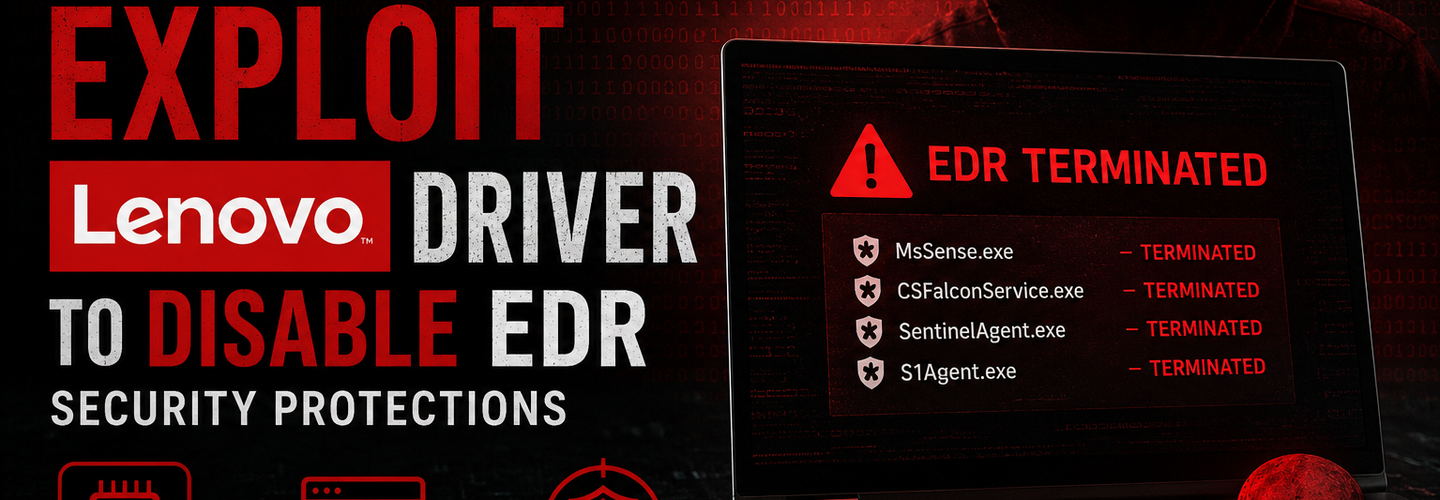
Hackers Exploit Vulnerable Lenovo Driver to Disable EDR Security Protections
Cybersecurity researchers are warning that threat actors are increasingly abusing legitimate but vulnerable drivers to undermine endpoint security tools, with a Lenovo driver now emerging as the latest concern in the growing “Bring Your Own Vulnerable Driver” (BYOVD) trend.
The issue highlights a broader shift in modern cyberattacks: instead of deploying noisy malware that triggers antivirus alerts, attackers are increasingly turning to trusted software components already signed and recognized by Windows systems. By exploiting weaknesses in vulnerable drivers, adversaries can interfere with Endpoint Detection and Response (EDR) protections, making attacks harder to detect and contain.
Security analysts say the activity demonstrates how trusted software supply chains and legacy drivers continue to create risk long after vendors release updates or discontinue products.
## Threat Overview
Researchers identified that attackers have been leveraging a vulnerable Lenovo driver capable of being abused to terminate or disrupt security-related processes running on Windows systems. The technique falls under the broader category of kernel-level abuse, where adversaries attempt to gain highly privileged access to operating system components.
Drivers operate at a deep level within Windows and are granted extensive permissions to interact with hardware and system memory. Because of these elevated privileges, a vulnerable or improperly secured driver can become a powerful attack vector if abused.
The Lenovo driver in question was reportedly legitimate and digitally signed, allowing it to bypass many traditional trust checks enforced by Windows. Once loaded onto a targeted machine, the vulnerable component could potentially be used to weaken or disable EDR protections that organizations rely on to detect ransomware, credential theft, lateral movement, and other malicious activity.
Security vendors note that BYOVD techniques have become increasingly common among ransomware operators and advanced intrusion groups over the past two years. Instead of exploiting unknown zero-day vulnerabilities, attackers often repurpose publicly known flaws in older drivers that remain accessible online.
This tactic has proven attractive because vulnerable drivers frequently evade scrutiny from traditional antivirus products due to their signed and legitimate origins.
## Technical Impact Analysis
While details surrounding the Lenovo driver exploitation vary across reported incidents, the broader security implications are significant.
EDR platforms depend heavily on visibility into system activity. These tools monitor processes, memory behavior, registry changes, network activity, and kernel-level events to identify suspicious behavior in real time. If attackers can interfere with those monitoring capabilities, organizations may lose one of their most important defensive layers.
Kernel-level driver abuse can lead to several security consequences:
- ▸Security process termination
- ▸Disabling behavioral monitoring
- ▸Tampering with protected services
- ▸Concealing malicious activity
- ▸Reduced forensic visibility
- ▸Increased ransomware execution success
Researchers emphasize that the threat is particularly concerning because it targets defensive infrastructure itself rather than directly attacking data or applications.
In many modern intrusions, attackers spend significant time attempting to neutralize security controls before deploying ransomware or stealing information. By impairing EDR visibility, threat actors gain more operational freedom inside compromised environments.
Microsoft has previously acknowledged the rise of vulnerable driver abuse and introduced measures such as the Microsoft Vulnerable Driver Blocklist, which is designed to prevent known dangerous drivers from loading on Windows systems. However, adoption gaps, outdated configurations, and inconsistent enforcement continue to leave many organizations exposed.
Some security teams also struggle with balancing compatibility and protection. Blocking older drivers outright can occasionally disrupt legacy hardware or enterprise applications, leading some organizations to disable strict driver controls.
That tradeoff increasingly favors attackers.
## The Growing BYOVD Problem
The Lenovo-related activity is part of a broader industry-wide challenge rather than an isolated event.
Over the past several years, cybersecurity firms have documented multiple ransomware groups abusing vulnerable drivers from various vendors, including hardware manufacturers and security software providers themselves.
The tactic is effective because trusted drivers inherently operate with elevated privileges. Once a vulnerable driver is loaded, attackers may gain capabilities that ordinary malware running in user mode cannot easily achieve.
Industry reports have shown that BYOVD attacks are increasingly appearing in:
- ▸Ransomware campaigns
- ▸Financially motivated intrusions
- ▸Credential theft operations
- ▸State-aligned cyber espionage activity
- ▸Data extortion incidents
Security researchers have also observed attackers rapidly reusing publicly disclosed driver vulnerabilities after proof-of-concept details become widely available online.
The problem is compounded by the sheer number of legacy drivers still circulating across enterprise environments. Large organizations often maintain older systems, outdated hardware, or legacy software dependencies that rely on drivers no longer actively maintained.
In many cases, vulnerable drivers remain installed for years without triggering alerts.
## Industry Implications
The Lenovo driver abuse case reinforces several uncomfortable realities facing enterprise defenders.
Trusted Software Is No Longer Automatically Safe
Digital signatures and vendor legitimacy remain important security mechanisms, but they are no longer sufficient indicators of safety. Attackers increasingly weaponize legitimate tools, drivers, and administrative utilities to blend into normal system activity.
This “living off trusted components” strategy complicates detection efforts because the software involved may not initially appear malicious.
Kernel-Level Security Remains a High-Risk Area
Windows kernel security has become a central battleground between attackers and defenders. Because drivers operate with powerful privileges, vulnerabilities in these components can have outsized impact.
Organizations are now being forced to pay closer attention to driver governance, integrity monitoring, and application control policies.
Security Products Themselves Are Targets
Modern cyberattacks increasingly focus on disabling security controls before launching the primary attack phase. EDR tampering has become a common precursor to ransomware deployment.
This trend has pushed security vendors to invest heavily in tamper protection, kernel isolation, and behavioral resilience technologies.
Regulatory and Compliance Pressure May Increase
Critical infrastructure operators and regulated industries could face increased scrutiny around driver management and endpoint hardening practices.
Cyber insurance providers may also begin evaluating driver control policies as part of risk assessments, particularly for organizations operating legacy Windows environments.
## Why This Matters
The exploitation of vulnerable drivers represents a troubling evolution in cybercrime tactics because it attacks the foundation of enterprise defense systems.
Traditional security strategies often assume that defensive software will remain operational during an attack. BYOVD techniques challenge that assumption directly.
If attackers can disable or blind EDR protections early in an intrusion, organizations may lose valuable detection windows that normally help contain threats before major damage occurs.
The risk extends beyond large enterprises. Small and medium-sized businesses frequently lack mature endpoint management practices, making them particularly vulnerable to outdated drivers and incomplete patch management.
Additionally, the growing use of legitimate signed components in attacks makes attribution and detection substantially more difficult. Security teams must now distinguish between normal driver activity and potentially malicious abuse of trusted software.
This shift raises the operational complexity of cybersecurity defense across the industry.
## How Users Can Stay Safe
Although the threat primarily affects enterprise environments, both organizations and individual users can take practical defensive measures to reduce exposure.
Keep Systems Updated
Apply Windows security updates promptly and ensure that driver updates from trusted vendors are installed regularly. Many vulnerable drivers remain exploitable simply because outdated versions persist on systems long after fixes become available.
Enable Microsoft’s Vulnerable Driver Blocklist
Organizations using modern Windows versions should verify that Microsoft’s vulnerable driver blocklist protections are enabled and actively enforced.
These protections can help prevent known risky drivers from loading.
Audit Installed Drivers
Security teams should conduct regular audits of installed drivers across endpoints and servers. Legacy or unnecessary drivers should be removed whenever possible.
Special attention should be given to systems running older hardware dependencies.
Strengthen Endpoint Protection Configurations
Ensure EDR and antivirus platforms have tamper protection enabled. Modern security tools often include safeguards designed to resist unauthorized modification or termination attempts.
Use Application Control Policies
Application allowlisting and driver control mechanisms can help restrict unauthorized or vulnerable components from running.
Technologies such as Windows Defender Application Control (WDAC) can significantly reduce attack surface exposure.
Monitor for Unusual Driver Activity
Security operations teams should monitor for suspicious driver loading events, unexpected kernel-level activity, or attempts to terminate security-related services.
Behavioral monitoring remains critical for identifying abuse of legitimate components.
Reduce Administrative Privileges
Limiting local administrative access can reduce opportunities for attackers to install or load malicious or vulnerable drivers.
Least-privilege access models remain an important defensive control.
## Official Responses
Microsoft and multiple security vendors have continued emphasizing the importance of driver security in recent years as BYOVD attacks become more widespread.
Microsoft has expanded its vulnerable driver blocklist initiatives and continues updating protections aimed at preventing known risky drivers from executing on Windows devices.
Security researchers also continue collaborating with hardware vendors to identify and remediate vulnerable drivers before they become widely abused in active attacks.
Lenovo has historically issued advisories and updates for driver-related vulnerabilities when identified, encouraging customers to maintain updated software and firmware environments.
Meanwhile, endpoint security vendors are increasingly enhancing behavioral analytics and tamper-protection capabilities to defend against kernel-level abuse attempts.
Government agencies have also warned about vulnerable driver exploitation trends. Cybersecurity authorities including the Cybersecurity and Infrastructure Security Agency and the National Security Agency have repeatedly urged organizations to strengthen endpoint hardening practices and improve patch management programs.
## Sources & References
- ▸Microsoft Security Guidance on Vulnerable Drivers
- ▸CISA Cybersecurity Advisories
- ▸Lenovo Security Advisories
- ▸MITRE ATT&CK – BYOVD Techniques
- ▸Microsoft Defender Tamper Protection Documentation
## Conclusion
The abuse of vulnerable Lenovo drivers to interfere with EDR protections underscores a larger cybersecurity challenge that extends far beyond a single vendor or vulnerability.
Attackers are increasingly exploiting trusted components already present within enterprise ecosystems, blurring the line between legitimate software and malicious activity. As BYOVD tactics continue evolving, organizations can no longer rely solely on traditional antivirus signatures or trust-based assumptions.
Defending against these threats requires a layered strategy focused on driver governance, endpoint hardening, behavioral monitoring, and proactive vulnerability management.
The rise of vulnerable driver exploitation also serves as a reminder that cybersecurity resilience depends not only on deploying security tools, but on protecting the integrity of those tools themselves.
Read More:
Gremlin Stealer Conceals C2 URLs and Exfiltration Paths in Encrypted Resource Sections
Copy Fail (CVE-2026-31431): The Linux Kernel Flaw That Handed Root to Anyone Who Asked
Malicious VS Code Extension Linked to Unauthorized Access of GitHub Internal Repositories
AI-Powered Cyber Threats Are Escalating Faster Than Enterprise Defenses Can Adapt
Urgent Chrome Update Released After Critical Remote Code Execution Vulnerabilities Discovered
## Analyst Commentary & Implementation Blueprint
Security advisory
Continuous security exposure assessment is critical to identifying public vulnerabilities before they are exploited. Organizations should maintain a passive inventory of all web servers, TLS configs, and open ports, ensuring that default configurations are eliminated and security advisories are actively implemented.
Hardened Security Configuration Blueprint
# General Security Hardening Directive
ServerTokens ProductOnly
ServerSignature Off
FileETag None
Actionable Mitigation Checklist
- ✔Perform passive asset inventories weekly.
- ✔Restrict administrative ports using local firewall controls.
- ✔Monitor active CVE alerts for exposed software.
Common Inquiries & FAQs
Why is passive scanning preferred for continuous auditing?
Passive audits do not cause operational impact or trigger firewall blocks, making them ideal for constant surveillance of internet-facing assets.
What should I do if a vulnerability is flagged?
Apply the latest vendor patches, restrict access to the resource via firewalls, or verify configuration flags to mitigate risks.
Surendra Reddy
Surendra Reddy is a cybersecurity researcher and founder of ReconShield, specializing in OSINT and defensive infrastructure analysis.
Connect on LinkedIn ↗// AUDIT BRIEFING DISCUSSION (2 COMMENTS)
Great breakdown of the passive infrastructure vectors. We recently audited our external DNS zones and found multiple dangling staging environments. Implementing wildcard certificates reduced our CT log leaks significantly.
Is there any automated tooling you recommend for daily crt.sh scraping? Manually checking CT logs is becoming unsustainable for our domain portfolio.
// MORE ARTICLES
Security Researchers Warn Critical n8n Flaws May Expose Automation Platforms to RCE
Researchers have disclosed critical vulnerabilities in n8n that could expose automation workflows and connected enterprise systems to remote code execution risks, prompting urgent patch recommendations for users and administrators.

How Agentic AI Is Changing Software Engineering and Expanding Mobile Attack Surfaces
Agentic AI is rapidly transforming software engineering workflows through automation and intelligent coding assistance, while cybersecurity experts warn of expanding mobile attack surfaces and emerging application security risks.

SplitVPN Hacked: Data Breach Exposes 865,000 User Records and 58 Million Hidden Connection Logs (July 2026)
SplitVPN hacked: 865,336 user records and 58 million connection logs exposed, directly contradicting the VPN's "no-logs" promise. What was leaked and what to do now.