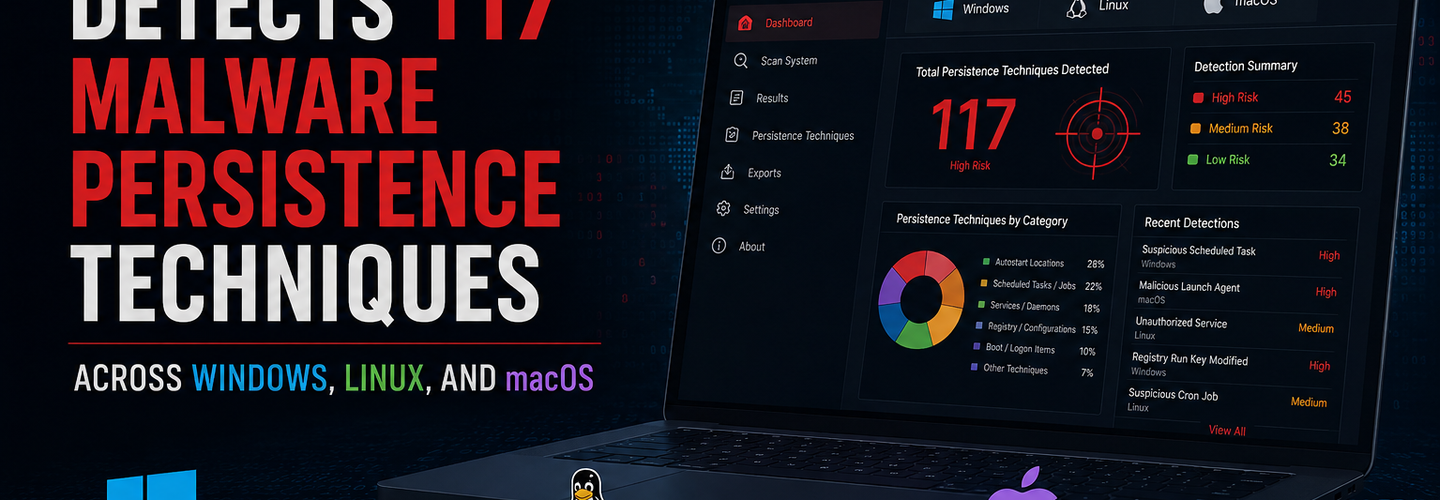
PyrsistenceSniper Detects 117 Malware Persistence Techniques Across Windows, Linux, and macOS
Cybersecurity defenders are facing a growing challenge that rarely makes headlines outside incident response circles: persistence. While ransomware campaigns and data breaches dominate public attention, many modern intrusions become dangerous because attackers quietly maintain long-term access to compromised systems. A newly released open-source security tool called PyrsistenceSniper aims to change how defenders identify those hidden footholds across Windows, Linux, and macOS environments.
The tool, designed for defensive security teams and digital forensics professionals, reportedly detects 117 distinct persistence techniques commonly abused by malware, threat actors, and advanced intrusion groups. Its cross-platform visibility is drawing attention from enterprise defenders, managed security providers, and blue teams looking to improve post-compromise detection capabilities.
As organizations increasingly operate hybrid infrastructures spanning multiple operating systems, security analysts say tools like PyrsistenceSniper reflect a broader industry shift toward proactive persistence hunting rather than relying solely on antivirus signatures or endpoint alerts.
## Threat Overview
Persistence mechanisms allow malicious software or unauthorized processes to survive reboots, user logouts, system updates, or even partial remediation attempts. In many real-world intrusions, persistence is what transforms a short-lived compromise into a long-term security incident.
Security researchers have repeatedly observed persistence techniques being leveraged by ransomware operators, espionage-focused threat groups, cryptomining campaigns, and financially motivated cybercriminals. These methods often target startup folders, scheduled tasks, registry entries, launch agents, services, kernel extensions, login items, cron jobs, and other system-level autostart locations.
PyrsistenceSniper appears designed to centralize visibility into these areas by scanning for suspicious or unauthorized persistence artifacts across major operating systems.
Unlike traditional antivirus products that prioritize malware signatures, persistence hunting tools focus on identifying abnormal system behavior and unauthorized configuration changes. That distinction is becoming increasingly important as modern malware families adopt fileless techniques, legitimate administrative tools, and living-off-the-land tactics to evade detection.
Cybersecurity analysts say persistence abuse has expanded significantly over the last several years due to the rise of stealth-focused operations.
According to multiple incident response reports published by major cybersecurity vendors, attackers increasingly prioritize durability inside victim environments, especially during espionage campaigns or pre-ransomware staging operations. In many breaches, adversaries spend days or weeks maintaining quiet access before triggering destructive payloads.
## Technical Impact Analysis
PyrsistenceSniper’s reported ability to identify 117 persistence techniques across Windows, Linux, and macOS is notable because cross-platform visibility remains a major blind spot for many organizations.
Large enterprises often deploy different security tools for each operating system, creating fragmented telemetry and inconsistent detection coverage. Threat actors have exploited this fragmentation by targeting overlooked systems, particularly Linux servers and macOS endpoints that may not receive the same monitoring attention as Windows environments.
The tool reportedly examines numerous persistence vectors including:
- ▸Scheduled execution mechanisms
- ▸Startup configurations
- ▸Service modifications
- ▸Registry-based autoruns
- ▸Shell initialization files
- ▸Launch daemons and agents
- ▸Cron-related persistence
- ▸User profile autostart entries
- ▸System service anomalies
- ▸Boot-level execution points
From a defensive standpoint, visibility into these persistence locations can help security teams identify remnants of prior compromises, unauthorized remote access tools, or suspicious administrative modifications that escaped earlier detection.
Analysts note that persistence discovery is particularly valuable during incident response investigations. Even after malicious payloads are removed, persistence artifacts can remain active and allow reinfection or re-entry into a network.
Another important aspect is platform normalization. Security teams often struggle to correlate persistence indicators across different operating systems because each environment uses distinct startup architectures and management frameworks.
By consolidating checks into a unified framework, PyrsistenceSniper may help reduce investigative complexity for security operations centers (SOCs) managing heterogeneous infrastructure.
Researchers also point out that persistence detection plays a critical role in supply chain security investigations. Compromised software installers, trojanized updates, or unauthorized administrative tooling may establish persistence in subtle ways that bypass standard malware scanning.
The rise of remote and hybrid work environments further increases the importance of persistence monitoring. Devices operating outside traditional corporate networks may not always receive immediate threat remediation or centralized visibility, allowing malicious footholds to remain undetected for extended periods.
## Industry Implications
The release of tools focused specifically on persistence detection reflects a broader evolution in cybersecurity defense priorities.
Over the past decade, enterprise security strategies largely emphasized prevention-based controls such as firewalls, antivirus platforms, and perimeter security. However, the increase in credential theft, cloud abuse, insider threats, and sophisticated malware campaigns has forced organizations to assume that some intrusions will eventually bypass preventive defenses.
This “assume breach” mindset has accelerated demand for threat hunting, behavioral monitoring, endpoint telemetry, and post-compromise visibility tools.
PyrsistenceSniper enters a market where defenders are increasingly investing in:
- ▸Endpoint detection and response (EDR)
- ▸Extended detection and response (XDR)
- ▸Threat hunting frameworks
- ▸Digital forensics tooling
- ▸Continuous exposure management
- ▸Security validation platforms
The timing is also significant. Regulatory pressure surrounding cyber resilience continues to intensify globally. New cybersecurity disclosure rules, ransomware reporting requirements, and infrastructure protection mandates are pushing organizations to improve detection maturity and incident response readiness.
For managed security service providers (MSSPs), persistence detection tools may also become valuable during compromise assessments and forensic investigations. Security consultants frequently encounter environments where attackers maintained hidden persistence for months before discovery.
Healthcare, financial services, government agencies, and critical infrastructure operators are particularly likely to benefit from enhanced persistence monitoring due to their elevated risk profiles.
Another industry trend influencing adoption is the growing focus on Linux and macOS security. Historically, Windows environments received the majority of defensive tooling investment. But cloud-native infrastructure, developer workstations, and enterprise Apple deployments have expanded the attack surface dramatically.
Security experts warn that attackers increasingly recognize these operational gaps.
## Why This Matters
Persistence is often the difference between a blocked attack and a full-scale breach.
An organization may successfully detect an initial intrusion attempt, remove malicious files, and restore systems—yet still remain compromised if persistence artifacts survive remediation efforts.
That risk becomes especially dangerous in modern enterprise environments where cloud services, remote access systems, identity providers, and distributed endpoints create multiple paths for attackers to regain access.
The emergence of tools like PyrsistenceSniper matters because defenders need deeper visibility into how systems maintain execution privileges over time.
Cybersecurity professionals frequently compare persistence artifacts to “digital fingerprints” left behind after unauthorized activity. Even when malware disappears, persistence entries can reveal compromise timelines, attacker objectives, or attempted lateral movement.
The broader implication is operational resilience.
As ransomware groups become more organized and financially motivated, persistence-based reinfection risks are growing. Several high-profile investigations over recent years revealed attackers returning to previously compromised environments through overlooked persistence mechanisms.
For defenders, persistence monitoring is no longer optional—it is becoming a core component of modern cyber hygiene.
## How Users Can Stay Safe
While tools like PyrsistenceSniper can help identify suspicious persistence mechanisms, cybersecurity experts stress that organizations should adopt layered defensive practices rather than relying on a single tool.
Security teams and users can reduce persistence-related risks by following several best practices:
1. Maintain Strong Endpoint Visibility
Organizations should deploy endpoint monitoring solutions capable of detecting unauthorized startup modifications, suspicious services, or abnormal scheduled tasks.
Continuous telemetry collection significantly improves incident response effectiveness.
2. Apply Security Updates Promptly
Many persistence-related compromises begin with exploitation of known vulnerabilities.
Keeping operating systems, browsers, VPNs, remote management software, and third-party applications fully patched remains one of the most effective defensive measures.
3. Audit Startup and Autorun Locations
Security administrators should regularly review startup entries, scheduled tasks, launch agents, cron jobs, and system services for unexpected modifications.
Routine audits can help identify suspicious persistence artifacts before they escalate into major incidents.
4. Implement Least Privilege Controls
Limiting administrative access reduces the ability of malicious software to establish deep persistence mechanisms.
Users should avoid operating with elevated privileges unless necessary.
5. Strengthen Identity Security
Compromised credentials frequently enable persistent unauthorized access.
Organizations should enforce:
- ▸Multi-factor authentication (MFA)
- ▸Conditional access policies
- ▸Password hygiene requirements
- ▸Identity monitoring controls
6. Monitor for Anomalous Behavior
Persistence mechanisms often generate subtle behavioral indicators such as unusual process launches, repeated login activity, or unauthorized configuration changes.
Behavioral analytics and threat hunting programs can improve detection rates.
7. Conduct Regular Incident Response Exercises
Security teams should practice persistence discovery and eradication workflows during tabletop exercises and compromise simulations.
Many organizations focus on initial containment but overlook long-term persistence cleanup procedures.
## Official Responses
At the time of writing, the broader cybersecurity community appears to be evaluating PyrsistenceSniper primarily as a defensive research and incident response utility rather than an offensive security framework.
Industry researchers have increasingly advocated for greater transparency around persistence detection because many traditional security tools prioritize prevention over forensic visibility.
Several major security vendors and government agencies—including the U.S. Cybersecurity and Infrastructure Security Agency (CISA), the UK National Cyber Security Centre (NCSC), and the Australian Cyber Security Centre (ACSC)—have repeatedly emphasized the importance of persistence monitoring in post-compromise investigations.
CISA guidance related to enterprise hardening and incident response consistently highlights persistence discovery as a critical remediation step following intrusions.
Defensive tooling that improves cross-platform visibility is likely to receive growing attention as organizations modernize their infrastructure and adopt more diverse endpoint ecosystems.
## Sources & References
- ▸U.S. Cybersecurity and Infrastructure Security Agency (CISA)
- ▸MITRE ATT&CK Framework
- ▸Microsoft Security Intelligence Reports
- ▸CrowdStrike Global Threat Reports
- ▸Mandiant Incident Response Research
- ▸Palo Alto Networks Unit 42 Threat Intelligence
- ▸SentinelOne Threat Labs
- ▸Elastic Security Research
- ▸Red Canary Threat Detection Reports
- ▸Public documentation and defensive analysis related to PyrsistenceSniper
## Conclusion
The release of PyrsistenceSniper highlights an increasingly important reality in cybersecurity: detecting malicious code is no longer enough. Organizations must also identify the hidden mechanisms that allow threats to survive inside systems long after initial compromise.
As enterprise environments become more distributed and attackers continue adopting stealth-focused techniques, persistence visibility is emerging as a critical layer of cyber defense.
For defenders, the value of tools like PyrsistenceSniper lies not in sensationalism, but in operational clarity. Understanding how systems maintain unauthorized execution paths can dramatically improve incident response outcomes, reduce reinfection risks, and strengthen long-term resilience.
In an era where attackers prioritize staying hidden, visibility into persistence may ultimately become one of the most important capabilities modern security teams possess.
Read More:
Hackers Exploit Vulnerable Lenovo Driver to Disable EDR Security Protections
QR Code Phishing Explodes in 2026 as Microsoft Detects 8.3 Billion Email Threats
Public Exploit Code Emerges for Chromium Flaw Potentially Affecting Millions Worldwide
F5 BIG-IP Appliances Targeted by Hackers for SSH Intrusions Into Enterprise Linux Systems
Vellore Man Arrested in Cambodia Cyber Slavery Racket Linked to Online Scam Networks
Cyber Fraud in Bengaluru: Elderly Woman Loses Rs 7.69 Lakh After Clicking Fake WhatsApp Link
10,000+ Zero-Day Vulnerabilities Identified by Anthropic Claude Mythos in Glasswing Project
## Analyst Commentary & Implementation Blueprint
Security advisory
Continuous security exposure assessment is critical to identifying public vulnerabilities before they are exploited. Organizations should maintain a passive inventory of all web servers, TLS configs, and open ports, ensuring that default configurations are eliminated and security advisories are actively implemented.
Hardened Security Configuration Blueprint
# General Security Hardening Directive
ServerTokens ProductOnly
ServerSignature Off
FileETag None
Actionable Mitigation Checklist
- ✔Perform passive asset inventories weekly.
- ✔Restrict administrative ports using local firewall controls.
- ✔Monitor active CVE alerts for exposed software.
Common Inquiries & FAQs
Why is passive scanning preferred for continuous auditing?
Passive audits do not cause operational impact or trigger firewall blocks, making them ideal for constant surveillance of internet-facing assets.
What should I do if a vulnerability is flagged?
Apply the latest vendor patches, restrict access to the resource via firewalls, or verify configuration flags to mitigate risks.
Surendra Reddy
Surendra Reddy is a cybersecurity researcher and founder of ReconShield, specializing in OSINT and defensive infrastructure analysis.
Connect on LinkedIn ↗// AUDIT BRIEFING DISCUSSION (2 COMMENTS)
Great breakdown of the passive infrastructure vectors. We recently audited our external DNS zones and found multiple dangling staging environments. Implementing wildcard certificates reduced our CT log leaks significantly.
Is there any automated tooling you recommend for daily crt.sh scraping? Manually checking CT logs is becoming unsustainable for our domain portfolio.
// MORE ARTICLES
Security Researchers Warn Critical n8n Flaws May Expose Automation Platforms to RCE
Researchers have disclosed critical vulnerabilities in n8n that could expose automation workflows and connected enterprise systems to remote code execution risks, prompting urgent patch recommendations for users and administrators.

How Agentic AI Is Changing Software Engineering and Expanding Mobile Attack Surfaces
Agentic AI is rapidly transforming software engineering workflows through automation and intelligent coding assistance, while cybersecurity experts warn of expanding mobile attack surfaces and emerging application security risks.

SplitVPN Hacked: Data Breach Exposes 865,000 User Records and 58 Million Hidden Connection Logs (July 2026)
SplitVPN hacked: 865,336 user records and 58 million connection logs exposed, directly contradicting the VPN's "no-logs" promise. What was leaked and what to do now.