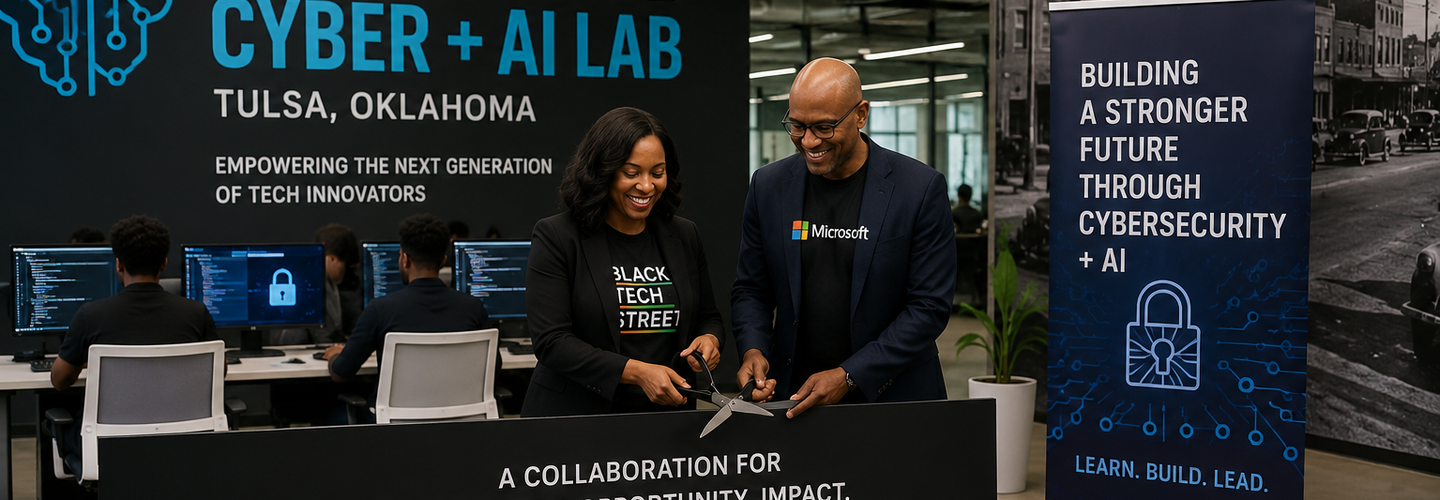
Greenwood Cyber + AI Lab Opens in Tulsa Through Microsoft and Black Tech Street Collaboration
"This moment in technology is moving incredibly quickly, and Microsoft believes it is important that innovation be paired with security, trust, and broad opportunity."
Michael Salazar, General Manager, Greenwood Cyber + AI Lab, Microsoft
On a Thursday morning in late May, members of the Carver Middle School band played inside a freshly opened technology lab housed in a building that once stood within a neighborhood reduced to ash by one of America's most devastating acts of racial violence. The Greenwood Entrepreneurship at Moton (GEM) building in Tulsa, Oklahoma — named for the historically Black school that once occupied the site — is now home to the Greenwood Cyber + AI Lab, a co-innovation facility jointly developed by Microsoft and Black Tech Street. For Tyrance Billingsley II, the founder and CEO of Black Tech Street, it was, in his words, "the most monumental day in Black Tech Street's history so far."
The symbolism is hard to overstate. Historic Greenwood was once called Black Wall Street — a thriving economic enclave destroyed in the 1921 Tulsa Race Massacre. A century later, the neighborhood is hosting one of the most consequential cybersecurity and artificial intelligence workforce initiatives in the country, backed by $10.6 million in federal investment and the engineering resources of one of the world's largest technology companies.
## What the Lab Actually Does
The Greenwood Cyber + AI Lab is not an incubator in the traditional sense — it's a hands-on co-innovation environment where organizations work directly alongside Microsoft engineers and researchers. That distinction matters. Rather than offering mentorship from afar, the facility provides direct access to advanced Microsoft AI and cybersecurity platforms, with real technical collaboration embedded into the model from day one.
The lab operates under four strategic focus areas: startup and enterprise innovation, critical infrastructure security, autonomous systems development, and responsible AI research. Each area reflects a deliberate alignment between national security priorities and community economic opportunity — a combination that has historically been difficult to achieve at scale.
$51MFederal Tech Hubs Funding for Tulsa Region$10.6MAllocated to Greenwood AI Center of Excellence2024Year Tulsa Named Federal Tech Hub
The lab is one of two pillars within the broader Greenwood AI Center of Excellence (G-ACE), designed and operated by Black Tech Street in partnership with Microsoft and SeedAI. The second pillar is ASPIRE — an AI Societal Program for Innovation, Research, and Education — which focuses on community-wide AI fluency, from middle schoolers to mid-career professionals. The dual structure is intentional: the lab accelerates applied innovation while ASPIRE builds the pipeline of technically literate talent that feeds it.
Context: Federal Tech Hubs Program
Tulsa was designated a Federal Tech Hub by the U.S. Economic Development Administration in 2024, specifically for its leadership in autonomous systems technologies including drones, robotics, and intelligent mobility. The city's Tech Hubs coalition, led by Tulsa Innovation Labs, secured $51 million to anchor the region's emergence as a national center for advanced autonomy — and the Greenwood AI Center of Excellence sits at the heart of that strategy.
## Critical Infrastructure Security Gets a Community Anchor
One of the lab's four focus areas deserves particular attention from the security community: critical infrastructure resilience. At a time when threats to power grids, water systems, transportation networks, and telecommunications infrastructure are escalating in both frequency and sophistication, the United States faces an equally serious but less publicized challenge — a severe shortage of cybersecurity professionals qualified to defend those systems.
According to ISC2's 2024 Cybersecurity Workforce Study, the global cybersecurity workforce gap stands at approximately 4.8 million unfilled positions. Within the United States alone, hundreds of thousands of cybersecurity roles remain vacant, with critical infrastructure sectors — energy, utilities, healthcare, and transportation — among the hardest hit. The problem is partly technical, but it's also geographic and demographic: the talent pipeline has historically drawn from a narrow band of institutions and communities, leaving vast reservoirs of potential untapped.
The Greenwood Cyber + AI Lab takes direct aim at that structural deficiency. By embedding cybersecurity research and workforce development inside a historically Black community with existing ties to entrepreneurship and resilience, the initiative represents a genuine attempt to diversify not just the people working in security, but the perspectives shaping how it's practiced.
"Founders, researchers, technologists, and community partners — responsibly developing and deploying technologies that create real-world impact. From helping startups scale to strengthening critical infrastructure resilience."— Michael Salazar, General Manager, Greenwood Cyber + AI Lab, Microsoft
## Responsible AI as a Security Imperative
The lab's fourth strategic pillar — responsible AI development — speaks directly to one of the most consequential threat vectors the security industry is grappling with right now. As AI systems proliferate across enterprise environments, government operations, and critical infrastructure, the attack surface they create has grown at a pace that most organizations are not equipped to manage. Adversarial machine learning, model poisoning, prompt injection, and AI-assisted social engineering represent a class of threats that traditional security frameworks were never designed to address.
Microsoft's involvement gives the Greenwood lab access to the company's substantial research output on AI security, including work from the Azure AI Red Team and the Security Copilot product line. That proximity to enterprise-grade AI security tooling — made available in a community-facing environment — is unusual in the workforce development landscape. Most cybersecurity training programs teach defensive concepts in isolation; this model integrates those concepts with the actual platforms defenders will encounter in production environments.
Why Responsible AI Matters for Defenders
- ▸AI models deployed without rigorous testing can be manipulated to produce false outputs, bypass detection logic, or expose sensitive training data through inference attacks.
- ▸Security teams that understand AI architecture are better positioned to evaluate vendor claims, conduct meaningful assessments, and design controls that hold up under adversarial pressure.
- ▸Regulatory frameworks governing AI-enabled systems — from NIST's AI Risk Management Framework to the EU AI Act — increasingly require documented evidence of responsible development practices.
- ▸Organizations that embed security into AI development from the outset face lower remediation costs and reduced liability exposure when incidents occur.
## Industry Implications: A Replicable Model?
The Greenwood Cyber + AI Lab is explicitly positioned as a model — not just a local initiative. Both Black Tech Street and Microsoft have framed the facility as a template for how communities across the United States might anchor AI and cybersecurity innovation in places that have historically been left out of the technology economy. Billingsley has said that the United States will need a model to look to as it works to lead the world in AI innovation, and that Tulsa "looks forward to being that example."
That framing carries real weight at a moment when the federal government is actively seeking to build domestic AI and cybersecurity capacity outside the traditional coastal tech corridors. The 2024 National Cybersecurity Strategy and subsequent implementation plans have emphasized workforce expansion and geographic diversification as national security priorities. The Greenwood model — community-led, federally funded, anchored by enterprise partnership — addresses all three legs of that stool simultaneously.
Early private-sector engagement supports the scale ambition. Lumen Technologies, a major telecommunications and technology company with a significant employer presence in the Tulsa region, has announced initial collaboration plans with the lab focused on applied AI, infrastructure resilience, and community engagement. As a company that describes itself as "the trusted network for AI," Lumen's participation signals that the lab is being taken seriously as a site of real enterprise-grade work, not just programmatic outreach.
## Why This Matters
The cybersecurity industry has a pipeline problem and a representation problem, and those two problems are deeply connected. A field that draws from a homogenous pool of institutions and networks will inevitably miss threat patterns, overlook edge cases, and design systems that work well for some users and poorly for others. Diversity in the security workforce is not merely an equity goal — it's an analytical necessity.
The Greenwood Cyber + AI Lab is one of the most credible attempts in recent memory to address both problems at once. It pairs federal backing with corporate expertise and community ownership in a configuration that gives it a real chance of producing durable outcomes rather than short-lived grant cycles. The ASPIRE program's focus on AI fluency for people of all ages ensures that the benefits aren't confined to participants already on a technology career path — they extend to the community's broader economic landscape.
For the security industry, this initiative matters because the talent it develops will eventually work in security operations centers, on infrastructure protection teams, and inside the AI development pipelines that will define the threat environment of the next decade. Getting those professionals trained with exposure to enterprise tools, responsible development practices, and real-world infrastructure challenges — rather than just abstract coursework — gives them a meaningful head start.
## How Organizations and Individuals Can Get Involved
- ▸→Security professionals can explore collaboration opportunities with the lab through Black Tech Street's official channels, particularly if their work touches autonomous systems, critical infrastructure, or AI security research.
- ▸→Organizations evaluating AI deployment should take seriously the responsible AI framework being developed at the lab — NIST's AI Risk Management Framework provides a compatible baseline for internal security reviews.
- ▸→Educators and institutions in the Tulsa region should connect with the ASPIRE program, which is designed to build AI literacy across age groups and professional backgrounds.
- ▸→Policymakers and workforce planners at the federal and state levels should study the G-ACE model as a potential template for replication in other federally designated Tech Hub cities.
- ▸→Individuals seeking careers in AI security or autonomous systems should watch for public-facing programs emerging from the ASPIRE initiative as the lab moves from its launch phase into full operation.
## Official Responses and Partner Statements
The lab's opening drew participation from Tulsa's Deputy Mayor Kristi Reyes, underscoring the municipal government's stake in the initiative's success. Billingsley II described the moment as deeply personal — the GEM building sits across the street from the middle school he attended, and Black Tech Street's headquarters now shares the space with the Microsoft lab.
Microsoft's Michael Salazar characterized the initiative as a demonstration of the company's belief that security and trust cannot be separated from the pace of technological progress. Partners including SeedAI and Tulsa Innovation Labs have each contributed structural components — SeedAI to the AI fluency and education programming, Tulsa Innovation Labs to the broader Tech Hub strategy that gave the project its federal mandate and funding runway.
NVIDIA had previously established an AI education partnership with Black Tech Street in September 2025, positioning Tulsa's Greenwood district within a growing constellation of major technology relationships that extend the community's reach into applied AI infrastructure well beyond what any single partner could provide.
The cybersecurity industry has spent years talking about the importance of diversity, equity, and inclusion in the security workforce. The Greenwood Cyber + AI Lab is a concrete, federally anchored, enterprise-partnered response to that conversation — one that bets on a community rather than a program, and on sustained collaboration rather than one-time investment. Whether it becomes the national model that Billingsley and Microsoft envision will depend on execution, continuity, and the willingness of the security industry to engage with it as a peer rather than a charity. The early indicators suggest that both the ambition and the architecture are in place. The rest is work.
Sources & References
- ▸PR Newswire — "Microsoft and Black Tech Street Launch Greenwood Cyber + AI Lab in Tulsa" (May 21, 2026)
- ▸HiTech Nectar — Full partner statement and lab initiative overview (May 22, 2026)
- ▸FOX23 Tulsa — Local coverage of Greenwood Cyber + AI Lab opening (May 2026)
- ▸Black Wall Street Times — NVIDIA and Black Tech Street AI Education Partnership (September 2025)
- ▸ISC2 — Cybersecurity Workforce Study 2024 (cybersecurity workforce gap data)
- ▸NIST — AI Risk Management Framework (AI RMF 1.0), National Institute of Standards and Technology
- ▸U.S. Economic Development Administration — Tech Hubs Program, Tulsa Designation (2024)
- ▸The White House — National Cybersecurity Strategy Implementation Plan (2024)
Read More:
F5 BIG-IP Appliances Targeted by Hackers for SSH Intrusions Into Enterprise Linux Systems
Vellore Man Arrested in Cambodia Cyber Slavery Racket Linked to Online Scam Networks
Cyber Fraud in Bengaluru: Elderly Woman Loses Rs 7.69 Lakh After Clicking Fake WhatsApp Link
10,000+ Zero-Day Vulnerabilities Identified by Anthropic Claude Mythos in Glasswing Project
PyrsistenceSniper Detects 117 Malware Persistence Techniques Across Windows, Linux, and macOS
## Analyst Commentary & Implementation Blueprint
Security advisory
Continuous security exposure assessment is critical to identifying public vulnerabilities before they are exploited. Organizations should maintain a passive inventory of all web servers, TLS configs, and open ports, ensuring that default configurations are eliminated and security advisories are actively implemented.
Hardened Security Configuration Blueprint
# General Security Hardening Directive
ServerTokens ProductOnly
ServerSignature Off
FileETag None
Actionable Mitigation Checklist
- ✔Perform passive asset inventories weekly.
- ✔Restrict administrative ports using local firewall controls.
- ✔Monitor active CVE alerts for exposed software.
Common Inquiries & FAQs
Why is passive scanning preferred for continuous auditing?
Passive audits do not cause operational impact or trigger firewall blocks, making them ideal for constant surveillance of internet-facing assets.
What should I do if a vulnerability is flagged?
Apply the latest vendor patches, restrict access to the resource via firewalls, or verify configuration flags to mitigate risks.
Surendra Reddy
Surendra Reddy is a cybersecurity researcher and founder of ReconShield, specializing in OSINT and defensive infrastructure analysis.
Connect on LinkedIn ↗// AUDIT BRIEFING DISCUSSION (2 COMMENTS)
Great breakdown of the passive infrastructure vectors. We recently audited our external DNS zones and found multiple dangling staging environments. Implementing wildcard certificates reduced our CT log leaks significantly.
Is there any automated tooling you recommend for daily crt.sh scraping? Manually checking CT logs is becoming unsustainable for our domain portfolio.
// MORE ARTICLES
SplitVPN Hacked: Data Breach Exposes 865,000 User Records and 58 Million Hidden Connection Logs (July 2026)
SplitVPN hacked: 865,336 user records and 58 million connection logs exposed, directly contradicting the VPN's "no-logs" promise. What was leaked and what to do now.

Critical WordPress wp2shell RCE Vulnerability Puts Millions of Sites at Risk—Patch Now
wp2shell is a pre-auth RCE in WordPress Core affecting 500M+ sites. Public exploits exist—patch to 7.0.2 or 6.9.5 immediately.
New Windows RDP Flaws Could Lead to Data Theft — Everything You Need to Know
Microsoft patched a dozen Windows RDP flaws in July 2026 that could leak memory data. See affected versions, KB numbers, and how to patch.