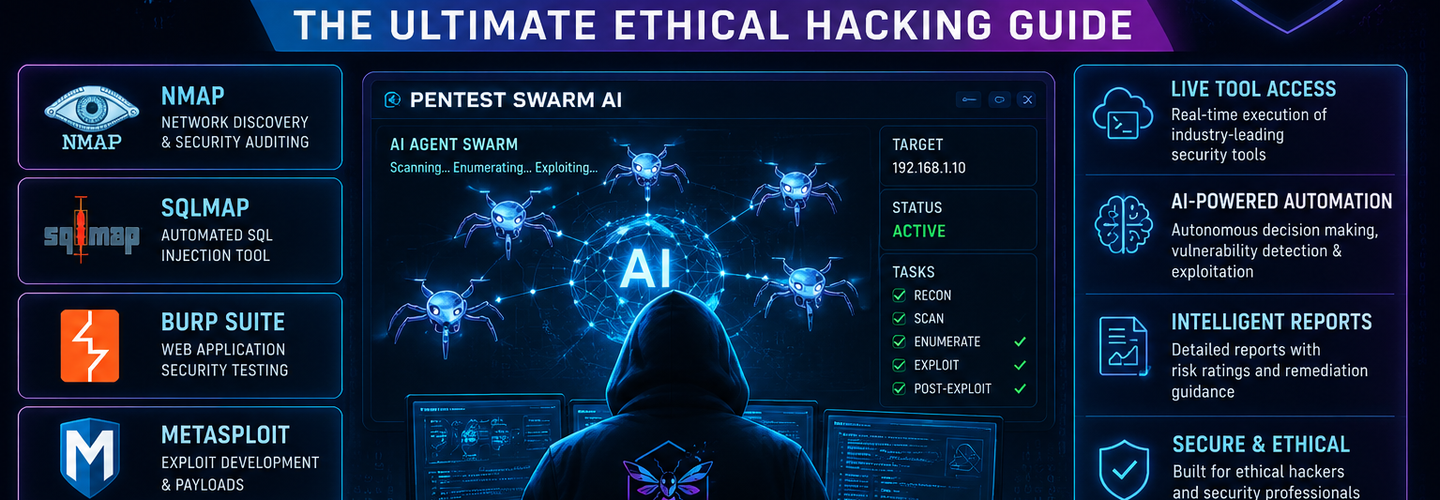
Pentest Swarm AI Tool With Live Access to Nmap, SQLMap, Burp Suite, and Metasploit: The Ultimate Ethical Hacking Guide
Summarize this blog post with: ChatGPT | Perplexity | Claude | Grok
Most security teams already use vulnerability scanners, recon tools, and penetration testing frameworks to identify weaknesses in their environments. What many organizations are missing is how AI-powered swarm agents can coordinate these tools into an autonomous offensive security workflow that continuously discovers, validates, and prioritizes risks. In this guide, you'll learn what Pentest Swarm AI is, how its multi-agent architecture works, which tools it integrates with, and how enterprises can safely use AI-driven penetration testing at scale.
Key Takeaways
- ▸Pentest Swarm AI uses multiple autonomous security agents that collaborate to automate reconnaissance, vulnerability analysis, exploitation, and reporting workflows.
- ▸AI-powered penetration testing improves scalability by coordinating offensive security tasks across multiple tools and attack stages simultaneously.
- ▸Swarm-based cybersecurity systems differ from traditional automation because they use specialized agents that share context and coordinate decisions dynamically.
- ▸Human oversight remains critical because AI-driven pentesting systems can generate false positives, unsafe exploit attempts, and incomplete security assessments.
- ▸Tool integrations commonly include Nmap, SQLMap, Burp Suite, Metasploit, ProjectDiscovery utilities, and AI orchestration frameworks.
- ▸Continuous security validation helps organizations identify vulnerabilities as infrastructure, applications, and cloud environments evolve.
- ▸AI-human collaboration produces better results than fully autonomous offensive security operations.
What Is Pentest Swarm AI and How Does It Work?
Pentest Swarm AI is a multi-agent penetration testing framework that uses autonomous AI security agents to coordinate reconnaissance, vulnerability discovery, exploitation, and reporting.
Unlike traditional automation scripts that execute predefined workflows, Pentest Swarm AI systems dynamically coordinate multiple specialized agents that communicate, share context, and adapt their actions based on discovered attack paths.
Swarm AI cybersecurity systems use specialized agents that collaborate through shared context and coordinated decision-making to execute complex security workflows.
For example, a reconnaissance agent may discover an exposed web application, pass findings to an enumeration agent, which then forwards identified vulnerabilities to an exploitation agent for validation.
According to Gartner, organizations are expected to increase AI-driven security automation investments significantly through 2027 as attack surfaces continue expanding — Source: Gartner, 2025.
Single-Agent vs Multi-Agent Security Systems
Single-agent security systems rely on one AI model to perform all offensive security tasks.
These systems often struggle with context management, decision-making complexity, and scalability.
Multi-agent pentesting systems divide responsibilities across specialized security agents.
Examples include:
- ▸Reconnaissance agents
- ▸Enumeration agents
- ▸Vulnerability analysis agents
- ▸Exploitation agents
- ▸Reporting agents
- ▸Remediation recommendation agents
This specialization improves efficiency and reduces workflow bottlenecks.
What Is Swarm Intelligence in Cybersecurity?
Swarm intelligence cybersecurity refers to multiple AI agents working collectively to solve complex security challenges.
The concept originates from biological swarm behavior observed in ants, bees, and birds.
For example, instead of one AI attempting to assess an entire enterprise environment, dozens of agents can simultaneously analyze infrastructure, applications, cloud assets, and exposed services.
Why Does Pentest Swarm AI Matter in Modern Cybersecurity?
Pentest Swarm AI matters because modern attack surfaces are growing faster than security teams can manually assess them.
Organizations now manage cloud infrastructure, APIs, SaaS platforms, containers, mobile applications, and remote work environments simultaneously.
According to IBM, the average cost of a data breach reached $4.88 million globally — Source: IBM Cost of a Data Breach Report, 2024.
Meanwhile, ISC2 reported a global cybersecurity workforce shortage exceeding 4 million professionals — Source: ISC2 Workforce Study, 2024.
Growing Attack Surfaces
Attack surfaces expand whenever organizations deploy new infrastructure, applications, or cloud services.
For example, a company launching microservices across AWS, Azure, and Kubernetes environments may expose hundreds of new attack vectors within weeks.
Continuous security validation
Limitations of Traditional Manual Pentesting
Traditional penetration testing provides valuable insights but is typically point-in-time and resource-intensive.
Many organizations conduct security assessments only once or twice annually.
That approach leaves long periods where newly introduced vulnerabilities remain undetected.
Need for Continuous Security Validation
Continuous security validation uses automated offensive security testing to identify vulnerabilities as infrastructure, applications, and cloud environments change.
This capability is one of the strongest advantages of Pentest Swarm AI platforms.
How Does Pentest Swarm AI Automate Reconnaissance and Enumeration?
Pentest Swarm AI automates reconnaissance and enumeration by assigning dedicated agents to discovery, mapping, fingerprinting, and vulnerability identification tasks.
These agents operate simultaneously while sharing findings through centralized orchestration systems.
Reconnaissance Agents
Reconnaissance agents identify internet-facing assets and attack surface exposures.
Common activities include:
- ▸Subdomain enumeration
- ▸DNS analysis
- ▸SSL inspection
- ▸Technology fingerprinting
- ▸Asset discovery
You can perform many of these tasks using ReconShield's:
Enumeration Agents
Enumeration agents gather detailed information about discovered services and technologies.
For example, after identifying an exposed web application, the agent may:
- ▸Enumerate endpoints
- ▸Detect frameworks
- ▸Identify CMS versions
- ▸Analyze HTTP headers
- ▸Review SSL configurations
Web application security testing
Vulnerability Analysis Agents
Vulnerability analysis agents correlate discovered assets with known CVEs, misconfigurations, and exploit paths.
For example, an agent may detect:
- ▸Outdated WordPress plugins
- ▸Exposed admin panels
- ▸Weak TLS configurations
- ▸Missing security headers
- ▸Public cloud storage exposures
How Do Swarm AI Agents Coordinate Attack Chains?
Swarm AI agents coordinate attack chains through orchestration layers that exchange context, findings, objectives, and execution priorities.
Instead of working independently, agents continuously update a shared knowledge graph.
Shared Context Architecture
A typical workflow looks like:
Asset discovery agent identifies targets
Port scanning agent discovers services
Enumeration agent fingerprints technologies
Vulnerability agent maps CVEs
Exploitation agent validates findings
Reporting agent generates evidence
This coordinated approach reduces duplicated effort and improves attack path discovery.
Vulnerability Chaining
Vulnerability chaining combines multiple lower-risk weaknesses into a higher-impact attack path.
For example:
- ▸Exposed Git repository
- ▸Leaked credentials
- ▸VPN access
- ▸Privilege escalation
Individually these issues may appear low risk.
Together they can create a critical compromise path.
Which Security Tools Integrate With Pentest Swarm AI Platforms?
Pentest Swarm AI platforms integrate with offensive security tools, reconnaissance frameworks, and orchestration systems to automate penetration testing workflows.
Nmap Integration
Nmap provides network discovery, host identification, and service enumeration capabilities.
AI agents commonly use Nmap to:
- ▸Discover open ports
- ▸Identify operating systems
- ▸Fingerprint services
- ▸Detect exposed infrastructure
Network reconnaissance techniques
SQLMap Integration
SQLMap automates SQL injection discovery and exploitation testing.
Swarm agents can use SQLMap findings to:
- ▸Validate injection points
- ▸Extract database metadata
- ▸Assess data exposure risks
Burp Suite Integration
Burp Suite provides web application testing capabilities for modern offensive security workflows.
AI agents leverage Burp for:
- ▸Crawling applications
- ▸Mapping attack surfaces
- ▸Identifying injection points
- ▸Analyzing requests and responses
Web application security testing
Metasploit Integration
Metasploit enables controlled exploit validation and attack simulation.
AI-driven workflows commonly use Metasploit to:
- ▸Validate exploitability
- ▸Assess privilege escalation
- ▸Demonstrate attack paths
Metasploit exploitation framework
ProjectDiscovery Integration
ProjectDiscovery tools provide scalable reconnaissance and vulnerability discovery capabilities.
Popular integrations include:
- ▸Subfinder
- ▸Httpx
- ▸Nuclei
- ▸Naabu
- ▸Katana
How Does Pentest Swarm AI Compare to Traditional Pentesting?
Pentest Swarm AI differs from traditional penetration testing by emphasizing automation, continuous validation, and multi-agent collaboration.
Speed and Scalability
Traditional pentests may require weeks of manual effort.
Swarm systems can analyze thousands of assets simultaneously.
Continuous vs Point-in-Time Assessments
Traditional assessments often occur quarterly or annually.
Swarm AI systems can run continuously.
Human Expertise Requirements
Human expertise remains essential.
However, AI agents reduce repetitive operational workload.
False Positive Handling
AI systems may generate false positives.
Experienced security professionals remain necessary for validation.
Human oversight remains essential in autonomous pentesting because AI systems can generate false positives, unsafe exploit attempts, and incomplete contextual analysis.
What Are the Benefits of AI-Powered Penetration Testing?
AI-powered penetration testing improves efficiency, scalability, visibility, and response speed across offensive security workflows.
Faster Security Assessments
Agents operate continuously without human scheduling limitations.
Reduced Operational Costs
Organizations can scale testing without proportionally increasing staffing requirements.
Better Risk Prioritization
AI agents correlate findings and identify exploit chains.
Improved Continuous Testing
Infrastructure changes trigger automatic reassessment workflows.
Automated vulnerability scanning
According to Verizon's Data Breach Investigations Report, vulnerability exploitation remains a leading breach vector — Source: Verizon DBIR, 2025.
What Are the Best Enterprise Use Cases for Pentest Swarm AI?
Pentest Swarm AI excels in environments requiring continuous visibility, large-scale assessments, and rapid validation workflows.
Enterprise Security Testing
Large organizations manage thousands of assets.
Swarm systems improve coverage and consistency.
Cloud Security Assessments
Cloud infrastructure changes constantly.
Autonomous agents continuously monitor exposure.
DevSecOps Security Pipelines
DevSecOps security pipeline integration enables automated testing during application development.
For example, agents can assess applications before production deployment.
Bug Bounty Augmentation
AI agents can identify likely attack paths before researchers investigate.
Red Team Automation
Red team automation enhances offensive security operations through coordinated reconnaissance and validation workflows.
Compliance Validation
Organizations use continuous testing to support:
- ▸PCI DSS
- ▸HIPAA
- ▸SOC 2
- ▸ISO 27001
Can AI Agents Replace Human Penetration Testers?
AI agents cannot fully replace human penetration testers because offensive security requires creativity, business context, and strategic decision-making.
While AI excels at automation, humans remain better at:
- ▸Complex attack path reasoning
- ▸Adversarial creativity
- ▸Business logic abuse discovery
- ▸Social engineering assessment
- ▸Risk communication
According to Microsoft Security research, AI currently functions best as a cybersecurity force multiplier rather than a full replacement for human analysts — Source: Microsoft Security, 2025.
Organizations achieve the best outcomes when AI augments experienced security professionals.
What Are the Risks and Limitations of Autonomous Pentesting Systems?
Autonomous pentesting systems introduce risks related to accuracy, safety, legality, and operational oversight.
AI Hallucinations
AI agents may misinterpret findings or create invalid attack assumptions.
Unsafe Exploit Execution
Uncontrolled exploitation attempts can affect production systems.
Compliance Concerns
Certain industries impose strict requirements regarding testing authorization.
Legal Restrictions
Unauthorized scanning remains illegal in many jurisdictions.
ReconShield emphasizes authorized defensive security practices and passive intelligence collection principles. See:
Need for Human Validation
Security professionals must validate findings before remediation or escalation.
How Can Organizations Deploy Pentest Swarm AI Safely?
Organizations should deploy Pentest Swarm AI using controlled environments, governance policies, and human oversight mechanisms.
Build Safe Testing Labs
Use:
- ▸Virtual machines
- ▸Docker containers
- ▸Capture-the-flag environments
- ▸Vulnerable training labs
Implement Human Approval Gates
Require analyst approval before:
- ▸Exploitation
- ▸Privilege escalation
- ▸Credential usage
- ▸Production testing
Establish Responsible Testing Policies
Document:
- ▸Authorization requirements
- ▸Scope limitations
- ▸Escalation procedures
- ▸Reporting workflows
What Skills Are Required to Use AI-Driven Pentesting Tools Effectively?
AI-driven pentesting tools still require foundational offensive security expertise.
Essential skills include:
- ▸Networking fundamentals
- ▸Linux administration
- ▸Web security testing
- ▸Cloud security
- ▸Threat modeling
- ▸Vulnerability management
Recommended Learning Roadmap
Learn networking fundamentals
Master Linux and scripting
Study web application security
Practice Nmap and Burp Suite
Learn Metasploit workflows
Explore AI security automation
Additionally, platforms like ReconShield provide valuable exposure to reconnaissance, OSINT, and infrastructure visibility workflows through tools such as:
- ▸Exposure Assessment Tool — Passively scan for misconfigured and exposed web services fronting your firewall infrastructure
- ▸Security Headers Auditor — Audit CSP and HSTS configurations on authentication portals
- ▸SSL/TLS Crypto Checker — Verify certificate integrity and cipher strength on GlobalProtect and management endpoints
- ▸DNS Lookup and Security Analysis Tool — Identify DNS misconfigurations that could be exploited alongside PAN-OS attacks
- ▸IP Reputation Intelligence Tool — Cross-reference attacker IP addresses from firewall logs against 50+ global threat feeds
- ▸WHOIS Domain Intelligence Tool — Attribute suspicious domains encountered during PAN-OS incident investigation
What's Next for Autonomous Offensive Security?
Autonomous offensive security is evolving toward intelligent human-AI collaboration rather than full automation.
Future developments will likely include:
- ▸Agentic security operations
- ▸Continuous attack simulation
- ▸Autonomous exposure management
- ▸AI-assisted remediation
- ▸Predictive vulnerability analysis
At the same time, organizations will require stronger governance, validation workflows, and ethical controls.
Conclusion
Pentest Swarm AI represents the next evolution of offensive security automation. By combining autonomous security agents, coordinated decision-making, and integrations with tools like Nmap, SQLMap, Burp Suite, Metasploit, and ProjectDiscovery, organizations can dramatically improve visibility into their attack surfaces.
However, the most effective deployments combine AI automation with experienced human security professionals. AI can accelerate reconnaissance, vulnerability analysis, and continuous testing, but human expertise remains essential for strategic thinking, contextual analysis, and safe exploitation validation.
As attack surfaces continue expanding, organizations that adopt responsible AI-assisted penetration testing strategies will be better positioned to identify weaknesses before adversaries do.
Written by
Surendra Reddy
Cybersecurity Researcher & Founder, ReconShield
Surendra is a cybersecurity engineer specializing in Open Source Intelligence (OSINT), exposure intelligence, and AI-driven threat analysis. He built ReconShield to democratize access to enterprise-grade infrastructure visibility tools and secure the digital internet-facing assets.
Reviewed by
ReconShield Security Research Team
Offensive Security, Threat Intelligence, and Exposure Management Specialists
## Analyst Commentary & Implementation Blueprint
Security advisory
Continuous security exposure assessment is critical to identifying public vulnerabilities before they are exploited. Organizations should maintain a passive inventory of all web servers, TLS configs, and open ports, ensuring that default configurations are eliminated and security advisories are actively implemented.
Hardened Security Configuration Blueprint
# General Security Hardening Directive
ServerTokens ProductOnly
ServerSignature Off
FileETag None
Actionable Mitigation Checklist
- ✔Perform passive asset inventories weekly.
- ✔Restrict administrative ports using local firewall controls.
- ✔Monitor active CVE alerts for exposed software.
Common Inquiries & FAQs
Why is passive scanning preferred for continuous auditing?
Passive audits do not cause operational impact or trigger firewall blocks, making them ideal for constant surveillance of internet-facing assets.
What should I do if a vulnerability is flagged?
Apply the latest vendor patches, restrict access to the resource via firewalls, or verify configuration flags to mitigate risks.
Surendra Reddy
Surendra Reddy is a cybersecurity researcher and founder of ReconShield, specializing in OSINT and defensive infrastructure analysis.
Connect on LinkedIn ↗// AUDIT BRIEFING DISCUSSION (2 COMMENTS)
Great breakdown of the passive infrastructure vectors. We recently audited our external DNS zones and found multiple dangling staging environments. Implementing wildcard certificates reduced our CT log leaks significantly.
Is there any automated tooling you recommend for daily crt.sh scraping? Manually checking CT logs is becoming unsustainable for our domain portfolio.
// MORE ARTICLES
AI Meets Penetration Testing: PentestCode Launches with 18 Specialized Security Agents
PentestCode launches with 18 integrated security tools and a 13-agent AI architecture that automates full penetration testing workflows.

AI Goes to War: Chinese Hackers Exploit Claude Code and DeepSeek in Government Attacks
Suspected Chinese hackers used Claude Code and DeepSeek in a split-model workflow to breach government systems. Here's what happened.

Best AI Cybersecurity Stocks to Buy as Cybercrime Surges in 2026
AI cybersecurity stocks are surging as cybercrime accelerates in 2026. Explore the sector's key players, growth drivers, and risks to weigh.