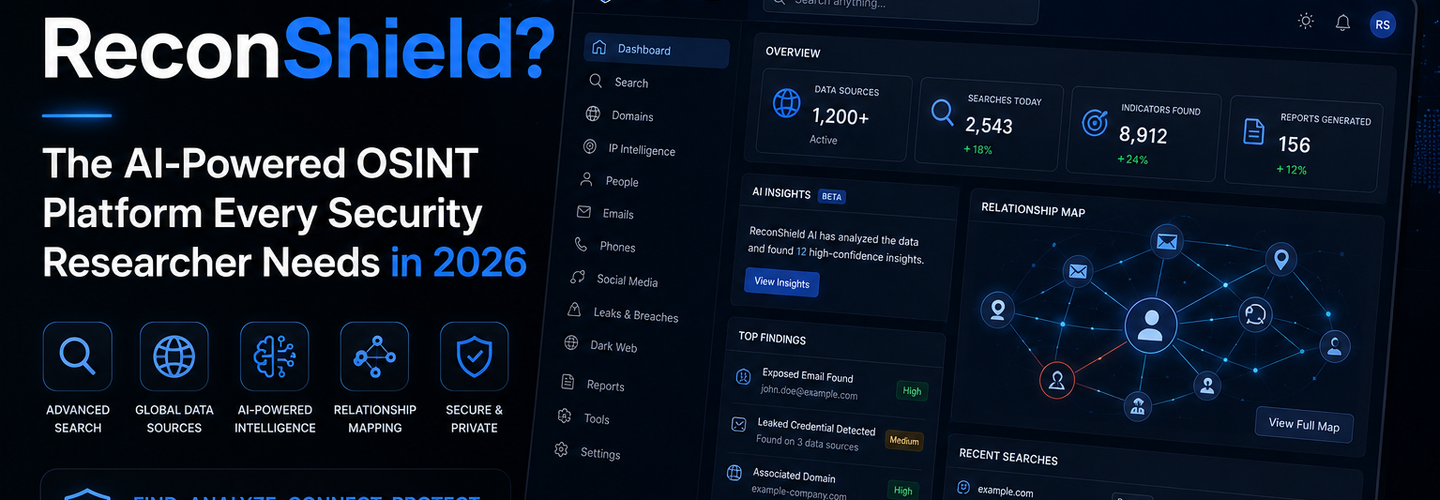
What Is ReconShield? The AI-Powered OSINT Platform Every Security Researcher Needs in 2026
Every day, thousands of independent security researchers, ethical hackers, and small business owners face the same problem: the best cybersecurity intelligence tools cost thousands of dollars per year. Enterprise platforms like Shodan Pro, Recorded Future, or RiskIQ are powerful — but they are locked behind corporate paywalls that price out anyone who isn't a Fortune 500 company.
ReconShield was built to fix exactly that. Founded by cybersecurity researcher Surendra Reddy, ReconShield is a next-generation, AI-powered OSINT (Open Source Intelligence) and threat intelligence platform that gives independent researchers, developers, and small businesses access to professional-grade security analytics — completely free.
⚡ Key Takeaway
ReconShield translates raw network data — port scans, SSL logs, DNS records, IP telemetry — into clear, structured, actionable risk assessments using AI. You don't need to be a seasoned expert to interpret results.
In this article, we break down exactly what ReconShield is, how its tools work, who should use it, and why its philosophy of "open intelligence" is reshaping defensive cybersecurity in 2026.
## What Is ReconShield?
ReconShield describes itself as a next-generation cybersecurity platform and Open Source Intelligence research hub engineered to provide unparalleled visibility into the digital attack surface. At its core, it is a suite of automated passive scanning tools that query public databases, DNS registries, and open threat-intelligence indexes — never interacting directly with target hosts or sending malicious payloads.
The platform was created in response to a clear market gap: sophisticated domain, DNS, and IP intelligence tools existed, but access was restricted to enterprises with large security budgets. ReconShield's mission is to democratize advanced security analytics by making these capabilities openly available.
What distinguishes ReconShield from older tools is its integration of AI analytics on top of raw network telemetry. Traditional scanners produce dense, difficult-to-parse output — walls of cryptographic hashes, port numbers, and header configurations. ReconShield layers AI interpretation over this data, outputting unified risk scores and step-by-step mitigation guidelines in plain language.
## Core Tools & Features
ReconShield offers several distinct tools, each designed to expose a different layer of an organization's attack surface:
🔍
Domain Reconnaissance
Passive scanning of domain infrastructure including WHOIS data, registrar details, and historical DNS changes.
🖧
DNS Intelligence
Full DNS record enumeration — A, AAAA, MX, TXT, CNAME, NS records — with anomaly detection and misconfiguration flags.
🌐
IP Threat Analysis
Cross-references IPs against global threat feeds to detect known malicious actors, blacklisted ranges, and ASN risk scores.
🛡
Vulnerability Simulation
Simulates common attack vectors against a domain's public-facing infrastructure — without ever touching the target server.
🤖
AI Risk Scoring
AI translates complex scan outputs into a unified risk score with prioritized remediation steps in plain language.
📈
Threat Intelligence Blog
Curated security research, IOC reports, zero-day alerts, and defensive analysis published by the ReconShield team.
## How Passive Reconnaissance Works
A fundamental concept to understand about ReconShield is that it operates exclusively through passive reconnaissance. This is a critical distinction in cybersecurity — and one that separates legal, ethical security research from unauthorized intrusion.
Active vs. Passive Scanning
Active scanning involves directly probing a target system — sending packets, attempting connections, or testing payloads. This is what penetration testing tools like Nmap in aggressive mode or Metasploit do. Without explicit written authorization from the system owner, active scanning is illegal in most jurisdictions under laws like the Computer Fraud and Abuse Act (CFAA) in the US or equivalent statutes globally.
Passive reconnaissance, by contrast, queries publicly available data sources: DNS registries, WHOIS databases, SSL certificate transparency logs, open threat-intelligence feeds, and BGP route tables. The target system never receives a single packet from the researcher's machine. ReconShield is entirely passive — it assembles a picture of an organization's attack surface entirely from publicly exposed metadata.
⚠ Legal Reminder
ReconShield is strictly intended for authorized cybersecurity research, defensive threat modeling, and professional security education. Unauthorized scanning of digital assets you do not own is illegal. Always obtain explicit written permission before auditing any system.
## Who Should Use ReconShield?
ReconShield was designed for a broad but specific audience. Here's how different user types benefit:
Independent Security Researchers & Ethical Hackers
Bug bounty hunters and independent researchers gain access to the same quality of OSINT tooling used by enterprise red teams — without paying enterprise prices. ReconShield's AI-interpreted outputs are especially valuable for researchers who need to quickly triage large scopes of domains.
Small Business Owners
Small and medium businesses often have no dedicated security team. ReconShield lets a non-technical owner scan their own domain and receive plain-language risk reports, making proactive security accessible without hiring a consultant.
System Administrators & DevSecOps Teams
Sysadmins can use ReconShield to continuously monitor their organization's exposed attack surface — checking for DNS misconfigurations, expired SSL certificates, shadow IT domains, and IP ranges that have appeared on threat blacklists.
Cybersecurity Students & Educators
The platform's clear output format and AI explanations make it an exceptional learning tool. Students can study real-world attack surface data without needing expensive lab environments or commercial tool licenses.
## ReconShield vs. Alternatives: How Does It Compare?
PlatformFree TierAI InterpretationPassive OnlyOSINT BlogReconShield✓ Full access✓ Yes✓ Yes✓ YesShodanLimited✗ No✓ Yes✗ NoSecurityTrails50 queries/mo✗ No✓ YesLimitedVirusTotalRate-limitedPartial✓ Yes✗ NoRecorded Future✗ Enterprise only✓ Yes✓ Yes✓ Yes
The table above illustrates ReconShield's unique positioning: it is the only platform in this comparison that combines a fully free tier, AI-driven interpretation, and a curated threat intelligence publication — making it the most accessible full-spectrum tool for independent researchers.
## Understanding the AI Risk Scoring Engine
One of ReconShield's most distinctive features is its AI risk scoring layer. Traditional security scanners output raw data — port 443 open, TLS 1.1 detected, SPF record missing — and expect the researcher to interpret what these findings mean in context. For non-specialists, this creates an enormous barrier to understanding.
ReconShield's AI engine contextualizes these findings. It weighs the combination of discovered vulnerabilities, cross-references them against known attack patterns in its threat intelligence database, and produces a unified risk score alongside prioritized mitigation steps. For example, rather than simply flagging a missing DMARC record, the engine explains that the absence makes the domain vulnerable to email spoofing, provides an example exploit scenario, and outputs the exact DNS TXT record the administrator needs to add to fix it.
💡 Why This Matters
The gap between raw technical data and actionable defense has historically required years of expertise to bridge. ReconShield's AI layer compresses that learning curve — giving a developer or business owner the same insight a senior security analyst would derive from the same scan data.
## Ethics, Compliance & Responsible Use
ReconShield operates under a strict ethical framework that prioritizes internet safety, legal compliance, and responsible security research. This isn't just policy language — it is architecturally enforced. Because the platform is passive-only by design, it cannot be misused as an active exploitation tool.
The platform explicitly prohibits scanning assets without authorization and provides a clear legal disclaimer requiring users to confirm they are either the authorized owner of the target infrastructure or hold explicit written permission to audit it. All threat intelligence published in the ReconShield blog is intended for security awareness, historical documentation of cyber events, and defensive training — not to facilitate attacks.
This ethical stance is particularly important as regulators worldwide tighten rules around offensive security tooling. ReconShield's passive architecture gives researchers a legally defensible way to conduct intelligence gathering without crossing into unauthorized computer access territory.
## The ReconShield Threat Intelligence Blog
Beyond its scanning tools, ReconShield operates a threat intelligence publication covering live cybersecurity developments. Categories include Cyber News, Cyber Crime analysis, Threat Intelligence reports, Phishing Attack breakdowns, and original Cybersecurity Research.
Recent coverage has addressed topics like AI-generated phishing campaigns reaching enterprise inboxes in under 30 seconds, critical zero-day vulnerabilities in widely deployed systems, and the expanding mobile attack surface created by agentic AI tools. The blog is designed to serve both technical researchers and business leaders who need to stay ahead of the evolving threat landscape.
## How to Get Started with ReconShield
Getting started with ReconShield requires no paid subscription, no credit card, and no complex setup. Here is a straightforward approach:
Step 1: Define Your Scope
Identify the domains, IP ranges, or infrastructure you own and want to audit. Never scan infrastructure you do not own or have explicit permission to test.
Step 2: Run a Domain Scan
Input your domain into ReconShield's reconnaissance engine. The platform will query public DNS records, WHOIS data, SSL certificate logs, and threat intelligence feeds, assembling a comprehensive picture of your exposed attack surface.
Step 3: Review the AI Risk Report
Read the AI-generated risk assessment. Pay particular attention to the highest-priority findings — these represent the vulnerabilities most likely to be exploited by adversaries. Each finding includes a plain-language explanation and a specific remediation action.
Step 4: Implement Mitigations
Work through the mitigation checklist. Common fixes include adding missing DMARC, SPF, and DKIM DNS records, updating expired SSL certificates, removing unnecessary open ports from public exposure, and patching outdated server headers that leak software version information.
Step 5: Monitor Continuously
Attack surfaces change. New subdomains get provisioned, certificates expire, and IP addresses appear on threat lists. Schedule periodic rescans to ensure your security posture doesn't degrade over time.
## Frequently Asked Questions
What is ReconShield?
ReconShield is a free, AI-powered OSINT and cybersecurity platform providing passive domain scanning, DNS intelligence, IP threat analysis, and vulnerability simulation for security researchers and organizations.
Is ReconShield free to use?
Yes. ReconShield's core toolset is entirely free, making professional-grade security intelligence accessible to independent researchers and small businesses that cannot afford enterprise subscriptions.
Does ReconShield hack or exploit systems?
No. ReconShield is a strictly passive platform. It queries public DNS registries, threat databases, and open intelligence feeds. It does not send payloads to target systems, probe ports directly, or exploit any vulnerabilities.
Who founded ReconShield?
ReconShield was founded by Surendra Reddy, a cybersecurity researcher and threat intelligence analyst specializing in OSINT, vulnerability research, and network reconnaissance.
Can ReconShield be used for bug bounty hunting?
Yes, within authorized scopes. Bug bounty hunters can use ReconShield to gather passive intelligence on in-scope domains as part of their reconnaissance methodology, consistent with the program's rules of engagement.
## Conclusion
ReconShield represents a meaningful shift in how cybersecurity intelligence is distributed. For too long, the most powerful OSINT and threat analysis tools were the exclusive property of organizations with enterprise budgets, leaving independent researchers, ethical hackers, and small businesses underequipped against an increasingly sophisticated threat landscape.
By combining passive reconnaissance, AI-driven risk interpretation, and a commitment to open access, ReconShield gives every security practitioner — regardless of resources — the visibility they need to defend their digital assets proactively. In a year when AI-generated phishing, zero-day exploitation, and supply chain attacks are accelerating, that visibility isn't optional. It's essential.
Whether you're a seasoned penetration tester, a startup CTO, or a cybersecurity student building your skills, ReconShield is one of the most capable free tools available in 2026. Start with a domain scan, review the AI risk report, and act on the mitigations. Security begins with visibility — and ReconShield delivers exactly that.
Read More:
AI-Powered Cyber Threats Are Escalating Faster Than Enterprise Defenses Can Adapt
Urgent Chrome Update Released After Critical Remote Code Execution Vulnerabilities Discovered
Hackers Exploit Vulnerable Lenovo Driver to Disable EDR Security Protections
QR Code Phishing Explodes in 2026 as Microsoft Detects 8.3 Billion Email Threats
Public Exploit Code Emerges for Chromium Flaw Potentially Affecting Millions Worldwide
## Analyst Commentary & Implementation Blueprint
Security advisory
Continuous security exposure assessment is critical to identifying public vulnerabilities before they are exploited. Organizations should maintain a passive inventory of all web servers, TLS configs, and open ports, ensuring that default configurations are eliminated and security advisories are actively implemented.
Hardened Security Configuration Blueprint
# General Security Hardening Directive
ServerTokens ProductOnly
ServerSignature Off
FileETag None
Actionable Mitigation Checklist
- ✔Perform passive asset inventories weekly.
- ✔Restrict administrative ports using local firewall controls.
- ✔Monitor active CVE alerts for exposed software.
Common Inquiries & FAQs
Why is passive scanning preferred for continuous auditing?
Passive audits do not cause operational impact or trigger firewall blocks, making them ideal for constant surveillance of internet-facing assets.
What should I do if a vulnerability is flagged?
Apply the latest vendor patches, restrict access to the resource via firewalls, or verify configuration flags to mitigate risks.
Surendra Reddy
Surendra Reddy is a cybersecurity researcher and founder of ReconShield, specializing in OSINT and defensive infrastructure analysis.
Connect on LinkedIn ↗// AUDIT BRIEFING DISCUSSION (2 COMMENTS)
Great breakdown of the passive infrastructure vectors. We recently audited our external DNS zones and found multiple dangling staging environments. Implementing wildcard certificates reduced our CT log leaks significantly.
Is there any automated tooling you recommend for daily crt.sh scraping? Manually checking CT logs is becoming unsustainable for our domain portfolio.
// MORE ARTICLES
Security Researchers Warn Critical n8n Flaws May Expose Automation Platforms to RCE
Researchers have disclosed critical vulnerabilities in n8n that could expose automation workflows and connected enterprise systems to remote code execution risks, prompting urgent patch recommendations for users and administrators.

How Agentic AI Is Changing Software Engineering and Expanding Mobile Attack Surfaces
Agentic AI is rapidly transforming software engineering workflows through automation and intelligent coding assistance, while cybersecurity experts warn of expanding mobile attack surfaces and emerging application security risks.
Microsoft Defender Zero-Day Patched: What IT Teams Need to Know
Microsoft patches RoguePlanet, a Defender zero-day (CVE-2026-50656) letting attackers gain SYSTEM access. Here's what IT teams need to know.