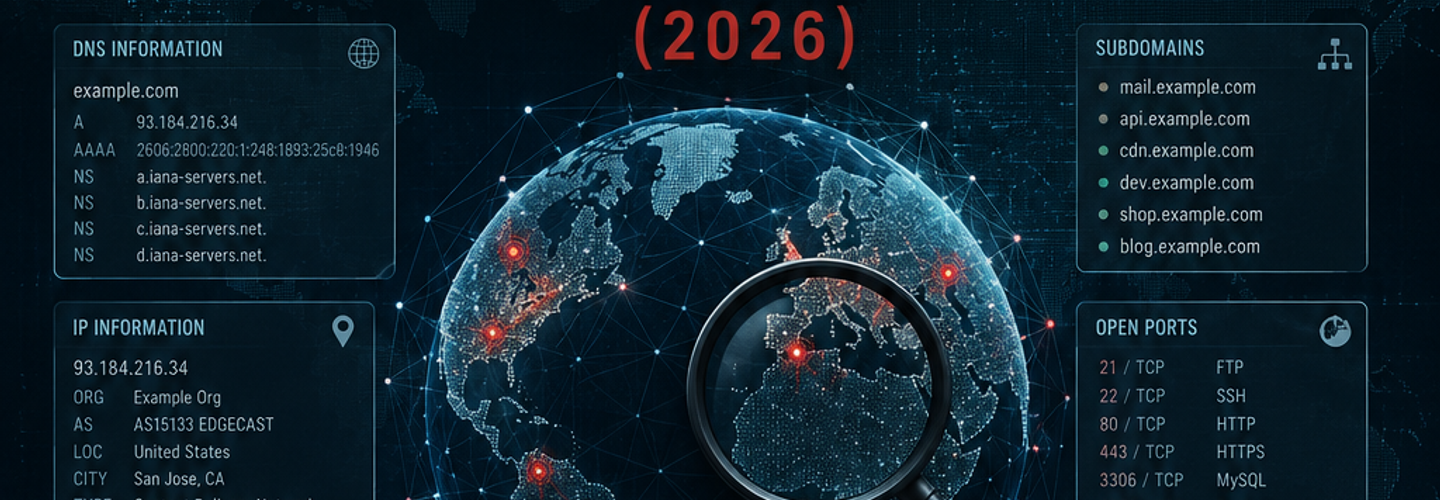
Passive Reconnaissance: The Complete OSINT Guide to Attack Surface Mapping
Summarize this blog post with: ChatGPT | Perplexity | Claude | Grok
You've probably run a WHOIS lookup or a Google search on a suspicious domain during an investigation — but if you've never structured those lookups into a repeatable, layered methodology, you're conducting reconnaissance by intuition rather than by design. Passive reconnaissance is the discipline of collecting maximum intelligence about a target using only publicly available data sources, without sending a single packet to the target's infrastructure. In this guide, you'll learn the complete passive reconnaissance methodology used by professional threat intelligence analysts, red teamers, and security researchers — including every data source, every tool, and the exact investigative sequence that transforms scattered public data into a complete infrastructure profile.
## Key Takeaways
- ▸Passive reconnaissance is the systematic collection of intelligence about a target using only publicly available open-source data — without interacting with the target's systems in any way that generates logs or alerts on their infrastructure.
- ▸Passive recon is legally and ethically distinct from active scanning — all data is collected from third-party registries, public databases, and archived sources rather than from the target directly, making it safe and defensible for security research.
- ▸DNS records, WHOIS registration data, SSL certificate transparency logs, and ASN routing data are the four highest-yield passive data sources for infrastructure mapping, collectively revealing the majority of an organization's attack surface.
- ▸The attack surface exposed by passive recon typically includes forgotten subdomains, misconfigured email authentication, exposed services, stale DNS records, and third-party dependencies — all without the target's knowledge.
- ▸Defensive teams use passive reconnaissance against their own infrastructure to discover the attacker's-eye view of their organization before threat actors do — identifying blind spots that internal asset inventories routinely miss.
- ▸Certificate Transparency logs are one of the most underused passive intelligence sources, providing a complete historical record of every SSL/TLS certificate ever issued for any domain — including subdomains never listed in DNS.
- ▸A structured passive recon methodology follows five phases: domain intelligence, DNS enumeration, certificate intelligence, network intelligence, and email security analysis — each phase feeding into the next.
## What Is Passive Reconnaissance and How Does It Differ From Active Scanning?
Passive reconnaissance is the intelligence-gathering discipline of collecting data about a target organization, domain, or IP address using exclusively public, third-party data sources — without sending any queries, packets, or requests directly to the target's infrastructure. The defining characteristic is non-interaction with the target: every data point is obtained from registries, databases, search engines, and archived sources that the target has no visibility into.
This distinction matters fundamentally for both legal and operational reasons. Active reconnaissance — port scanning a target's servers, probing application endpoints, fuzzing DNS resolvers — generates log entries on the target's systems and may constitute unauthorized computer access under laws including the Computer Fraud and Abuse Act (CFAA) in the United States and the Computer Misuse Act in the United Kingdom. Passive reconnaissance generates no such logs. Querying a WHOIS database for a domain's registration data, checking a Certificate Transparency log for subdomains, or reviewing a domain's publicly visible MX records are actions directed at third-party infrastructure — not at the target — and are universally recognized as legitimate security research activities.
Operationally, passive reconnaissance is also more effective than many security teams realize. The average organization exposes over 500 unique assets through publicly queryable passive data sources — Source: RiskIQ Attack Surface Research, 2024 — the majority of which are unknown to the organization's own IT or security team. Use the ReconShield passive diagnostics scanner to run an immediate, fully passive audit of your own domain's publicly visible infrastructure — email authentication records, SSL configuration, HTTP security headers, and exposure indicators — in a single non-intrusive workflow.
## Why Do Security Teams Use Passive Reconnaissance?
Security teams use passive reconnaissance for three distinct operational purposes: red team attack simulation, blue team defensive discovery, and threat intelligence investigation — and the same methodology serves all three purposes because the data sources and collection techniques are identical regardless of which side of the security equation you're on.
Red teams use passive reconnaissance as the mandatory first phase of any penetration test or adversary simulation exercise. Before any active exploitation attempt, a competent red team spends hours or days conducting passive recon to map the target's full external attack surface, identify the most exploitable entry points, understand the technology stack, and gather employee and organizational data that enables social engineering. Passive recon determines where to focus active testing — making it the highest-leverage phase of the entire engagement.
Blue teams and security operations use passive reconnaissance against their own infrastructure to discover the attacker's perspective: what does a threat actor see when they research your organization using only public sources? The answer almost always reveals assets the internal team didn't know were visible — forgotten subdomains, expired certificates still serving traffic, exposed administrative interfaces, and stale DNS records pointing to decommissioned infrastructure. For the full methodology behind how professional analysts structure this self-directed passive intelligence workflow, the ReconShield Anatomy of Passive OSINT guide is the definitive reference.
Threat intelligence investigators use passive reconnaissance to attribute malicious infrastructure, track threat actor campaigns, and map the full scope of attacks detected during incident response — all without alerting the attacker by probing their infrastructure directly.
## What Are the Five Phases of a Passive Reconnaissance Methodology?
A complete passive reconnaissance methodology follows five sequential phases: domain intelligence, DNS enumeration, certificate transparency analysis, network and ASN intelligence, and email security analysis — each phase building on the previous one to produce an increasingly complete and correlated picture of the target's infrastructure.
Phase 1 — Domain Intelligence: Registration, History, and Ownership
Domain intelligence is the foundation of passive reconnaissance, establishing who registered the target domain, when, through which registrar, with which name servers, and under what EPP protection status — providing the organizational and administrative context that all subsequent phases build upon.
Start every passive recon engagement by querying the target domain's WHOIS and RDAP registration record. The creation date immediately distinguishes a long-established legitimate organization from a recently registered lookalike or phishing domain. The registrar identity reveals whether the organization uses enterprise-grade registrars with registry-level lock support or consumer registrars with weaker security controls. The EPP status codes reveal whether the domain is protected against unauthorized transfer and modification. Use the ReconShield WHOIS Intelligence tool to retrieve the full registration record — including EPP status, registrar-listed name servers, and expiry date — in a single normalized lookup.
Historical WHOIS data extends the intelligence picture backward in time. Pre-GDPR WHOIS archives captured registrant contact data — email addresses, phone numbers, organizational names — that may reveal corporate structure, key personnel, and historical infrastructure relationships even when current records are fully redacted. Historical registration data also reveals domain ownership transfers that may indicate acquisition history, brand evolution, or infrastructure consolidation events relevant to the investigation.
Phase 2 — DNS Enumeration: Zone Mapping Without Zone Transfer
DNS enumeration in passive reconnaissance maps every discoverable hostname in a target's DNS zone using public data sources rather than direct zone transfer requests — reconstructing the organization's infrastructure topology through passive DNS databases, search engine results, certificate transparency logs, and public DNS resolvers.
The primary passive DNS enumeration technique is correlation across multiple public datasets: passive DNS databases that cache historical resolution data, certificate transparency logs that capture subdomain names from issued certificates, web archive crawls that record links to organizational subdomains, and search engine results that index organizational assets. Each source contributes unique visibility — passive DNS reveals historically active subdomains, CT logs reveal subdomains that received certificates (including those never publicly promoted), and web archives reveal assets that have since been taken offline.
For each discovered hostname, query the full DNS record set — A, AAAA, CNAME, MX, TXT, and NS records — to understand the hosting infrastructure, detect CNAME aliases pointing to third-party services (which create subdomain takeover risk), and identify email authentication configuration gaps. The ReconShield DNS Security Analysis tool returns the complete record set for any hostname alongside DNSSEC status, SPF validation, and DMARC enforcement — providing both the raw DNS data and its security implications simultaneously.
Phase 3 — Certificate Transparency Analysis: Subdomain Discovery Through TLS Logs
Certificate Transparency (CT) analysis is the passive reconnaissance technique that leverages the public, append-only logs maintained by certificate authorities to discover every SSL/TLS certificate ever issued for a target domain — including certificates for internal subdomains, staging environments, development infrastructure, and organizational services that were never publicly promoted.
Certificate Transparency was mandated by Google for all publicly trusted certificates from 2018 onward. Every CA must submit every issued certificate to at least two public CT logs — creating a permanent, searchable public record of every domain and subdomain that has received a certificate. For passive reconnaissance, this means that every subdomain a target organization has ever secured with an SSL certificate — staging.example.com, admin.example.com, legacy-api.example.com — appears in CT log search results, regardless of whether DNS records for those subdomains are currently active or the subdomains were ever publicly known.
CT log analysis typically reveals 30–60% more subdomains than DNS enumeration alone — Source: Detectify Security Research, 2024 — including infrastructure that organizations believe is private or forgotten. Combine CT log findings with the ReconShield SSL/TLS Checker to audit the current certificate status of each discovered subdomain — identifying which previously certificated assets are still active and which represent potential dangling infrastructure.
Phase 4 — Network and ASN Intelligence: IP Ranges and Hosting Infrastructure
Network intelligence maps the IP address ranges associated with the target organization — identifying which IP blocks are directly owned by the organization through RIR registration, which belong to hosting providers serving the organization's infrastructure, and which are associated with third-party CDN, cloud, or SaaS services.
Start with ASN lookup: query the target organization's name in RIR WHOIS databases (ARIN for North American organizations, RIPE for European) to identify any ASNs registered directly to the organization. Larger enterprises frequently operate their own ASNs — revealing the complete range of IP addresses under their direct operational control. The ReconShield IP Reputation Intelligence tool returns ASN ownership, network block registration, and hosting provider classification for any IP address, enabling rapid determination of whether an address is corporate-owned infrastructure or cloud-hosted.
For each discovered IP address, passive port intelligence provides the service profile — what TCP ports are open and what services are running — without active scanning. Shodan and Censys maintain continuous passive scans of the entire IPv4 address space, providing cached port and banner data that represents the historical service profile of any IP address. The ReconShield Port Scanner provides current passive port data for any IP or hostname within authorized research scope.
Phase 5 — Email Security Analysis: Authentication Posture and Mail Infrastructure
Email security analysis examines the target organization's DNS-published email authentication records — SPF, DKIM, and DMARC — to assess their resistance to email spoofing and identify gaps that could be exploited for phishing campaigns impersonating the organization.
A missing or weakly configured SPF record means the organization's domain can be spoofed in the "From" address of phishing emails without technical difficulty. A DMARC record at p=none enforcement means spoofed emails are monitored but not blocked — providing no actual protection against delivery of spoofed messages to recipients. A DMARC record at p=reject with correct SPF and DKIM alignment blocks domain spoofing effectively at compliant receiving mail servers. The presence or absence of each of these records is visible in public DNS — making email authentication posture one of the most intelligence-rich passive signals about an organization's security maturity.
Query the target's MX records to identify mail infrastructure providers, TXT records to retrieve SPF and DMARC policy strings, and _dmarc.yourdomain.com for DMARC configuration. The ReconShield DNS Security Analysis tool validates all three simultaneously. For understanding the complete email authentication attack surface that passive recon surfaces, the ReconShield SPF-DKIM-DMARC Blueprint covers every record type and misconfiguration in implementation depth.
## What Are the Best Passive Reconnaissance Data Sources?
The highest-yield passive reconnaissance data sources — ranked by intelligence density and operational utility — are Certificate Transparency logs, passive DNS databases, WHOIS/RDAP registries, RIR network databases, and public web archives. Each source provides distinct intelligence that does not fully overlap with the others, making multi-source correlation essential for complete coverage.
Certificate Transparency logs (crt.sh, Google CT, Cloudflare Nimbus) provide subdomain enumeration through historical certificate data — the highest-volume source of previously unknown subdomains. Passive DNS databases (VirusTotal, SecurityTrails, Farsight DNSDB) provide historical DNS resolution data — revealing what IP addresses subdomains have historically pointed to, and which domains have historically resolved to a target IP. WHOIS and RDAP registries provide domain and IP block registration data from ICANN-accredited registrars and Regional Internet Registries.
Search engine dorking — structured search queries using advanced operators to surface specific file types, administrative interfaces, exposed configuration data, and organizational assets indexed by major search engines — provides an additional passive intelligence source that captures assets visible to web crawlers. Common dork patterns include site:example.com filetype:pdf, site:example.com inurl:admin, and "example.com" ext:env to surface exposed environment files. For the complete passive OSINT collection methodology including advanced search engine techniques, the ReconShield Anatomy of Passive OSINT guide covers every data source and correlation technique in operational detail.
Social media and professional network intelligence provides organizational structure, employee role data, technology stack disclosures in job postings, and conference presentation materials that reveal internal architecture details. LinkedIn job postings for security engineers frequently disclose the exact technology stack, SIEM platform, cloud providers, and network segmentation approach used internally — intelligence that an attacker uses to tailor initial access techniques and post-exploitation tooling.
## What Does Passive Reconnaissance Reveal About Your Own Organization?
Running passive reconnaissance against your own infrastructure consistently reveals four categories of security-relevant findings that internal asset inventories and vulnerability scanners routinely miss: forgotten subdomains, email authentication gaps, exposed service misconfigurations, and third-party dependency risks.
Forgotten subdomains are the most common finding. Organizations that have operated for more than five years typically have dozens of subdomains created for marketing campaigns, product launches, partner portals, and development environments that were never formally decommissioned. Many still resolve to active infrastructure — or worse, resolve to deprovisioned cloud resources that are now claimable by attackers through subdomain takeover. CT log analysis consistently surfaces these forgotten assets before attackers do.
Email authentication gaps are the second most common finding. Passive DNS analysis of MX and TXT records frequently reveals that subsidiary domains, acquired company domains, and regional domains lack SPF, DKIM, or DMARC records — leaving them fully spoofable for phishing campaigns targeting the parent organization's customers and partners. For the complete remediation workflow for email authentication gaps surfaced by passive recon, the ReconShield SPF-DKIM-DMARC Blueprint is the definitive implementation reference.
Exposed service misconfigurations — missing HTTP security headers, weak SSL/TLS cipher suites, absent HSTS headers — are visible to passive reconnaissance through certificate transparency data and can be audited passively using the ReconShield Security Headers Auditor and SSL/TLS Checker. For the complete framework of browser-level security controls, the ReconShield OWASP HTTP Headers Hardening guide covers every header and its security implication.
## How Do Threat Actors Use Passive Reconnaissance Before an Attack?
Threat actors use passive reconnaissance to build a complete target profile before any active exploitation attempt — identifying the specific entry points most likely to succeed, the employee accounts most valuable to compromise, the third-party services whose vulnerabilities can be leveraged against the target, and the communication patterns that enable convincing social engineering.
A professional threat actor group targeting a financial institution spends days or weeks in passive reconnaissance before attempting any active attack. They map every external asset through CT logs and passive DNS. They identify all employee LinkedIn profiles to construct organizational hierarchy and identify high-privilege targets for spear-phishing. They review job postings to identify the specific security tools deployed internally. They analyze DMARC configuration to determine whether email spoofing is viable. They check supply chain dependencies through third-party service CNAME records to identify upstream attack paths.
The average attacker spends 3–5 days in reconnaissance before initial access attempts — Source: Mandiant M-Trends Report, 2024 — and the data gathered during this phase directly determines the sophistication and targeting precision of subsequent attacks. Organizations that run the same reconnaissance against themselves — and act on the findings — remove the informational advantage that attackers gain during this phase. Understanding how attackers use this data to build IOC patterns and campaign infrastructure is covered in the ReconShield Beginner's Guide to Threat Intelligence and IOC Analysis.
The ReconShield Shadow IT Exposed Ports guide documents the specific exposed services that attackers target first when scanning enterprise perimeters — and how passive port intelligence identifies them before they are exploited.
## Common Passive Reconnaissance Findings and How to Remediate Them
The most consistently impactful passive recon findings — ordered by frequency and exploitability — are dangling CNAME records, missing DMARC enforcement, weak or expired SSL certificates, exposed administrative interfaces, and leaked configuration data in public repositories.
Dangling CNAME records are the highest-severity finding from CT and passive DNS analysis. A CNAME pointing to a deprovisioned cloud resource can be claimed by any attacker who registers the same resource name on the same platform. Remediation is immediate: remove the CNAME record from your zone file as soon as the underlying service is decommissioned, and conduct quarterly audits of all CNAME targets to detect drift. Audit all CNAME records using the ReconShield DNS Security Analysis tool.
Missing or unenforced DMARC allows your domain to be spoofed in phishing campaigns targeting your customers and partners with no technical barrier. Remediation requires deploying SPF, DKIM, and DMARC records progressively — starting at p=none to collect reporting data, then advancing to p=quarantine and p=reject as the legitimate sending infrastructure is fully mapped. The ReconShield SPF-DKIM-DMARC Blueprint provides the step-by-step enforcement progression.
Weak SSL/TLS configuration — expired certificates, deprecated TLS 1.0/1.1 support, weak cipher suites — is visible through CT logs and passive service analysis. Audit all discovered certificates using the ReconShield SSL/TLS Checker and remediate in order of public exposure.
## Passive Reconnaissance Tools for Security Teams
Effective passive reconnaissance requires a toolset covering domain registration intelligence, DNS enumeration, certificate transparency analysis, IP reputation and network attribution, and web application security posture — all without generating detectable traffic on the target's infrastructure.
The ReconShield passive intelligence suite provides complete coverage across every reconnaissance phase:
WHOIS Intelligence Tool — Phase 1 domain intelligence. Returns registration data, EPP status, name servers, registrar identity, creation and expiry dates for any domain — the starting point for every passive recon engagement.
DNS Security Analysis Tool — Phase 2 DNS enumeration. Returns A, AAAA, MX, TXT, NS, CNAME, and SOA records. Validates SPF, DKIM, and DMARC configuration. Checks DNSSEC status. Essential for both zone mapping and email security posture assessment.
SSL/TLS Checker — Phase 3 certificate intelligence. Audits TLS certificates, Subject Alternative Names, cipher suite configuration, and certificate chain integrity for any domain or subdomain discovered through CT log analysis.
IP Reputation Intelligence Tool — Phase 4 network intelligence. Returns ASN ownership, hosting provider classification, geolocation, proxy and VPN detection, and multi-feed reputation scoring for any IP address — essential for infrastructure attribution.
Port Scanner — Phase 4 service intelligence. Passively maps open TCP ports and service profiles for any authorized target IP — revealing what services are exposed to the public internet without active probing.
Security Headers Auditor — Phase 5 web security posture. Evaluates browser-level security controls including CSP, HSTS, and X-Frame-Options — the application layer complement to network and DNS reconnaissance findings.
Exposure Assessment Tool — Cross-phase OWASP misconfiguration detection. Performs passive analysis of web application configuration risks that compound the impact of findings from all other reconnaissance phases.
Passive Scanner Suite — Full-stack passive audit. Runs email authentication, SSL/TLS configuration, and HTTP security header analysis across any domain in a single non-intrusive workflow — the fastest path to a complete external security posture snapshot.
## What's Next: Continuous Passive Monitoring as a Security Program
The evolution from periodic passive reconnaissance engagements to continuous passive monitoring programs represents the current frontier of external attack surface management — treating the organization's publicly visible infrastructure as a dynamic, continuously audited security surface rather than a static inventory reviewed annually.
Continuous passive monitoring pipelines apply the same data sources as manual passive recon — CT log streaming, passive DNS feed subscriptions, WHOIS change monitoring, reputation feed updates — on automated, near-real-time schedules. New subdomains appearing in CT logs are automatically queried for DNS records and CNAME dangling risks. WHOIS name server changes trigger immediate alerts. IP reputation changes for corporate mail server addresses generate notifications before email delivery is impacted.
Organizations with continuous external attack surface monitoring programs discover new exposed assets an average of 23 days faster than those conducting periodic manual audits — Source: CyCognito Attack Surface Research, 2024 — and detect misconfiguration and exposure regressions before threat actors can exploit them. The ReconShield passive scanner suite provides the operational foundation for building continuous monitoring workflows, combining email security, SSL configuration, and web security header analysis in a single auditable interface.
## Conclusion
Passive reconnaissance is not a hacker technique — it is a professional intelligence discipline practiced by red teamers, threat intelligence analysts, blue teams, and security researchers worldwide. The data it surfaces is publicly available, the collection methods are legally defensible, and the findings it produces are consistently more revealing than many organizations expect.
The most impactful use of passive recon is self-directed: run it against your own infrastructure before attackers do. Start with domain intelligence using the ReconShield WHOIS Checker. Map your DNS records and email authentication posture with the DNS Security Analysis tool. Audit your certificates with the SSL/TLS Checker. Check IP reputation for all public-facing servers with the IP Reputation tool. Then use the passive scanner suite to run the full integrated audit.
Organizations that see themselves the way attackers see them — through publicly available data — consistently maintain better external security postures than those relying exclusively on internal asset inventories and authenticated vulnerability scans.
Written by Surendra Reddy Cybersecurity Researcher & Founder, ReconShield. Surendra specializes in OSINT, exposure intelligence, and AI-driven threat analysis. He built ReconShield to democratize access to enterprise-grade infrastructure visibility tools. Author Profile →
Reviewed by ReconShield Editorial Team — Peer-reviewed for technical accuracy against current passive intelligence methodologies and OSINT research standards.
## Analyst Commentary & Implementation Blueprint
Security advisory
Continuous security exposure assessment is critical to identifying public vulnerabilities before they are exploited. Organizations should maintain a passive inventory of all web servers, TLS configs, and open ports, ensuring that default configurations are eliminated and security advisories are actively implemented.
Hardened Security Configuration Blueprint
# General Security Hardening Directive
ServerTokens ProductOnly
ServerSignature Off
FileETag None
Actionable Mitigation Checklist
- ✔Perform passive asset inventories weekly.
- ✔Restrict administrative ports using local firewall controls.
- ✔Monitor active CVE alerts for exposed software.
Common Inquiries & FAQs
Why is passive scanning preferred for continuous auditing?
Passive audits do not cause operational impact or trigger firewall blocks, making them ideal for constant surveillance of internet-facing assets.
What should I do if a vulnerability is flagged?
Apply the latest vendor patches, restrict access to the resource via firewalls, or verify configuration flags to mitigate risks.
Surendra Reddy
Surendra Reddy is a cybersecurity researcher and founder of ReconShield, specializing in OSINT and defensive infrastructure analysis.
Connect on LinkedIn ↗// AUDIT BRIEFING DISCUSSION (2 COMMENTS)
Great breakdown of the passive infrastructure vectors. We recently audited our external DNS zones and found multiple dangling staging environments. Implementing wildcard certificates reduced our CT log leaks significantly.
Is there any automated tooling you recommend for daily crt.sh scraping? Manually checking CT logs is becoming unsustainable for our domain portfolio.
// MORE ARTICLES
SplitVPN Hacked: Data Breach Exposes 865,000 User Records and 58 Million Hidden Connection Logs (July 2026)
SplitVPN hacked: 865,336 user records and 58 million connection logs exposed, directly contradicting the VPN's "no-logs" promise. What was leaked and what to do now.

Critical WordPress wp2shell RCE Vulnerability Puts Millions of Sites at Risk—Patch Now
wp2shell is a pre-auth RCE in WordPress Core affecting 500M+ sites. Public exploits exist—patch to 7.0.2 or 6.9.5 immediately.
New Windows RDP Flaws Could Lead to Data Theft — Everything You Need to Know
Microsoft patched a dozen Windows RDP flaws in July 2026 that could leak memory data. See affected versions, KB numbers, and how to patch.