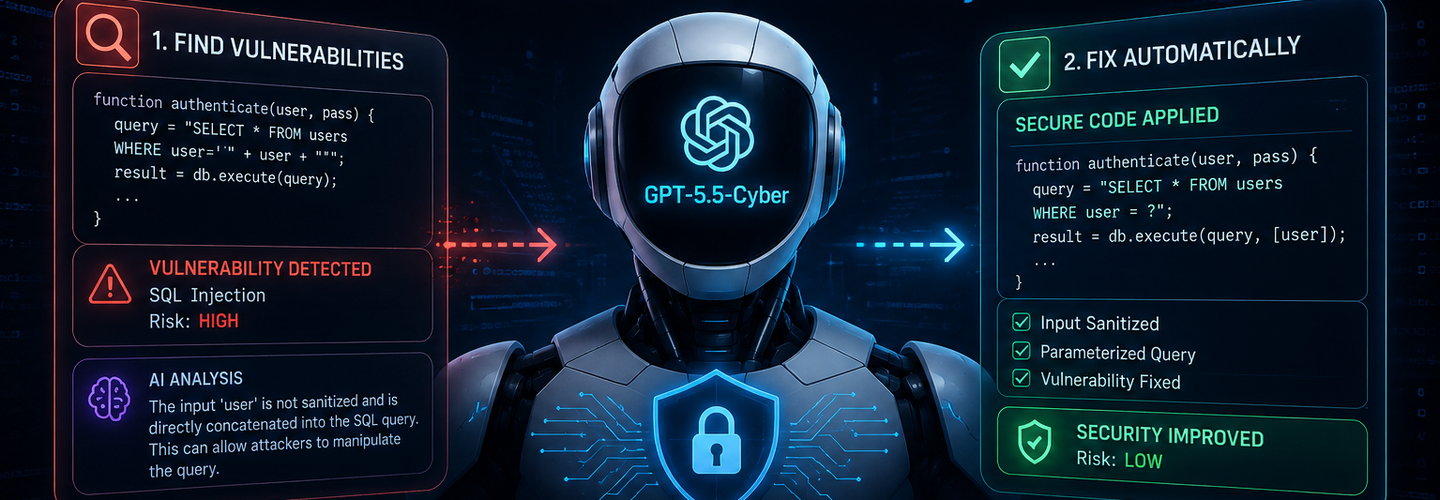
GPT-5.5-Cyber: OpenAI's AI Security Model That Finds and Fixes Vulnerabilities Automatically
Summarize this blog post with: ChatGPT | Perplexity | Claude | Grok
If you work in security, you've already watched AI move from writing code to breaking it. Yet many teams still treat AI as a helper for triage, missing how fast it is becoming an autonomous defender that patches flaws on its own. In this guide, you'll learn what GPT-5.5-Cyber is, how it finds and fixes vulnerabilities automatically, where its limits lie, and how to deploy it safely. For ongoing coverage, follow our hub for the latest AI and cybersecurity research.
## Key Takeaways
- ▸GPT-5.5-Cyber is a specialized AI security model designed to detect and remediate software vulnerabilities with minimal human input.
- ▸Automated patching is the headline feature, letting the model propose, test, and apply fixes for discovered flaws.
- ▸AI vulnerability discovery is accelerating, with AI-assisted research now surfacing flaws faster than manual review.
- ▸Human oversight remains essential, because automated fixes can introduce regressions or miss business logic.
- ▸Defenders and attackers both benefit, so the same capabilities that secure code can be misused offensively.
- ▸Integration matters most. GPT-5.5-Cyber delivers value when paired with scanners, CI/CD pipelines, and human review.
- ▸Prompt injection and data exposure are real risks that teams must control before granting AI access to code.
## What Is GPT-5.5-Cyber?
GPT-5.5-Cyber is a security-focused AI model built to automatically find software vulnerabilities and generate fixes for them. It combines large-language-model reasoning with security tooling to act as an autonomous code auditor.
First, it differs from a general chatbot. For example, instead of only explaining a flaw, it can locate the vulnerable line, write a patch, and validate the change against tests. An AI security model is a system trained to detect, analyze, and remediate security weaknesses across code and infrastructure.
Second, it reflects a broader industry shift. AI-driven discovery is already mainstream, as shown when Google foiled an AI-created zero-day cyberattack and when vendors shipped Firefox patches powered by Claude Mythos and AI tools. AI-assisted research now surfaces vulnerabilities faster than traditional manual code review.
## Why Does GPT-5.5-Cyber Matter for Cybersecurity?
GPT-5.5-Cyber matters because it compresses the time between finding a vulnerability and fixing it, the window attackers exploit most. Faster remediation directly reduces real-world risk.
Moreover, scale is the core advantage. For example, a single model can review thousands of files in minutes, a workload that would take a human team weeks. This mirrors the trend in our analysis of how AI-powered attacks rise as security flaws surface faster.
In addition, the volume of flaws demands automation. AI now contributes directly to large-scale vulnerability discovery in production software — Source: ReconShield Threat Research, 2026. Our coverage of Microsoft's June 2026 Patch Tuesday, where AI aided discovery of 200 vulnerabilities, shows this is already happening at enterprise scale.
## How Does GPT-5.5-Cyber Find Vulnerabilities Automatically?
GPT-5.5-Cyber finds vulnerabilities by analyzing source code, dependencies, and configurations to identify insecure patterns and known weakness classes. It reasons about code the way a senior security engineer would, but at machine speed.
First, it maps the codebase. For example, the model parses functions, traces data flow, and flags untrusted input reaching sensitive operations — the foundation of risks listed in our OWASP Top 10 explained guide.
Second, it correlates context. The model combines static analysis, pattern recognition, and threat intelligence to prioritize the flaws most likely to be exploited. This layered approach resembles the workflows behind AI bug-bounty platforms covered in our BugHunter review of the 2026 AI bug bounty toolkit.
What Types of Vulnerabilities Can It Detect?
GPT-5.5-Cyber can detect injection flaws, authentication weaknesses, insecure configurations, and logic errors across many languages. Its breadth comes from training on vast security datasets.
For example, it can identify SQL injection in a backend route and a missing security header in a web response at the same time. You can validate that header layer independently using ReconShield's HTTP security headers checker.
## How Does GPT-5.5-Cyber Fix Vulnerabilities Automatically?
GPT-5.5-Cyber fixes vulnerabilities by generating a patch, testing it against the existing codebase, and proposing or applying the change. Automated remediation is what separates it from a simple scanner.
First, it drafts a targeted fix. For example, for an injection flaw, it may rewrite a query to use parameterized statements rather than string concatenation. Automated remediation involves generating, validating, and deploying code changes that close a discovered security gap.
Second, it verifies before shipping. The model runs tests and checks for regressions, similar to the assisted-fix capabilities in the Claude Code security extension for vulnerability detection. That being said, every automated patch should still pass human review before reaching production.
## What Can GPT-5.5-Cyber Do That Traditional Tools Cannot?
GPT-5.5-Cyber can understand intent and context, allowing it to fix logic flaws that signature-based scanners typically miss. Traditional tools detect known patterns; AI reasons about novel ones.
First, it handles nuance. For example, a classic scanner may flag a function as risky, while GPT-5.5-Cyber can determine whether the input is actually attacker-controllable and write the correct fix accordingly.
Second, it adapts across stacks. AI security models generalize across languages and frameworks without needing a separate rule set for each. This flexibility is why AI now powers offensive tooling too, such as the PentestSwarm AI tool with live access to Nmap, SQLMap, Burp Suite, and Metasploit.
## GPT-5.5-Cyber vs Traditional Vulnerability Scanners
GPT-5.5-Cyber and traditional scanners serve different strengths, and the best results come from using them together. One brings speed and pattern coverage; the other brings reasoning and remediation.
Detection Approach
Traditional scanners rely on signatures and known rules, which makes them fast and predictable but blind to novel logic flaws. For example, a scanner reliably catches outdated libraries but may miss a subtle authorization bug.
Remediation Capability
GPT-5.5-Cyber not only detects but also drafts and tests fixes, while most scanners stop at reporting. By pairing them, you can let a scanner confirm coverage and let the AI handle the actual repair.
When to Use Which
Use a deterministic scanner for compliance and repeatable baselines, and use GPT-5.5-Cyber for deep code reasoning and automated patching. For example, run ReconShield's vulnerability scanner for fast perimeter scoring, then route complex code-level findings to the AI model. They complement each other rather than compete.
## Is GPT-5.5-Cyber Safe? Risks and Limitations
GPT-5.5-Cyber introduces real risks, including prompt injection, false fixes, and exposure of sensitive code, that teams must control before adoption. Powerful automation requires careful guardrails.
First, prompt injection is a leading threat. For example, malicious instructions hidden in code comments or data could manipulate the model, an attack class detailed in our analysis of ChatGPT vulnerabilities and prompt-injection enterprise defenses.
Second, automated fixes can backfire. An incorrect AI-generated patch can introduce new bugs or break business logic if applied without review. Data exposure is also a concern, echoing the warnings in our coverage of critical Microsoft 365 Copilot vulnerabilities exposing sensitive information.
Can Attackers Misuse AI Security Models?
Yes, attackers can misuse AI security models to discover and weaponize vulnerabilities faster than defenders can patch them. The same capability that defends code can also attack it.
Moreover, this dual-use reality is already documented. For example, our reporting on North Korean hackers exploiting AI cybersecurity blind spots shows how adversaries adopt these tools quickly.
## How Can Security Teams Use GPT-5.5-Cyber Safely?
Security teams can use GPT-5.5-Cyber safely by sandboxing it, requiring human approval for fixes, and integrating it with existing tooling. Controlled deployment captures the benefits without the worst risks.
First, keep humans in the loop. For example, configure the model to open a pull request rather than push directly to production, so an engineer reviews every change.
Follow these practical guardrails:
- ▸Isolate access — Run the model in a sandbox with least-privilege access to code and secrets.
- ▸Require approval — Treat AI patches as proposals that need human sign-off.
- ▸Scan in parallel — Validate findings with independent tools like the website vulnerability scanner and SSL/TLS checker.
- ▸Log everything — Audit every AI action for accountability and incident review.
- ▸Test rigorously — Run full regression and security tests before deployment.
[Insert image: A pull request showing an AI-generated security fix awaiting human review | Alt text: "Review an AI-generated vulnerability fix from GPT-5.5-Cyber before deployment"]
In addition, pair the model with strong fundamentals. For example, combine it with the practices in our guide on how to scan a website for vulnerabilities in 2026 and explore ReconShield's full set of free security and OSINT tools.
## What's Next for AI-Driven Vulnerability Management?
The next phase is autonomous, continuous remediation, where AI models monitor, patch, and verify code around the clock. Human teams will shift toward oversight and strategy.
First, expect deeper CI/CD integration. For example, AI models will increasingly run inside build pipelines, blocking vulnerable code before release.
Second, expect systemic risk to grow alongside capability. By studying analyses like AI cyber risk becoming systemic and AI-driven cyber threats and enterprise security adaptation, teams can prepare for a future where both attack and defense are AI-accelerated.
## Conclusion
GPT-5.5-Cyber represents a major step toward AI that not only finds vulnerabilities but fixes them automatically, shrinking the dangerous gap between discovery and patch. The opportunity is real, but so are the risks of prompt injection, faulty fixes, and adversarial misuse. The smart path is controlled adoption: sandbox the model, keep humans in the loop, and pair it with proven tools and processes. Start strengthening your foundation today by validating your own exposure with ReconShield's free vulnerability scanner.
Written by the ReconShield Editorial Team — a cybersecurity publication covering cyber threats, data breaches, vulnerabilities, malware, threat intelligence, and online privacy.
Reviewed by Surendra Reddy, Founder & Principal Security Engineer at ReconShield, specializing in vulnerability management, network diagnostics, and attack surface analytics.
## Analyst Commentary & Implementation Blueprint
Security advisory
Continuous security exposure assessment is critical to identifying public vulnerabilities before they are exploited. Organizations should maintain a passive inventory of all web servers, TLS configs, and open ports, ensuring that default configurations are eliminated and security advisories are actively implemented.
Hardened Security Configuration Blueprint
# General Security Hardening Directive
ServerTokens ProductOnly
ServerSignature Off
FileETag None
Actionable Mitigation Checklist
- ✔Perform passive asset inventories weekly.
- ✔Restrict administrative ports using local firewall controls.
- ✔Monitor active CVE alerts for exposed software.
Common Inquiries & FAQs
Why is passive scanning preferred for continuous auditing?
Passive audits do not cause operational impact or trigger firewall blocks, making them ideal for constant surveillance of internet-facing assets.
What should I do if a vulnerability is flagged?
Apply the latest vendor patches, restrict access to the resource via firewalls, or verify configuration flags to mitigate risks.
Surendra Reddy
Surendra Reddy is a cybersecurity researcher and founder of ReconShield, specializing in OSINT and defensive infrastructure analysis.
Connect on LinkedIn ↗// AUDIT BRIEFING DISCUSSION (2 COMMENTS)
Great breakdown of the passive infrastructure vectors. We recently audited our external DNS zones and found multiple dangling staging environments. Implementing wildcard certificates reduced our CT log leaks significantly.
Is there any automated tooling you recommend for daily crt.sh scraping? Manually checking CT logs is becoming unsustainable for our domain portfolio.
// MORE ARTICLES
Security Researchers Warn Critical n8n Flaws May Expose Automation Platforms to RCE
Researchers have disclosed critical vulnerabilities in n8n that could expose automation workflows and connected enterprise systems to remote code execution risks, prompting urgent patch recommendations for users and administrators.
How Agentic AI Is Changing Software Engineering and Expanding Mobile Attack Surfaces
Agentic AI is rapidly transforming software engineering workflows through automation and intelligent coding assistance, while cybersecurity experts warn of expanding mobile attack surfaces and emerging application security risks.

SplitVPN Hacked: Data Breach Exposes 865,000 User Records and 58 Million Hidden Connection Logs (July 2026)
SplitVPN hacked: 865,336 user records and 58 million connection logs exposed, directly contradicting the VPN's "no-logs" promise. What was leaked and what to do now.