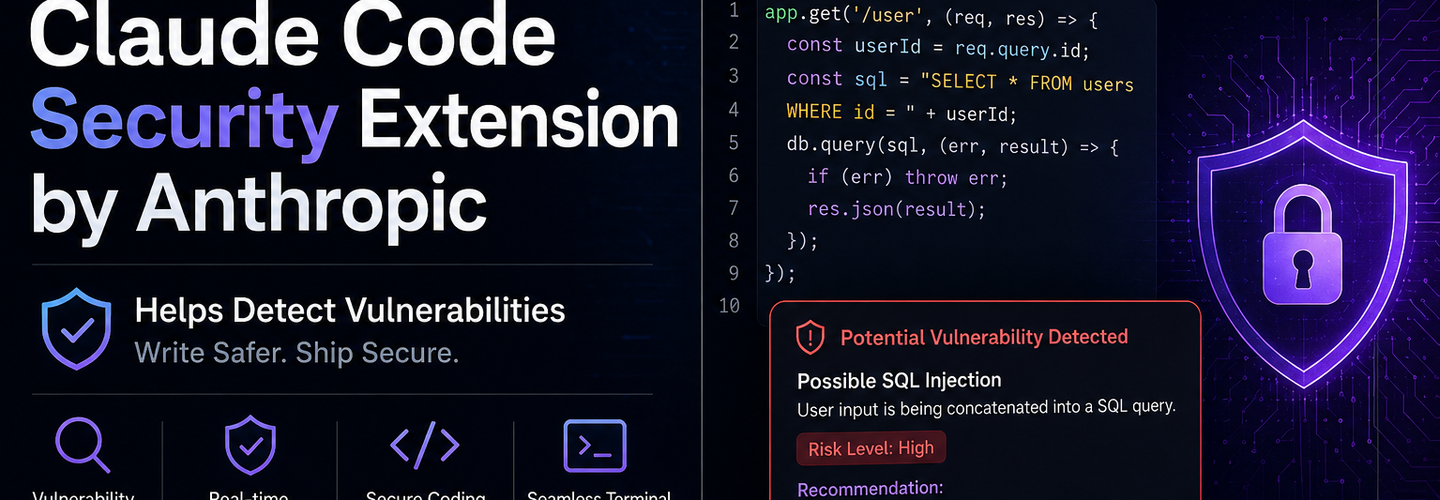
Claude Code Security Extension by Anthropic Helps Detect Vulnerabilities
Artificial intelligence is rapidly transforming software development, and coding assistants are now becoming a standard part of modern engineering workflows. From generating code snippets to debugging applications, AI-powered developer tools are helping teams move faster than ever before. However, speed without security can create major risks.
To address this growing concern, Anthropic recently introduced a free security extension for Claude Code designed to help developers identify vulnerabilities during development workflows. The release represents another major step toward integrating secure coding practices directly into AI-assisted programming environments.
As organizations increasingly rely on AI-generated code, security experts have warned about the possibility of introducing insecure functions, exposed credentials, weak authentication logic, and unsafe dependencies into production systems. Anthropic’s new security-focused extension aims to reduce those risks by giving developers additional visibility into potential security issues before software is deployed.
In this article, ReconShield explores what the Claude Code security extension does, how it works, why it matters for cybersecurity teams, and how AI-assisted secure development could shape the future of software engineering.
Why AI Coding Security Matters
AI coding assistants have become extremely popular across startups, enterprises, and open-source communities. Developers now use AI tools to:
- ▸Generate application logic
- ▸Write APIs
- ▸Debug code
- ▸Create automation scripts
- ▸Build infrastructure configurations
- ▸Refactor legacy software
- ▸Accelerate DevOps workflows
While these tools improve productivity, they can also unintentionally generate insecure code patterns. Researchers and security professionals have repeatedly demonstrated that AI-generated code may include:
- ▸Hardcoded secrets
- ▸Weak authentication logic
- ▸SQL injection vulnerabilities
- ▸Unsafe deserialization
- ▸Insecure API calls
- ▸Poor input validation
- ▸Vulnerable dependencies
- ▸Misconfigured cloud settings
This creates a new challenge for organizations adopting AI development tools at scale.
Traditional security reviews often happen later in the software development lifecycle. By that stage, vulnerabilities may already be deeply integrated into the application architecture. Anthropic’s security extension attempts to move security earlier into the development process.
This approach aligns with modern DevSecOps strategies where security becomes part of continuous development instead of a separate final-stage review.
What Is the Claude Code Security Extension?
The Claude Code security extension is a free security-focused plugin designed to work alongside Claude Code terminal workflows. Its primary goal is to help developers identify potentially risky coding patterns and vulnerabilities while they write or review code.
Instead of replacing existing security tools, the extension acts as an additional layer of developer-focused security guidance.
According to Anthropic, the extension is intended to support safer AI-assisted development by helping developers:
- ▸Detect possible vulnerabilities
- ▸Improve secure coding awareness
- ▸Review risky code suggestions
- ▸Reduce accidental exposure risks
- ▸Encourage defensive programming practices
The extension can be especially useful for teams integrating AI-generated code into production environments.
Because AI coding assistants can produce large amounts of code quickly, developers may not always manually inspect every generated function or dependency. A built-in security layer can help reduce oversight issues and improve overall development hygiene.
Key Security Features
Although the exact implementation may evolve over time, security-focused AI development extensions typically include several important capabilities.
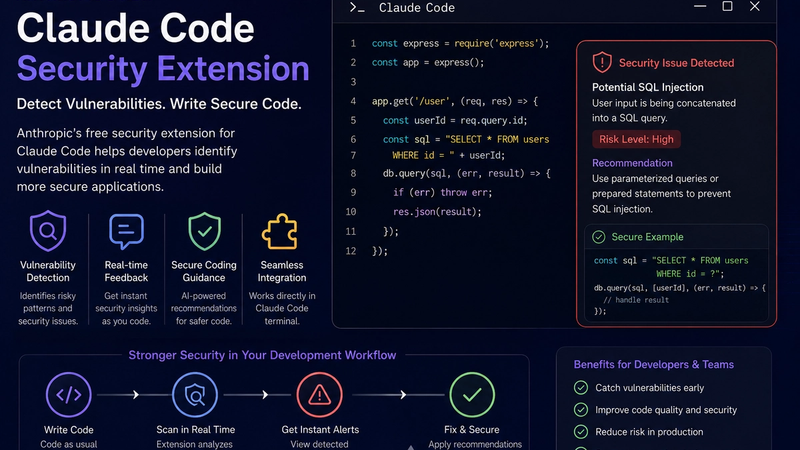
## 1. Vulnerability Detection
One of the core functions of the extension is identifying potentially insecure code patterns.
Examples may include:
- ▸Unsanitized user input
- ▸Weak password handling
- ▸Insecure database queries
- ▸Dangerous shell execution
- ▸Missing authentication checks
- ▸Unsafe file handling
- ▸Exposed tokens or credentials
Early detection helps developers fix issues before deployment.
## 2. Real-Time Security Feedback
Real-time feedback is becoming a major trend in modern software development tools.
Instead of waiting for scheduled scans or manual reviews, developers can receive immediate security suggestions while writing code.
This improves:
- ▸Developer awareness
- ▸Faster remediation
- ▸Secure coding habits
- ▸Workflow efficiency
Continuous feedback loops are especially valuable in fast-moving development teams.
## 3. AI-Assisted Secure Coding Recommendations
The extension may also provide safer alternatives when risky patterns are detected.
For example:
- ▸Suggesting parameterized queries instead of raw SQL
- ▸Recommending stronger authentication methods
- ▸Advising proper input validation
- ▸Highlighting risky third-party libraries
This educational approach helps developers improve long-term security practices instead of simply fixing isolated issues.
## 4. Integration With Developer Workflows
One major advantage of terminal-based security tooling is minimal workflow disruption.
Developers often avoid tools that slow productivity or create excessive friction. Security extensions integrated directly into development environments are more likely to be adopted consistently.
The Claude Code extension appears designed to support developer-first usability while improving visibility into security concerns.
The Growing Security Risks of AI-Generated Code
AI-generated code is becoming increasingly common across industries, but security researchers continue to debate its long-term risks.
Some major concerns include:
## Insecure Training Data
AI coding models learn patterns from massive public code repositories. Unfortunately, not all publicly available code follows secure development practices.
As a result, AI-generated suggestions can occasionally replicate insecure patterns found in training datasets.
## Overreliance on Automation
Developers may trust AI-generated outputs too quickly without performing adequate security reviews.
This can create a false sense of confidence, especially among inexperienced developers.
## Supply Chain Risks
Modern applications rely heavily on third-party packages and dependencies. AI tools may recommend outdated or vulnerable libraries if developers fail to validate recommendations carefully.
Software supply chain attacks continue to rise globally, making dependency security increasingly important.
## Faster Vulnerability Propagation
Because AI accelerates development speed, insecure patterns can spread across projects more rapidly than traditional manual coding workflows.
Without security guardrails, organizations may unknowingly introduce vulnerabilities at scale.
Why Security-Integrated AI Development Is Important
The release of security-focused AI development tools reflects a broader shift within the cybersecurity industry.
Organizations are beginning to recognize that AI productivity must be balanced with defensive controls.
Security-integrated development environments provide several advantages:
## Earlier Detection
Finding vulnerabilities during development is significantly cheaper and easier than fixing them after deployment.
## Improved Developer Awareness
Developers gain direct exposure to secure coding principles while actively writing code.
## Reduced Operational Risk
Early remediation helps prevent future breaches, downtime, compliance issues, and reputational damage.
## Better DevSecOps Alignment
Integrated security tooling supports continuous security validation across the software lifecycle.
AI and the Future of Secure Software Development
AI-assisted development is unlikely to disappear. In fact, adoption is expected to grow rapidly over the next several years.
This means organizations must adapt their security strategies accordingly.
Future secure coding ecosystems may include:
- ▸AI-powered vulnerability detection
- ▸Automated code review
- ▸Security-aware coding assistants
- ▸Real-time compliance validation
- ▸Intelligent dependency analysis
- ▸Secure infrastructure recommendations
- ▸AI-assisted threat modeling
Rather than treating AI as a security risk alone, many organizations now see it as both a productivity accelerator and a defensive opportunity.
The challenge is ensuring that security evolves alongside automation.
How Developers Can Use AI Tools More Securely
Even with security-focused extensions, developers should continue following established secure coding practices.
## Review AI-Generated Code Carefully
Never assume generated code is automatically safe.
Developers should manually inspect:
- ▸Authentication logic
- ▸Database queries
- ▸API integrations
- ▸File handling operations
- ▸Cloud configurations
## Validate Dependencies
Always verify third-party packages before adding them to production systems.
Look for:
- ▸Maintenance activity
- ▸Known vulnerabilities
- ▸Community trust
- ▸Security advisories
## Use Security Scanning Tools
AI security extensions should complement, not replace, traditional security tooling such as:
- ▸Static analysis
- ▸Dependency scanning
- ▸Container scanning
- ▸Secrets detection
- ▸Infrastructure security validation
## Apply Least Privilege Principles
Applications and automation systems should operate with minimal required permissions.
This limits damage if vulnerabilities are exploited.
## Maintain Human Oversight
Human review remains critical for:
- ▸Security architecture
- ▸Business logic validation
- ▸Compliance requirements
- ▸Threat modeling
- ▸Risk assessment
AI can assist developers, but it should not become the sole decision-maker for security-sensitive systems.
Industry Response to AI Security Tooling
The cybersecurity industry is increasingly focused on securing AI-assisted development pipelines.
Many organizations now prioritize:
- ▸AI governance
- ▸Secure AI deployment
- ▸Model transparency
- ▸AI risk assessment
- ▸Development workflow security
Security vendors are also investing heavily in:
- ▸AI code scanning
- ▸Automated remediation
- ▸Threat intelligence integration
- ▸Secure AI infrastructure
Anthropic’s release reflects the growing understanding that AI coding systems require security-centric design principles.
As AI adoption expands, demand for integrated security controls will likely continue rising.
Potential Benefits for Enterprise Teams
Large organizations may benefit significantly from AI-integrated security tooling.
## Faster Secure Development
Teams can maintain rapid development cycles while improving security visibility.
## Reduced Security Bottlenecks
Integrated tooling reduces dependency on manual review processes alone.
## Improved Security Culture
Developers receive ongoing exposure to security best practices.
## Better Compliance Support
Continuous vulnerability monitoring can assist organizations with compliance and audit readiness.
Challenges and Limitations
Despite the advantages, AI security extensions are not perfect.
## False Positives
Automated detection systems may occasionally flag harmless code as risky.
## False Negatives
Some vulnerabilities may still bypass automated analysis entirely.
## Context Limitations
AI systems may struggle to fully understand business-specific logic or application context.
## Evolving Threat Landscape
Attack techniques constantly evolve, requiring continuous updates to security models and detection capabilities.
Because of these limitations, security extensions should be viewed as supportive tools rather than complete replacements for professional security practices.
The Role of Responsible AI Development
Responsible AI development involves balancing innovation with security, privacy, and transparency.
As AI tools become more deeply integrated into software engineering, organizations must establish policies for:
- ▸AI usage governance
- ▸Code validation
- ▸Security review
- ▸Access control
- ▸Data protection
- ▸Risk monitoring
Security-first AI adoption helps organizations reduce unintended exposure while benefiting from automation.
Anthropic’s security-focused release reflects the broader movement toward responsible AI-assisted software development.
Final Thoughts
The launch of Anthropic’s free Claude Code security extension highlights the growing importance of secure AI-assisted development. As coding assistants become more common across the technology industry, organizations must ensure that security evolves alongside productivity.
AI-generated code can accelerate innovation, but it can also introduce vulnerabilities if not reviewed carefully. Integrated security tooling provides developers with additional visibility into risky patterns before they reach production environments.
The future of software development will likely involve a combination of:
- ▸Human expertise
- ▸AI-assisted productivity
- ▸Automated security validation
- ▸Continuous monitoring
Organizations that successfully balance speed and security will be better positioned to manage modern cyber risks.
For developers, security researchers, and enterprise teams, tools that combine AI assistance with defensive security practices may become an essential part of the modern software development lifecycle.
Suggested Internal Links for ReconShield
Read More:
F5 BIG-IP Appliances Targeted by Hackers for SSH Intrusions Into Enterprise Linux Systems
Vellore Man Arrested in Cambodia Cyber Slavery Racket Linked to Online Scam Networks
Cyber Fraud in Bengaluru: Elderly Woman Loses Rs 7.69 Lakh After Clicking Fake WhatsApp Link
10,000+ Zero-Day Vulnerabilities Identified by Anthropic Claude Mythos in Glasswing Project
PyrsistenceSniper Detects 117 Malware Persistence Techniques Across Windows, Linux, and macOS
Greenwood Cyber + AI Lab Opens in Tulsa Through Microsoft and Black Tech Street Collaboration
Open-Source Ecosystem Under Threat as Hackers Breach 34 Software Packages
## Analyst Commentary & Implementation Blueprint
Security advisory
Continuous security exposure assessment is critical to identifying public vulnerabilities before they are exploited. Organizations should maintain a passive inventory of all web servers, TLS configs, and open ports, ensuring that default configurations are eliminated and security advisories are actively implemented.
Hardened Security Configuration Blueprint
# General Security Hardening Directive
ServerTokens ProductOnly
ServerSignature Off
FileETag None
Actionable Mitigation Checklist
- ✔Perform passive asset inventories weekly.
- ✔Restrict administrative ports using local firewall controls.
- ✔Monitor active CVE alerts for exposed software.
Common Inquiries & FAQs
Why is passive scanning preferred for continuous auditing?
Passive audits do not cause operational impact or trigger firewall blocks, making them ideal for constant surveillance of internet-facing assets.
What should I do if a vulnerability is flagged?
Apply the latest vendor patches, restrict access to the resource via firewalls, or verify configuration flags to mitigate risks.
Surendra Reddy
Surendra Reddy is a cybersecurity researcher and founder of ReconShield, specializing in OSINT and defensive infrastructure analysis.
Connect on LinkedIn ↗// AUDIT BRIEFING DISCUSSION (2 COMMENTS)
Great breakdown of the passive infrastructure vectors. We recently audited our external DNS zones and found multiple dangling staging environments. Implementing wildcard certificates reduced our CT log leaks significantly.
Is there any automated tooling you recommend for daily crt.sh scraping? Manually checking CT logs is becoming unsustainable for our domain portfolio.
// MORE ARTICLES

AI Meets Penetration Testing: PentestCode Launches with 18 Specialized Security Agents
PentestCode launches with 18 integrated security tools and a 13-agent AI architecture that automates full penetration testing workflows.

AI Goes to War: Chinese Hackers Exploit Claude Code and DeepSeek in Government Attacks
Suspected Chinese hackers used Claude Code and DeepSeek in a split-model workflow to breach government systems. Here's what happened.

Best AI Cybersecurity Stocks to Buy as Cybercrime Surges in 2026
AI cybersecurity stocks are surging as cybercrime accelerates in 2026. Explore the sector's key players, growth drivers, and risks to weigh.