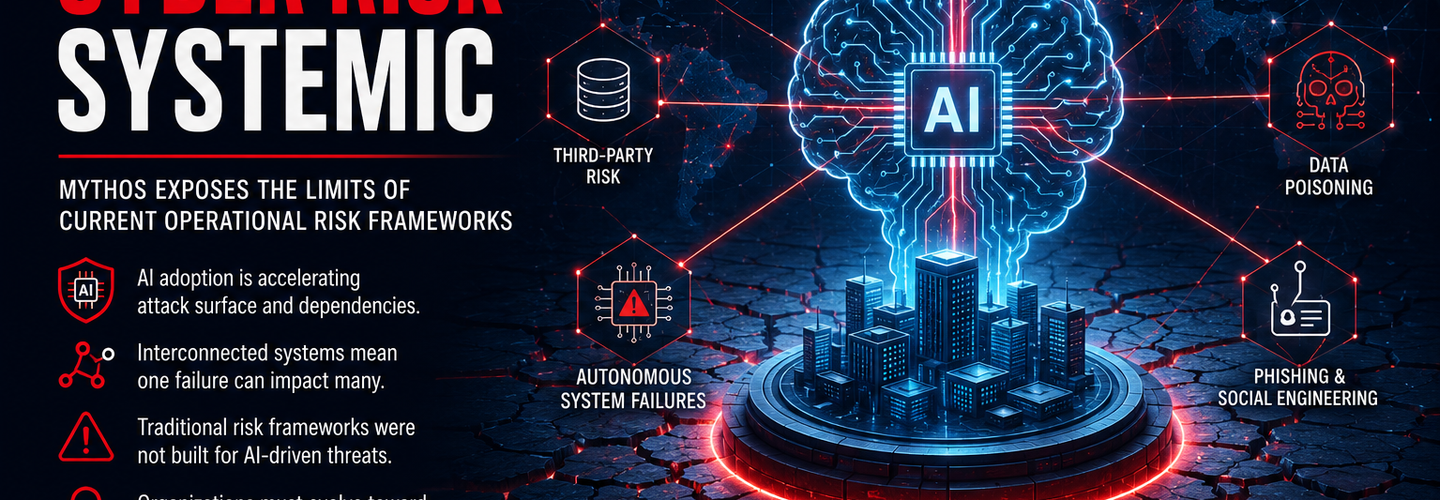
AI Cyber Risk Becomes Systemic, Mythos Warns
## KEY HIGHLIGHTS
- ▸Mythos argues that AI is transforming cyber risk into a systemic business threat.
- ▸Traditional operational risk frameworks struggle to address interconnected AI dependencies.
- ▸Generative AI increases the attack surface across enterprises and supply chains.
- ▸AI failures can cascade rapidly through cloud platforms, APIs, and automated systems.
- ▸Security teams must adopt adaptive, real-time risk management strategies.
- ▸Regulatory scrutiny around AI governance is accelerating globally.
- ▸Organizations that ignore systemic AI risks may face operational and financial disruption.
## Introduction
A single AI failure can now impact thousands of organizations simultaneously. That is the warning highlighted by Mythos, which argues that AI cyber risk is evolving beyond isolated incidents into a systemic threat.
The concern is not theoretical. According to IBM’s 2024 Cost of a Data Breach Report, the average breach involving AI-related attack vectors cost organizations more than $4.8 million globally. As businesses integrate AI into operations, security gaps become deeply interconnected.
Traditional security models were built for predictable systems. AI changes that equation by introducing autonomous decision-making, dynamic learning, and large-scale dependencies across vendors and cloud providers.
The result is a new cybersecurity challenge that existing governance frameworks were never designed to handle.
## What Is Systemic AI Cyber Risk?
Systemic cyber risk refers to threats capable of spreading across multiple organizations, industries, or critical systems at once. Unlike conventional breaches, systemic incidents create chain reactions.
Mythos argues that AI accelerates this risk because many organizations rely on the same models, APIs, cloud infrastructure, and automation tools.
For example, if a widely used AI model contains a vulnerability, attackers could exploit it across healthcare systems, banks, logistics providers, and government agencies simultaneously.
This mirrors past supply chain incidents such as the SolarWinds breach. However, AI introduces a larger attack surface because systems continuously evolve and interact with sensitive data.
A 2025 industry analysis from Gartner estimated that over 70% of enterprises now use generative AI in at least one core business function. That level of adoption creates concentrated dependency risk.
The challenge becomes even more serious when organizations deploy AI without clear visibility into training data, model behavior, or third-party integrations.
Real-World Example: AI-Powered Fraud Escalation
In 2024, several financial institutions reported increases in AI-generated phishing and voice cloning scams. Attackers used generative AI to imitate executives and bypass verification procedures.
One widely reported incident involved a multinational company losing millions after employees were deceived by AI-generated deepfake video calls impersonating senior leadership.
These attacks demonstrated how AI security risks now extend beyond technical vulnerabilities into operational trust itself.
## Why Current Operational Risk Frameworks Fall Short
Most operational risk frameworks were designed around static systems and human-driven processes. AI environments behave differently.
Traditional frameworks focus on identifying known threats, assigning risk scores, and implementing controls. AI systems can change outputs dynamically, making risk difficult to predict.
Mythos highlights several major limitations:
Limited Visibility
Many organizations do not fully understand which AI models employees use daily. Shadow AI adoption is increasing rapidly across departments.
A 2025 survey by Deloitte found that 62% of enterprises lacked centralized oversight of employee AI tool usage.
Dependency Concentration
Modern AI ecosystems rely heavily on a few cloud providers and model vendors. A disruption affecting one provider can impact thousands of businesses instantly.
This creates a “single point of systemic failure” problem.
Speed of Exploitation
AI-driven attacks evolve faster than traditional incident response cycles. Malware can now adapt automatically using machine learning techniques.
Security teams operating on quarterly assessments cannot keep pace with real-time AI threats.
Governance Gaps
Many regulatory standards were created before generative AI became mainstream. Organizations often lack policies covering model integrity, AI transparency, or adversarial manipulation.
Without updated governance, enterprises remain exposed.
## How AI Systemic Risk Works
The mechanics behind AI-driven cyber threats are rooted in interconnected infrastructure.
Modern enterprises depend on multiple AI components simultaneously:
- ▸Cloud-hosted models
- ▸Third-party APIs
- ▸Autonomous agents
- ▸AI-enhanced analytics platforms
- ▸Automated decision systems
When one layer fails, the impact spreads quickly.
Shared Infrastructure Risk
If attackers compromise a popular AI provider, malicious outputs could propagate across customer environments instantly.
This resembles software supply chain attacks but operates at machine speed.
Data Poisoning
Attackers can manipulate training datasets to influence model behavior. Poisoned data may cause AI systems to make incorrect or dangerous decisions.
In cybersecurity environments, this could disable fraud detection or weaken threat monitoring.
Prompt Injection Attacks
Generative AI tools can be manipulated through malicious prompts that bypass safety mechanisms.
Researchers have demonstrated prompt injection attacks capable of exposing sensitive enterprise information.
Autonomous Attack Automation
Cybercriminals increasingly use AI to automate reconnaissance, phishing campaigns, and exploit generation.
According to Darktrace, AI-assisted phishing attacks increased by over 135% between 2023 and 2025.
The speed and scale of these attacks overwhelm legacy defense models.
## Best Practices to Reduce AI Cyber Risk
Organizations cannot eliminate AI cyber risk, but they can reduce exposure significantly through proactive governance and security controls.
Establish AI Governance Policies
Every organization should maintain clear policies for AI usage, vendor approval, and data handling.
Security teams must know which AI tools employees access.
Conduct AI Risk Assessments
Traditional risk assessments are insufficient. Enterprises need continuous AI-specific evaluations covering model behavior, integrations, and third-party dependencies.
Implement Zero Trust Principles
AI systems should operate under strict access controls.
Limit permissions, segment sensitive data, and monitor model interactions continuously.
Strengthen Vendor Due Diligence
Organizations should evaluate AI vendors for transparency, security practices, and incident response capabilities.
Vendor concentration risk must become part of enterprise risk management discussions.
Monitor for AI Abuse
Deploy behavioral analytics capable of identifying abnormal AI-generated activity.
This includes detecting deepfake attempts, AI-generated phishing content, and anomalous automation patterns.
Train Employees
Human awareness remains critical.
Employees should understand the risks of uploading sensitive information into public AI tools and recognize AI-enhanced social engineering tactics.
## Recent Trends and 2024–2025 Statistics
The scale of AI adoption is increasing faster than many organizations can secure it.
Recent cybersecurity trends reveal several warning signs:
- ▸Microsoft reported a significant rise in AI-assisted phishing campaigns during 2025.
- ▸Gartner predicts that by 2026, over 40% of AI-related data breaches will result from improper cross-border AI governance.
- ▸The World Economic Forum identified AI-enabled cybercrime as one of the top global business risks for the next decade.
- ▸CrowdStrike observed a sharp increase in adversarial AI techniques targeting enterprise environments.
- ▸Generative AI tools are now commonly used in business operations, customer support, and software development workflows.
Regulators are responding aggressively.
The EU AI Act, emerging U.S. federal guidance, and updated cybersecurity regulations globally are placing greater accountability on organizations deploying AI systems.
Companies that fail to adapt their cyber resilience strategies may face compliance penalties alongside operational disruption.
## Conclusion
Mythos highlights an uncomfortable reality: AI is changing cybersecurity from an isolated technical problem into a systemic operational challenge.
Traditional operational risk frameworks struggle to address the speed, scale, and interconnected nature of AI ecosystems.
Organizations must move beyond periodic assessments and adopt continuous, adaptive security models built for AI-driven environments.
The enterprises that succeed will treat AI governance as a core business function, not just an IT responsibility.
As AI adoption accelerates, systemic cyber risk will become one of the defining security issues of the decade.
8. FAQ SECTION
Q: What is AI cyber risk?
A: AI cyber risk refers to cybersecurity threats created or amplified by artificial intelligence systems. These risks include data poisoning, automated attacks, prompt injection, and AI-powered phishing.
Q: Why is AI considered a systemic cyber risk?
A: AI becomes systemic when vulnerabilities affect multiple organizations simultaneously through shared cloud providers, AI models, or infrastructure dependencies.
Q: How do operational risk frameworks fail against AI threats?
A: Traditional operational risk frameworks rely on static assessments and predictable systems. AI environments evolve dynamically, making threats harder to predict and contain.
Q: What industries face the highest AI security risks?
A: Financial services, healthcare, government, manufacturing, and critical infrastructure sectors face elevated AI security risks due to sensitive data and operational reliance on automation.
Q: How can organizations reduce AI-driven cyber threats?
A: Organizations can reduce exposure by implementing AI governance, continuous monitoring, zero trust security, vendor assessments, and employee awareness training.
Read More:
Pentagon’s CYBERCOM Requests Massive AI Funding Jump for Cybersecurity
Google Reports North Korean Hackers Using AI to Target Cybersecurity Blind Spots
## Analyst Commentary & Implementation Blueprint
Security advisory
Continuous security exposure assessment is critical to identifying public vulnerabilities before they are exploited. Organizations should maintain a passive inventory of all web servers, TLS configs, and open ports, ensuring that default configurations are eliminated and security advisories are actively implemented.
Hardened Security Configuration Blueprint
# General Security Hardening Directive
ServerTokens ProductOnly
ServerSignature Off
FileETag None
Actionable Mitigation Checklist
- ✔Perform passive asset inventories weekly.
- ✔Restrict administrative ports using local firewall controls.
- ✔Monitor active CVE alerts for exposed software.
Common Inquiries & FAQs
Why is passive scanning preferred for continuous auditing?
Passive audits do not cause operational impact or trigger firewall blocks, making them ideal for constant surveillance of internet-facing assets.
What should I do if a vulnerability is flagged?
Apply the latest vendor patches, restrict access to the resource via firewalls, or verify configuration flags to mitigate risks.
Surendra Reddy
Surendra Reddy is a cybersecurity researcher and founder of ReconShield, specializing in OSINT and defensive infrastructure analysis.
Connect on LinkedIn ↗// AUDIT BRIEFING DISCUSSION (2 COMMENTS)
Great breakdown of the passive infrastructure vectors. We recently audited our external DNS zones and found multiple dangling staging environments. Implementing wildcard certificates reduced our CT log leaks significantly.
Is there any automated tooling you recommend for daily crt.sh scraping? Manually checking CT logs is becoming unsustainable for our domain portfolio.
// MORE ARTICLES
Security Researchers Warn Critical n8n Flaws May Expose Automation Platforms to RCE
Researchers have disclosed critical vulnerabilities in n8n that could expose automation workflows and connected enterprise systems to remote code execution risks, prompting urgent patch recommendations for users and administrators.
How Agentic AI Is Changing Software Engineering and Expanding Mobile Attack Surfaces
Agentic AI is rapidly transforming software engineering workflows through automation and intelligent coding assistance, while cybersecurity experts warn of expanding mobile attack surfaces and emerging application security risks.

Critical Tenda Router Backdoor (CVE-2026-11405): Check If Your Device Is Vulnerable Now
CVE-2026-11405 is an unpatched Tenda router backdoor granting full admin access without a password. Check if your model is affected now.