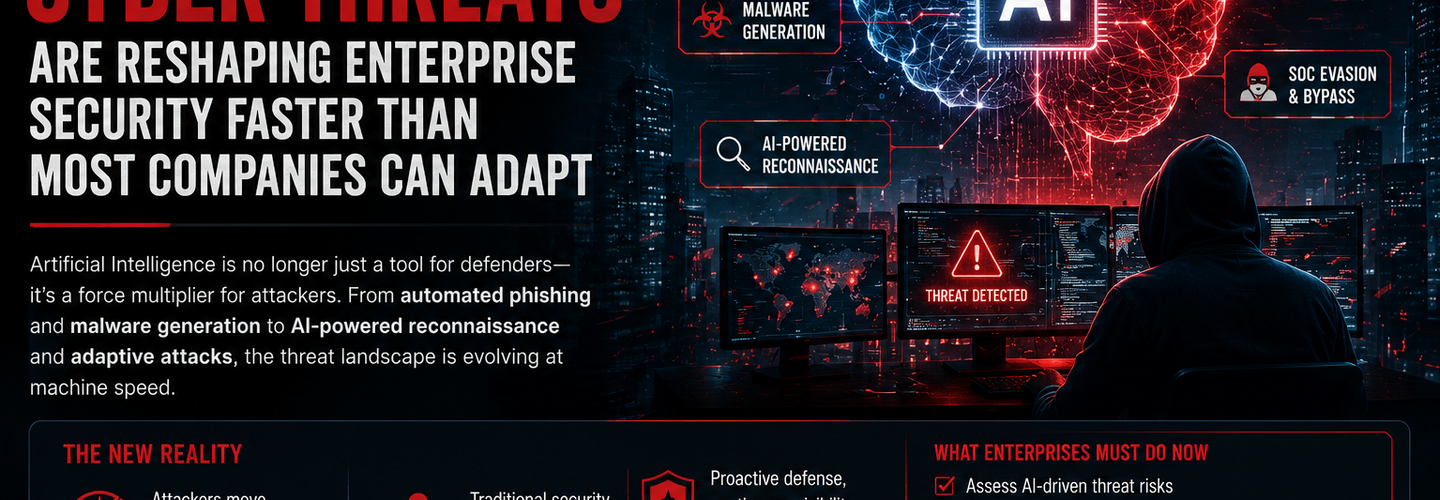
AI-Driven Cyber Threats Are Reshaping Enterprise Security Faster Than Most Companies Can Adapt
Artificial intelligence has become the defining force in cybersecurity in 2026 — not only for defenders, but increasingly for threat actors. Security researchers, government agencies, and enterprise CISOs are warning that AI-assisted phishing campaigns, automated vulnerability discovery, deepfake impersonation fraud, and adaptive malware are accelerating faster than traditional security teams can respond.
Over the past year, organizations across finance, healthcare, manufacturing, telecommunications, and critical infrastructure have reported a sharp increase in highly personalized cyberattacks powered by generative AI tools. Analysts say the shift is transforming cybercrime from opportunistic activity into a scalable industrial operation.
What makes the trend especially concerning is that many of these attacks no longer rely on sophisticated zero-day exploits. Instead, adversaries are exploiting human trust, identity systems, cloud misconfigurations, and overloaded security operations centers using automation and AI-enhanced social engineering.
Cybersecurity leaders now face a difficult reality: the threat landscape is evolving in real time, while many enterprise defenses remain built for an earlier era of cyber risk.
## AI Is Amplifying Existing Threats Rather Than Inventing New Ones
Contrary to Hollywood-style narratives, AI is not “creating super hackers overnight.” Security experts say the real danger comes from how artificial intelligence dramatically improves the speed, scale, and personalization of existing cyber threats.
Threat intelligence firms have observed a rise in:
- ▸AI-generated phishing emails with near-perfect grammar and contextual awareness
- ▸Deepfake voice impersonation targeting executives and finance departments
- ▸Automated credential stuffing and identity attacks
- ▸AI-assisted malware obfuscation techniques
- ▸Faster reconnaissance against exposed cloud assets
- ▸Large-scale misinformation and disinformation campaigns
- ▸AI-powered scam operations targeting consumers
The result is a lower barrier to entry for cybercriminals and a higher operational tempo for organized threat groups.
According to multiple industry reports released this year, phishing success rates continue to rise despite increased security awareness training. Researchers attribute part of that increase to generative AI’s ability to craft believable, localized, and emotionally convincing content at scale.
Security analysts note that traditional phishing detection methods — especially those relying on spelling mistakes or suspicious wording — are becoming less effective as AI-generated lures grow more sophisticated.
## Security Operations Centers Are Under Pressure
Enterprise security teams are struggling with alert fatigue, staffing shortages, and increasingly complex hybrid environments. The introduction of AI-enhanced attacks is amplifying those challenges.
Modern organizations now manage sprawling attack surfaces that include:
- ▸Remote employees
- ▸Cloud workloads
- ▸SaaS platforms
- ▸APIs
- ▸IoT devices
- ▸Third-party vendors
- ▸Mobile endpoints
- ▸AI-integrated applications
Each additional connected system introduces new visibility gaps and potential entry points.
Security operations centers (SOCs) are also dealing with an overwhelming volume of telemetry data. Analysts frequently face thousands of alerts daily, many of which turn out to be false positives. AI-assisted attacks can blend into normal business activity more effectively, making malicious behavior harder to distinguish.
Some cybersecurity firms are responding by deploying defensive AI systems designed to automate detection and incident response. However, experts caution that AI is not a silver bullet.
“Organizations cannot automate their way out of poor security hygiene,” several industry analysts warned during recent cybersecurity conferences. AI tools may improve efficiency, but foundational security controls still determine resilience during real-world incidents.
## Deepfake Fraud Is Emerging as a Major Business Risk
One of the fastest-growing concerns among enterprise leaders is deepfake-enabled fraud.
Threat actors are increasingly using synthetic audio and video to impersonate executives, vendors, and employees. Security researchers have documented cases where finance teams received convincing voice messages appearing to come from company leadership requesting urgent wire transfers or confidential information.
The technology behind these impersonation campaigns has become cheaper, more accessible, and easier to use. Even limited publicly available audio samples from earnings calls, webinars, or social media videos can provide enough material for convincing voice cloning attempts.
Industries particularly vulnerable include:
- ▸Banking and financial services
- ▸Healthcare
- ▸Insurance
- ▸Legal services
- ▸Government agencies
- ▸Cryptocurrency firms
The rise of remote and hybrid work environments has also weakened traditional identity verification practices. Many organizations still rely heavily on voice recognition, email trust, or informal approval processes that can be manipulated.
Security leaders are increasingly recommending secondary verification channels for financial approvals and sensitive operational decisions.
## Critical Infrastructure Remains a High-Value Target
Government agencies worldwide continue warning that critical infrastructure operators face elevated cyber risk levels amid geopolitical tensions and expanding digital dependencies.
Energy providers, transportation systems, telecommunications networks, water utilities, and healthcare systems remain attractive targets because disruption can create both financial and societal consequences.
Recent advisories from Western cybersecurity agencies have emphasized the importance of:
- ▸Network segmentation
- ▸Multi-factor authentication
- ▸Offline backups
- ▸Continuous monitoring
- ▸Rapid patch management
- ▸Supply chain risk assessment
Operational technology (OT) environments are a particular concern. Many industrial systems were not originally designed with modern cybersecurity threats in mind, making them difficult to secure without disrupting operations.
Experts warn that ransomware groups and nation-state actors increasingly view supply chains and managed service providers as indirect pathways into larger organizations.
This interconnected ecosystem means a security failure at one vendor can ripple across multiple industries.
## The Cloud Security Problem Isn’t Going Away
Cloud adoption continues to outpace security maturity in many organizations.
While major cloud providers invest heavily in infrastructure security, researchers say most breaches stem from customer-side misconfigurations rather than provider failures.
Common enterprise weaknesses include:
- ▸Exposed storage buckets
- ▸Excessive permissions
- ▸Weak API security
- ▸Poor identity management
- ▸Inadequate logging
- ▸Shadow IT deployments
The rapid adoption of AI tools inside enterprise environments is adding another layer of complexity. Employees frequently integrate third-party AI services into workflows without full security reviews, creating concerns around data leakage, intellectual property exposure, and compliance violations.
Security teams are now racing to establish governance policies around generative AI usage before sensitive business data is unintentionally exposed.
## Ransomware Groups Continue to Evolve
Despite increased law enforcement pressure and international disruption efforts, ransomware remains one of the most financially damaging cyber threats facing organizations.
Threat groups have adapted their tactics by focusing more heavily on:
- ▸Data theft and extortion
- ▸Supply chain compromise
- ▸Multi-stage intrusions
- ▸Identity-based attacks
- ▸Double and triple extortion models
Many attackers now threaten to leak stolen data publicly even if victims restore operations from backups.
Healthcare organizations, educational institutions, local governments, and manufacturing firms continue to face elevated risk due to operational sensitivity and limited cybersecurity resources.
Incident response firms report that ransomware negotiations and recovery costs frequently extend far beyond the ransom itself, including legal expenses, regulatory penalties, downtime losses, reputational damage, and customer notification obligations.
Cyber insurance providers have also tightened underwriting requirements, forcing organizations to improve baseline security controls before obtaining coverage.
## Why This Matters
The cybersecurity industry is entering a period where speed matters as much as sophistication.
AI-enhanced cyber threats allow attackers to scale operations globally with minimal resources. A single campaign can now target thousands of organizations simultaneously using automated personalization and adaptive tactics.
For businesses, the implications extend beyond IT departments.
Cyber incidents increasingly affect:
- ▸Financial stability
- ▸Regulatory compliance
- ▸Customer trust
- ▸Brand reputation
- ▸Operational continuity
- ▸Investor confidence
The convergence of AI, cloud computing, remote work, and interconnected supply chains has fundamentally altered enterprise risk management.
Organizations that fail to modernize security practices may find themselves unable to keep pace with evolving threat conditions.
At the same time, experts stress that panic is not the answer. Most successful breaches still exploit preventable weaknesses such as weak passwords, delayed patching, excessive privileges, phishing susceptibility, and poor visibility.
Strong cybersecurity fundamentals remain highly effective.
## How Users Can Stay Safe
Security professionals recommend several practical steps for both organizations and individual users:
Enable Multi-Factor Authentication (MFA)
MFA significantly reduces the effectiveness of credential theft and phishing attacks. Authentication apps and hardware security keys provide stronger protection than SMS-based codes.
Verify Unusual Requests
Employees should independently verify urgent financial or sensitive requests through secondary communication channels, especially if audio or video messages appear suspicious.
Keep Systems Updated
Unpatched vulnerabilities remain one of the most common entry points for attackers. Organizations should prioritize rapid patch management and asset visibility.
Limit Excessive Permissions
Identity and access management remains critical. Users and applications should only receive the minimum privileges necessary.
Use Security Awareness Training
Modern phishing simulations and security education programs help employees recognize evolving social engineering tactics.
Back Up Critical Data
Offline and immutable backups remain essential defenses against ransomware and destructive attacks.
Monitor Third-Party Risk
Vendors, suppliers, and contractors can introduce indirect exposure. Organizations should assess partner security controls regularly.
Establish AI Governance Policies
Companies deploying generative AI tools should define clear policies regarding sensitive data handling, access controls, and approved usage.
## Official Responses and Industry Action
Governments and regulatory agencies worldwide are intensifying cybersecurity oversight amid rising digital threats.
Several recent initiatives include:
- ▸Expanded cybersecurity reporting requirements
- ▸New critical infrastructure protection mandates
- ▸AI governance frameworks
- ▸Increased collaboration between public and private sectors
- ▸International ransomware disruption operations
Major technology vendors are also increasing investment in AI-assisted defense platforms, threat intelligence sharing, and secure-by-design initiatives.
However, cybersecurity experts emphasize that technology alone cannot solve systemic security problems.
Effective resilience requires:
- ▸Executive leadership involvement
- ▸Security-first culture
- ▸Continuous employee education
- ▸Incident response planning
- ▸Cross-industry collaboration
Organizations that treat cybersecurity solely as an IT issue may struggle to respond effectively during large-scale incidents.
## Sources & References
- ▸CISA Cybersecurity Advisories
- ▸NIST Cybersecurity Framework
- ▸ENISA Threat Landscape Reports
- ▸IBM X-Force Threat Intelligence Index
- ▸Microsoft Digital Defense Report
- ▸Verizon Data Breach Investigations Report (DBIR)
- ▸World Economic Forum Cybersecurity Insights
## Conclusion
Cybersecurity is no longer a niche technical concern isolated within corporate IT departments. It has become a core business resilience issue shaped by artificial intelligence, geopolitical instability, cloud dependency, and digital interconnectedness.
The current wave of AI-enhanced threats demonstrates that attackers are evolving rapidly — but so are defensive capabilities. Organizations that prioritize visibility, identity protection, incident preparedness, and security culture will be better positioned to withstand the next generation of cyber risks.
As enterprises continue integrating AI into daily operations, the balance between innovation and security will define the future of digital trust.
Read More:
How Agentic AI Is Changing Software Engineering and Expanding Mobile Attack Surfaces
UK Says AI-Fueled Cyber Risks Are Tied to Security Weaknesses Rather Than Repository Transparency
Everpure strengthens cyber resilience by positioning data management as the final layer of defence
Gremlin Stealer Conceals C2 URLs and Exfiltration Paths in Encrypted Resource Sections
Copy Fail (CVE-2026-31431): The Linux Kernel Flaw That Handed Root to Anyone Who Asked
## Analyst Commentary & Implementation Blueprint
Security advisory
Continuous security exposure assessment is critical to identifying public vulnerabilities before they are exploited. Organizations should maintain a passive inventory of all web servers, TLS configs, and open ports, ensuring that default configurations are eliminated and security advisories are actively implemented.
Hardened Security Configuration Blueprint
# General Security Hardening Directive
ServerTokens ProductOnly
ServerSignature Off
FileETag None
Actionable Mitigation Checklist
- ✔Perform passive asset inventories weekly.
- ✔Restrict administrative ports using local firewall controls.
- ✔Monitor active CVE alerts for exposed software.
Common Inquiries & FAQs
Why is passive scanning preferred for continuous auditing?
Passive audits do not cause operational impact or trigger firewall blocks, making them ideal for constant surveillance of internet-facing assets.
What should I do if a vulnerability is flagged?
Apply the latest vendor patches, restrict access to the resource via firewalls, or verify configuration flags to mitigate risks.
Surendra Reddy
Surendra Reddy is a cybersecurity researcher and founder of ReconShield, specializing in OSINT and defensive infrastructure analysis.
Connect on LinkedIn ↗// AUDIT BRIEFING DISCUSSION (2 COMMENTS)
Great breakdown of the passive infrastructure vectors. We recently audited our external DNS zones and found multiple dangling staging environments. Implementing wildcard certificates reduced our CT log leaks significantly.
Is there any automated tooling you recommend for daily crt.sh scraping? Manually checking CT logs is becoming unsustainable for our domain portfolio.
// MORE ARTICLES
Security Researchers Warn Critical n8n Flaws May Expose Automation Platforms to RCE
Researchers have disclosed critical vulnerabilities in n8n that could expose automation workflows and connected enterprise systems to remote code execution risks, prompting urgent patch recommendations for users and administrators.
How Agentic AI Is Changing Software Engineering and Expanding Mobile Attack Surfaces
Agentic AI is rapidly transforming software engineering workflows through automation and intelligent coding assistance, while cybersecurity experts warn of expanding mobile attack surfaces and emerging application security risks.
SplitVPN Hacked: Data Breach Exposes 865,000 User Records and 58 Million Hidden Connection Logs (July 2026)
SplitVPN hacked: 865,336 user records and 58 million connection logs exposed, directly contradicting the VPN's "no-logs" promise. What was leaked and what to do now.