
Breaking: Hackers Claim Massive Accenture Data Breach, 35GB of Source Code Allegedly Stolen
Summarize this blog post with:
ChatGPT | Perplexity | Claude | Grok
You've probably seen Accenture's name attached to major cloud migrations and digital transformation projects for Fortune Global 500 companies. What you might not know yet is that a threat actor is currently selling 35GB of data they claim came directly from Accenture's own development environment, and the company has confirmed something happened without confirming how much. In this guide, you'll learn exactly what's been verified, what remains an unconfirmed claim, and what security teams — especially those connected to Accenture's Azure DevOps environments — should check right now.
Key Takeaways
- ▸A threat actor using the alias "888" posted a listing on the cybercrime forum PwnForums on July 6, 2026, claiming to have stolen roughly 35GB of Accenture data in an intrusion during early July.
- ▸Accenture has confirmed a security incident but has not verified the actor's claims about the volume or specific types of data taken.
- ▸The alleged dataset reportedly includes source code, RSA keys, SSH keys, Azure Personal Access Tokens, Azure Storage access keys, and configuration files.
- ▸The actor shared a screenshot appearing to show a cloned Azure DevOps repository hosted under an accenture.com domain as proof of access.
- ▸This is not "888"'s first claim against Accenture — a 2024 claim regarding employee data was disputed by Accenture, which said only three individuals were actually affected.
- ▸Stolen source code and cloud credentials can be reused as a playbook for follow-on attacks, even when the original breach is contained.
- ▸Organizations connected to Accenture-managed Azure DevOps environments should treat this as a precautionary trigger for credential rotation regardless of verification status.
What Is the Latest Accenture Data Breach Claim?
The latest Accenture data breach claim centers on a forum post from a threat actor known as "888," who stated they stole just over 35GB of source code and related material from Accenture in July 2026. The post appeared on PwnForums, a cybercrime marketplace, and was first surfaced by security researchers and outlets including BleepingComputer, SecurityWeek, and Cybernews. According to the listing, the compromised material spans source code, RSA keys, SSH keys, Azure Personal Access Tokens (PATs), Azure Storage access keys, and configuration files — a combination that, if accurate, would give a buyer meaningful insight into how Accenture's internal systems are built and secured.
To support the claim, the actor published a screenshot appearing to show them cloning a specific Azure DevOps repository, reportedly named "121123_AtriasTalentAcademy," hosted under a redacted accenture.com-associated hostname. For example, this kind of proof-of-possession screenshot is a common tactic cybercriminals use to build buyer confidence before a sale, though a single screenshot alone doesn't confirm the full scope of what was actually accessed or exfiltrated.
Why Does This Breach Claim Matter?
This claim matters because Accenture sits unusually close to the infrastructure of the organizations it serves. Accenture is one of the world's largest IT services and consulting firms, employing more than 700,000 people and serving the vast majority of the Fortune Global 500 — Source: Cybernews, 2026. Large consulting firms like Accenture routinely operate inside client cloud environments, identity systems, and codebases as part of transformation projects, which means a compromise of Accenture's own development environment could theoretically expose patterns relevant to its clients as well, even without direct client data being taken.
At the same time, the specific data types claimed carry outsized long-term risk regardless of the final confirmed scope. Threat intelligence researchers note that source code can reveal internal application logic and weak implementation patterns that attackers later use to find exploitable flaws — Source: Cybersecurity Dive, 2026. Exposed Azure PATs and storage access keys compound this risk further, since valid credentials could let an attacker move through repositories and cloud storage well after the original point of entry has been closed.
What Has Accenture Confirmed About the Breach?
Accenture has confirmed that a security incident occurred but has stopped short of validating the actor's claims about scope. Responding to media inquiries, an Accenture spokesperson stated the company is aware of an isolated matter and has already remediated its source, with no impact to operations. That statement confirms containment occurred, but it does not confirm the 35GB figure, validate the exact data types listed, explain how the actor gained access, or disclose whether any client data was involved.
As such, the most accurate framing right now treats this as a confirmed security incident of unconfirmed scope. Public reporting has not surfaced independent forensic verification of the actor's specific claims, and cybercrime forum listings frequently exaggerate volume or repackage older intrusion data to increase a sale's credibility. That said, Accenture's acknowledgment moves this well beyond an unverified forum rumor, which is why security teams connected to Accenture's environments shouldn't wait for full confirmation before taking precautionary steps.
What Do We Know About the Threat Actor "888"?
The actor behind this claim, known as "888," has a documented history of targeting large, well-known organizations on cybercrime forums. The same alias previously attempted to sell a database of Accenture employee data in June 2024, following what was described as a third-party breach. Accenture disputed the scale of that earlier claim at the time, stating its review found the exposed data limited to three individuals' names and Accenture email addresses.
Beyond Accenture, "888" has reportedly been linked to alleged breach claims involving other major organizations, including Decathlon, Credit Suisse, Shell, Heineken, and UNICEF. This pattern is worth keeping in mind when evaluating the current claim: a track record of prior activity lends some credibility to the actor's capability, while a history of disputed or exaggerated prior claims argues for caution around the specific figures being advertised now.
Timeline: How the Accenture Breach Claim Unfolded
Piecing together reporting from multiple outlets, the sequence of events looks like this:
Early July 2026 — the alleged intrusion reportedly occurred, according to the threat actor's own account.
July 6, 2026 — "888" posted the data-for-sale listing on PwnForums, including a proof-of-possession screenshot.
Following days — Accenture initially told some media outlets it was not aware of a cyberattack, before confirming an isolated security matter the next day.
Ongoing — Accenture has not provided further specifics on scope, access method, or client impact, and multiple outlets continue seeking updates.
What Security Risks Does This Pose for Clients and Partners?
The security risk here extends beyond Accenture itself because of what the claimed data could theoretically expose about connected client systems. Source code and configuration files could help attackers identify vulnerabilities in software used by Accenture's clients or partners — Source: Cybersecurity Dive, 2026. Given Accenture's role building and maintaining systems for major enterprises, even indirect exposure of internal development patterns carries downstream implications worth monitoring.
Moreover, if the claimed Azure PATs and storage access keys are genuine and still valid, they could allow further lateral movement inside cloud environments well beyond the original point of compromise. Organizations that have worked with Accenture on Azure DevOps projects, in particular, have reason to review their own credential hygiene as a precaution, independent of whether every detail of the actor's claim holds up.
How Should Organizations Respond Right Now?
Organizations connected to Accenture-managed development environments should treat this as a precautionary trigger for credential review, not wait for full confirmation of scope. Security teams facing a possible repository or secrets exposure scenario have a fairly standard checklist to work through quickly.
- ▸Rotate or revoke credentials that may appear in shared repositories, configuration files, or build systems tied to joint projects with Accenture.
- ▸Audit Azure DevOps access logs for any unfamiliar clone or pull activity on shared repositories, particularly around early July 2026.
- ▸Review PAT (Personal Access Token) expiration and scope policies, since long-lived, broadly scoped tokens are exactly what makes this class of breach dangerous well after containment.
- ▸Monitor for phishing attempts that reference Accenture project names or internal terminology, since leaked source code can make social engineering far more convincing.
- ▸Check whether any of your own domains or subdomains were referenced in the leaked configuration files, using a subdomain enumeration tool to confirm nothing unexpected is publicly exposed.
Before assuming your organization isn't affected, an IP reputation lookup can help confirm whether infrastructure referenced in threat intelligence around this incident has already been flagged elsewhere, and a WHOIS domain lookup is useful for investigating any new phishing domains that emerge referencing this breach.
[Insert image: Timeline graphic of the Accenture breach claim from intrusion to disclosure | Alt text: "Accenture data breach claim timeline July 2026"]
Practical Security Best Practices for Third-Party Risk
This incident is a useful prompt to revisit third-party and vendor risk practices more broadly, not just in reaction to Accenture specifically.
- ▸Maintain an inventory of shared repositories and access tokens with any consulting or services vendor, and review it on a defined schedule rather than only after an incident.
- ▸Enforce short-lived, narrowly scoped access tokens wherever possible instead of long-lived credentials with broad permissions.
- ▸Segment vendor access so that a compromise on the vendor's side can't directly reach your production systems.
- ▸Run a website vulnerability scanner against your own internet-facing assets periodically, since leaked source code patterns can sometimes reveal shared vulnerabilities across an ecosystem of clients using similar frameworks.
- ▸Verify your exposed services' certificate hygiene with an SSL certificate checker, especially for anything connected to shared development pipelines.
What's Next? Tracking the Accenture Breach Investigation
This story is still developing, and several outlets, including BleepingComputer, Cybernews, and SecurityWeek, have indicated they're continuing to seek updates from Accenture.
- ▸Watch for a data sample leak or forensic confirmation that would validate or refute the actor's specific claims about volume and content.
- ▸Follow whether client-specific data surfaces in any future disclosure, since Accenture has not yet confirmed or ruled this out.
- ▸Review our coverage of related enterprise-scale incidents, including our breakdown of the top critical CVE-2026 vulnerabilities affecting the kind of cloud and DevOps infrastructure implicated here.
- ▸Bookmark our cybersecurity news hub for updates as this story develops.
Conclusion
The Accenture breach claim sits in a familiar but uncomfortable gray zone: a confirmed incident wrapped around a set of unverified, potentially exaggerated details from a threat actor with a documented history of overselling stolen data. What is confirmed is enough to warrant action — Accenture has acknowledged a real security matter, and the claimed data types (source code, cloud keys, and configuration files) are serious regardless of the final confirmed volume. Organizations connected to Accenture's development environments shouldn't wait for perfect clarity before rotating credentials and reviewing access logs. Stay subscribed to trusted cybersecurity news sources so updates to this developing story reach you as soon as they're confirmed.
Written by ReconShield Editorial Team — a cybersecurity publication covering cyber threats, data breaches, vulnerabilities, malware, threat intelligence, and online privacy, providing practical insights to help readers stay informed and secure.
Reviewed by Surendra Reddy, Founder & Principal Security Engineer, ReconShield — a cybersecurity researcher specializing in OSINT, infrastructure exposure intelligence, and passive diagnostic tooling.
Disclaimer: This article was initially drafted using AI assistance. However, the content has undergone thorough revisions, editing, and fact-checking by human editors and subject matter experts to ensure accuracy.
Read More:
AI Bug Hunting: How Security Researchers Use AI to Find Vulnerabilities in 2026
CVE-2026-46331: New Linux pedit COW Exploit Enables Root Access by Poisoning Cached Binaries
Massive Temu Data Leak Claim Emerges: 310 Million Accounts Allegedly Exposed
Update Chrome Now: 382 Security Vulnerabilities Patched, Including 15 Critical Bugs
Security Alert: Multiple FatFs Vulnerabilities Impact Embedded Devices Worldwide
Top 15 Critical CVE-2026 Vulnerabilities Every IT Team Should Know
## Analyst Commentary & Implementation Blueprint
Security advisory
Continuous security exposure assessment is critical to identifying public vulnerabilities before they are exploited. Organizations should maintain a passive inventory of all web servers, TLS configs, and open ports, ensuring that default configurations are eliminated and security advisories are actively implemented.
Hardened Security Configuration Blueprint
# General Security Hardening Directive
ServerTokens ProductOnly
ServerSignature Off
FileETag None
Actionable Mitigation Checklist
- ✔Perform passive asset inventories weekly.
- ✔Restrict administrative ports using local firewall controls.
- ✔Monitor active CVE alerts for exposed software.
Common Inquiries & FAQs
Why is passive scanning preferred for continuous auditing?
Passive audits do not cause operational impact or trigger firewall blocks, making them ideal for constant surveillance of internet-facing assets.
What should I do if a vulnerability is flagged?
Apply the latest vendor patches, restrict access to the resource via firewalls, or verify configuration flags to mitigate risks.
Surendra Reddy
Surendra Reddy is a cybersecurity researcher and founder of ReconShield, specializing in OSINT and defensive infrastructure analysis.
Connect on LinkedIn ↗// AUDIT BRIEFING DISCUSSION (2 COMMENTS)
Great breakdown of the passive infrastructure vectors. We recently audited our external DNS zones and found multiple dangling staging environments. Implementing wildcard certificates reduced our CT log leaks significantly.
Is there any automated tooling you recommend for daily crt.sh scraping? Manually checking CT logs is becoming unsustainable for our domain portfolio.
// MORE ARTICLES
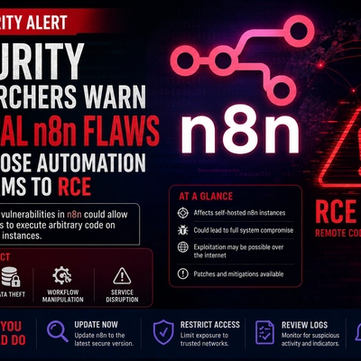
Security Researchers Warn Critical n8n Flaws May Expose Automation Platforms to RCE
Researchers have disclosed critical vulnerabilities in n8n that could expose automation workflows and connected enterprise systems to remote code execution risks, prompting urgent patch recommendations for users and administrators.

How Agentic AI Is Changing Software Engineering and Expanding Mobile Attack Surfaces
Agentic AI is rapidly transforming software engineering workflows through automation and intelligent coding assistance, while cybersecurity experts warn of expanding mobile attack surfaces and emerging application security risks.
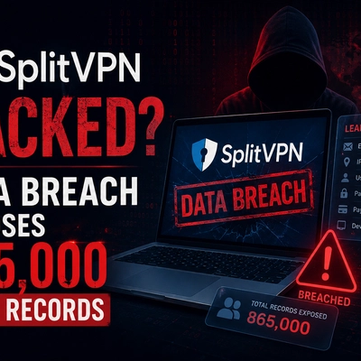
SplitVPN Hacked: Data Breach Exposes 865,000 User Records and 58 Million Hidden Connection Logs (July 2026)
SplitVPN hacked: 865,336 user records and 58 million connection logs exposed, directly contradicting the VPN's "no-logs" promise. What was leaked and what to do now.