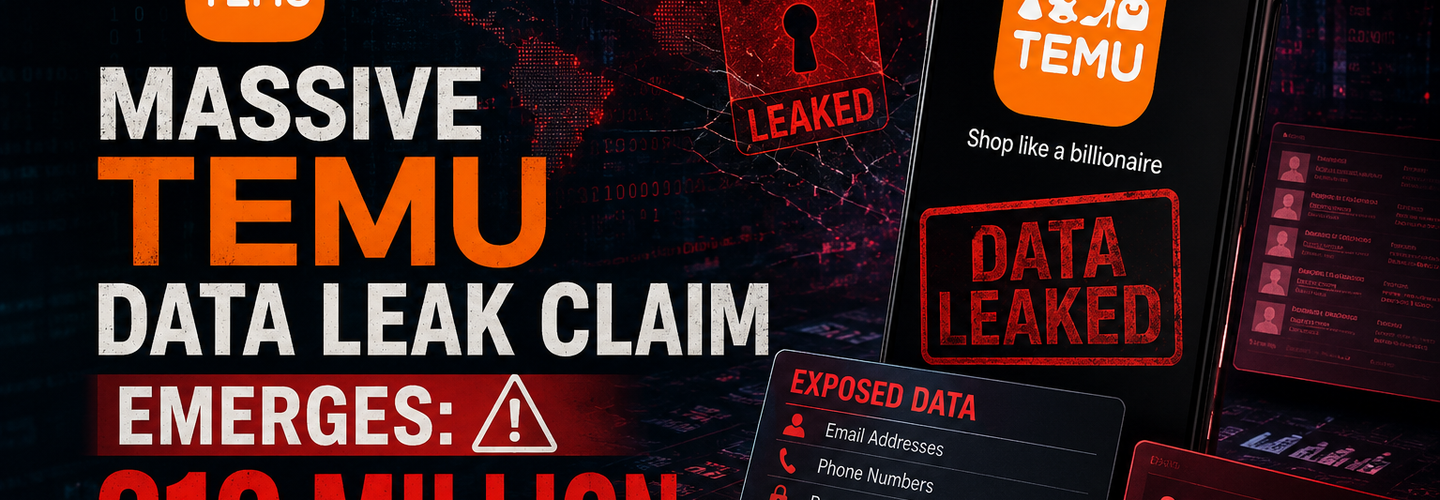
Massive Temu Data Leak Claim Emerges: 310 Million Accounts Allegedly Exposed
Summarize this blog post with: ChatGPT | Perplexity | Claude | Grok
You've probably seen the headlines claiming that 310 million Temu accounts have been exposed in a massive data leak. But headlines often appear long before investigators determine whether a breach is genuine, recycled, or exaggerated. In this guide, you'll learn what is currently known, what remains unverified, what data may be at risk, and the practical steps every Temu user should take today. For ongoing coverage, bookmark our latest cybersecurity news hub.
Editor's Update (July 2, 2026): Following publication, ReconShield received an official response from Temu through its communications agency, Redhill. The article has been updated to include the company's statement in the interest of accuracy, transparency, and balanced reporting.
## Key Takeaways
- ▸The reported Temu breach currently originates from claims that require independent verification before being treated as a confirmed security incident.
- ▸Data breach claims frequently emerge before companies or researchers complete forensic investigations, so early numbers often change.
- ▸Credential reuse significantly increases the risk of account compromise after any suspected data exposure.
- ▸Multi-factor authentication reduces the likelihood of unauthorized access even if a password becomes exposed.
- ▸Official statements from the company and trusted researchers are more reliable than social media rumors.
- ▸Password updates, phishing awareness, and account monitoring are the most effective immediate responses.
- ▸Separating verified evidence from unconfirmed claims helps users make calm, informed security decisions.
## What Is the Alleged Temu Data Leak?
The alleged Temu data leak is an unverified claim that a database containing roughly 310 million Temu user accounts was exposed or offered for sale. At this stage, the figure originates from a threat-actor or third-party claim rather than an independently confirmed forensic finding. That distinction matters enormously for how seriously you should treat the specific numbers.
A data breach claim is an allegation of unauthorized data exposure that requires independent verification before it can be treated as a confirmed security incident. In practice, attackers post samples or listings on hacking forums and dark-web marketplaces to attract buyers or attention. Sometimes these listings are genuine, sometimes they are recycled from older breaches, and sometimes they are fabricated entirely.
For example, in many high-profile cases the headline number shrinks dramatically once researchers de-duplicate records and strip out fake or publicly scraped data. So when you read "310 million accounts," treat it as the size of the claim, not a measured fact. The reported Temu leak currently consists of claims that should be distinguished from independently verified forensic findings.
## Why This Alleged Temu Breach Matters
This incident matters because e-commerce platforms hold a dense concentration of personal and behavioral data that is highly valuable to attackers. Even an alleged leak can trigger real-world harm through phishing, scams, and account-takeover attempts that piggyback on the news cycle.
First, privacy is the immediate concern. Shopping platforms typically store names, contact details, order history, and shipping addresses, which can be used to craft convincing scams. For example, a scammer who knows your name and a recent order can send a "delivery problem" message that feels legitimate.
Second, credential reuse turns one exposure into many. If a password tied to your email leaks anywhere, attackers will test it across banking, email, and social accounts. This technique, known as credential stuffing attacks explained in our infostealer breakdown, is cheap and automated at scale.
Third, consumer trust and e-commerce security take a hit even before verification. To put the risk in context, see how this compares to other major data breaches in 2026, where billions of exposed records reshaped the threat landscape.
## Has the 310 Million Temu Account Leak Been Confirmed?
As of publication, the 310 million Temu account leak has not been independently confirmed as a genuine, recent breach of Temu's systems. The number reflects a claim circulating in breach-trading and social channels, and it has not been matched to a verified forensic investigation in our review.
Security researchers recommend monitoring official company statements and trusted cybersecurity reports before drawing conclusions about alleged data breaches. This is the single most important habit during a fast-moving incident. Early claims are routinely revised once samples are analyzed.
To understand why verification takes time, it helps to know how companies investigate data breaches using indicators, log analysis, and sample validation. For now, the responsible confidence level is "unverified claim under review," not "confirmed breach."
## Temu's Official Response
Update (July 2, 2026): Following publication of this article, ReconShield received the following official statement from Temu through its communications agency, Redhill:
"Temu's security team has conducted a comprehensive investigation into the alleged data breach and can confirm that the claims are categorically false; the data being circulated is not from our systems."
Temu further stated that it takes attempts to spread false information seriously and reserves the right to pursue legal action against individuals or organizations responsible for disseminating false claims.
- ▸According to Temu, the company maintains the following security measures:
- Mobile Application Security Assessment (MASA) certification
- A HackerOne vulnerability disclosure program
- Two-factor authentication (2FA)
- Membership in the Anti-Phishing Working Group (APWG)
- PCI DSS compliance for payment security
ReconShield is publishing Temu's statement to ensure readers have access to the company's official position. At the time of writing, ReconShield has not independently verified the authenticity or origin of the allegedly leaked dataset, and readers should distinguish between third-party allegations and independently verified forensic findings.
ReconShield will continue to monitor this developing story and update the article if additional independently verifiable evidence becomes available.
What Is the Difference Between a Hacker Claim and a Verified Data Breach?
A hacker claim is an unproven assertion, while a verified data breach is an exposure confirmed through forensic evidence, sample validation, or an official disclosure. The gap between the two is where most misinformation lives.
For example, a forum post offering "310M Temu records" is a claim. A verified breach would include reproducible evidence — valid, unique records that match real accounts, corroborated by the company or credible researchers. Until that evidence exists publicly, the prudent stance is caution without panic.
## What Information Was Allegedly Exposed in the Temu Leak?
The data allegedly exposed in the Temu leak reportedly includes personal and account-related fields commonly found in e-commerce databases. Based on how similar claims are typically described, the listed fields may include the following:
- ▸Email addresses — the most common and most reusable identifier.
- ▸Phone numbers — frequently targeted for SMS phishing (smishing).
- ▸Usernames — useful for account-takeover attempts.
- ▸Shipping or address details — valuable for convincing, personalized scams.
- ▸Hashed or plaintext passwords — only if specifically claimed and verified.
Importantly, payment information has not been verified as part of this alleged exposure. Reputable platforms typically tokenize card data through PCI-DSS-compliant processors, which limits raw card exposure. Treat any "full card data" claim with strong skepticism until proven.
Could Payment Information Be Included in the Alleged Temu Leak?
Payment information is unlikely to appear in raw form in most e-commerce leaks because card data is usually tokenized and handled by third-party processors. That said, partial billing details or addresses can still appear and fuel targeted fraud.
For example, even without card numbers, an attacker who knows your billing name and recent purchases can impersonate customer support. As a precaution, review your card statements and enable transaction alerts with your bank regardless of whether payment data is confirmed.
## How Did the Alleged Temu Data Leak Become Public?
The alleged Temu data leak became public the way most breach claims do — through posts on hacking forums, breach-trading marketplaces, and amplification on social media. A threat actor typically advertises a dataset, shares a small sample, and names a price or audience.
For example, breach claims often spread rapidly on social platforms before any researcher validates the sample, which inflates the perceived severity. This is why a calm, evidence-first reading of the situation protects you better than reactive panic.
From there, journalists and analysts attempt to verify the sample, cross-reference it against known breaches, and request comment from the company. Until that cycle completes, the claim remains a lead, not a conclusion — a pattern we see repeatedly across breach and fraud alerts.
## Should Temu Users Change Their Passwords Immediately?
Yes — changing your Temu password now is a low-cost, high-value precaution, even while the leak remains unverified. Updating credentials closes the window of opportunity if any exposure turns out to be real.
Credential reuse increases the likelihood of account compromise after any suspected data exposure because attackers frequently test leaked passwords across multiple services. This is the core reason a single leak can cascade across your digital life.
In fact, roughly 65% of people reuse the same password across multiple accounts — Source: Google/Harris Poll, 2019, and over 80% of hacking-related breaches involve compromised or weak credentials — Source: Verizon Data Breach Investigations Report, 2023. By creating a unique password for Temu, you can neutralize most automated reuse attacks. For a deeper routine, follow strong password security best practices drawn from real password-theft incidents.
## How Can You Protect Yourself After a Suspected Data Breach?
You can protect yourself after a suspected data breach by changing passwords, enabling multi-factor authentication, monitoring accounts, and staying alert for phishing. Immediate post-breach precautions include changing passwords, enabling multi-factor authentication, monitoring financial accounts, and remaining alert for phishing attempts.
Enable Multi-Factor Authentication
Multi-factor authentication should be your first defensive upgrade after any breach scare. Multi-factor authentication provides an additional security layer that helps prevent unauthorized access even if a password becomes exposed.
For example, MFA blocks more than 99.9% of automated account-compromise attacks — Source: Microsoft, 2019, because a stolen password alone is no longer enough to log in. Use an authenticator app rather than SMS where possible, since app-based codes resist SIM-swap attacks.
Watch Closely for Phishing
Phishing attempts spike immediately after breach headlines because attackers exploit fear and urgency. Expect emails or texts claiming "Your Temu account was hacked — verify now," each designed to harvest credentials.
For example, a fake "secure your account" link may lead to a lookalike login page. Learning how phishing attacks work helps you spot the red flags: mismatched domains, urgent threats, and unexpected attachments.
Check Whether Your Account Was Affected
You can check whether your account was affected by reviewing official communications and using breach-monitoring services. Free tools like Have I Been Pwned let you check if your email appears in known datasets, and you can validate a sender's email authentication setup to confirm whether a "Temu" message is spoofed.
## Security Tools and Practical Resources for Consumers
The best response to a suspected breach combines good habits with reliable tools that verify, monitor, and harden your accounts. You don't need paid software to start — many of the most effective resources are free.
Here are practical resources to use right now:
- ▸Password managers — generate and store unique passwords for every site (Bitwarden, 1Password, KeePass).
- ▸Authenticator apps — Google Authenticator, Microsoft Authenticator, or Authy for MFA codes.
- ▸Email breach monitoring — Have I Been Pwned to check exposure across known leaks.
- ▸Credit and identity monitoring — bank transaction alerts and credit-bureau notifications.
- ▸Domain and email verification — use the email security checker to detect spoofed sender domains.
- ▸Suspicious link investigation — run a WHOIS lookup on unfamiliar domains before clicking.
[Insert image: Screenshot of the ReconShield email security tool showing SPF, DKIM, and DMARC results | Alt text: "Verify email spoofing protection with ReconShield email security checker"]
For a broader toolkit, explore our roundup of cybersecurity tools for consumers, which highlights free, no-registration options for everyday protection.
## What Has Temu Said About the Reported Leak?
Official responses during early-stage breach claims are typically cautious, and any statement should be read directly from Temu's verified channels rather than secondhand summaries. Companies often acknowledge they are "investigating reports" before confirming or denying specifics.
For example, a vendor may state that it has found no evidence of a system compromise while it continues to review the claim. The absence of confirmation is not the same as a denial, so continue monitoring official updates and credible security outlets for changes.
## What's Next for the Temu Data Leak Investigation?
What comes next is verification: researchers will analyze any leaked sample, de-duplicate records, and determine whether the data is new, recycled, or fabricated. Expect the headline number to be revised as evidence emerges.
First, watch for sample validation results from independent researchers. Second, monitor for official confirmation or debunking from Temu. Third, regulators in some regions may open inquiries if a genuine exposure of personal data is established.
In the meantime, treat the situation as a prompt to strengthen your own security posture. Keep an eye on our latest vulnerability and breach alerts so you're working from verified updates rather than rumor.
## Conclusion
The Massive Temu Data Leak Claim — 310 million accounts allegedly exposed — is, at this moment, an unverified claim under review, not a confirmed breach. The number reflects the scale of the allegation, and responsible analysis separates hacker claims from forensic evidence before drawing conclusions.
Your best move is calm, proactive action rather than panic. Change your Temu password, enable multi-factor authentication, watch for phishing, and monitor your financial accounts — protections that pay off whether or not this specific claim proves true. For verified updates and practical defensive guidance, keep following ReconShield's cybersecurity news and threat intelligence.
Written by the ReconShield Editorial Team — a cybersecurity publication covering cyber threats, data breaches, vulnerabilities, malware, threat intelligence, and online privacy, providing practical analysis that helps readers stay informed and secure.
Reviewed by Surendra Reddy, Founder & Principal Security Engineer at ReconShield — a veteran cybersecurity researcher and information security practitioner specializing in OSINT reconnaissance, breach analysis, and defensive security.
Disclaimer: This article was initially drafted using AI assistance. However, the content has undergone thorough revisions, editing, and fact-checking by human editors and subject matter experts to ensure accuracy. The 310 million figure reflects an unverified claim; treat it as such until independently confirmed.
Read More:
Chrome 149 Released With Critical Security Fixes for Windows, macOS, and Linux
BugHunter AI: The Ultimate AI-Powered Bug Bounty Toolkit for Ethical Hackers in 2026
GPT-5.5-Cyber: OpenAI's AI Security Model That Finds and Fixes Vulnerabilities Automatically
AI Bug Hunting: How Security Researchers Use AI to Find Vulnerabilities in 2026
CVE-2026-46331: New Linux pedit COW Exploit Enables Root Access by Poisoning Cached Binaries
## Analyst Commentary & Implementation Blueprint
Security advisory
Continuous security exposure assessment is critical to identifying public vulnerabilities before they are exploited. Organizations should maintain a passive inventory of all web servers, TLS configs, and open ports, ensuring that default configurations are eliminated and security advisories are actively implemented.
Hardened Security Configuration Blueprint
# General Security Hardening Directive
ServerTokens ProductOnly
ServerSignature Off
FileETag None
Actionable Mitigation Checklist
- ✔Perform passive asset inventories weekly.
- ✔Restrict administrative ports using local firewall controls.
- ✔Monitor active CVE alerts for exposed software.
Common Inquiries & FAQs
Why is passive scanning preferred for continuous auditing?
Passive audits do not cause operational impact or trigger firewall blocks, making them ideal for constant surveillance of internet-facing assets.
What should I do if a vulnerability is flagged?
Apply the latest vendor patches, restrict access to the resource via firewalls, or verify configuration flags to mitigate risks.
Surendra Reddy
Surendra Reddy is a cybersecurity researcher and founder of ReconShield, specializing in OSINT and defensive infrastructure analysis.
Connect on LinkedIn ↗// AUDIT BRIEFING DISCUSSION (2 COMMENTS)
Great breakdown of the passive infrastructure vectors. We recently audited our external DNS zones and found multiple dangling staging environments. Implementing wildcard certificates reduced our CT log leaks significantly.
Is there any automated tooling you recommend for daily crt.sh scraping? Manually checking CT logs is becoming unsustainable for our domain portfolio.
// MORE ARTICLES
Security Researchers Warn Critical n8n Flaws May Expose Automation Platforms to RCE
Researchers have disclosed critical vulnerabilities in n8n that could expose automation workflows and connected enterprise systems to remote code execution risks, prompting urgent patch recommendations for users and administrators.

How Agentic AI Is Changing Software Engineering and Expanding Mobile Attack Surfaces
Agentic AI is rapidly transforming software engineering workflows through automation and intelligent coding assistance, while cybersecurity experts warn of expanding mobile attack surfaces and emerging application security risks.
SplitVPN Hacked: Data Breach Exposes 865,000 User Records and 58 Million Hidden Connection Logs (July 2026)
SplitVPN hacked: 865,336 user records and 58 million connection logs exposed, directly contradicting the VPN's "no-logs" promise. What was leaked and what to do now.