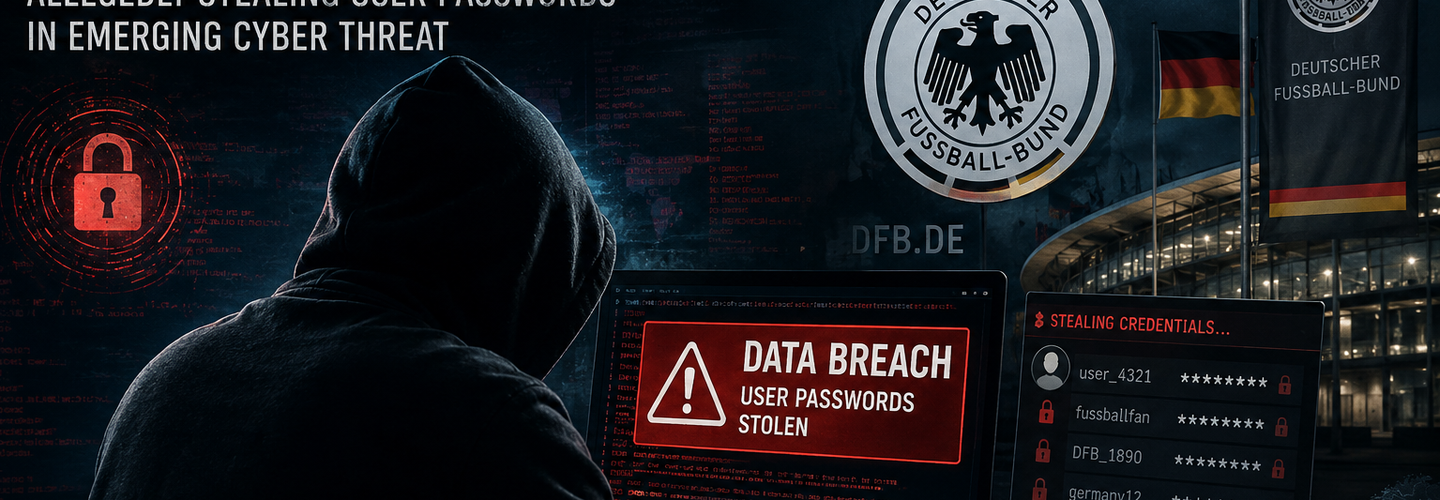
Hackers Target German Football Association, Allegedly Stealing User Passwords in Emerging Cyber Threat
The world of professional sports is becoming an increasingly attractive target for cybercriminals, and the latest incident involving the German Football Association has once again underscored how digital threats now extend far beyond traditional corporate environments.
Reports circulating within cybersecurity monitoring communities suggest that threat actors are claiming to possess stolen credentials allegedly linked to systems associated with the German Football Association. While the full scope of the incident has not yet been independently verified, the claims have already triggered concern among security professionals who warn that sports organizations are rapidly becoming high-value targets due to their extensive fan databases, commercial partnerships, media infrastructure, and financial ecosystems.
The alleged compromise arrives at a time when the sports industry is facing mounting cyber pressure from credential theft campaigns, ransomware operations, phishing attacks, and data exposure incidents targeting clubs, leagues, ticketing systems, and sports governing bodies worldwide.
Security analysts say the incident reflects a broader trend: cybercriminal groups are increasingly exploiting weak password hygiene, credential reuse, and poorly secured third-party systems connected to large organizations with public visibility.
## Growing Cyber Risks Facing Sports Organizations
Major sporting associations have evolved into highly digitized enterprises. Beyond managing teams and competitions, organizations today oversee massive ecosystems involving online ticketing, merchandise stores, payment systems, streaming platforms, athlete records, sponsorship contracts, and fan engagement applications.
This transformation has dramatically expanded the attack surface available to cybercriminals.
In recent years, multiple sports organizations across Europe and North America have reported security incidents involving unauthorized access attempts, credential leaks, distributed denial-of-service (DDoS) attacks, and ransomware-related disruptions.
Cybersecurity researchers note that sports organizations often face a unique challenge: balancing rapid digital expansion with enterprise-grade security maturity.
“Many sports institutions historically prioritized operational continuity and fan engagement over cybersecurity resilience,” said one European threat intelligence analyst familiar with attacks targeting entertainment and sports sectors. “But attackers increasingly recognize that these organizations hold valuable personal data and often maintain extensive third-party vendor relationships.”
The alleged German Football Association incident appears to fit this broader pattern.
## Alleged Password Theft Raises Immediate Concerns
Although official technical details remain limited, reports indicate that hackers are claiming access to user credentials potentially associated with online systems connected to the organization.
Credential theft incidents can create serious downstream risks even when only partial datasets are compromised.
Cybersecurity professionals warn that stolen passwords can enable:
- ▸Account takeover attempts
- ▸Credential stuffing attacks
- ▸Phishing campaigns
- ▸Identity fraud
- ▸Unauthorized access to partner systems
- ▸Business email compromise risks
The danger becomes significantly greater when users reuse passwords across multiple platforms.
According to research published by the National Cyber Security Centre (NCSC) and multiple password security studies, password reuse remains one of the most persistent weaknesses across both consumer and enterprise environments.
Even a relatively small credential leak can become operationally significant if attackers combine exposed usernames and passwords with previously leaked databases from unrelated breaches.
## Why Sports Organizations Are Attractive Targets
Sports associations present a uniquely lucrative environment for threat actors.
Unlike many traditional enterprises, sports entities maintain a combination of highly visible public infrastructure and commercially valuable data repositories. These often include:
- ▸Fan databases
- ▸Membership portals
- ▸Athlete information
- ▸Sponsor communications
- ▸Internal operational systems
- ▸Media access platforms
- ▸Payment processing services
Attackers may also view sports organizations as softer targets compared to heavily regulated financial or healthcare institutions.
Large public events further complicate the threat landscape. High-profile tournaments and matches create periods of increased network activity and operational urgency, conditions that attackers sometimes exploit to pressure organizations during critical business windows.
Security researchers have also observed growing cybercriminal interest in sports betting ecosystems, digital ticketing infrastructure, and live-streaming platforms.
## Third-Party Risks Continue to Expand
One of the most persistent concerns in modern cyber incidents involves third-party exposure.
Even if a core organization maintains strong internal security controls, vendors, contractors, and service providers can inadvertently introduce vulnerabilities into the broader ecosystem.
Sports organizations frequently rely on external providers for:
- ▸Ticketing services
- ▸Marketing platforms
- ▸Cloud hosting
- ▸Payment processing
- ▸Event management
- ▸Media distribution
- ▸Fan engagement applications
Threat intelligence teams increasingly warn that attackers often target the weakest link within interconnected digital environments.
This means that password theft or credential exposure affecting a supplier or integrated service provider can potentially cascade into larger organizational risks.
Recent industry incidents across multiple sectors have shown how third-party compromise can rapidly evolve into widespread operational disruption.
## Technical Impact Analysis
While investigators continue assessing the legitimacy and scope of the alleged claims, cybersecurity experts say even limited credential exposure warrants immediate incident response measures.
Organizations facing suspected password-related incidents typically prioritize several defensive actions:
- ▸Credential resets
- ▸Multi-factor authentication enforcement
- ▸Log analysis
- ▸Session invalidation
- ▸Threat hunting
- ▸Monitoring for suspicious login attempts
- ▸Vendor risk reviews
Security operations teams also frequently examine whether exposed credentials were linked to privileged accounts or administrative systems.
The potential impact varies substantially depending on the type of accounts involved.
If attackers obtained access to consumer-facing user accounts, risks may center around privacy concerns and credential reuse attacks. If internal employee credentials were exposed, the threat level could escalate considerably due to the possibility of lateral movement or access to operational systems.
Experts caution against assuming that password exposure alone represents the full extent of an incident.
Credential theft is often associated with broader cyber campaigns involving phishing operations, infostealer malware infections, or unauthorized cloud access activity.
## The Human Factor Remains a Major Weakness
Security awareness specialists continue emphasizing that human behavior remains one of the most exploited attack surfaces.
Weak passwords, reused credentials, and susceptibility to phishing attempts continue enabling a substantial percentage of modern cyber intrusions.
According to Verizon’s annual Data Breach Investigations Report, credential abuse consistently ranks among the leading causes of confirmed breaches globally.
The rise of infostealer malware has further amplified the problem. These malicious programs are designed to harvest saved browser passwords, session cookies, authentication tokens, and other sensitive data from infected devices.
Once stolen, credentials are frequently traded or sold within cybercriminal marketplaces.
Organizations managing large public-facing communities — including sports associations — face elevated exposure because they interact with millions of users who may not consistently follow strong cybersecurity practices.
## Industry Implications
The alleged attack targeting the German Football Association may serve as another warning sign for the broader sports industry.
Professional sports increasingly depend on digital infrastructure not only for operations, but also for revenue generation and global audience engagement.
Cyber incidents can therefore produce consequences extending far beyond IT systems.
Potential impacts include:
- ▸Reputational damage
- ▸Fan trust erosion
- ▸Sponsorship concerns
- ▸Regulatory scrutiny
- ▸Legal exposure
- ▸Operational disruption
- ▸Financial losses
In Europe, organizations handling personal data must also navigate obligations under the General Data Protection Regulation (GDPR), which imposes strict breach notification and data protection requirements.
Failure to adequately secure sensitive user data can lead to regulatory investigations and substantial penalties depending on the severity of the incident.
Cyber insurance providers are also paying closer attention to credential security practices and third-party risk management as ransomware and identity-based attacks continue rising worldwide.
## Why This Matters
The incident highlights a critical reality facing modern organizations: cyber threats are no longer confined to banks, governments, or technology companies.
Any organization operating large digital ecosystems — especially those with global visibility and extensive user communities — can become a target.
Sports organizations occupy a particularly sensitive position because they combine emotional public engagement with commercially valuable data environments.
For users, the alleged password theft claims reinforce the ongoing importance of strong account security habits.
For enterprises, the situation demonstrates how credential security, vendor oversight, and identity protection must remain central components of cybersecurity strategy.
The broader concern is not merely whether passwords were exposed, but how rapidly attackers can weaponize stolen credentials across interconnected digital ecosystems.
## How Users Can Stay Safe
Cybersecurity experts recommend several immediate steps for users concerned about credential-related threats:
Use Unique Passwords
Avoid reusing passwords across multiple services. Password managers can help generate and store complex credentials securely.
Enable Multi-Factor Authentication (MFA)
MFA significantly reduces the risk of unauthorized account access even if passwords are exposed.
Monitor Account Activity
Users should regularly review login histories, password reset notifications, and suspicious account behavior.
Watch for Phishing Attempts
Cybercriminals often exploit public breach news to launch fake security alert emails designed to steal additional information.
Update Passwords Promptly
If users suspect credential exposure, they should immediately change passwords on affected and reused accounts.
Keep Devices Updated
Maintaining updated operating systems, browsers, and security software helps reduce exposure to malware and credential theft threats.
## Official Responses and Ongoing Investigation
At the time of writing, publicly available information regarding the alleged incident remains limited, and investigators continue assessing the credibility and scope of the claims.
Cybersecurity analysts caution against premature conclusions until official confirmation and forensic reviews become available.
Organizations responding to suspected credential-related incidents often work alongside external incident response firms, legal advisors, and law enforcement agencies to determine whether unauthorized access occurred and whether sensitive information was affected.
Security experts expect increased scrutiny around identity protection practices within sports organizations following the emergence of these reports.
## Sources & References
- ▸German Federal Office for Information Security (BSI)
- ▸National Cyber Security Centre (NCSC) Password Guidance
- ▸Verizon Data Breach Investigations Report
- ▸European Union GDPR Information Portal
- ▸CISA Cybersecurity Advisories
## Conclusion
The alleged cyber incident involving the German Football Association reflects the growing convergence between global sports operations and modern cybersecurity risk.
As sports organizations continue expanding their digital ecosystems, attackers are increasingly recognizing the value of fan data, credential access, and interconnected operational systems.
Whether the reported password theft claims prove fully accurate or not, the broader lesson remains clear: identity security, multi-factor authentication, and proactive threat monitoring are now essential requirements for organizations operating in high-visibility digital environments.
For both enterprises and users, the era of treating sports platforms as low-risk targets is rapidly coming to an end.
Read More:
Gremlin Stealer Conceals C2 URLs and Exfiltration Paths in Encrypted Resource Sections
Copy Fail (CVE-2026-31431): The Linux Kernel Flaw That Handed Root to Anyone Who Asked
Malicious VS Code Extension Linked to Unauthorized Access of GitHub Internal Repositories
AI-Powered Cyber Threats Are Escalating Faster Than Enterprise Defenses Can Adapt
Urgent Chrome Update Released After Critical Remote Code Execution Vulnerabilities Discovered
Hackers Exploit Vulnerable Lenovo Driver to Disable EDR Security Protections
QR Code Phishing Explodes in 2026 as Microsoft Detects 8.3 Billion Email Threats
## Analyst Commentary & Implementation Blueprint
Security advisory
Continuous security exposure assessment is critical to identifying public vulnerabilities before they are exploited. Organizations should maintain a passive inventory of all web servers, TLS configs, and open ports, ensuring that default configurations are eliminated and security advisories are actively implemented.
Hardened Security Configuration Blueprint
# General Security Hardening Directive
ServerTokens ProductOnly
ServerSignature Off
FileETag None
Actionable Mitigation Checklist
- ✔Perform passive asset inventories weekly.
- ✔Restrict administrative ports using local firewall controls.
- ✔Monitor active CVE alerts for exposed software.
Common Inquiries & FAQs
Why is passive scanning preferred for continuous auditing?
Passive audits do not cause operational impact or trigger firewall blocks, making them ideal for constant surveillance of internet-facing assets.
What should I do if a vulnerability is flagged?
Apply the latest vendor patches, restrict access to the resource via firewalls, or verify configuration flags to mitigate risks.
Surendra Reddy
Surendra Reddy is a cybersecurity researcher and founder of ReconShield, specializing in OSINT and defensive infrastructure analysis.
Connect on LinkedIn ↗// AUDIT BRIEFING DISCUSSION (2 COMMENTS)
Great breakdown of the passive infrastructure vectors. We recently audited our external DNS zones and found multiple dangling staging environments. Implementing wildcard certificates reduced our CT log leaks significantly.
Is there any automated tooling you recommend for daily crt.sh scraping? Manually checking CT logs is becoming unsustainable for our domain portfolio.
// MORE ARTICLES
Security Researchers Warn Critical n8n Flaws May Expose Automation Platforms to RCE
Researchers have disclosed critical vulnerabilities in n8n that could expose automation workflows and connected enterprise systems to remote code execution risks, prompting urgent patch recommendations for users and administrators.

How Agentic AI Is Changing Software Engineering and Expanding Mobile Attack Surfaces
Agentic AI is rapidly transforming software engineering workflows through automation and intelligent coding assistance, while cybersecurity experts warn of expanding mobile attack surfaces and emerging application security risks.
SplitVPN Hacked: Data Breach Exposes 865,000 User Records and 58 Million Hidden Connection Logs (July 2026)
SplitVPN hacked: 865,336 user records and 58 million connection logs exposed, directly contradicting the VPN's "no-logs" promise. What was leaked and what to do now.