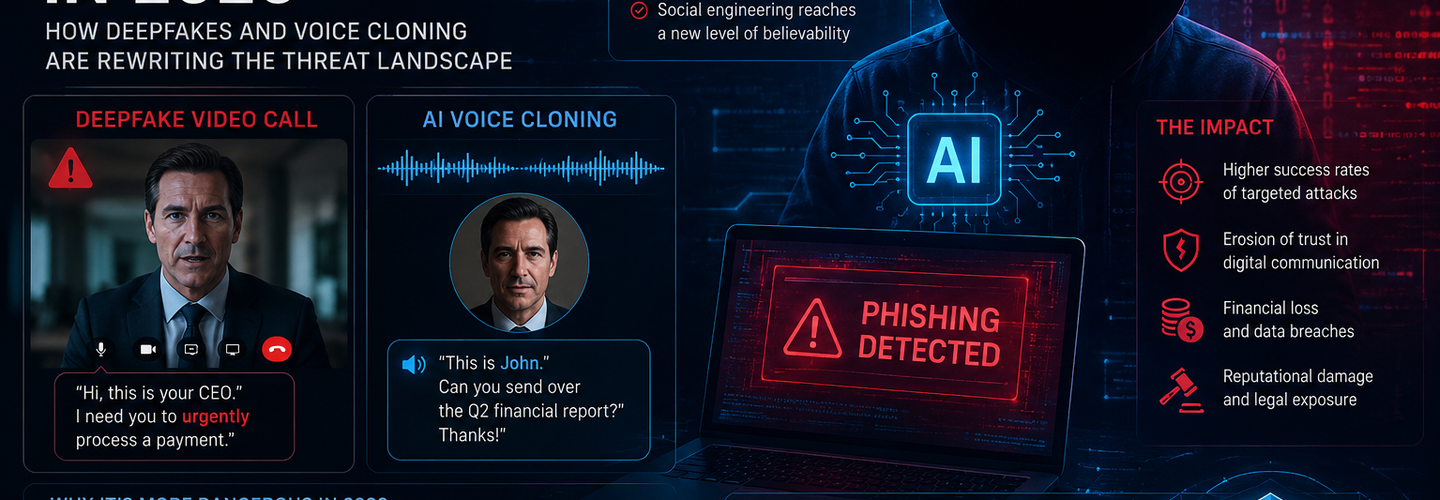
AI-Powered Phishing 2026: Deepfakes, Voice Cloning & How to Defend Your Organization
There's a moment many security professionals now dread — a CFO receives a video call from what appears to be the CEO, the face looks right, the voice sounds right, and the request is reasonable enough: authorize a wire transfer. The CFO complies. The money is gone. And the "CEO" never made a call at all.
This is no longer a hypothetical. Incidents matching this exact profile have cost organizations millions, and the attack surface is growing faster than most enterprise defenses can keep up with. The 2026 threat landscape around phishing and social engineering has fundamentally changed — not incrementally, but structurally — and the driving force is artificial intelligence deployed at scale by criminal groups operating with the efficiency of well-funded startups.
## The Threat Overview: When Phishing Became a Precision Weapon
For most of the last two decades, phishing was a volume game. Spray enough malformed emails at enough inboxes, and statistically a few would land. Security awareness training taught people to look for spelling errors, mismatched sender domains, and suspicious urgency — and for a while, that worked well enough.
That era is effectively over.
1,265%Surge in AI-linked phishing attacks since 202380%+Of all observed social engineering is now AI-assisted (ENISA 2025)4×Higher click-through rates for AI-generated vs. human-written phishing$40BProjected AI-enabled fraud losses globally by 2027
ENISA's 2025 Threat Landscape report, which analyzed nearly 4,900 cybersecurity incidents across a 12-month window, found that AI-supported phishing had become the dominant mode of social engineering worldwide. Three years earlier, that figure was negligible. The shift from experimental curiosity to primary attack vector happened in roughly 18 months — a speed that left most organizational defenses essentially unprepared.
Active Threat Alert
CrowdStrike's 2026 Global Threat Report documented an 89% increase in attacks by AI-enabled adversaries, with the fastest recorded criminal "breakout time" — from initial access to lateral movement — clocked at just 27 seconds.
## Technical Impact Analysis: Three Vectors Reshaping Enterprise Risk
Understanding the specific mechanics helps defenders prioritize correctly. Three AI-driven vectors are responsible for the bulk of 2026's most damaging social engineering incidents:
Voice Cloning at Scale. Creating a convincing audio impersonation of an executive once required access to substantial audio samples and significant technical skill. Today, commercially available voice-cloning tools can generate a realistic voice model from as little as 20 to 30 seconds of audio — material that exists publicly for nearly every senior corporate officer in the world, drawn from earnings calls, conference talks, and LinkedIn videos. The FBI formally warned in late 2024 that criminals were exploiting generative AI to commit fraud at unprecedented scale and with dramatically increased believability. That warning proved understated within months.
Deepfake Video Impersonation in Live Calls. Perhaps the most psychologically destabilizing development is real-time deepfake video used during active video conferences. Attackers — sometimes using freely available consumer tools — can overlay a synthetic face onto their own during a call, convincingly impersonating an executive or government official. A documented case in Australia saw a local government defrauded of $2.3 million after officials authorized payments based on a deepfake video call, using tools now commercially accessible to any moderately motivated criminal actor.
LLM-Crafted Spear Phishing at Industrial Volume. Traditional spear phishing required a human operator to research each target individually — reviewing LinkedIn profiles, company websites, and news mentions to craft a personalized lure. AI removes that constraint entirely. In one documented campaign tracked by Brightside AI, approximately 800 accounting firms were simultaneously targeted with phishing emails referencing specific state registration details, achieving a 27% click rate — far above typical phishing benchmarks. The operation required minimal human involvement per target.
"We are no longer dealing with opportunistic actors running spray-and-pray campaigns. The adversary model in 2026 is a coordinated, AI-augmented operation that scales human-level social engineering to machine-level throughput."— Senior threat researcher, enterprise security vendor (2026)
IBM Cost of a Data Breach Report — 2025 Findings
1 in 6 confirmed data breaches now involves attackers using AI. Of those, 37% used AI-generated phishing content, and 35% used deepfake impersonation as an attack component. The global average breach cost hit $4.45 million.
## Industry Implications: Who Is Being Targeted and Why
The financial services, healthcare, and manufacturing sectors continue to absorb disproportionate losses — not simply because they're lucrative targets, but because they have organizational structures and approval workflows that AI-enhanced social engineering is specifically designed to exploit. Finance departments receive wire transfer requests. Healthcare administrators handle insurance and vendor payments. Manufacturing procurement teams manage large supplier invoices. Each represents a workflow where a convincingly impersonated authority figure can insert a fraudulent transaction that clears before anyone verifies it independently.
The public sector faces a compounding problem. Federal funding reductions — including the expiration of cooperative agreements supporting the Multi-State Information Sharing and Analysis Center (MS-ISAC) — have left many state, local, tribal, and territorial entities with fewer resources at precisely the moment threat actors are intensifying focus on them. Critical infrastructure operators, already wrestling with long-lived operational technology that can't be rapidly patched or replaced, now face AI-enhanced adversaries with markedly better tools for reconnaissance and impersonation.
Perhaps the most alarming industry development is the emergence of criminal "supergroups." Threat actors including Scattered Spider, LAPSUS$, and ShinyHunters reportedly formed an alliance in 2025, combining expertise in deepfake voice and video capabilities with mature ransomware and malware deployment. The COM, as the group is known, represents a convergence of social engineering sophistication with post-access capabilities — a reminder that the phishing lure is often just the first domino.
## Why This Matters
The traditional indicators of a phishing attempt — awkward grammar, suspicious sender domains, implausible scenarios — have been systematically stripped away by AI. What remains is an attack surface that is fundamentally harder to defend at the human layer alone.
This matters beyond the individual organization. The World Economic Forum's Global Cybersecurity Outlook 2026 found that 73% of organizations were directly affected by cyber-enabled fraud last year — a figure that reflects how broadly these threats have diffused across sectors and geographies. When a local government loses $2.3 million to a deepfake call, or when an accounting firm's staff submits credentials at a 27% rate to AI-crafted emails, the systemic implications are significant: public services disrupted, client data exposed, financial reserves depleted.
The accelerating adoption of AI by defenders is real, but so is the adoption curve on the offensive side. CrowdStrike's 2026 data showed a 89% year-on-year increase in attacks by AI-enabled adversaries. ChatGPT alone was mentioned in criminal forums 550% more than any other AI model — a signal that even consumer-grade tools are actively being weaponized. The window between a new AI capability becoming publicly available and that capability appearing in active criminal campaigns has narrowed to weeks, sometimes days.
## How Users and Organizations Can Stay Safe
- ▸Establish out-of-band verification for financial transactions. No wire transfer or invoice above a defined threshold should be authorized based solely on a single communication channel — whether email, phone, or video. A separate, pre-established verification call to a known number is non-negotiable.
- ▸Implement DMARC, DKIM, and SPF fully. Email authentication remains the most reliable signal against domain spoofing. Ensure your domain is configured with a DMARC policy of at minimum "quarantine," ideally "reject," and monitor DMARC aggregate reports regularly.
- ▸Train staff with AI-generated phishing simulations. Employees should encounter AI-crafted phishing content in a controlled training environment before they encounter it in production. Simulations that use voice cloning and deepfake scenarios are particularly valuable for finance and executive support teams.
- ▸Create internal "safe word" protocols for executives. Establish a pre-agreed verbal or written verification phrase that can be used during calls or video meetings to confirm identity. Deepfakes cannot know a code word established privately between two individuals.
- ▸Deploy phishing-resistant MFA (FIDO2/passkeys). SMS-based and app-based OTP codes are vulnerable to real-time phishing proxies. Hardware security keys or passkeys eliminate credential-theft as an attack outcome, even if a user clicks through a phishing link.
- ▸Limit public audio and video exposure of executives. Consider the digital footprint of senior leadership. While earnings calls and conferences serve legitimate purposes, organizations should be aware that any public audio is training data for a voice clone.
- ▸Adopt a Zero Trust security posture. Never trust, always verify — particularly for access to sensitive systems, financial workflows, and administrative functions. Lateral movement by attackers who gain initial access through a phishing lure is contained by micro-segmentation and continuous authentication.
## Official Responses and Vendor Actions
Federal Bureau of Investigation (FBI)
The FBI's Internet Crime Complaint Center (IC3) formally warned in December 2024 that criminal actors are leveraging generative AI to produce fraudulent content at greater scale and with improved believability. The bureau encouraged organizations to implement multi-factor verification processes and establish internal code words for financial authorization.
The FBI reported that U.S. cybercrime losses in 2025 reached $16.6 billion in reported complaints — a figure the bureau itself acknowledged represents a significant undercount given the gap between actual and reported incidents.
ENISA — European Union Agency for Cybersecurity
ENISA's 2025 Threat Landscape analysis, covering 4,875 incidents across a 12-month period, highlighted AI-assisted phishing as the dominant form of observed social engineering. The agency specifically noted that adversaries are leveraging jailbroken models, synthetic media, and model poisoning techniques to improve operational effectiveness — and called on member states to accelerate cybersecurity awareness programs aligned to the evolving threat.
World Economic Forum — Global Cybersecurity Outlook 2026
The WEF's flagship annual report identified widening "cyber equity" gaps — the divergence between well-resourced large enterprises and under-resourced SMEs and public bodies — as a structural vulnerability that AI-enhanced attackers actively exploit. The report emphasized that building cyber resilience now requires collaboration between business and government, and that geopolitical fragmentation is deepening interdependencies that attackers can exploit across borders.
Mitigation Priority for CISOs
Security leaders should prioritize phishing-resistant authentication, verified out-of-band transaction approval workflows, and AI-generated simulation training as foundational 2026 controls. Perimeter defenses and traditional spam filtering are necessary but no longer sufficient against this threat class.
## Conclusion
The fundamental challenge of 2026 is not that organizations lack awareness of phishing — it's that the tools previously used to identify phishing have been systematically neutralized. Grammar checkers can't detect an LLM-written email. Caller ID can't verify a cloned voice. Video verification can't catch a real-time deepfake.
What remains is process, authentication architecture, and culture. Organizations that build verification workflows independent of any single communication channel — that train employees on what AI-generated attacks actually look and sound like — and that implement phishing-resistant authentication throughout their identity stack will be materially more resilient than those that don't.
The threat landscape will keep accelerating. Criminal actors with access to the same AI tools as defenders have an asymmetric advantage: they only need to succeed once. The most durable defenses are those that assume a sophisticated, patient adversary and build systems that don't rely on any single human catching any single suspicious signal at the right moment.
Read More:
Gremlin Stealer Conceals C2 URLs and Exfiltration Paths in Encrypted Resource Sections
Copy Fail (CVE-2026-31431): The Linux Kernel Flaw That Handed Root to Anyone Who Asked
Malicious VS Code Extension Linked to Unauthorized Access of GitHub Internal Repositories
AI-Powered Cyber Threats Are Escalating Faster Than Enterprise Defenses Can Adapt
Urgent Chrome Update Released After Critical Remote Code Execution Vulnerabilities Discovered
Hackers Exploit Vulnerable Lenovo Driver to Disable EDR Security Protections
QR Code Phishing Explodes in 2026 as Microsoft Detects 8.3 Billion Email Threats
## Analyst Commentary & Implementation Blueprint
Security advisory
Continuous security exposure assessment is critical to identifying public vulnerabilities before they are exploited. Organizations should maintain a passive inventory of all web servers, TLS configs, and open ports, ensuring that default configurations are eliminated and security advisories are actively implemented.
Hardened Security Configuration Blueprint
# General Security Hardening Directive
ServerTokens ProductOnly
ServerSignature Off
FileETag None
Actionable Mitigation Checklist
- ✔Perform passive asset inventories weekly.
- ✔Restrict administrative ports using local firewall controls.
- ✔Monitor active CVE alerts for exposed software.
Common Inquiries & FAQs
Why is passive scanning preferred for continuous auditing?
Passive audits do not cause operational impact or trigger firewall blocks, making them ideal for constant surveillance of internet-facing assets.
What should I do if a vulnerability is flagged?
Apply the latest vendor patches, restrict access to the resource via firewalls, or verify configuration flags to mitigate risks.
Surendra Reddy
Surendra Reddy is a cybersecurity researcher and founder of ReconShield, specializing in OSINT and defensive infrastructure analysis.
Connect on LinkedIn ↗// AUDIT BRIEFING DISCUSSION (2 COMMENTS)
Great breakdown of the passive infrastructure vectors. We recently audited our external DNS zones and found multiple dangling staging environments. Implementing wildcard certificates reduced our CT log leaks significantly.
Is there any automated tooling you recommend for daily crt.sh scraping? Manually checking CT logs is becoming unsustainable for our domain portfolio.
// MORE ARTICLES
SplitVPN Hacked: Data Breach Exposes 865,000 User Records and 58 Million Hidden Connection Logs (July 2026)
SplitVPN hacked: 865,336 user records and 58 million connection logs exposed, directly contradicting the VPN's "no-logs" promise. What was leaked and what to do now.

Critical WordPress wp2shell RCE Vulnerability Puts Millions of Sites at Risk—Patch Now
wp2shell is a pre-auth RCE in WordPress Core affecting 500M+ sites. Public exploits exist—patch to 7.0.2 or 6.9.5 immediately.
New Windows RDP Flaws Could Lead to Data Theft — Everything You Need to Know
Microsoft patched a dozen Windows RDP flaws in July 2026 that could leak memory data. See affected versions, KB numbers, and how to patch.