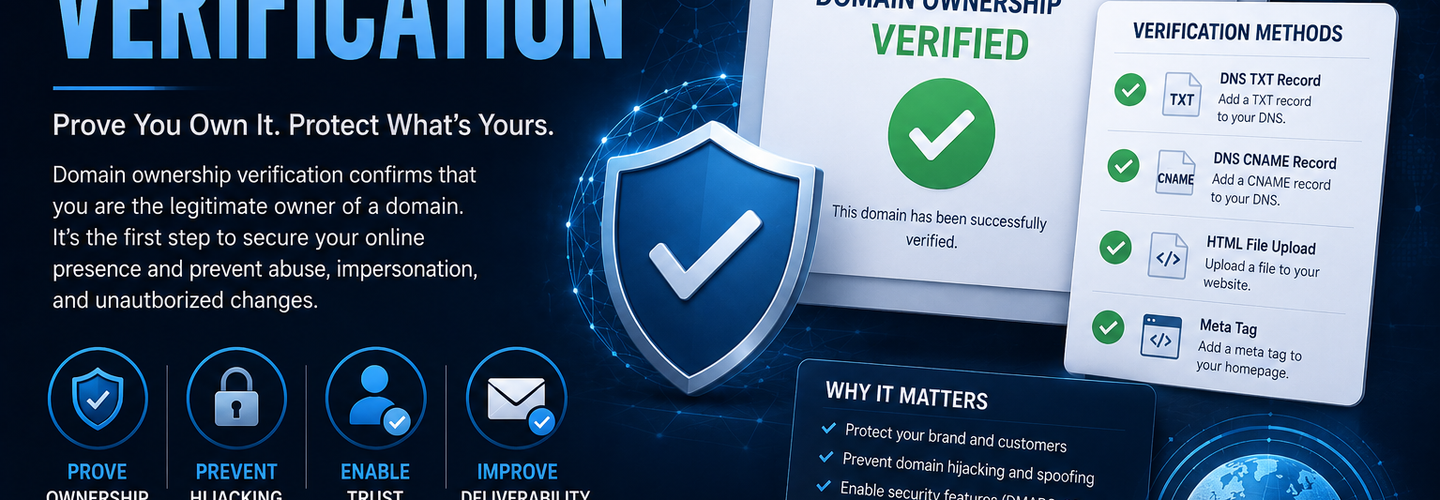
Domain Ownership Verification: The Complete Guide to Proving, Checking, and Securing Domain Control
If you've configured Google Search Console, requested an SSL certificate, or set up Microsoft 365 for your organization, you've already performed domain ownership verification — likely without fully understanding the security architecture behind it. But for security professionals, domain administrators, and threat investigators, domain ownership verification is far more than a one-time checkbox: it is the foundational trust mechanism that determines who has legitimate authority over every domain on the internet. In this guide, you'll learn exactly what domain ownership verification is, every method used to prove it, how to investigate any domain's rightful owner using WHOIS and RDAP, and how attackers exploit verification gaps to launch domain hijacking, subdomain takeover, and targeted phishing campaigns.
## Key Takeaways
- ▸Domain ownership verification is the process of proving, through a technical or procedural method, that a specific individual or organization has administrative control over a domain name's DNS records, web server files, or registrant email account.
- ▸Three primary verification methods exist: DNS TXT record insertion, CNAME record insertion, and file or meta-tag based verification — each with distinct use cases, security tradeoffs, and operational requirements.
- ▸WHOIS and RDAP lookups are the investigative standard for identifying the registered owner, registrar, name servers, creation date, and expiry status of any domain on the internet.
- ▸Domain hijacking, subdomain takeover, and expired-domain exploitation are active attack vectors that insufficient ownership verification enables — 44% of organizations experienced at least one domain-related attack in 2023 — Source: CSC Domain Security Report, 2024.
- ▸Certificate Authorities enforce domain ownership verification as the mandatory gatekeeping requirement before issuing any SSL/TLS certificate, making it central to the internet's cryptographic trust model.
- ▸Poor domain portfolio hygiene — forgotten subdomains, expired CNAME records, and unmonitored DNS changes — consistently represents one of the highest-probability external attack surface exposures for organizations of all sizes.
- ▸Organizations that implement registrar locking, continuous DNS monitoring, and regular WHOIS audits directly reduce their exposure to domain hijacking, brand impersonation, and third-party phishing campaigns targeting their customers.
## What Is Domain Ownership Verification?
Domain ownership verification is the process of cryptographically or procedurally proving that a specific entity controls the DNS settings, web server files, or registrant email account associated with a domain name, in order to establish trust with an external service or authority. Verification is the mechanism that allows a Certificate Authority, search engine, or email security platform to confirm that the requesting party is actually the legitimate administrator of the domain in question — not an impersonator or attacker.
Verification is not the same as registration. Registration is the act of purchasing and reserving a domain name through an accredited registrar. Ownership verification is the subsequent proof of control — demonstrating to a third party that the registrant identity matches the entity requesting elevated access or trust. These two concepts are frequently conflated, particularly in organizations managing large domain portfolios across multiple registrars, which creates operational blind spots and security gaps that attackers actively target.
Every major internet security service requires domain ownership verification before granting privileged access. Google Search Console, Let's Encrypt, AWS Certificate Manager, Microsoft 365, Cloudflare, and virtually every enterprise SaaS platform use it as the trust gate. Without it, any third party could fraudulently claim control over domains they do not own. For a deep-dive into the domain registration infrastructure that ownership verification sits on top of, read the comprehensive guide to WHOIS domain lookups and RDAP intelligence.
## Why Does Domain Ownership Verification Matter for Security?
Domain ownership verification is one of the most consequential security controls in the modern internet trust model because it underpins SSL certificate issuance, email authentication enforcement, search engine authority, and the entire anti-phishing framework. When verification is absent, poorly managed, or actively subverted, the chain of trust collapses across all systems that depend on it.
The attack statistics confirm the urgency. Domain hijacking incidents increased by more than 45% over the past three years — Source: CSC Domain Security Report, 2024. Phishing campaigns increasingly rely on lookalike domains — typosquatted or homoglyph variants of legitimate brands — that bypass email security filters by mimicking the appearance of verified domains — Source: Proofpoint State of the Phish, 2024. For regulated industries including financial services, healthcare, and insurance, a single unverified rogue domain can trigger breach notification requirements, regulatory penalties, and customer fraud liability simultaneously.
Beyond external attacks, inadequate domain ownership hygiene creates internal visibility gaps. Organizations with unaudited domain portfolios routinely discover forgotten subdomains hosting decommissioned services, expired certificates on production endpoints, and orphaned third-party integrations in their DNS zones — all of which represent directly exploitable attack surface. Run ReconShield's passive exposure assessment tool against your public-facing domain infrastructure to surface these misconfigurations before an attacker discovers them through automated scanning.
Domain Hijacking and How Attackers Gain Control
Domain hijacking occurs when an attacker gains unauthorized control of a domain name by exploiting registrar authentication vulnerabilities, compromised registrar account credentials, or social engineering attacks against domain registrar support teams. Once hijacked, the attacker can redirect all web traffic, issue fraudulent SSL certificates, intercept email, and conduct highly convincing phishing campaigns — all while operating under a domain the public trusts.
The attack surface is wider than most security teams realize. Registrar account credentials are frequently targeted in credential stuffing campaigns. Registrar support desks have historically been susceptible to social engineering. And domain transfer authorization mechanisms at some registrars have been exploited through predictable or reused authorization codes. Every domain in your portfolio that lacks registrar lock is a potential hijacking target. A thorough shadow IT and exposed-asset audit should include a full inventory of all registered domains alongside their lock status and DNS configurations.
Subdomain Takeover: The Verification Gap Attackers Love
Subdomain takeover is a vulnerability that occurs when a DNS record points to a third-party service endpoint that has since been deprovisioned, allowing any attacker who claims that service account to take control of the subdomain. This attack requires no registrar access — only the discovery of an orphaned CNAME or A record pointing to an unclaimed cloud resource.
For example: a development team creates api.example.com as a CNAME pointing to an AWS Elastic Beanstalk endpoint. The service is later decommissioned. The DNS record remains. An attacker registers the same Beanstalk environment name and immediately controls api.example.com — issuing valid TLS certificates for it and serving malicious content under the trusted subdomain. Understanding which DNS record types create the highest subdomain takeover risk is essential; the DNS record types security guide covers CNAME, A, and NS record vulnerabilities in depth. For a comprehensive view of your full subdomain exposure, explore ReconShield's subdomain intelligence hub.
## What Are the Methods of Domain Ownership Verification?
Domain ownership verification methods are the specific technical mechanisms used to prove domain control, and each method works by requiring the domain administrator to modify a resource that only the legitimate administrator can access — a DNS zone, a web server, or the registrant email account. The three primary methods are DNS-based verification using TXT records, DNS-based verification using CNAME records, and file or meta-tag based web server verification.
DNS TXT Record Verification
First, DNS TXT record verification is the most widely adopted method and the current industry security standard for domain validation. The verifying service generates a unique cryptographic string and instructs the domain administrator to publish it as a TXT record at the domain root or a specified subdomain. Once the TXT record propagates globally and the service queries it successfully, domain control is confirmed.
TXT record verification proves DNS administrative control rather than web server access, making it the appropriate method for services like Google Search Console, Microsoft 365 tenant verification, and Certificate Authorities using the ACME DNS-01 challenge protocol. TXT records leave a persistent, queryable trace in public DNS — meaning security researchers can examine them to identify which platforms and services a domain has verified against, and spot any suspicious verification strings from unknown providers. Use ReconShield's DNS security analysis tool to query all TXT records for any domain and simultaneously audit SPF policies, DMARC configurations, and third-party verification strings from a single interface.
DNS CNAME Record Verification
Second, CNAME record verification requires creating a canonical name record pointing from a verifier-specified subdomain to a verifier-controlled hostname. AWS Certificate Manager, certain CDN providers, and a number of email delivery platforms use CNAME verification specifically because it enables continuous automatic certificate renewal — once the CNAME is in place, the service can re-validate domain control programmatically on every renewal cycle without additional human input.
CNAME verification carries a material security tradeoff: the CNAME record must remain in DNS for the integration to stay active. If the associated third-party service account is later deleted or deprovisioned without removing the CNAME record, it becomes an immediate subdomain takeover vulnerability. Security teams should audit every CNAME in their DNS zones quarterly. The DNS record types guide explains exactly which CNAME configurations create the highest residual risk after service decommissioning.
File-Based and Meta Tag Verification
Third, file-based verification requires uploading a specific HTML file to the web root directory, or embedding a generated meta tag in the site's homepage <head>. This method proves web server access rather than DNS control — a fundamentally different form of ownership proof. It is used by Google Search Console as its alternative to DNS verification, as well as by certain website security scanners and SEO platforms.
File-based verification has a practical limitation: the verification file must remain accessible at the specified path to maintain active verified status with the service. For organizations managing dozens or hundreds of domains, this creates significant operational overhead compared to set-and-persist DNS-based methods. Moreover, if web server access is compromised, an attacker could potentially modify verification tokens — which makes DNS-based methods the preferred choice for security-sensitive verification requirements.
## How to Check Who Owns a Domain: WHOIS and RDAP
Checking domain ownership requires querying WHOIS or RDAP databases, which are publicly accessible registries containing domain registration details including registrant identity, registrar name, name server assignments, registration and expiry dates, and domain status flags. These records are the authoritative source for domain attribution in threat intelligence investigations, brand protection programs, legal proceedings, and anti-phishing research.
WHOIS was the original query protocol — a simple plaintext system. RDAP (Registration Data Access Protocol) is its structured modern replacement, returning JSON-formatted data that is machine-readable, extensible, and specifically designed for programmatic threat analysis workflows. Virtually all major domain registrars now support RDAP natively, and ICANN has mandated its adoption across the industry. For a complete operational guide to interpreting WHOIS and RDAP output for security investigations, the WHOIS domain intelligence guide is the definitive reference on this platform.
Use ReconShield's WHOIS domain intelligence tool to query RDAP endpoints in real time and instantly retrieve registrant details, registrar identity, registration and expiry timestamps, name server assignments, and domain status codes — all without registration. For threat investigators, pairing WHOIS data with IP reputation intelligence delivers the complete attribution picture: who registered the domain, which ASN is hosting it, and whether the associated IP addresses carry any threat feed history from known malicious infrastructure campaigns.
GDPR Privacy Redaction and Investigative Workarounds
GDPR and equivalent privacy regulations have significantly reduced the volume of personal registrant data visible in public WHOIS records, but investigators retain multiple legitimate attribution pathways using structured passive OSINT techniques. Registrars are required to redact personal contact information for individual registrants under GDPR, which has made bulk phishing domain attribution more difficult — but not impossible.
Several data points remain consistently available even under GDPR-compliant WHOIS: registrar identity, registration creation date, expiry date, name server assignments, domain status flags, and in most cases the organization name for corporate registrations. These fields are frequently sufficient for initial attribution in brand abuse or phishing investigations. Combining them with passive OSINT reconnaissance techniques — certificate transparency log analysis, passive DNS pivoting, and infrastructure correlation — extends attribution capability substantially without requiring any active probing of target infrastructure.
## How Do Certificate Authorities Use Domain Ownership Verification?
Certificate Authorities use domain ownership verification as the mandatory gatekeeping step in the SSL/TLS certificate issuance workflow, ensuring that only entities with proven DNS or web server control can obtain certificates for a domain — this requirement is enforced across every publicly trusted CA by the CA/Browser Forum Baseline Requirements. Without domain ownership verification, any party could obtain a certificate for a domain they don't control, enabling trivial man-in-the-middle attacks against any HTTPS website.
DV (Domain Validation) certificates require only domain ownership verification — proof of DNS or web server control. OV (Organization Validation) and EV (Extended Validation) certificates layer additional organization identity checks on top of that baseline. Let's Encrypt — the world's largest CA by volume, having issued over 3 billion certificates — uses the ACME protocol exclusively, supporting DNS-01 challenges (TXT record verification) and HTTP-01 challenges (file-based verification). Free DV certificates through Let's Encrypt have democratized HTTPS — but they have also lowered the barrier for attackers to obtain trusted certificates for phishing domains, making domain-level threat intelligence more important than ever.
Verifying the certificate chain on any domain reveals the issuing CA, the validation level applied, the notBefore and notAfter validity window, and certificate transparency log entries. Run ReconShield's SSL/TLS cryptographic checker on any domain to surface the full certificate chain analysis: cipher suite strength, expiry countdown, validation level classification, and whether the certificate appears in public CT logs. Unmanaged certificate expirations remain one of the leading causes of unplanned service downtime — and they are entirely preventable through continuous monitoring of certificate validity windows.
## How Domain Ownership Verification Enables Email Authentication
Domain ownership verification is the prerequisite for implementing SPF, DKIM, and DMARC — the three email authentication protocols that prevent domain spoofing — because all three are published as DNS records that only a verified domain administrator can configure and enforce. Without verified DNS administrative access, email authentication controls cannot be set, which leaves your domain open to impersonation in phishing campaigns.
SPF (Sender Policy Framework) specifies which IP addresses and mail servers are authorized to send email on behalf of your domain — published as a DNS TXT record. DKIM (DomainKeys Identified Mail) applies cryptographic signatures to outgoing email to prove message integrity in transit — the public verification key is published as a DNS TXT record. DMARC (Domain-based Message Authentication, Reporting, and Conformance) defines the enforcement policy for SPF and DKIM failures and provides aggregate reporting on authentication outcomes — also published as a TXT record. Together, these three protocols form the complete email authentication stack.
For the full implementation walkthrough — including exact DNS TXT record syntax, DMARC policy progression from monitor to reject, and troubleshooting common misconfiguration failures — the SPF, DKIM, and DMARC implementation blueprint covers every step in depth. Audit your live email authentication configuration using ReconShield's DNS security analysis tool, which parses SPF syntax for policy errors, checks DMARC enforcement level, identifies missing DKIM selector records, and flags MX record anomalies — all in a single query.
## Best Practices for Securing Domain Ownership
Securing domain ownership requires a layered defense combining registrar-level locking, continuous DNS monitoring, credential hygiene for registrar accounts, and regular WHOIS record auditing — because attackers target every layer of the domain control chain, not just DNS. Organizations that treat domain ownership as a static registration event rather than an ongoing security discipline consistently face higher hijacking exposure.
Enable Registrar Lock immediately on every production domain. Registrar lock — also called domain lock or EPP lock status clientTransferProhibited — prevents unauthorized domain transfers, name server modifications, and registrant contact changes without explicit manual authorization and identity verification. Most registrars offer standard registrar lock at no additional cost. Registry Lock, a higher-assurance service offered by select registrars and registries for critical domains, additionally requires direct coordination with the domain registry operator for any change — providing near-impenetrable transfer protection for mission-critical domains.
Audit your full domain portfolio on a quarterly schedule. Organizations frequently lose track of domains registered years earlier for product launches, acquisition integrations, or one-off marketing campaigns. Each forgotten domain is a potential expired-domain takeover vector. The shadow IT and exposed-asset detection guide explains exactly how to systematically surface forgotten internet-facing assets before adversaries discover them through automated scanning.
Monitor DNS changes continuously. Unauthorized DNS record modifications — particularly changes to NS, MX, A, and CNAME records — are the first detectable indicator of an active domain hijacking event. Establish a verified DNS baseline for every production domain and configure alerting on any deviation. Query your live DNS configuration at any time using ReconShield's DNS security analysis tool to establish that baseline and validate it on a scheduled basis.
Renew critical domains at least 60 days before expiry. Expired domains are claimed within minutes by adversaries operating automated drop-catching services. An expired domain that previously served a legitimate website retains residual brand recognition, existing inbound link authority, and cached search credibility — making it immediately valuable for phishing infrastructure, affiliate fraud, or brand impersonation campaigns. Enable auto-renewal for every production domain, and set calendar-based renewal reminders as a secondary control.
Harden your web server security layer. Domain ownership extends beyond DNS into the web application layer. Properly configured HTTP security headers — particularly HSTS (HTTP Strict Transport Security), Content Security Policy (CSP), and X-Frame-Options — prevent attackers from abusing your verified domain through clickjacking and content injection attacks that undermine the end-to-end trust your domain verification establishes. For the complete header hardening checklist, the OWASP HTTP headers hardening guide provides the authoritative configuration reference.
## Tools for Domain Ownership Verification and Investigation
Domain ownership verification tools range from registrar-native account portals to passive OSINT intelligence platforms, and the most effective security programs use a layered combination of both to achieve complete, continuous visibility over their entire domain portfolio. No single tool provides the full picture required for mature domain governance.
ReconShield's WHOIS intelligence tool delivers RDAP-backed domain registration data — registrant details, registrar identity, NS records, registration timestamps, and domain status flags — with zero account registration required. For DNS record enumeration, SPF policy auditing, and DMARC configuration inspection, the DNS lookup and security analysis tool provides real-time record queries across all record types simultaneously. The SSL/TLS checker completes the verification picture by validating certificate chain integrity, cipher suite strength, and expiry windows at the cryptographic layer.
For deeper infrastructure attribution — mapping IP address space, identifying hosting providers, and cross-referencing threat intelligence feeds — combine WHOIS data with the IP reputation intelligence tool. This combination delivers the multi-layer domain attribution picture that threat investigation and brand protection teams need: who registered the domain, who is hosting it, and whether the underlying infrastructure has been flagged in global threat feeds. The full ReconShield security tools suite provides passive infrastructure visibility across DNS, SSL, HTTP headers, port exposure, and IP threat feeds — all in one platform, completely free, with no active scanning of target systems.
## What's Next for Domain Ownership Verification?
Domain ownership verification is evolving toward continuous automated attestation, multi-perspective geographic validation, and AI-assisted phishing domain detection — driven by escalating domain-based fraud, increasingly sophisticated routing-layer attacks, and regulatory pressure on identity and trust infrastructure. Static, point-in-time verification is being replaced by persistent verification models that continuously attest to domain control status across every validation cycle.
The CA/Browser Forum is actively developing multi-perspective domain validation requirements, which would mandate that Certificate Authorities verify domain ownership from multiple geographically distributed vantage points simultaneously. This directly addresses BGP hijacking attacks that can fraudulently redirect DNS verification traffic to attacker-controlled infrastructure in a localized geographic region, allowing them to pass DV checks without legitimate domain control. The BGP route leak security guide explains exactly how these routing-layer interception attacks work and why geographic multi-perspective validation closes this critical gap.
At the same time, RDAP is rapidly expanding as the global standard for domain registration data access, with richer structured data models, improved differentiated privacy controls, and planned support for real-time domain status change event notifications. Security teams that build RDAP-native query workflows and programmatic domain monitoring capabilities today will be positioned at the front of this transition as it becomes mandatory across the full registrar ecosystem.
## Conclusion
Domain ownership verification is not an administrative formality to complete once during initial setup. It is the foundational trust mechanism that determines who legitimately controls every domain on the internet — and it requires active, ongoing governance to remain secure. Organizations that treat it as a compliance checkbox consistently face higher domain hijacking exposure, weaker email authentication posture, harder-to-attribute subdomain takeovers, and more damaging phishing campaigns targeting their customers and partners.
Start building domain ownership hygiene today: audit your full domain portfolio, enable registrar lock on every production domain, configure DNS TXT-record verification for every cloud service and security platform you operate, and establish continuous DNS change monitoring. Use ReconShield's free cybersecurity tools — WHOIS lookup, DNS security analysis, SSL/TLS checker, and IP reputation intelligence — to establish a verified, continuously monitored baseline of your complete internet-facing domain footprint. Domain security is not a one-time task. It is a continuous discipline — and the organizations that enforce it consistently are the ones attackers move past.
Written by Surendra Reddy Cybersecurity Researcher & Founder, ReconShield. Surendra is a cybersecurity engineer specializing in Open Source Intelligence (OSINT), exposure intelligence, and AI-driven threat analysis. He built ReconShield to democratize access to enterprise-grade infrastructure visibility tools and secure the digital internet-facing assets.
Reviewed by ReconShield Editorial Team
## Analyst Commentary & Implementation Blueprint
Security advisory
Continuous security exposure assessment is critical to identifying public vulnerabilities before they are exploited. Organizations should maintain a passive inventory of all web servers, TLS configs, and open ports, ensuring that default configurations are eliminated and security advisories are actively implemented.
Hardened Security Configuration Blueprint
# General Security Hardening Directive
ServerTokens ProductOnly
ServerSignature Off
FileETag None
Actionable Mitigation Checklist
- ✔Perform passive asset inventories weekly.
- ✔Restrict administrative ports using local firewall controls.
- ✔Monitor active CVE alerts for exposed software.
Common Inquiries & FAQs
Why is passive scanning preferred for continuous auditing?
Passive audits do not cause operational impact or trigger firewall blocks, making them ideal for constant surveillance of internet-facing assets.
What should I do if a vulnerability is flagged?
Apply the latest vendor patches, restrict access to the resource via firewalls, or verify configuration flags to mitigate risks.
Surendra Reddy
Surendra Reddy is a cybersecurity researcher and founder of ReconShield, specializing in OSINT and defensive infrastructure analysis.
Connect on LinkedIn ↗// AUDIT BRIEFING DISCUSSION (2 COMMENTS)
Great breakdown of the passive infrastructure vectors. We recently audited our external DNS zones and found multiple dangling staging environments. Implementing wildcard certificates reduced our CT log leaks significantly.
Is there any automated tooling you recommend for daily crt.sh scraping? Manually checking CT logs is becoming unsustainable for our domain portfolio.
// MORE ARTICLES
Chrome 149 Released With Critical Security Fixes for Windows, macOS, and Linux
Chrome 149 is out with critical security fixes for Windows, macOS, and Linux. Learn what's patched, the risks of waiting, and how to update Chrome now.
Billions of Passwords at Risk After Massive Infostealer Data Leak
Billions of passwords are at risk after a massive infostealer data leak. Learn how the breach happened, who's exposed, and how to secure your accounts now.
Update Firefox Now: Multiple Vulnerabilities Expose Users to RCE Attacks
Update Firefox now: multiple vulnerabilities expose users to RCE attacks. Learn which flaws matter, who's affected, and how to patch your browser safely today.